
Lost Car Key Fob: What to Do Next, How to Replace It, and How Much It May Cost

Losing a key fob feels urgent because, in many cars, it is not just a remote — it is the key. The good news is that most drivers still have a workable path forward, even if the fob is gone, dead, or locked inside the car. The right fix depends on your vehicle’s key type, whether you have a spare, and whether your car can be opened or started without the missing fob.
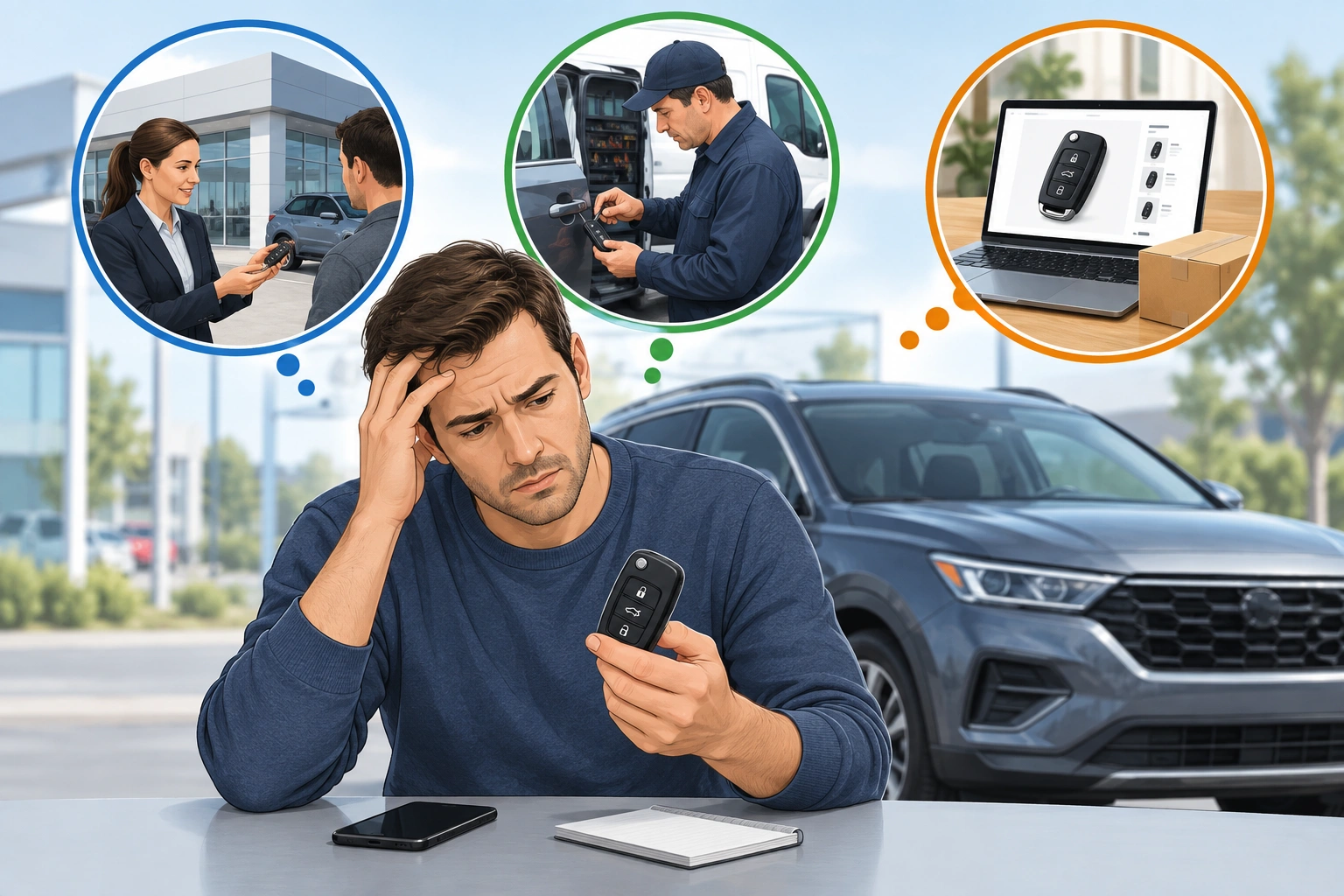
If you’re in the middle of this right now, the goal is simple: get back into the car, protect it, and line up a replacement without wasting time on the wrong service.
First 10 Minutes: What to Do When You Realize the Fob Is Missing
Before you call anyone, slow the situation down and verify the obvious. Most “lost fob” emergencies turn out to be a misplaced fob, a fob left in a coat pocket, or a spare sitting at home.
Check these places in order:
- The last place you used the car.
- Your pockets, bag, jacket, and laundry.
- The floorboard, seat tracks, and center console.
- The home entry table, kitchen counter, or charging station.
- Any place you may have set it down while unloading groceries, fuel, or work gear.
Then take the next steps in order:
1. Use the spare if you have one.
2. Check the owner’s manual for manual entry or backup access.
3. Secure the vehicle if theft is a concern.
4. Gather the VIN and proof of ownership.
5. Call a dealer or automotive locksmith with your exact vehicle details.
If the fob is truly missing, think about security next. If you suspect it was stolen or found by someone who can identify your vehicle, treat it as more than an inconvenience. You may need to disable the lost fob later so it cannot keep working.
If you have roadside assistance, call with your exact location, vehicle make and model, and the type of key you lost. That helps the dispatcher decide whether you need lockout help, towing, or a locksmith-style response.
Can You Still Unlock or Start the Car Without the Fob?
Sometimes yes, sometimes no. The answer depends on how your vehicle was built.
If your car uses a traditional key plus a fob, you may still be able to unlock the doors with the mechanical key and start the car with the key itself, even if the remote portion is missing.
If your vehicle has a smart key or push-button start, there may still be a hidden mechanical key inside the fob. That hidden blade usually works only for the door lock or an exterior key cylinder. It does not usually start a push-to-start car by itself. In other words, it can get you in, but it may not get you driving.
Some vehicles also have a backup start method, such as placing the fob in a marked slot, holding it near the start button, or using a backup code or card. Those methods are vehicle-specific, so the owner’s manual is the best place to confirm them.
What you should not assume: that every keyless car can be started by simply pressing a button with no fob present. Many cannot. In those vehicles, the fob must be present and recognized by the immobilizer system before the car will start.
A quick decision rule
- If you have a hidden mechanical key: you may be able to unlock the door manually.
- If your car has a backup start slot or marked fob area: check the manual for the exact procedure.
- If you have a spare fob at home: replacement is less urgent, but you still need a plan.
- If you lost the only fob for a push-to-start vehicle: expect professional replacement and programming.
Identify Your Key Type Before You Choose a Fix
This matters because the replacement path changes with the hardware.
Standard key with remote buttons
This is the simplest setup. The car may start with a cut key, while the remote functions are separate.
Transponder key
This looks like a regular key but contains a chip. The chip must be recognized by the vehicle’s immobilizer. A copied metal blade alone usually is not enough.
Smart key or proximity key
This is the modern push-button setup. The vehicle detects the fob nearby and may unlock or start without inserting a key.
Switchblade key
This combines a folding metal key with remote functions. If you want the folding style preserved, the replacement usually has to match the exact key assembly. If you do not care about the folding feature, a locksmith may be able to make the cutting and programming work with a different setup, depending on the vehicle.
That last point is useful because it gives you a trade-off: keep the original style and usually pay more, or separate the key function from the remote and potentially save time and money.
Most Likely Scenarios, in Order of Probability
When someone says they lost a car key fob, the real situation usually falls into one of these buckets:
1. The fob is misplaced, not gone
This is the best-case scenario. Search the last three places you used it, then the places where you normally unload items. People often find it in a coat pocket, gym bag, or between seat cushions.
2. You have a spare
If there is another working fob, the job is easier. You may only need a replacement for convenience and security, not immediate mobility.
3. The fob is gone, but the car still has manual access
This is common on vehicles with hidden mechanical keys. You may be able to get in and arrange replacement without towing.
4. The fob is lost and the car is immobilized
This is where professional help matters most. A smart key or transponder may need cutting, coding, and pairing before the vehicle will accept it.
Dealer vs Locksmith vs Online Provider
This is the decision most people need to make quickly. Here is the practical comparison.
| Option | Best for | Trade-offs | Programming | Typical speed |
|---|---|---|---|---|
| Dealer | OEM parts, complex vehicles, brand-specific systems | Usually higher cost; may require appointment or towing | Often required by dealer | Can take days if parts must be ordered |
| Automotive locksmith | Fast mobile help, many lost-key situations, no spare available | Coverage varies by vehicle and model year | Often able to program many keys and fobs | Often faster than dealer |
| Online/aftermarket provider | Lower-cost replacement parts, planned replacement | Compatibility must be checked carefully; still may need programming | Sometimes easy, sometimes not supported | Depends on shipping and service needed |
The proof-of-ownership check can also differ. Dealers commonly verify identity and ownership before ordering or programming a key. Locksmiths usually need the VIN and proof that you are authorized to access the vehicle. Online sellers may not verify ownership at all, which is why compatibility and security are on you.
Which provider to call first
- Locked out: call a locksmith first if you need immediate entry; call roadside assistance if it is already included in your coverage.
- No spare: call a locksmith first for the fastest replacement path, or a dealer if your vehicle is known to need dealer-only programming.
- Push-to-start: call a locksmith first if they service your make and model; otherwise call the dealer.
- Suspected theft: call the dealer or a locksmith and ask about disabling the missing fob, then secure the car and consider reporting the theft.
How to choose
- Choose a dealer if your vehicle is unusual, the fob is highly integrated, or you want OEM parts and don’t mind paying more.
- Choose a locksmith if you need mobile service, faster turnaround, or a more flexible solution.
- Choose online/aftermarket if you already know the exact compatible part number and are comfortable arranging programming separately.
What Documents and Vehicle Details You’ll Need
Having the right paperwork ready saves time and prevents fraud delays.
Expect to provide:
- Vehicle Identification Number (VIN)
- Year, make, and model
- Proof of ownership, such as registration, title, or insurance card
- Personal ID
That is normal. It protects both you and the provider.
If you are calling a locksmith or roadside provider, have the vehicle’s exact location ready too. If you are locked out, say so directly. If the car is parked in a garage, tell them that. Details like this affect the tools and response needed.
How Replacement and Programming Usually Work
Replacement is usually a two-part job: getting the correct hardware and teaching the vehicle to accept it.
Step 1: Identify the correct fob
The provider matches the replacement to your vehicle’s year, make, model, and trim. This is where mistakes happen if someone buys a “close enough” remote online.
Step 2: Cut the emergency key blade, if needed
If your fob contains a hidden mechanical key, that blade may need to be cut separately.
Step 3: Pair or program the fob
Some vehicles support simple owner programming, but many do not. A basic remote may be something you can sync yourself from the driver’s seat, while a transponder key or smart key may require a locksmith’s diagnostic tool or dealer equipment. The exact method depends on the make, model, and trim.
Step 4: Test lock, unlock, start, and panic functions
Do not leave until the core functions work. If the car starts but the remote buttons do not, or vice versa, the job is not complete.
Cost and Turnaround Time: What to Expect
There is no universal price because the vehicle and key type matter so much.
Here is the realistic range from the sources we have:
- Latest key fobs: replacement can range from relatively inexpensive aftermarket options to much higher dealer-priced units, depending on brand and vehicle.
- Some aftermarket fobs: some can be low-cost, but compatibility and programming still matter.
- Dealer replacements: in some cases, replacement can require dealership service and cost hundreds of dollars.
Turnaround can also vary:
- If the part is in stock and programming is straightforward: same-day service may be possible.
- If the part must be ordered: this can take days.
- If you need a special OEM or switchblade setup: expect more delay than a basic remote.
The fastest route is usually not the cheapest. The cheapest route is usually not the easiest. If you’re stranded, speed matters more than a small savings.
Can the Lost Fob Be Disabled or Erased?
Sometimes yes, and that can matter a lot.
If the missing fob might be in someone else’s hands, especially if your vehicle is identifiable from a parking permit, driveway location, or key ring, disabling the old fob is worth asking about. That reduces the chance that a found or stolen fob can still unlock or start the car.
Whether this is possible depends on the vehicle. Some systems can be reprogrammed so the missing fob is no longer accepted. Others do not truly “erase” a lost fob in the same simple way; instead, the vehicle may relearn new fobs, or the provider may need to reset the immobilizer or key memory using a model-specific procedure. The provider should confirm the exact method for your make and model.
Here is the decision test:
- Lost in your house or office? Replacement may be enough.
- Lost in public or possibly stolen? Ask about erasing the old fob.
- Already replaced and want the old one dead? Tell the provider you want the missing fob removed from the system.
What If the Lost Fob Turns Up Later?
A found fob does not automatically become useful again.
If the vehicle still recognizes it, it may work. If the car has been reprogrammed to forget that fob, the found unit may need to be programmed again. If the fob was disabled for security, assume it is no longer trusted by the car.
If you find it before replacement is complete, keep it and tell the provider. If you find it afterward, ask whether it can be reused or whether the vehicle needs a new pairing session.
When to Call an Automotive Locksmith
Call a locksmith right away if any of these are true:
- You have no spare
- The car uses a smart key or push-button start
- You need same-day access
- The car is stuck somewhere inconvenient
- You want mobile service instead of towing
- You need the missing fob disabled
- You are not sure whether the dealer is the only option
A locksmith is often the most practical middle ground between speed and cost, especially when the car is not a simple metal-key setup.
Common Mistakes That Slow Everything Down
A few errors come up again and again:
- Buying the wrong fob because the trim or year was guessed
- Forgetting the VIN and proof of ownership before calling
- Assuming every car supports self-programming
- Replacing only the remote when the emergency key blade is also needed
- Waiting too long to secure a possibly stolen fob
- Towing the car before checking whether mobile service is available
The biggest one is buying first and checking compatibility later. That often turns a simple replacement into a return, reorder, and reprogram problem.
Practical Next Step
If your lost car key fob is the only one you have, the fastest path is usually: confirm whether the vehicle can still be opened manually, gather the VIN and ownership documents, and call a dealer or automotive locksmith with your exact vehicle details. If you already have a spare, your job is easier — but it is still worth asking whether the missing fob should be disabled for security.
For related diagnosis, see our guides on how to reset a car key fob without guesswork, key fob problems after disconnecting the car battery, and whether a bad car battery can cause key fob problems.
FAQs
Can I drive my car if I lost the key fob?
Sometimes, but only if your vehicle still has a usable mechanical key or another authorized key. Many push-button vehicles will not start without a recognized fob.
Can a locksmith replace a lost key fob?
Often yes, but not for every vehicle. Coverage depends on the key type, vehicle security system, and whether programming equipment is available.
Do I need the VIN to replace a lost fob?
Usually yes. The VIN helps identify the correct replacement and is commonly requested along with proof of ownership.
Will a found fob still work after replacement?
Not always. If the vehicle was reprogrammed or the missing fob was disabled, the found unit may no longer be accepted.
Is an aftermarket fob worth it?
It can be, especially if you want a lower-cost option and your vehicle supports it. Just verify compatibility before buying.
