
Does Insurance Cover a Lost Car Key Fob? What Drivers Need to Know

If you’ve lost a car key fob, the short answer is: usually no, standard auto insurance does not cover a simple lost key fob. The answer changes if the fob was stolen or if you have a specific key coverage add-on, and theft-related losses may also be covered under another policy depending on the facts and the policy language.
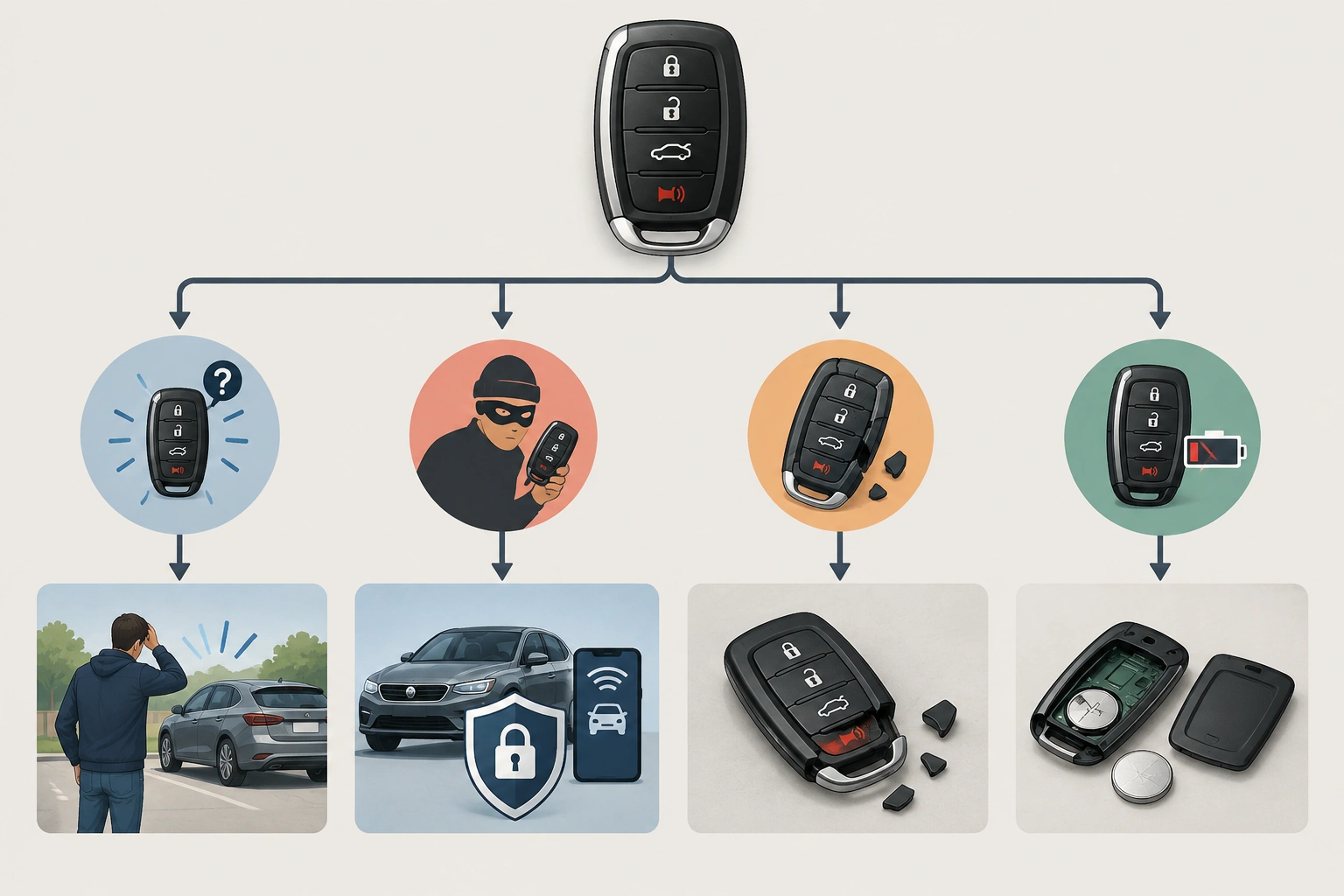
The practical way to think about it is this:
- Lost fob: usually out-of-pocket
- Stolen fob: may be covered, depending on the policy
- Damaged fob: sometimes repairable, often out-of-pocket unless a specific coverage applies
- Dead battery: almost never an insurance claim; usually just a battery replacement
That distinction matters because the next step is different in each case. A missing fob can be a simple search problem, a replacement problem, or a security problem if you suspect theft.
If you’re still trying to locate the fob, my step-by-step recovery guide for a lost car key is the best place to start before you spend money on a replacement.
Quick answer: lost, stolen, damaged, or dead?
Before you call an insurer, identify the problem as accurately as you can. Coverage usually follows the event, not the inconvenience.
1) The key fob is simply lost
This is the most common situation. You can’t find it, but you don’t know whether it was stolen. In most cases, auto insurance does not pay to replace it. The cost usually falls to you.
2) The key fob was stolen
If someone took the fob from your bag, house, or car, the story changes. Some policies may help, especially if theft is involved. Progressive notes that comprehensive coverage can cover theft-related losses, but not lost keys. It also notes that homeowners insurance may cover car keys if they’re stolen. Coverage still depends on the exact policy language and deductible.
If the fob was stolen from the car, comprehensive or a related theft claim is more likely to be the policy to check first. If it was stolen from home, homeowners or renters insurance may be the more relevant policy to review.
3) The fob is damaged
A cracked shell, broken buttons, water damage, or an internal failure may or may not be covered. Standard auto policies usually don’t treat this as a routine claim, unless your policy has a special key coverage provision.
4) The battery is dead
This is the easiest fix and the one least likely to involve insurance. If the fob worked recently and now only fails at close range, the battery may be the issue. In that case, replacing the battery is usually far cheaper than replacing the whole unit.
5) The keys are locked inside the car
That’s not a replacement issue yet. Roadside assistance may help with lockout service, but that is different from paying for a new fob.
Which insurance coverage might apply
There are only a few coverage paths worth checking, and some are more relevant than others.
| Situation | Likely insurance path | Deductible impact | Best next step |
|---|---|---|---|
| Lost key fob | Usually none | N/A | Replace out of pocket, check for spare |
| Stolen key fob | Comprehensive or homeowners/renters, depending on policy | Often yes | Confirm theft and ask insurer about coverage |
| Damaged key fob | Rarely covered under standard auto policy | Often yes | Compare repair/replacement cost to deductible |
| Dead battery | Usually no coverage needed | N/A | Replace the battery first |
| Locked out of car | Roadside assistance may help | Usually no or low | Call roadside assistance or a locksmith |
Comprehensive coverage
Comprehensive coverage is the one people most often ask about. It generally covers non-collision losses such as theft, vandalism, fire, or weather damage. It is not the same thing as “covers everything.” In practice, comprehensive coverage generally does not pay for a key fob that was merely misplaced. It may be relevant when the fob is part of a theft-related loss.
Roadside assistance
Roadside assistance can be useful if the issue is access, not replacement. It may help with lockout service, towing, or getting the car opened safely. But it usually helps with the situation rather than paying for the lost key itself.
Personal property coverage
If the fob was stolen from your home, purse, or bag, homeowners, renters, or similar property coverage may be relevant. This is one reason stolen keys are treated differently from lost keys. The theft may fall under a property policy rather than your auto policy.
Key coverage add-ons
Some insurers offer a separate key coverage option. If you bought an add-on, check whether it covers only theft, whether it includes programming, and what the claim limit is.
Dealer-purchased protection plans
Some dealerships sell key protection when you buy the vehicle. That coverage is separate from your auto policy. If you have it, don’t assume your insurer handles the claim. Check the dealership paperwork.
What your policy usually does not cover
This is the part that saves people time and money.
Most standard auto policies do not pay for a lost key fob just because it’s inconvenient. That means the default answer is usually no.
A few common exclusions and limitations matter here:
- Simple loss is usually not covered
- Deductibles can make small claims pointless
- Collision coverage does not apply
- Coverage limits may be lower than the replacement cost
- Programming fees may or may not be included
That last point matters. On many modern vehicles, the fob is only part of the bill. You may also be paying for cutting, programming, immobilizer pairing, or a dealer service fee. If your deductible is higher than the replacement cost, a claim won’t help.
Step-by-step: what to do right after you lose or damage a key fob
The fastest route is not always the cheapest route, so separate the emergency from the paperwork.
1) Confirm whether it’s lost, stolen, dead, or damaged
If the fob is unresponsive, try the spare battery or a backup fob before assuming it’s gone. A dead battery can look like a dead key fob.
If you suspect theft, treat it differently. A stolen fob can create a security risk, especially if it’s tied to a car that can be started without a traditional blade key.
2) Use the spare if you have one
A spare buys you time. It also tells you whether the problem is the fob itself or the car’s reader/system.
3) Check your insurance terms before filing anything
Look at:
– your declarations page
– comprehensive coverage details
– roadside assistance terms
– any key coverage endorsement
– deductible amount
If the policy does not mention keys, assume they are not covered.
4) If theft is involved, document it
If the fob was stolen, write down when and where it happened. If there was a break-in, keep the police report number if one exists. Insurers often want a clear theft story before they consider a claim.
5) Decide whether you need immediate access or full replacement
If you just need to get back into the car, roadside assistance or a locksmith may solve the immediate problem. If you need a replacement fob, then dealer or locksmith programming becomes the main issue.
How to verify coverage before filing a claim
A quick policy check can save you from filing a claim that won’t pay enough to matter.
Use this decision rule:
- If the event is not covered, don’t file.
- If the event is covered, file only when the expected payout will exceed your deductible by enough to justify the claim.
That usually means:
– the fob was stolen, not merely lost
– the policy specifically covers key loss or theft-related key replacement
– the deductible is lower than the expected total cost by a meaningful amount
– you’re comfortable with the claim being on your record
If the claim is for a small replacement cost, the paperwork and deductible often outweigh the benefit. If the fob was stolen and the claim also helps address a larger theft-related event, the math can change.
Replacement options: dealership vs locksmith vs aftermarket fob
Once you’ve decided you’re paying for replacement, the next choice is who does the work.
Dealership
Dealerships are often the most expensive option, but they can be the safest choice for vehicles with dealer-only programming or newer smart keys. If your vehicle uses a complex immobilizer system, the dealer may be the cleanest route.
Best for: newer vehicles, dealer-only systems, OEM preference
Trade-off: higher cost, sometimes longer wait
Automotive locksmith
A qualified automotive locksmith can often replace and program a fob faster and for less than a dealership. This is especially useful when you need a practical fix without paying dealer pricing.
Best for: cost-conscious drivers, many common makes and models, faster service
Trade-off: not every vehicle is supported, and some systems still require dealer access
If you need a replacement and want to compare realistic paths, my guide on how to replace a lost car key without the original explains the dealer-versus-locksmith decision in more detail.
Aftermarket fob
Aftermarket fobs can reduce cost, but compatibility is the issue. Some work well; others create headaches if the vehicle is picky about programming or signal quality.
Best for: older or widely supported vehicles
Trade-off: lower price, but more compatibility risk
OEM fob
OEM means original equipment manufacturer. It usually costs more, but it tends to be the most straightforward fit.
Best for: reliability and exact match
Trade-off: highest cost in many cases
How much a replacement key fob usually costs
Exact pricing varies by vehicle, trim, and whether programming is required, so it’s safer to think in cost buckets rather than promises.
Typical out-of-pocket ranges are often roughly:
- Aftermarket replacement: about $50 to $200 for many common vehicles, sometimes more if programming is required
- Automotive locksmith: about $100 to $300 total in many cases, depending on the vehicle and programming needs
- Dealership replacement: about $200 to $600+, especially for smart keys or proximity fobs
A dead battery may be only a small repair. A full smart key replacement is a different story because the vehicle has to recognize the new fob securely. That is why a quote from a dealership can look much higher than a simple battery swap.
The practical comparison is not “insurance or no insurance.” It’s usually deductible versus total replacement cost. If the bill is below your deductible, a claim does nothing for you.
When it makes sense to file an insurance claim
Use this simple rule:
- File a claim only if the policy clearly covers the event and the expected payout exceeds your deductible by enough to justify the claim.
That usually means:
– the fob was stolen, not merely lost
– the policy specifically covers key loss or theft-related key replacement
– the deductible is lower than the expected total cost by enough to make the claim worthwhile
– you’re comfortable with the claim being on your record
If the replacement cost is small, the paperwork and deductible often outweigh the benefit. If the fob was stolen and the claim also helps address a larger theft-related event, the math can change.
When to Call an Automotive Locksmith
Call an automotive locksmith when the issue is more than a dead battery and less than a full dealership-only project.
That usually makes sense when:
– you need a replacement quickly
– you want to compare cost against the dealer
– the vehicle can be programmed by a locksmith
– you’re not sure whether the fob is repairable
– you need lockout help and replacement advice in one visit
A locksmith is especially useful when you’re stuck between “I need the car working today” and “I don’t want to pay dealership pricing unless I have to.”
If the key was stolen, a locksmith can also help with security steps, including reprogramming or disabling the missing fob where the vehicle supports it. That matters because a stolen fob is not just a replacement issue; it can be a vehicle-access issue.
Common mistakes to avoid
A few errors show up again and again:
Assuming all lost keys are covered
They usually are not. Lost is different from stolen, and insurance treats that difference seriously.
Filing a claim before checking the deductible
If the deductible is higher than the replacement cost, you’ve added paperwork without benefit.
Replacing the whole fob when only the battery is dead
This is the easiest way to overspend. Test the battery first if the fob recently started acting weak.
Buying an aftermarket fob without checking compatibility
A cheap fob that won’t program is not a bargain.
Ignoring security after a theft
If the fob was stolen, don’t just replace it and move on. Make sure the missing unit can’t still access the car.
FAQs about insurance and lost car keys
Does comprehensive coverage pay for lost keys?
Usually no. Comprehensive coverage may help with theft-related loss, but not with a simple lost key fob.
Will roadside assistance replace my key fob?
Usually not. Roadside assistance may help with lockout service or towing, but replacement is often still your responsibility.
Can homeowners or renters insurance cover a stolen key fob?
Sometimes, yes. If the key was stolen as personal property, those policies may be relevant. Check the policy language and deductible.
Does insurance cover a dead key fob battery?
No, not in the usual sense. A dead battery is normally just a battery replacement.
Should I call the insurer, dealer, or locksmith first?
If you suspect theft, document what happened and then call the insurer to ask whether the event is covered. If you need the car working now, call a locksmith or dealer first for replacement options.
Will filing a claim raise my premium?
It can, depending on the insurer, claim history, and the type of claim. That’s another reason small key claims often don’t make sense.
What documents do I need for a key fob claim?
Gather the basics before you call:
– your policy number
– vehicle year, make, and model
– VIN
– proof of ownership or registration
– driver’s license or other ID if requested
– a written description of what happened
– date, time, and location of the loss or theft
– police report number, if the fob was stolen
– any key code, key tag, or spare key information you have
– repair or replacement estimate from a dealership or locksmith
Is a dealership always required for replacement?
No. Many vehicles can be handled by an automotive locksmith, but some newer systems still require dealer access.
Bottom line
If your key fob is simply lost, insurance usually won’t cover it. If it was stolen, there may be coverage through comprehensive, homeowners/renters, or a separate key protection plan. If the battery is dead, replace the battery first. And if the replacement quote is below your deductible, paying out of pocket is often the smarter move.
For most drivers, the best next step is to confirm what actually happened, check the policy wording, and then choose the fastest replacement path that fits the vehicle.
