
How to Find a Lost Car Key: A Calm, Step-by-Step Recovery Plan

Losing a car key feels urgent because it is urgent. You may be locked out, late, or staring at a driveway wondering whether the key is in the house, the car, or gone for good. The fastest way to solve it is not to search randomly. It is to narrow the problem first, then move through the most likely places in order.
If the key is a mechanical key, transponder key, or smart key fob, the search is similar at the beginning but the next steps change once you know whether the key is actually missing, locked inside the car, or just misplaced somewhere obvious. That distinction matters because the recovery path, security risk, and replacement cost can change a lot by key type.
Quick Triage: Is the Key Lost, Locked Inside the Car, or Left Somewhere Obvious?
Before you spend 20 minutes tearing apart the house, answer three questions:
- Did you last use the key near the car?
- Do you have a spare key or tracker?
- Is there any chance the key is inside the vehicle?
Use this quick decision tree:
- If you can see the key in the car: stop searching the house and focus on access help.
- If the key is not visible but the car is locked and you last had the key nearby: check the car, your pockets, bags, and the last place you parked before assuming it is gone.
- If you know you had it at home last: search the highest-probability home spots first.
- If you lost it while out: retrace your route and contact the places you visited the same day.
- If you suspect theft, not misplacement: treat it as a security issue, not just a missing item.
- If you need the car now and you have no spare: stop the broad search and call a locksmith, roadside assistance, or the dealership based on your key type.
That last one saves a lot of time. People often assume the key is lost at home when it is actually sitting in a cup holder, center console, trunk, or seat crease. If you recently parked in a hurry, check the ignition area too.
Start With the Most Likely Places Car Keys Get Left
The best searches are boring. They cover the places keys naturally end up when your hands are full, your mind is elsewhere, or you set them down “just for a second.”
A practical order is:
1. The exact place you usually drop them
That could be a key bowl, hook, tray, charging station, kitchen counter, or the same chair by the door. People often check the obvious spot and stop too early. Look around that area too, not just on it. A key can slide behind a mail stack, fall between couch cushions, or land on the floor beside the usual drop zone.
2. Pockets and clothing
Check coat pockets, jacket linings, pants pockets, hoodie pockets, and any outer layer you wore recently. Keys slip into lining folds and can stay there unnoticed. If you changed clothes after coming home, check the clothes you removed, not just what you are wearing now.
3. Bags and containers
Purses, backpacks, gym bags, laptop bags, grocery bags, lunch totes, and shopping bags are common hiding places because keys fall to the bottom or get caught in side pockets. Open every compartment. Shake the bag over a table if needed.
4. Laundry
This is one of the most frustrating places because the key may have been in a pocket before the clothes went into a hamper or washer. Check the hamper, pockets in recently worn clothes, and the laundry room floor. If you hear a metal rattle in the washer or dryer, stop the cycle and inspect it before continuing.
5. Surfaces and low furniture
Go straight to tables, counters, desks, nightstands, couch cushions, and the floor around where you sat down last. A useful trick: search with your phone flashlight held low to the surface. Keys reflect differently at shallow angles, which makes them easier to spot under clutter.
Retrace Your Last Steps to Narrow the Search
When people find a lost car key quickly, it is usually because they stop thinking “Where is it?” and start thinking “Where was I holding it last?”
Rebuild the timeline from the last time you remember using the key:
- Think of the last time you unlocked, started, or touched the car.
- List the places you went after that.
- Replay what your hands were doing. Were you carrying groceries, a coffee, a phone, or a child’s bag?
- Check the places where you set things down temporarily. That includes counters, desks, store checkout counters, restaurant tables, and bathroom sinks.
- Call or revisit the last two or three places if the key went missing away from home.
This works because keys are usually lost during transitions, not while sitting still. A parking lot, gas station, office entrance, hotel lobby, or gym locker area is more likely than the middle of a normal routine.
One realistic example: a driver leaves work with the key in hand, stops to answer a call, and sets the fob on the desk while packing a laptop. The key is not “lost” in the house at all; it is still at work. Retracing the last five minutes often beats searching the whole day.
Check the Car Itself Before You Assume It Is Truly Lost
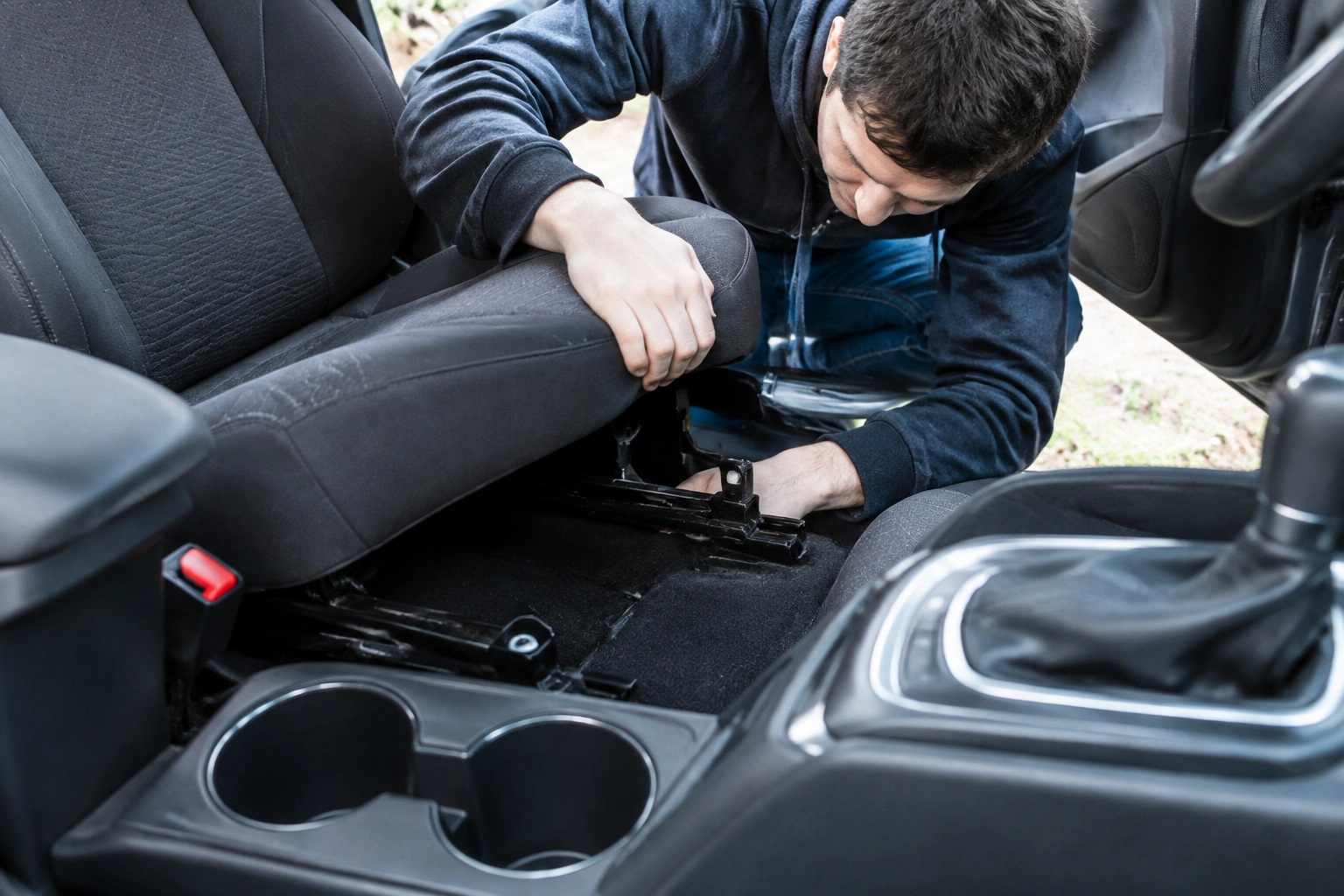
If there is any chance the key is inside the vehicle, check the car thoroughly before moving to replacement. That changes the problem from “lost key” to “access issue.”
Search these spots:
- driver and passenger seat cushions
- under the seats
- cup holders
- center console
- door pockets
- floor mats
- trunk or cargo area
- under loose items like jackets, grocery bags, or child seats
If the key is a smart key, look for the fob anywhere it may have been dropped while unloading. Smart keys are small, and they often disappear into seat gaps or fall between the seat and center console.
If you find the key visible inside the car, do not force the door or damage a window. Roadside assistance or an automotive locksmith can usually help with legitimate access methods. If the key is inside but the car will not start, the issue may be different from a missing key entirely.
Adjust Your Search Based on Key Type
Different key types create different clues.
Mechanical key
A mechanical key is the simplest to misplace and usually the easiest to replace. If the key is plain metal, the search is mostly about location. Check pockets, bags, counters, and the ignition area if you use an older vehicle.
Transponder key
A transponder key has an electronic chip that communicates with the vehicle. You may still be able to find the physical key the same way you would a mechanical one, but replacing it is usually more involved because the new key must be paired to the car.
Smart key or key fob
A smart key can unlock and start the vehicle without being inserted into a traditional ignition. That convenience also means the key may be in a jacket pocket, bag, or inside the vehicle without you noticing. If your vehicle uses a smart key, check the places where you sat, stood, and unloaded items. These keys are often lost during everyday movement, not dramatic events.
Use a Spare Key, Tracker, or Connected App if You Have One
If you have a spare key, use it early. A spare solves the immediate access problem and buys you time to keep searching without pressure.
If the missing key has a Bluetooth tracker attached, open the tracker app and check the last known location. That is most useful when the key was lost outside the home or in a large area like a parking lot, office, or hotel.
A few practical trade-offs:
- Spare key: fastest immediate solution, but it does not recover the missing key.
- Tracker app: useful if the key had a tracker attached, but only then.
- Connected vehicle app: helpful if your car’s system supports it, but not every make and model does.
If the spare key is at home and you are stranded elsewhere, compare the cost and delay of getting the spare delivered with calling a locksmith. If you can safely wait and someone can bring the spare, that is usually the simplest option. If you cannot wait, or the vehicle must be moved, call a mobile automotive locksmith or roadside assistance right away.
What to Do If You Lost the Key Away From Home
Travel changes the search. At home, you can check likely surfaces and laundry. Away from home, you need to work the route backward and decide whether you are stranded or can recover a spare later.
Prioritize these locations:
- hotel front desk or lost-and-found
- restaurant or café where you sat down
- gym locker room or front desk
- office desk, break room, restroom, or parking lot
- gas station counter
- store checkout lane or customer service desk
- rideshare pickup/drop-off area
Call the last place you remember using the key. Ask whether anyone turned in a fob or key. If you were carrying bags, check every pocket and compartment before assuming the key is gone.
If you are traveling and do not have a spare, your next step is usually local access help, not waiting to get home. A mobile locksmith may be able to meet you where the vehicle is. If the car cannot be driven without the key and a locksmith cannot service your key type, a dealership may need the vehicle information and, in some cases, the car itself.
If the vehicle must be moved and you cannot get access on site, arrange towing only after you confirm whether the locksmith or dealership can handle the key type remotely or on location. That can save a second trip and extra delay.
When to Stop Searching and Arrange Access or Replacement
There is a point where continued searching costs more time than it saves.
Move on if:
- you have checked the car, home, bags, pockets, laundry, and last known locations
- the key has been missing long enough that it is unlikely to be nearby
- you need the car today
- you do not have a spare
- the key may have been stolen or taken accidentally
If you still need access to the vehicle, the next step is usually a locksmith, dealership, or roadside assistance provider. If the car is inaccessible and you cannot confirm the key is inside, you may also need towing depending on the situation.
Locksmith vs Dealership: Which Is the Better Next Call?
Here is the practical comparison most drivers need:
| Option | Best for | Pros | Trade-offs |
|---|---|---|---|
| Spare key | Immediate access when available | Fastest and usually cheapest | Only helps if you already have one |
| Automotive locksmith | Many lost-key situations, especially when speed matters | Often mobile, often faster, may be less expensive | Not every locksmith can handle every high-security system |
| Dealership | Vehicles with specific programming or high-security requirements | Can be the right fit for certain makes/models | Often slower and may involve towing or appointment delays |
| Roadside assistance | Lockout or access help when the key may be in the car | Convenient for urgent access | May not solve full replacement needs |
If your priority is speed, call a mobile automotive locksmith first and ask whether they can handle your key type. If they cannot, the dealership is the next likely stop.
What Information You Need to Replace a Lost Car Key
Before you call, gather the details that help a locksmith or dealer confirm the right key:
- vehicle year, make, and model
- VIN
- proof of ownership
- your photo ID
- the key type if you know it
- whether you have a spare or any working key at all
The VIN is especially important because key replacement is tied to the vehicle’s identity and security system. If you do not know where to find it, check the dashboard near the windshield, the driver’s door jamb, insurance paperwork, or registration documents.
Having this information ready cuts down on back-and-forth and helps the provider tell you whether they can cut, program, or order the replacement.
Security Warning: What to Do If the Key May Be Stolen
A lost key is not always just lost. If you left it somewhere public, dropped it in a parking lot, or suspect someone may have taken it, treat it as a security risk.
That matters because a person with the key may be able to access the vehicle later. In that case, ask whether the missing key should be disabled or whether the vehicle should be reprogrammed so the lost key no longer works. Some smart keys and transponder keys may need reprogramming, and in some vehicles all remaining keys may need to be updated for security. The exact process depends on the vehicle.
If you think the key was stolen, do not wait days before acting. The sooner you address it, the less risk you carry.
How to Prevent This From Happening Again
Once the problem is solved, make the next loss easier to recover from.
A few practical habits help:
- keep a spare key in a known, secure place
- use a tracker on the key ring if your routine makes misplacement common
- choose one drop zone at home and use it consistently
- attach a bright keychain so the fob stands out under papers or bags
- separate car keys from unrelated keys if you carry a large ring
The goal is not perfection. It is reducing the number of places the key can disappear and making the next search shorter.
Frequently Asked Questions
Can I find a lost car key with my phone?
Only if the key has a compatible Bluetooth tracker or your vehicle system supports a connected location feature. A phone by itself cannot locate an ordinary key.
What if I lost my only car key?
If you have no spare, focus on whether the key is inside the car or in a likely location. If not, contact a locksmith or dealership with your VIN and proof of ownership.
Is it cheaper to call a locksmith or the dealership?
Often a locksmith is faster and may cost less, but some smart keys and high-security systems require dealership programming. Compare both before committing.
Should I replace the key if I think it was stolen?
Yes, or at least ask about disabling the missing key. If someone else may have it, replacement is a security decision, not just a convenience one.
What if the key is in the car?
Use legitimate access help instead of forcing entry. Roadside assistance or an automotive locksmith can usually help you get back in safely.
If you have reached the point where the key is not turning up, the next move is not more random searching. It is deciding whether you need access, replacement, or security protection first.
