
How to Check a Catalytic Converter With an OBD2 Scanner

Quick Answer
You can check a catalytic converter with an OBD2 scanner by reading trouble codes, comparing upstream and downstream oxygen sensor data, and checking the catalyst monitor status. A P0420 or P0430 code, combined with a downstream sensor signal that closely follows the upstream signal, can indicate reduced converter efficiency. However, confirm that oxygen sensors, exhaust leaks, and engine-running problems aren’t causing misleading results before replacing the converter.
What to check first
- Read trouble codes: Look for P0420, P0430, oxygen sensor faults, and engine misfire codes.
- Compare sensor signals: Graph the upstream and downstream oxygen sensors when the engine is fully warmed up.
- Review fuel trims: Check whether the engine is running excessively rich or lean.
- Check readiness: Confirm whether the vehicle’s catalyst monitor has completed its self-test.
- Verify other faults: Investigate exhaust leaks, faulty sensors, and misfires before condemning the converter.
Important limitation
- Don’t rely on one reading: A basic scanner can identify warning codes, but live data and manufacturer-specific diagnostic tests provide stronger evidence.
If your check engine light is on, an OBD2 scanner can help you determine whether the catalytic converter needs further testing. The key is knowing how to interpret the readings rather than replacing an expensive part based on one code.
In this guide, I’ll explain the diagnostic process, what oxygen sensor patterns mean, how to interpret common trouble codes, and when professional testing is worthwhile.
In This Guide
- What Can an OBD2 Scanner Tell You About a Catalytic Converter?
- How Do You Check a Catalytic Converter With an OBD2 Scanner?
- How Do You Read Oxygen Sensor Live Data?
- Which Codes and Monitor Results Matter?
- How Do You Rule Out Other Problems?
- When Is an OBD2 Scanner Not Enough?
- Frequently Asked Questions
What Can an OBD2 Scanner Tell You About a Catalytic Converter?
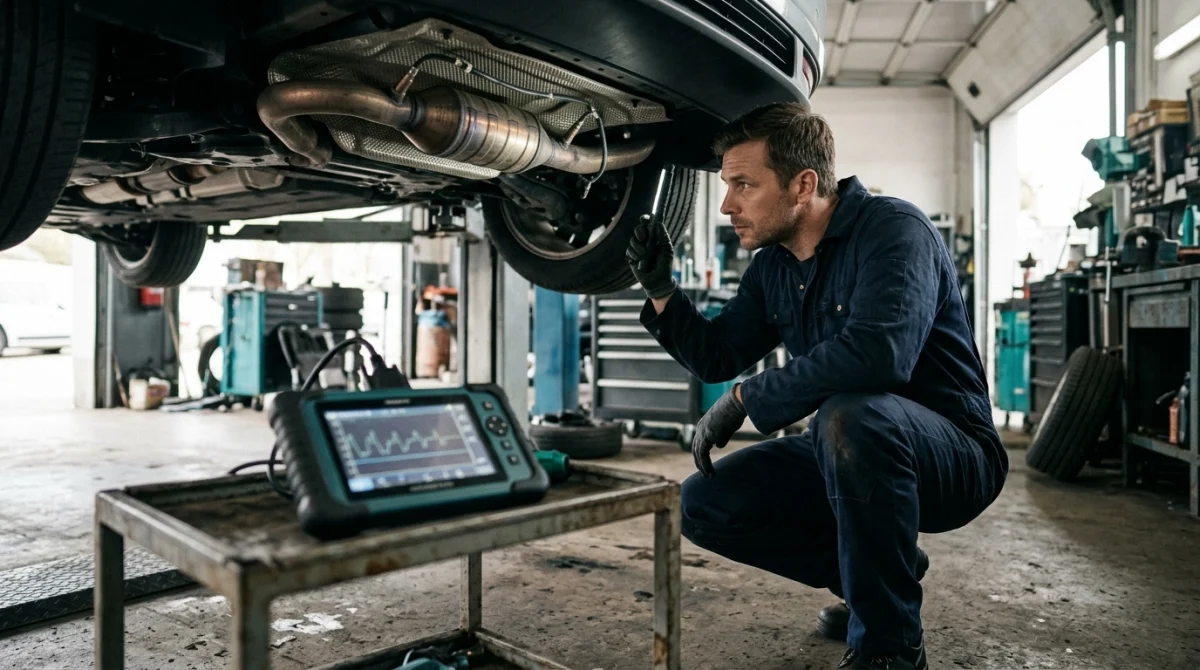
An OBD2 scanner can reveal catalyst-efficiency trouble codes, oxygen sensor behavior, fuel-trim readings, and the status of the vehicle’s emissions monitors. These clues help you assess converter performance without removing the exhaust component.
A catalytic converter is an emissions-control device that uses chemical reactions to reduce harmful exhaust pollutants. The engine control module (ECM) monitors its operation using information from oxygen or air-fuel ratio sensors and other operating conditions.
How the converter test works
Many gasoline vehicles use an upstream oxygen sensor before the catalytic converter and a downstream sensor after it. The upstream sensor helps the engine manage its air-fuel mixture, while the downstream sensor helps the computer evaluate catalyst performance.
When the converter works effectively, it stores and releases oxygen as exhaust conditions change. This usually reduces the rapid fluctuations seen in the downstream signal on systems using conventional narrowband oxygen sensors.
When catalyst efficiency falls, the downstream signal may begin to resemble the upstream signal more closely. The computer can use this behavior, under specified operating conditions, to determine whether catalyst performance has dropped below its programmed threshold.
What equipment do you need?
- An OBD2 scanner that reads stored, pending, and permanent diagnostic trouble codes where supported.
- A scanner with live-data graphing for the relevant oxygen sensors.
- Access to fuel trims and catalyst readiness information.
- The vehicle’s service information for the correct sensor types and test conditions.
A simple code reader may be enough to identify P0420 or P0430, but a scanner with graphing and enhanced diagnostic functions offers more useful evidence.
Section takeaway: An OBD2 scanner evaluates evidence of catalyst performance; it doesn’t directly inspect the converter’s internal condition.
How Do You Check a Catalytic Converter With an OBD2 Scanner?
Start by scanning for trouble codes, then review live data and catalyst readiness. Compare the sensor signals only after the engine reaches operating temperature and the vehicle meets the manufacturer’s test conditions.
Step 1: Connect the scanner and read all codes
Locate the vehicle’s diagnostic connector, usually beneath the dashboard, and connect your scanner according to its instructions. Switch the ignition on and select the vehicle or automatic identification option if your tool supports it.
Read stored and pending codes before clearing anything. Save the available freeze-frame information, which records selected operating conditions from when a fault was detected.
Look for these code groups:
- P0420: Catalyst system efficiency below threshold, Bank 1.
- P0430: Catalyst system efficiency below threshold, Bank 2.
- P0130–P0167: Various oxygen sensor circuit, response, and heater faults, depending on the specific code.
- P0300–P030x: Random or cylinder-specific misfire faults.
- P0171 or P0174: System too lean on the specified bank.
- P0172 or P0175: System too rich on the specified bank.
These codes point toward possible causes, not automatic replacement decisions. Diagnose other engine or sensor faults before treating a catalyst-efficiency code as proof of converter failure.
Step 2: Check catalyst monitor readiness
Open the scanner’s I/M readiness or monitor-status screen and find the catalyst monitor. Depending on the vehicle, it may show ready, complete, not ready, or incomplete.
A completed monitor means the vehicle’s computer has run its relevant self-test. It doesn’t necessarily mean the converter passed, so check for diagnostic codes and available test results as well.
If the monitor is incomplete, the vehicle may not yet have met the required conditions. Recent battery disconnection, code clearing, or certain repairs can reset readiness information.
Step 3: Warm up the engine safely
For a meaningful live-data comparison, the engine and exhaust system generally need to reach operating temperature. Follow the manufacturer’s conditions because catalyst-monitor requirements differ between vehicles.
Don’t idle the vehicle in an enclosed garage to warm it up. If a road test is needed, use a safe route and obey traffic laws.
Step 4: Graph both oxygen sensors
Open live data and select the upstream and downstream oxygen sensor PIDs for the same bank. Graph them together when possible, so you can compare their patterns over the same period.
On a V6 or V8 engine with two monitored banks, compare the correct sensor pairs separately. Bank 1 identifies the side containing cylinder number one; it doesn’t universally mean the driver’s side.
Step 5: Interpret the pattern and verify the evidence
On a conventional narrowband system, the upstream signal commonly switches between low and high voltage as the engine control system adjusts the mixture. A downstream signal that changes more slowly and remains comparatively stable can support the conclusion that the converter is storing oxygen effectively.
If the downstream signal closely mirrors the upstream signal under the correct test conditions, catalyst efficiency may be reduced. Before making a repair decision, check for sensor faults, exhaust leaks, abnormal fuel trims, and any manufacturer-specific test results.
Section takeaway: A reliable diagnosis combines codes, monitor status, and live data rather than relying on a single scanner screen.
How Do You Read Oxygen Sensor Live Data?
Compare the upstream and downstream signals while the engine operates under the conditions specified for the vehicle. Their relative behavior matters more than one isolated voltage value.
What does normal oxygen sensor data look like?
On many traditional narrowband systems, an upstream sensor may fluctuate approximately between 0.1 and 0.9 volts during closed-loop operation. This is a general reference, not a universal specification for every vehicle or sensor design.
A downstream narrowband sensor may show slower, smaller fluctuations when the converter is functioning well. However, its behavior varies with engine load, catalyst temperature, fuel control, and the vehicle’s diagnostic strategy.
Wideband air-fuel ratio sensors work differently. Their displayed current, lambda, equivalence ratio, or manufacturer-specific values may be more useful than trying to apply narrowband voltage expectations to them.
What patterns suggest a possible bad catalytic converter?
| Scanner finding | Possible meaning | Next check |
|---|---|---|
| Upstream switches; downstream is comparatively steady | Consistent with normal catalyst oxygen-storage behavior | Confirm monitor results and check for other faults |
| Both narrowband signals closely follow each other | Possible loss of catalyst efficiency | Check sensor operation, exhaust leaks, and catalyst test results |
| Downstream signal stays fixed or appears implausible | Possible sensor, wiring, heater, or data-display problem | Check sensor-related codes and manufacturer test procedures |
| High positive or negative fuel trims | Possible air-fuel mixture or engine-management fault | Diagnose intake leaks, fueling, and sensor inputs |
| Catalyst monitor incomplete | The self-test has not finished | Follow the specified drive-cycle conditions and rescan |
Why should you check fuel trims?
Short-term fuel trim (STFT) shows immediate fuel corrections, while long-term fuel trim (LTFT) reflects learned corrections over time. Large corrections can indicate an underlying mixture problem that affects emissions and may damage the converter if left unresolved.
For example, an engine misfire or an excessively rich mixture can send abnormal exhaust gases into the converter. If those problems continue, replacing the converter without correcting the cause can lead to another failure.
Don’t treat one fuel-trim number as a universal pass-or-fail threshold. Interpret the readings at the recorded engine speed and load, compare both banks when applicable, and consult the manufacturer’s specifications.
Section takeaway: Sensor patterns are diagnostic clues, not a universal visual test that proves a converter is good or bad.
Which Codes and Monitor Results Matter?
P0420 and P0430 are the main generic OBD2 codes associated with catalyst efficiency, but other codes can explain why the system reports a problem. Read the complete code list before deciding which component needs attention.
What does P0420 mean?
P0420 means Catalyst System Efficiency Below Threshold, Bank 1. The engine computer has determined that the monitored catalyst system isn’t meeting its programmed efficiency threshold under the conditions used for the test.
The code doesn’t automatically mean the converter is physically blocked or completely worn out. Reduced catalyst efficiency, a faulty oxygen sensor, an exhaust leak, or an underlying engine problem can contribute to the diagnosis.
What does P0430 mean?
P0430 indicates catalyst efficiency below threshold on Bank 2. It serves a similar purpose to P0420 but applies to the second monitored bank.
If both codes appear, investigate shared causes such as fuel-control problems or maintenance issues, while also checking each bank’s sensor signals and exhaust components. Don’t assume that both converters need replacement without confirming the diagnosis.
What does a permanent code or incomplete monitor mean?
A permanent diagnostic trouble code records an emissions-related fault that the vehicle’s computer must verify as corrected before removing it. Many scanners can display permanent codes but cannot erase them on demand.
An incomplete catalyst monitor means the computer hasn’t finished its test. A missing P0420 code with an incomplete monitor is not proof that the converter has passed.
Check the monitor’s status and follow the vehicle manufacturer’s drive-cycle instructions. Avoid clearing codes simply to turn off the warning light, because doing so can erase useful diagnostic evidence and reset readiness monitors.
For background on emissions diagnostics and vehicle requirements, consult the U.S. Environmental Protection Agency and your vehicle manufacturer’s service information.
Section takeaway: Read the trouble codes alongside the monitor status, and distinguish a completed test from an incomplete one.
How Do You Rule Out Other Problems?

Before replacing a catalytic converter, check the faults that can trigger an efficiency code or interfere with the test. A careful diagnosis can prevent unnecessary parts replacement and help protect a replacement converter.
Check for exhaust leaks
A leak near the exhaust manifold, converter, or oxygen sensor connections can affect the sensor readings used to evaluate catalyst efficiency. Inspect the exhaust system for visible damage, loose connections, corrosion, and signs of escaping exhaust.
Never crawl under a vehicle supported only by a jack. Exhaust components can remain dangerously hot, and exhaust fumes can cause serious harm in enclosed or poorly ventilated spaces.
Check oxygen sensor faults
Read any oxygen sensor circuit, heater, or response codes and inspect the relevant wiring and connectors. A sensor that reports incorrect information can mislead the engine computer’s catalyst assessment.
A sensor that appears slow or inactive doesn’t automatically need replacement either. Verify its response using the correct procedure for its type and the vehicle’s service specifications.
Check misfires and fuel mixture problems
Misfires, rich running, lean running, and other engine faults can affect exhaust composition and catalyst operation. Resolve these problems before making a final decision about the converter.
Pay particular attention to:
- Misfire codes and available misfire counters.
- Fuel trims that differ significantly from expected values.
- Intake or vacuum leaks that can cause a lean mixture.
- Fuel-delivery or ignition faults that cause abnormal combustion.
- Coolant-temperature or other sensor problems that interfere with fuel control.
Look for evidence of physical damage
A converter may also suffer internal substrate damage, overheating, or blockage. Rattling from the converter area can indicate loose internal material, while substantial power loss can have several possible causes, including exhaust restriction.
Live oxygen sensor data alone cannot confirm a blocked converter. A qualified technician may need an exhaust backpressure test, temperature measurements, or other tests specified for the vehicle.
Expert tip: Diagnose the underlying engine and exhaust faults before approving a converter replacement. Repairing the root cause can help prevent repeat damage.
Section takeaway: Confirm the converter diagnosis only after checking the sensors, exhaust system, fuel control, and engine operation.
When Is an OBD2 Scanner Not Enough?
An OBD2 scanner is a useful starting point, but it cannot confirm every catalytic converter fault. If the data is inconclusive, a more complete diagnostic test may be necessary.
When should you use a more capable scanner?
A basic reader may show only generic trouble codes, while a more advanced scanner can graph sensor data and display additional manufacturer-specific information. Some tools also support Mode $06 test results, which may show catalyst-monitor measurements and limits when the vehicle exposes them.
Mode $06 data is not presented identically across every vehicle or scanner. Use the manufacturer’s interpretation guidance rather than assuming a particular test identifier or raw number has the same meaning for every model.
When is professional testing worthwhile?
Consider a qualified automotive technician if the code returns after repairs, the sensor patterns remain unclear, or the vehicle has significant power loss. A technician can combine scan data with physical inspections and tests that isolate the underlying cause.
The AAA website can help you find general vehicle-maintenance guidance, while your manufacturer’s official service resources can provide vehicle-specific diagnostic requirements.
For emissions-related repair requirements, the National Highway Traffic Safety Administration is another useful starting point for vehicle safety information, recalls, and manufacturer resources. Emissions compliance requirements themselves can also depend on your location.
What should you do after the repair?
After the confirmed fault is repaired, use the scanner to check for current and pending codes and verify the relevant monitor status. Complete the manufacturer’s specified drive cycle when needed, then rescan to see whether the catalyst monitor passes and the fault returns.
Don’t assume a repair has succeeded just because the check engine light is off immediately afterward. The monitor may not have completed its evaluation yet.
Section takeaway: Use the scanner to narrow down the cause, then use vehicle-specific testing to confirm uncertain results.
Frequently Asked Questions
Can an OBD2 scanner tell me if my catalytic converter is bad?
Yes, it can provide useful evidence through catalyst-related codes, oxygen sensor live data, readiness information, and supported onboard test results. However, no single reading guarantees that the converter itself has failed; other engine, sensor, and exhaust problems must be considered.
What OBD2 code indicates a bad catalytic converter?
P0420 indicates catalyst system efficiency below threshold on Bank 1, while P0430 indicates the same type of issue on Bank 2. These codes identify an efficiency problem, not necessarily a physically damaged converter, so further testing is needed.
Should the downstream oxygen sensor stay completely flat?
No. A functioning downstream sensor does not have to produce a perfectly flat signal. On many conventional systems, it fluctuates less than the upstream sensor, but its behavior depends on the sensor design, engine conditions, and the converter’s operating state.
Can a bad oxygen sensor cause a P0420 code?
Yes. A faulty or inaccurate oxygen sensor, its wiring, or an exhaust leak can affect catalyst-monitor results. Check the sensor circuit and response before concluding that the catalytic converter needs replacement.
Can I check a catalytic converter with a cheap OBD2 scanner?
A basic scanner can retrieve P0420 and P0430 if it supports standard emissions codes. For a more informative check, choose a tool that supports live-data graphing, the relevant oxygen sensor parameters, fuel trims, and readiness monitoring.
Will clearing P0420 fix my catalytic converter?
No. Clearing a trouble code removes or resets certain diagnostic information, but it does not repair the underlying fault. The code may return when the vehicle repeats the relevant monitor test, and clearing codes can reset emissions readiness.
Can I drive with a P0420 code?
A P0420 code alone does not establish how safe or reliable the vehicle is to drive. If the engine runs roughly, loses significant power, overheats, or the check engine light flashes, stop driving when safe and arrange prompt diagnosis; a flashing light can indicate a damaging misfire.
Even if the vehicle appears to run normally, arrange an inspection rather than ignoring the emissions fault. Local emissions-testing rules may also affect whether the vehicle can pass inspection.
Final Takeaway
The best way to check a catalytic converter with an OBD2 scanner is to combine trouble-code results, catalyst readiness, and upstream-versus-downstream oxygen sensor data. Fuel trims and other engine codes help you identify problems that could affect the converter or create misleading results.
Start with the scan, verify the operating conditions, and investigate other faults before buying replacement parts. If the readings don’t clearly identify the cause, use vehicle-specific diagnostic procedures or ask a qualified technician to confirm the result.
