
Why a Key Fob Only Works Sometimes: How to Diagnose the Problem and Fix It

If your key fob only works sometimes, that usually means the system is still partly alive — but something is weak, worn, out of sync, or being interfered with. In plain English: the fob may still be transmitting, but not reliably enough to work every time.
That matters because intermittent problems tend to get worse. A remote that locks the car today but ignores you tomorrow can turn into a no-start or no-unlock problem at the worst possible moment. As RAC Drive explains, drops, water damage, worn parts, and reprogramming issues can all be behind a fob that acts up unpredictably. And if the issue is battery-related, NHTSA’s vehicle safety guidance is a good reminder to keep access and starting methods working reliably, especially when you depend on push-button start.
The good news: you can narrow this down pretty quickly with a few practical checks.
What the failure looks like tells you a lot
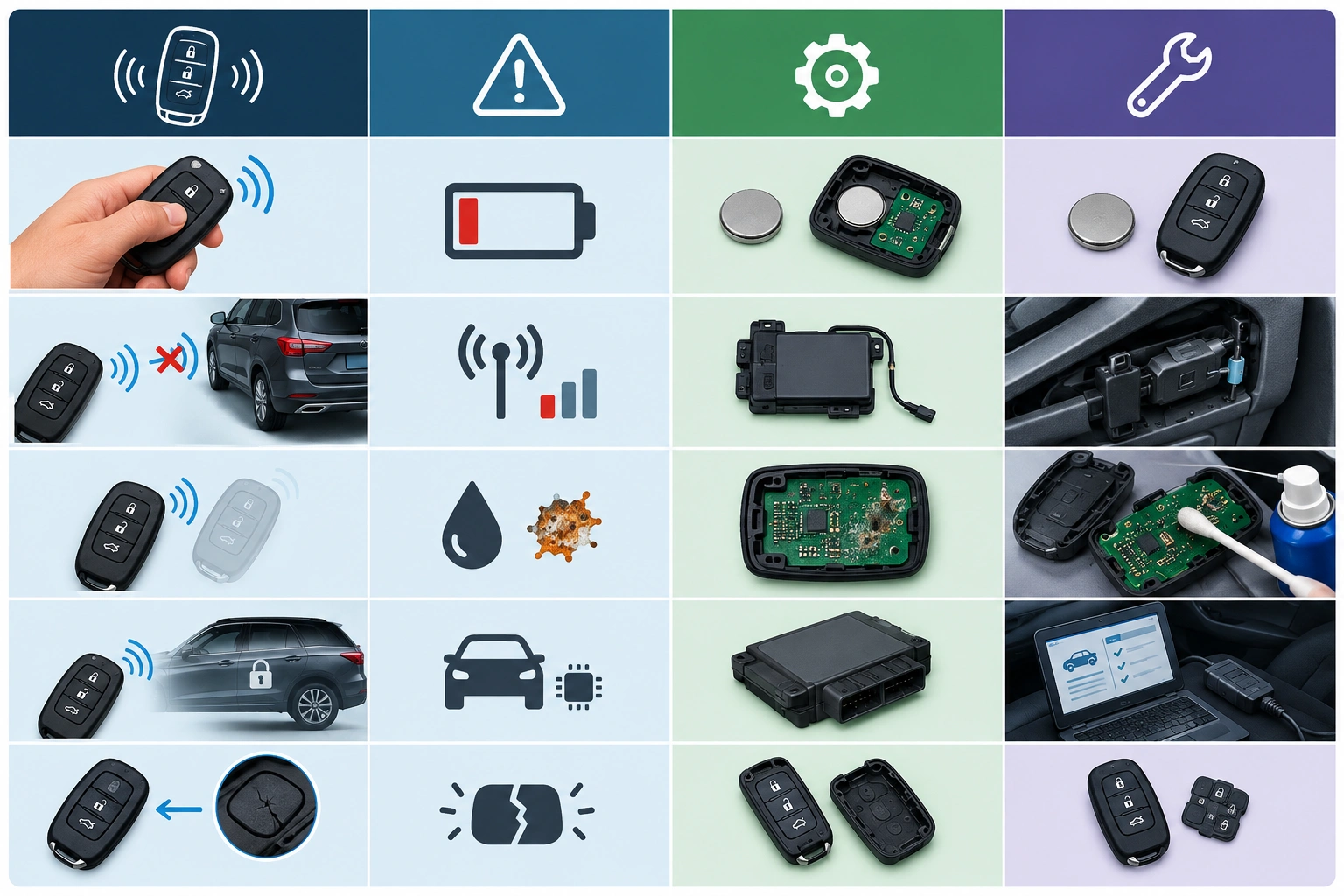
Intermittent key fob problems usually fall into a few patterns. Each one points in a different direction.
1) It works, but only at close range
If the fob unlocks the car only when you’re standing right next to it, the signal is probably weak. That often points to a failing fob battery, tired internal contacts, or a receiver that is less sensitive than it should be.
2) It works only after repeated button presses
When you have to press lock or unlock two, three, or four times before the car responds, the button contacts inside the fob may be worn or dirty. The battery can still be fine and the real problem is that the button press isn’t making a consistent connection.
3) It works in some places, not others
If the fob behaves normally in your driveway but not in a parking garage, near a certain building, or beside another electronic device, think interference first. Signal issues can be location-specific.
4) The spare fob behaves the same way
If both your main fob and spare are unreliable, the problem is less likely to be the fob itself. That pattern pushes you toward the vehicle battery, receiver, or a broader sync issue.
5) Push-button start fails, but the doors still unlock
That can happen when the fob signal is weak enough for remote entry to work sometimes, but not strong enough for the car to detect it reliably during start-up. In that case, the battery is often the first thing to check.
6) The LED or indicator is inconsistent
If your fob has a small LED, a weak flash, no light, or an LED that only responds when you press harder can point to a battery, contact, or board problem. A healthy LED response does not prove the fob is perfect, but no response after a fresh battery is a useful clue.
The most likely causes, from common to less common
Here’s the order I’d check them in.
Weak key fob battery
This is the most common place to start. A fading battery can cause short range, delayed response, and “works today, not tomorrow” behavior. Many fobs use a CR2032 battery, though others use a different coin cell, a rechargeable battery, or a vehicle- and fob-specific design.
A weak battery may still have enough power to work occasionally, which is why intermittent failure is so confusing. The fob is not dead — just marginal.
Worn buttons or internal contacts
If the battery is new but the fob still only works when pressed a certain way, the problem may be inside the shell. Rubber button pads can wear, metal contacts can get dirty, and circuit-board joints can crack after years of use or a hard drop.
Damage from drops or water
A fob that’s been dropped on concrete, sat in a wet pocket, or taken through a wash cycle can act unpredictable long before it stops completely. Water damage is especially important because it can corrode the battery contacts or board.
Interference
Garage door openers, building wiring, nearby electronics, and even where you’re standing can interfere with the signal. If the problem is tied to one location, interference becomes much more likely.
Reprogramming or sync issues
Sometimes the fob and vehicle lose sync after a battery change, a low vehicle battery event, or another electrical disturbance. In those cases, the fob may still be fine but the car no longer recognizes it properly.
Vehicle battery or receiver problems
If the car battery is weak, the remote system may act erratic on some vehicles. A failing key fob signal receiver can do the same thing. If both fobs are unreliable, this is where I’d look next.
Quick at-home checks to separate a weak battery from a failing fob
These simple tests can help before you buy parts:
- Swap in a fresh battery and make sure it’s the correct type for your exact fob.
- Watch for the LED or indicator light when you press a button; compare the response before and after the battery swap.
- Test the spare fob to see whether the problem follows the fob or seems vehicle-side.
- Try every button individually to see whether one function fails before the others.
- Observe range after the battery replacement; if range improves briefly and then drops again, the fob may have a deeper issue.
Quick comparison: fob problem or car problem?
| Symptom pattern | Most likely cause | Best next step |
|---|---|---|
| Works only close to the car | Weak fob battery or weak signal | Replace the fob battery first |
| Works only after repeated presses | Worn button or dirty contact | Inspect and clean the fob |
| Fails in one area but not another | Interference | Test in a different location |
| Both fobs act the same | Vehicle battery, receiver, or sync issue | Check the car battery and vehicle-side system |
| Push-start works only when fob is held near the start button | Weak fob battery | Replace the battery and retest |
| Works for a few days after battery replacement, then fails again | Deeper fob issue | Inspect for damage or consider replacement |
Step-by-step troubleshooting you can do at home
Here’s the order I’d use in the driveway before spending money on parts or service.
1) Replace the key fob battery first
If the battery is old, the range has dropped, or the fob acts randomly, this is the first move. It’s quick, inexpensive compared with a new fob, and it solves a lot of intermittent problems.
Make sure you verify the correct battery type in the owner’s manual or on the old battery. Some fobs use a CR2032, but many do not.
2) Test the fob in two different locations
Try it at home, then again in a different place like a grocery lot or open street. If it fails only in one spot, that points toward interference rather than a dead fob.
3) Use the spare fob
This is one of the fastest ways to separate vehicle-side trouble from fob-side trouble.
- If the spare works normally, the original fob is the likely problem.
- If both are unreliable, suspect the car battery, receiver, or a sync issue.
4) Check for button feel and physical damage
Press each button slowly. If one button feels mushy, sticks, or only works when you press hard, the shell or contact pad may be worn.
Look for:
– cracks in the case
– corrosion around the battery compartment
– signs of moisture
– loose battery clips
– buttons that sit crooked
5) Try the car’s backup start method
If you have push-button start and the car doesn’t detect the fob, many vehicles have a backup method that lets the car read the fob when it’s held very close to the start button or placed in a designated spot. Your owner’s manual shows the exact procedure for your model.
If the backup method works every time, that reinforces the idea that the fob signal is weak rather than completely dead.
How to tell whether the problem is the fob or the car
Use these decision rules:
- One fob fails, the spare works: the original fob is the likely culprit.
- Both fobs fail in the same way: look at the car battery, receiver, or vehicle-side sync.
- The issue only happens in one location: interference is probably part of it.
- The fob works close to the car but not at normal distance: weak battery or weak signal strength is likely.
- The car has slow cranking, dim lights, or other electrical oddities: don’t ignore the vehicle battery.
- The car starts normally, but remote lock/unlock is still intermittent: the fob can still be the issue even if push-start works, because different functions may fail at different times.
A weak vehicle battery can sometimes create odd remote-entry behavior, but symptoms vary by vehicle. That’s why it’s worth checking the car itself if the fob symptoms don’t make sense.
For more on start-up and detection issues, our guides on key fob not detected and the car won’t start and key fob not detected on push-button start walk through the backup-start approach in more detail.
Fixes by cause
If the battery is weak
Replace it, then retest the fob over a few days. If the problem disappears, you’ve likely found it.
If the buttons or contacts are worn
Open the fob carefully, clean the battery contacts, and inspect the button pad for damage. If the shell is cracked or the board is loose, repair may not hold for long.
If interference is the issue
Test away from the suspected source. A garage or parking structure can be enough to make a marginal signal seem dead. If the fob works normally elsewhere, you may not need parts at all.
If the fob lost sync
Reprogramming may be needed. Some vehicles allow limited DIY sync steps, but many cannot be reprogrammed by the owner and may require a dealer or locksmith with the right equipment. Reprogramming helps only when the issue is communication, not when the battery or hardware is failing.
If the vehicle battery is weak
Charge or replace the vehicle battery and retest. If the car battery is borderline, the remote system can act flaky even when the fob is fine.
If the receiver is faulty
That’s a vehicle-side repair. When both fobs behave badly and the car battery is healthy, the receiver or related module deserves attention.
Temporary workarounds when the fob is unreliable
If the fob works only sometimes, don’t wait until you’re stranded to learn the backup method.
- Use the physical key blade if your fob has one.
- Keep the spare fob in a safe, separate place.
- Learn the emergency start procedure for your vehicle.
- If the car won’t unlock remotely, use the mechanical door lock if equipped.
These are not long-term fixes, but they keep you moving while you sort out the real cause.
When to repair, replace, or reprogram the fob
Choose the fix based on the symptom pattern:
- Replace the battery if the fob still works sometimes and range has dropped.
- Repair or clean the fob if the buttons are sticky, inconsistent, or damaged from a drop.
- Reprogram if the fob suddenly lost communication after a battery change or electrical event.
- Replace the whole fob if the case is damaged, corrosion is present, or the problem keeps coming back after basic fixes.
If the fob is older and already showing multiple symptoms — short range, button inconsistency, and intermittent detection — replacement is often the cleaner long-term choice than chasing one repair after another. As Keyless Entry Remote notes, random failures often become complete failures at the worst time, so waiting too long can cost you convenience and reliability.
When to Consult a Locksmith
Call a locksmith, dealer, or qualified mechanic when:
- both fobs are failing
- the car battery is weak or recently replaced and the issue continues
- the fob has water damage or visible corrosion
- reprogramming is needed and DIY steps don’t work
- the vehicle won’t detect the fob even with backup methods
A locksmith may be able to help with testing, replacement, and some reprogramming jobs, depending on the vehicle and local equipment. A dealer may be the better choice when the vehicle needs manufacturer-specific programming or module diagnosis.
How to reduce future key fob problems
A few habits help keep the problem from coming back:
- replace the battery before it’s completely dead
- keep the fob dry
- avoid pressing buttons with wet or dirty hands
- don’t store the fob where it gets crushed in a pocket or bag
- keep an eye on range changes, because they often show up before total failure
The key is to treat intermittent behavior as an early warning, not a minor annoyance. A fob that works “most of the time” is usually telling you something is wearing out.
FAQ
Why does my key fob only work sometimes?
The most common reasons are a weak battery, worn internal contacts, damage, interference, or a sync issue. If both the original and spare fob act up, the car battery or receiver becomes more likely.
What should I check first if it suddenly gets worse?
Start with the battery and the spare fob. If the range changed quickly or the LED response is weak, the battery is the easiest first test.
Can a key fob battery be “not dead” but still bad?
Yes. A battery can have enough power for occasional use but not enough for reliable range or repeated presses.
Why does it work near the car but not farther away?
That usually means the signal is weak. A dying battery is the first thing to rule out, followed by interference and internal wear.
Can my phone or garage cause the problem?
Yes, sometimes. If the fob only fails in one location, interference is a real possibility.
Do I need reprogramming?
Only if the fob and car seem out of sync. Reprogramming won’t help much if the battery is weak or the fob hardware is damaged.
Should I replace the whole fob?
Replace it when the housing is damaged, corrosion is present, or repeated battery changes and cleaning don’t solve the issue.
