
Can an OBD2 Scanner Read Airbag Codes?

Quick Answer
Yes, an OBD2 scanner can read airbag codes if it supports Supplemental Restraint System (SRS) diagnostics for your vehicle. Most basic code readers focus on engine and emissions-related faults, so they may not access the airbag control module. Before buying a scanner, check its compatibility with your exact make, model, and year.
What you need to know
- Basic OBD2 readers: Usually read supported engine and emissions codes, not airbag faults.
- SRS-compatible scanners: Can access airbag codes on supported vehicles.
- Vehicle compatibility: Diagnostic coverage varies by make, model, year, and scanner software.
- Code clearing: Some scanners can clear eligible SRS codes, but clearing a code does not repair the fault.
- Safety first: An illuminated airbag warning light needs proper diagnosis because some restraint functions may be impaired.
If your airbag warning light is on, you might wonder whether the OBD2 scanner in your garage can tell you what’s wrong. The answer depends on the scanner’s capabilities and the diagnostic systems supported by your vehicle.
In this guide, I’ll explain how SRS diagnostics work, which scanner features matter, how to interpret the results, and when to seek professional help. I’ll also cover why reading an airbag code is different from fixing the underlying problem.
In This Guide
Can OBD2 Scanners Read Airbag Codes?
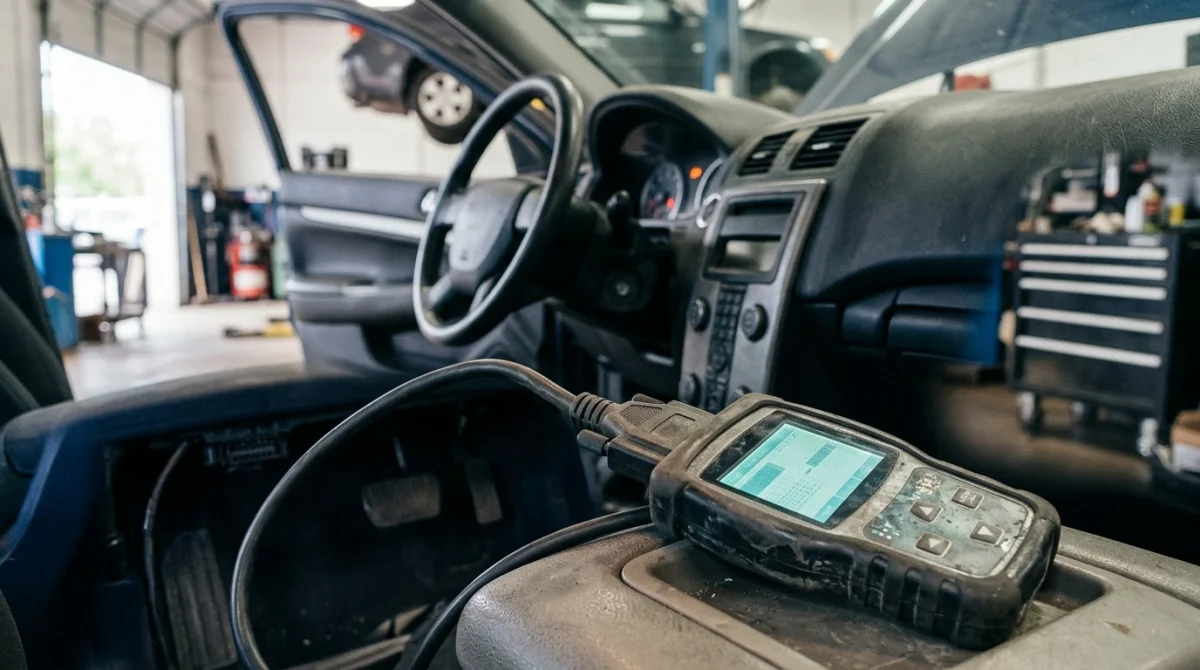
Yes, some OBD2 scanners can read airbag codes, but not every scanner supports this function. You need a tool that can communicate with your vehicle’s Supplemental Restraint System, commonly called the SRS.
What Is an Airbag Code?
An airbag code is a diagnostic trouble code stored when the vehicle’s restraint system detects a fault or abnormal condition. Depending on the vehicle, the SRS may monitor airbags, crash sensors, seat belt pretensioners, and passenger occupant-detection components.
The code helps identify the system or circuit that needs attention. It does not automatically confirm that a particular airbag, sensor, or wiring component has failed.
Why Does Scanner Compatibility Matter?
OBD2 provides a standardized way to access certain vehicle diagnostics, particularly emissions-related information. However, accessing the engine computer does not guarantee access to other modules, including the airbag control module.
For example, a basic scanner might read a check engine code but display no SRS information. A more capable scanner may access both systems if its software supports your vehicle.
- Basic code reader: Primarily reads supported engine and emissions-related codes.
- Enhanced scanner: May access additional vehicle systems, depending on its coverage.
- Full-system diagnostic tool: May provide SRS codes, live data, and selected service functions.
Always check the manufacturer’s compatibility list. The words “OBD2 compatible” alone do not mean that a scanner can read airbag codes.
Why Basic Scanners Cannot Read Airbag Codes
Basic OBD2 scanners often cannot read airbag codes because their software focuses on standardized powertrain diagnostics. Airbag systems use a separate control module and may require additional diagnostic support.
Engine Codes and SRS Codes Are Different
The engine control module monitors functions such as misfires, fuel delivery, and emissions-related sensors. The SRS module monitors the vehicle’s restraint system and its associated circuits.
Although both systems may use the same diagnostic port, they do not necessarily share the same diagnostic access. Your scanner must support the specific module you want to check.
Common Reasons a Scanner Misses Airbag Faults
- Limited functionality: The scanner only supports generic engine diagnostics.
- Missing SRS coverage: The tool cannot communicate with the airbag module.
- Vehicle incompatibility: The scanner supports other vehicles but not your exact model or year.
- Outdated software: The tool may need an update to support the relevant diagnostic functions.
- Communication problems: An electrical or network fault may prevent communication with the module.
If your scanner reports no codes while the airbag light remains illuminated, don’t assume the system is safe. First, confirm that the scanner actually accessed the SRS module.
Can a Bluetooth OBD2 Adapter Read Airbag Codes?
Yes, some Bluetooth adapters can support SRS diagnostics when paired with compatible software. However, many inexpensive adapters and general-purpose apps only provide basic engine information.
Before purchasing an adapter, verify compatibility across the adapter, app, vehicle, and required SRS functions. An adapter’s ability to connect to your phone does not guarantee access to the airbag system.
What Scanner Do You Need to Read Airbag Codes?
Choose a scanner that explicitly supports SRS or airbag diagnostics for your vehicle. A full-system scanner can be a useful option, but its actual coverage matters more than its advertised feature count.
Features Worth Checking Before You Buy
- SRS code reading: Retrieves airbag-related diagnostic trouble codes.
- Code descriptions: Explains the reported fault where supported.
- Live data: Displays available SRS status information or sensor data.
- Code clearing: Clears eligible codes when the vehicle and tool permit it.
- Vehicle coverage: Supports your exact make, model, year, and relevant system.
These features are not interchangeable. A scanner may read SRS codes without supporting live data, special tests, or code clearing.
Basic Reader vs. SRS Scanner vs. Full-System Tool
| Tool type | SRS access | Typical use |
|---|---|---|
| Basic OBD2 reader | Usually unavailable | Basic engine and emissions diagnostics |
| SRS-capable scanner | Available on supported vehicles | Reading airbag codes and possibly live data |
| Full-system scanner | Depends on vehicle coverage | Multiple modules and additional diagnostic functions |
| Manufacturer diagnostic equipment | Designed for supported systems | Vehicle-specific diagnosis and service procedures |
If you’re comparing tools, review the manufacturer’s current specifications and supported vehicle list. For example, you can investigate the official Autel website to find diagnostic products and check their stated capabilities.
Expert tip: Confirm SRS coverage for your specific vehicle before buying. A scanner that reads engine codes may still be unable to access the airbag module.
How to Check Airbag Codes Safely
To check airbag codes, use a compatible scanner to access the SRS module and retrieve its diagnostic information. The exact connection procedure depends on the vehicle and scanner instructions.
A Safe Diagnostic Workflow
- Identify your vehicle: Record its make, model, year, and relevant trim information.
- Check scanner compatibility: Confirm that the tool supports SRS diagnostics for your vehicle.
- Read the owner’s manual: Follow the manufacturer’s instructions for diagnostic access and warning lights.
- Connect the scanner correctly: Follow the tool’s instructions for the diagnostic port and ignition state.
- Select the SRS system: Choose the airbag or restraint-system module rather than running only an engine scan.
- Save the results: Record the complete code, description, and module information.
- Arrange the appropriate repair: Use the diagnostic results to guide further inspection by a qualified technician.
This is a general workflow, not a universal repair procedure. Some vehicles require manufacturer-specific software, additional prerequisites, or professional diagnostic equipment.
What If the Scanner Cannot Connect?
A failed connection does not automatically mean that the airbag control module has failed. The scanner may lack the required coverage, or an electrical or communication problem may be preventing access.
Verify compatibility first. If the warning remains, ask a qualified technician to scan the SRS module using suitable equipment.
Why Should You Save the Original Codes?
Recording the original codes helps preserve information that can guide diagnosis. Clearing them before documenting the results may remove useful details about the fault.
Save the exact code and its description instead of relying on a vague message such as “airbag fault.” Different faults can produce similar symptoms but require different diagnostic checks.
Safety note: Never probe airbag connectors, test SRS circuits with an ordinary test light, or disconnect restraint components without following the manufacturer’s specific safety procedure.
What Airbag Codes Mean
An SRS code identifies a fault or abnormal condition detected by the restraint system. Its precise meaning depends on the code definition, vehicle manufacturer, and reporting module.
Common Categories of Airbag Faults
- Circuit faults: Problems detected in a monitored electrical circuit.
- Sensor faults: Abnormal readings or communication involving supported sensors.
- Seat belt pretensioner faults: Problems associated with a monitored pretensioner circuit or component.
- Occupant-detection faults: Issues involving a passenger classification or seat-occupancy system, where fitted.
- Communication faults: Problems exchanging information between electronic modules.
- Crash-related faults: Conditions that may require manufacturer-specific inspection or repair.
These categories explain common types of faults, not the diagnosis of a particular vehicle. The same general symptom can have different causes across different models.
Does an Airbag Code Tell You Which Part to Replace?
No. A code helps narrow down the affected system or circuit, but it does not always identify the failed component.
For example, a seat-related circuit code does not automatically prove that a seat sensor needs replacement. The underlying cause could involve a connector, wiring, a component, or another monitored condition.
Replacing parts based only on a short code description can waste money and leave the warning unresolved. Use the manufacturer’s diagnostic procedure to determine the cause.
Can a Weak Battery Trigger an Airbag Warning?
Low voltage or an electrical interruption can contribute to certain vehicle faults, but not every airbag warning comes from a weak battery. The stored code and vehicle-specific diagnostic information are needed to determine whether voltage played a role.
If the warning appeared after a battery replacement, jump-start, or electrical repair, tell the technician. The timing provides useful context, but it does not prove that the restraint system is functioning correctly.
What If the Airbag Light Appeared After a Collision?
A vehicle involved in a collision may need restraint-system inspection even if no airbags visibly deployed. Depending on the vehicle and the event, the system may store crash-related information or detect faults that require specific repair procedures.
Don’t assume that clearing a code restores a collision-damaged system. Review the NHTSA’s airbag safety guidance and arrange a qualified inspection when a collision may have affected the restraint system.
Can You Clear Airbag Codes With an OBD2 Scanner?
Some SRS-capable scanners can clear eligible airbag codes on supported vehicles. However, reading codes and clearing codes are separate functions, and neither action repairs the underlying fault.
Why Might an Airbag Code Return?
- The fault remains active: The system still detects the original problem.
- The repair is incomplete: A circuit or component still needs attention.
- A special procedure is required: The manufacturer may specify additional checks or service operations.
- Crash-related data is present: The vehicle may require an approved repair or replacement procedure.
- The scanner lacks clearing support: It can retrieve the code but cannot perform the required clearing function.
A warning light going out after a reset does not prove that every restraint component will work correctly in a crash. The cause must be addressed and the system checked according to the manufacturer’s instructions.
Should You Disconnect the Battery to Reset the Airbag Light?
Battery disconnection is not a reliable universal way to reset an SRS warning. It may leave the fault unresolved and can create additional requirements on some vehicles.
Airbag systems may retain electrical energy temporarily, and their safe handling procedures vary. Do not disconnect the battery or touch SRS components as an improvised reset method.
Expert tip: Record the original SRS codes before any clearing attempt. Follow the vehicle manufacturer’s approved procedure and confirm that the underlying problem has been repaired.
When Should You Get Professional Airbag Diagnosis?

Arrange professional diagnosis if the airbag warning light stays on, appears while driving, or fails to go out as described in the owner’s manual. An illuminated SRS warning may mean that some airbags or seat belt pretensioners will not function as intended.
Warning Signs You Shouldn’t Ignore
- The airbag light remains illuminated after startup.
- The light appears intermittently or while driving.
- The vehicle has been involved in a collision.
- The warning appeared after steering-wheel, seat, dashboard, or electrical work.
- The scanner cannot access the SRS module or returns unclear information.
- You suspect a restraint-system component may have been deployed or damaged.
The Insurance Institute for Highway Safety’s airbag resources explain the protective role of airbags. Don’t ignore a warning simply because the vehicle still starts and drives normally.
Should You Visit a Dealership or an Independent Repair Shop?
Either can be appropriate if the provider has compatible diagnostic equipment, access to the required service information, and training in restraint-system repairs. Some vehicles require manufacturer-specific tools or procedures.
Before booking, ask whether the shop can access the SRS module on your exact vehicle. Request the diagnostic findings and proposed repair before authorizing parts or labor.
Is It Safe to Drive With the Airbag Light On?
You should not assume that a vehicle with an active airbag warning has a fully functioning restraint system. Depending on the fault, one or more airbags or pretensioners may not provide their intended protection.
Follow the owner’s manual and arrange prompt inspection. If there is collision damage or another serious warning, stop in a safe location and seek appropriate assistance.
Frequently Asked Questions
Can a cheap OBD2 scanner read airbag codes?
Usually not if it only supports generic engine and emissions diagnostics. Some affordable scanners include SRS functionality, but you should verify compatibility with your specific make, model, and year before purchasing one.
Are airbag codes the same as check engine codes?
No, they generally refer to different diagnostic systems. Engine codes concern powertrain or emissions-related faults, while airbag codes are retrieved from the SRS module. The exact code definition and reporting module determine what the fault means.
Will an OBD2 scanner turn off my airbag light?
Some SRS-capable scanners can clear eligible codes when the vehicle supports that function. However, the underlying problem must be addressed, and the warning may return if the fault remains active.
Can a scanner confirm that my airbags will deploy?
No scanner can guarantee that every airbag will deploy correctly in a future collision. A compatible tool can identify certain faults, but a qualified technician must evaluate the results and follow the manufacturer’s inspection and verification procedures.
Can a Bluetooth OBD2 scanner read SRS codes through a phone?
Yes, certain adapter-and-app combinations support SRS diagnostics. Others only read engine data. Verify that the adapter, app, vehicle, and required airbag functions are compatible before buying.
Do I need a dealership to diagnose an airbag light?
Not necessarily. A qualified independent repair shop may be able to diagnose and repair the fault if it has suitable SRS equipment and vehicle-specific information. Some models or repairs require manufacturer-specific tools or procedures.
What if my scanner finds no codes but the airbag light is on?
First, check whether the scanner actually accessed the SRS module. An engine-only scan cannot rule out an airbag fault. If the warning persists, arrange a scan using a compatible SRS diagnostic tool.
Final Takeaway: Choose the Right Scanner for Airbag Diagnostics
An OBD2 scanner can read airbag codes when it supports SRS diagnostics for your vehicle. A basic engine reader may return no relevant information even when the airbag warning light is illuminated.
Before buying a scanner, verify its SRS coverage, supported functions, and vehicle compatibility. If the warning remains on, have the system diagnosed and repaired rather than relying on a reset.
At ReplaceKeyFob.com, the goal is to help you understand your vehicle’s diagnostic options before spending money on tools or repairs. Start by identifying the warning, confirming which system needs scanning, and choosing the right diagnostic approach.
“`
