
How to Fix P0128 Without Replacing the Wrong Part

To fix P0128, check coolant level first, inspect for leaks, confirm the thermostat opens at the right temperature, test the engine coolant temperature sensor, and clear the code only after the cooling system works correctly. A stuck-open thermostat causes most P0128 cases, but low coolant, bad wiring, or a false sensor reading can trigger it too.
- Most common fix: replace a stuck-open thermostat.
- First check: coolant level when the engine is cold.
- Do not do: erase the code before diagnosis.
- Repair urgency: fix within days, not months.
You scanned your car, saw P0128, and now you want the fastest safe fix.
The good news: P0128 usually means the engine runs too cool, not too hot. The bad news: replacing the thermostat without testing can waste money.
This takes about 8 minutes to read. Start with the simple checks before buying parts.
P0128 is a warm-up problem. Your car’s computer expected the coolant temperature to rise faster than it did.
What P0128 Means in Plain English
P0128 means the engine coolant temperature stayed below the thermostat regulating temperature for too long after startup.
Your powertrain control module watches coolant temperature, intake air temperature, engine run time, and warm-up speed. Federal OBD rules require monitoring of the thermostat and engine coolant temperature sensor on equipped engines, which is why this code can appear when the warm-up pattern does not match the expected value. See the federal OBD cooling system monitoring rule for the technical standard.
The simple version is this: the engine did not warm up on schedule.
- The thermostat stayed open too soon.
- The coolant level dropped too low.
- The coolant temperature sensor sent bad data.
- The cooling fan stayed on too long.
- Cold weather delayed engine warm-up.
The thermostat is the first suspect, but not the only suspect.
How to Fix P0128 Step by Step
Fix P0128 by testing the cooling system in the right order. Start with the parts you can inspect safely, then move toward parts that need tools.
This order matters because low coolant can copy the same symptoms as a stuck-open thermostat. A weak sensor can also tell the computer the engine is colder than it is.
Work only on a cold engine. Hot coolant systems hold pressure and can cause burns.
- Park on level ground and let the engine cool fully.
- Check coolant level in the reservoir.
- Inspect hoses, radiator, water outlet, and thermostat housing for leaks.
- Scan live coolant temperature data.
- Compare warm-up speed with normal operating range.
- Check thermostat operation.
- Repair the failed part, clear the code, then complete a drive cycle.
This process saves time because each step confirms or removes one likely cause.
Check Coolant Level Before Replacing the Thermostat
Low coolant can trigger P0128 because the temperature sensor needs proper coolant contact to read correctly.
When coolant drops below the sensor area or traps air in the system, the powertrain control module receives unstable temperature data. That data can make the engine look colder than it is.
Check the plastic coolant reservoir first. The coolant should sit between the minimum and maximum marks when the engine is cold.
- Low level means you need to find the leak.
- Rusty coolant means the system needs service.
- Oily coolant points to a bigger internal problem.
- Air bubbles can appear after recent cooling system work.
Top up only with the coolant type listed for your vehicle. Mixing the wrong coolant can create sludge and reduce heat transfer.
Test the Thermostat for a Stuck-Open Failure
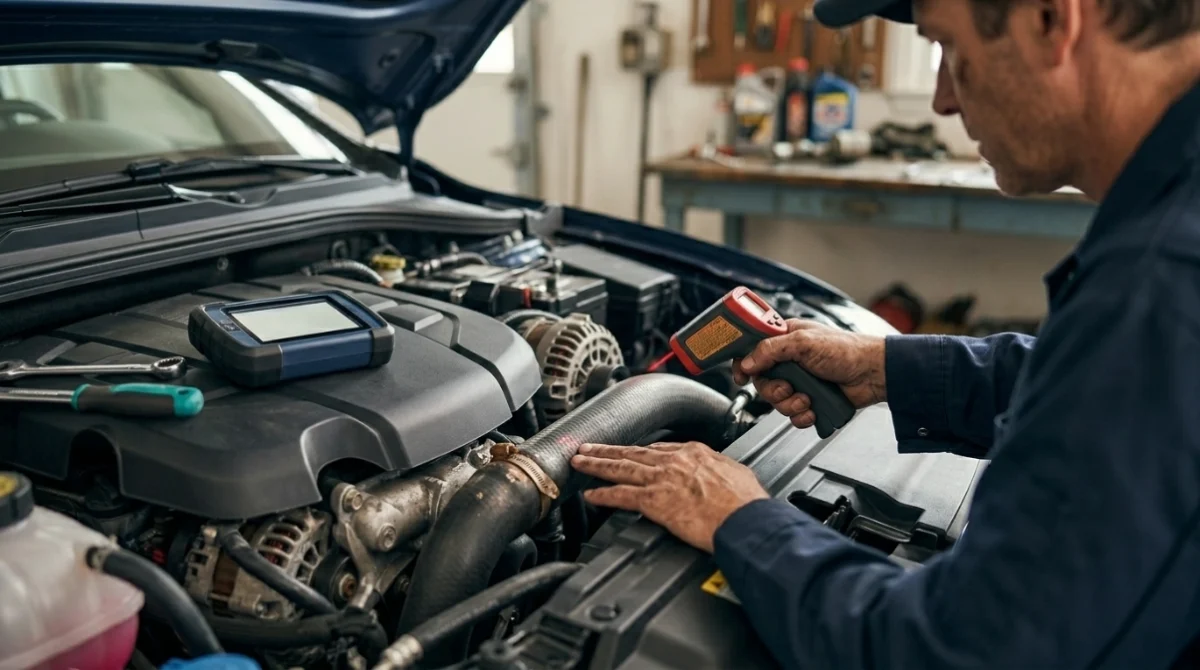
A stuck-open thermostat is the most common reason P0128 appears.
The thermostat should stay closed during cold startup so the engine warms quickly. Once the coolant reaches the designed temperature, the thermostat opens and sends coolant through the radiator.
When the thermostat sticks open, coolant flows through the radiator too early. The engine warms slowly, cabin heat feels weak, and the temperature gauge can sit lower than normal.
| Test result | What it means | Best next step |
|---|---|---|
| Upper radiator hose warms too early | Thermostat leaks open | Replace thermostat |
| Engine never reaches normal temperature | Coolant circulates too soon | Test thermostat and coolant sensor |
| Gauge reads cold but engine feels hot | Sensor or wiring fault | Test live data and wiring |
The key conclusion is simple: do not judge the thermostat by appearance. Judge it by warm-up behavior.
Test the Coolant Temperature Sensor and Wiring
The engine coolant temperature sensor can cause P0128 when it reports a false cold reading.
The sensor sends coolant temperature data to the engine computer. The computer uses that data for fuel control, fan control, emissions readiness, and warm-up monitoring.
RepairPal explains that P0128 tracks how long the engine takes to reach and maintain the correct operating temperature. Their guide also notes symptoms such as poor fuel economy and a check engine light, which match a faulty thermostat or bad sensor signal. Review the RepairPal P0128 diagnostic guide for a mechanic-focused explanation.
- Use a scan tool with live data.
- Read coolant temperature before startup.
- Compare coolant temperature with outside air temperature.
- Start the engine and watch the temperature rise.
- Look for sudden jumps, drops, or frozen readings.
A cold engine should show coolant temperature close to ambient temperature. A reading that starts far too low or far too high points to a sensor or wiring issue.
What Most People Get Wrong About P0128
Most people get P0128 wrong because they treat it like an overheating code.
P0128 usually means the engine did not warm up fast enough. That is different from an engine that overheats, loses coolant fast, or enters a red temperature zone.
Do not open the radiator cap on a hot engine. Wait until the system cools completely.
Wrong belief 1: P0128 means the engine is overheating
P0128 points to a cool-running engine, not an overheating engine. A separate over-temperature code or red warning light needs faster action.
Wrong belief 2: Clearing the code fixes the problem
Clearing P0128 only removes the warning from memory. The code will return after the computer sees the same failed warm-up pattern.
Wrong belief 3: The thermostat is always bad
The thermostat causes many P0128 cases, but low coolant and bad sensor data can trigger the same code. Testing prevents wasted parts.
Can You Drive With a P0128 Code?
You can drive a short distance with P0128 if the car runs smoothly, the temperature gauge stays stable, and no red warning light appears.
Do not ignore the code for weeks. A cool-running engine can use more fuel, produce higher emissions, delay emissions readiness, and reduce heater performance.
OBD readiness also matters after repair. New York DMV explains that an OBDII drive cycle begins with a cold start and specific coolant and air temperature conditions. Their OBDII readiness drive cycle guide shows why readiness monitors need the right conditions after clearing codes.
- If the engine overheats, stop driving.
- If coolant is low, inspect for leaks first.
- If the heater blows cold, fix it soon.
- If inspection is due, repair before testing.
The practical rule is simple: P0128 is not a tow-now code in most cases, but it is not a forget-it code.
Repair Cost to Fix P0128
P0128 repair cost depends on the failed part, labor access, and coolant type.
A thermostat replacement costs less on many four-cylinder engines because the housing is easy to reach. Some modern engines use plastic thermostat assemblies, electronic thermostats, or tight packaging that raises labor time.
| Repair | Typical reason | Cost level |
|---|---|---|
| Coolant top-up | Low coolant with no major leak found | Low |
| Thermostat replacement | Stuck-open thermostat | Medium |
| Coolant sensor replacement | Bad sensor signal | Low to medium |
| Wiring repair | Corroded connector or damaged harness | Varies |
The cheapest fix is the correct diagnosis. The wrong part turns a small repair into two repairs.
After Repair, Clear P0128 the Right Way
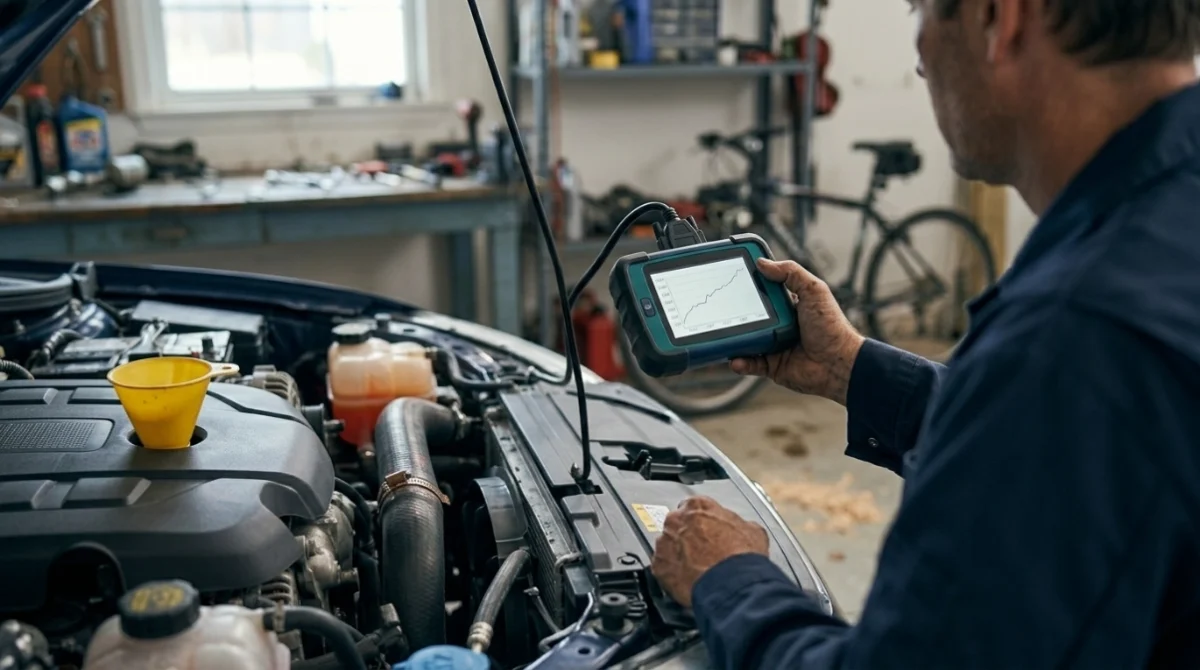
Clear P0128 only after the coolant system warms normally and no leak remains.
Use an OBD2 scanner to erase the code, then drive from a cold start under normal conditions. The computer needs to see the engine reach its target warm-up pattern before the repair counts.
What most people don’t think to ask is whether the car will pass inspection right after clearing the code. The answer is no if readiness monitors have not completed.
- Repair the failed part.
- Refill coolant to the correct level.
- Bleed air from the cooling system.
- Clear the code with a scanner.
- Start cold and monitor live temperature data.
- Complete the required drive cycle.
If P0128 returns after a correct thermostat replacement, focus on coolant sensor data, wiring, fan operation, and trapped air.
When to Replace the Thermostat
Replace the thermostat when warm-up data shows coolant flowing through the radiator before the engine reaches normal temperature.
Also replace the thermostat if the housing leaks, the seal fails, or the part is stuck open during bench testing. Use the correct temperature rating for the vehicle.
Do not install a lower-temperature thermostat to “help” the engine run cooler. The computer expects the factory thermostat range and can keep setting P0128 when the engine runs below that target.
- Use OEM-style temperature rating.
- Replace the gasket or seal.
- Clean the mating surface.
- Refill with correct coolant.
- Bleed trapped air after repair.
If you are in a cold climate, check whether short trips caused incomplete warm-up. If the code returns on longer drives, the thermostat still needs testing.
P0128 is best fixed by diagnosing the warm-up problem before replacing parts.
As vehicles use smarter cooling systems, live temperature data will matter more than dashboard gauge position.
Check your cold coolant level and scan live coolant temperature before buying a thermostat.
Frequently Asked Questions
Will P0128 clear itself after replacing the thermostat?
P0128 can clear itself after several successful drive cycles, but using a scanner is faster. The code should only be erased after the thermostat repair, coolant refill, and air bleeding are complete.
Can low coolant cause a P0128 code?
Yes, low coolant can cause P0128 because the sensor can read unstable coolant temperature. Low coolant also introduces air pockets that slow or confuse temperature readings during warm-up.
Does P0128 affect fuel economy?
Yes, P0128 can reduce fuel economy because the engine computer sees the engine as too cold. Cold operation often changes fuel strategy and delays efficient closed-loop operation.
Is P0128 the same as a bad coolant temperature sensor?
No, P0128 is not the same as a bad coolant temperature sensor. The code reports a warm-up failure, and the cause can be the thermostat, coolant level, sensor, wiring, or fan control.
How long does it take to fix P0128?
Simple diagnosis can take 15–30 minutes with a scan tool and cold engine. Thermostat replacement often takes 1–3 hours, depending on engine access and cooling system bleeding needs.
