
How to Calibrate a Steering Angle Sensor

This post contains affiliate links. As an Amazon Associate, ReplaceKeyFob earns from qualifying purchases, at no extra cost to you.
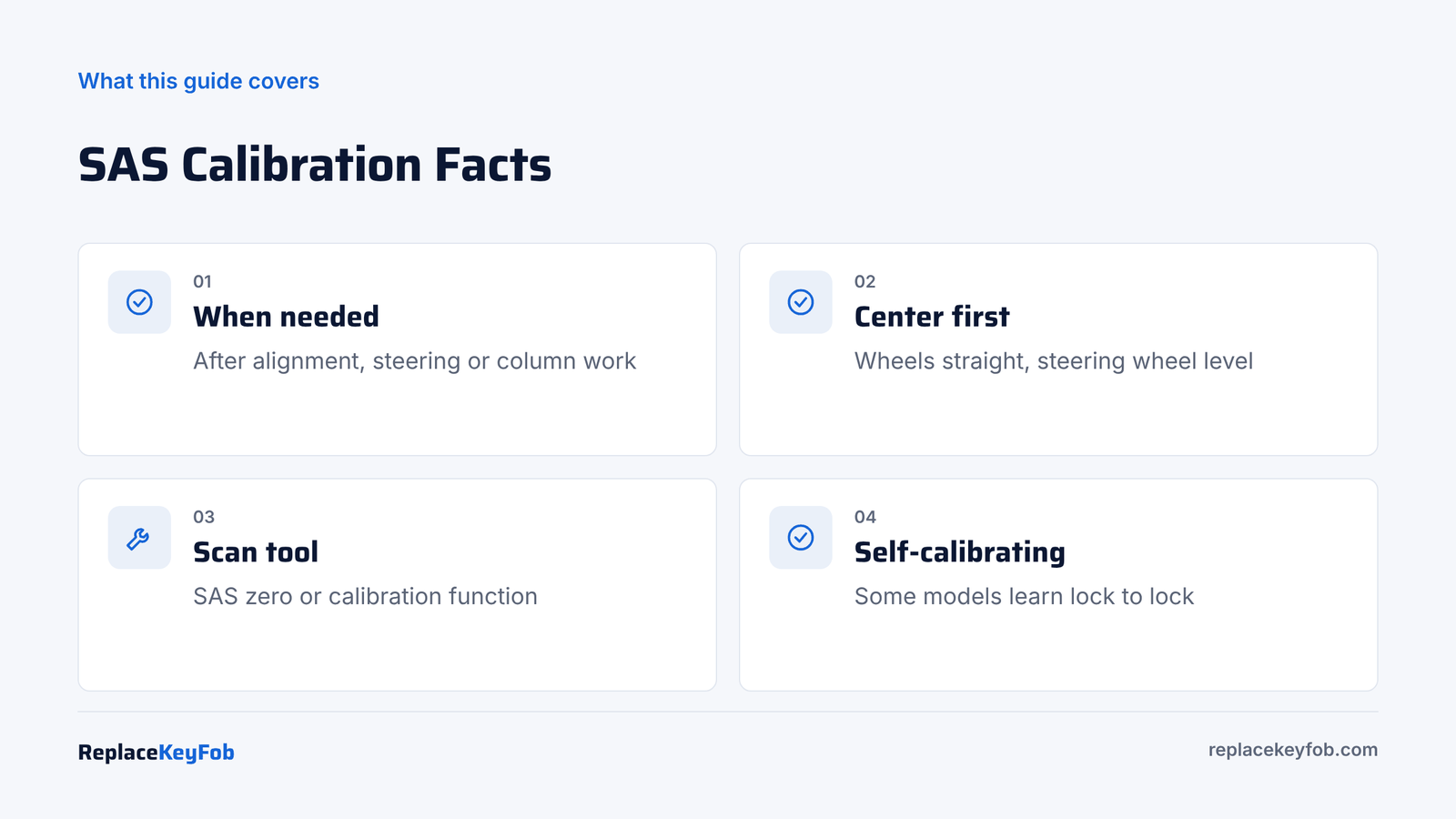
To calibrate a steering angle sensor, center the steering wheel with the front wheels pointing straight, ideally right after a wheel alignment. Connect a scan tool with an SAS calibration function to the ABS or stability module, and run the zero point calibration. Some cars self-calibrate when you turn the wheel fully left, fully right and back to center, then drive straight.
The steering angle sensor (SAS) tells the stability control system where the driver is pointing the car. The system compares that with yaw rate and wheel speeds to decide whether the car is skidding. If the sensor thinks “straight ahead” is a few degrees off, the stability system can get confused, the ESC or traction light comes on, and on some cars the lane-keeping or adaptive headlights stop working.
Calibration resets the sensor’s zero point so it matches the real straight-ahead position. This guide covers when you need it, how to do it with a scan tool, which cars can do it without one, and how to test the sensor.
Where the Sensor Is and How It Works
The steering angle sensor usually sits on the steering column behind the steering wheel, often built into the clock spring assembly or the multifunction switch housing. On some vehicles it is part of the electric power steering unit on the rack. Most modern sensors are digital and report angle and turning speed over the vehicle network, which is why a scan tool can read and zero them. Older analog sensors could not be calibrated and were simply replaced.
When Steering Angle Sensor Calibration Is Needed
| Event | Calibration needed? |
|---|---|
| Wheel alignment | Yes on most cars with stability control |
| Steering rack, tie rod or column work | Yes |
| Steering angle sensor or clock spring replaced | Yes |
| Battery disconnected | Sometimes; many sensors keep calibration, some lose it |
| Suspension parts replaced (control arms, struts) | Usually, because alignment changes |
| ESC or traction light after any of the above | Very likely |
Many alignment shops now include SAS calibration, but not all do. If the ESC light came on right after an alignment, the calibration may have been skipped.
What You Need
- A correct wheel alignment, or at least wheels pointing straight with the steering wheel level
- A level surface
- A scan tool with SAS calibration for your make
- About 10 to 15 minutes
Scan tool with SAS calibration
Look for a steering angle sensor calibration or reset function that lists your make and year, plus ABS live data so you can read the steering angle.
As an Amazon Associate, ReplaceKeyFob earns from qualifying purchases.
Compare options in our guide to the best OBD2 scanner with SAS calibration.
Step 1: Center the Steering
- Park on a level surface with the front wheels pointing straight ahead.
- Look at the steering wheel. The spokes should be level. If the wheel is noticeably off center when the wheels are straight, get an alignment first. Calibrating to a crooked wheel locks the error in.
- Start the engine. Many systems need the engine running so the electric power steering is active.
Why alignment comes first: the sensor calibration saves “straight ahead” as wherever the steering wheel is at that moment. If the toe is wrong, the car still pulls and the wheel is still off center.
Step 2: Calibrate With a Scan Tool
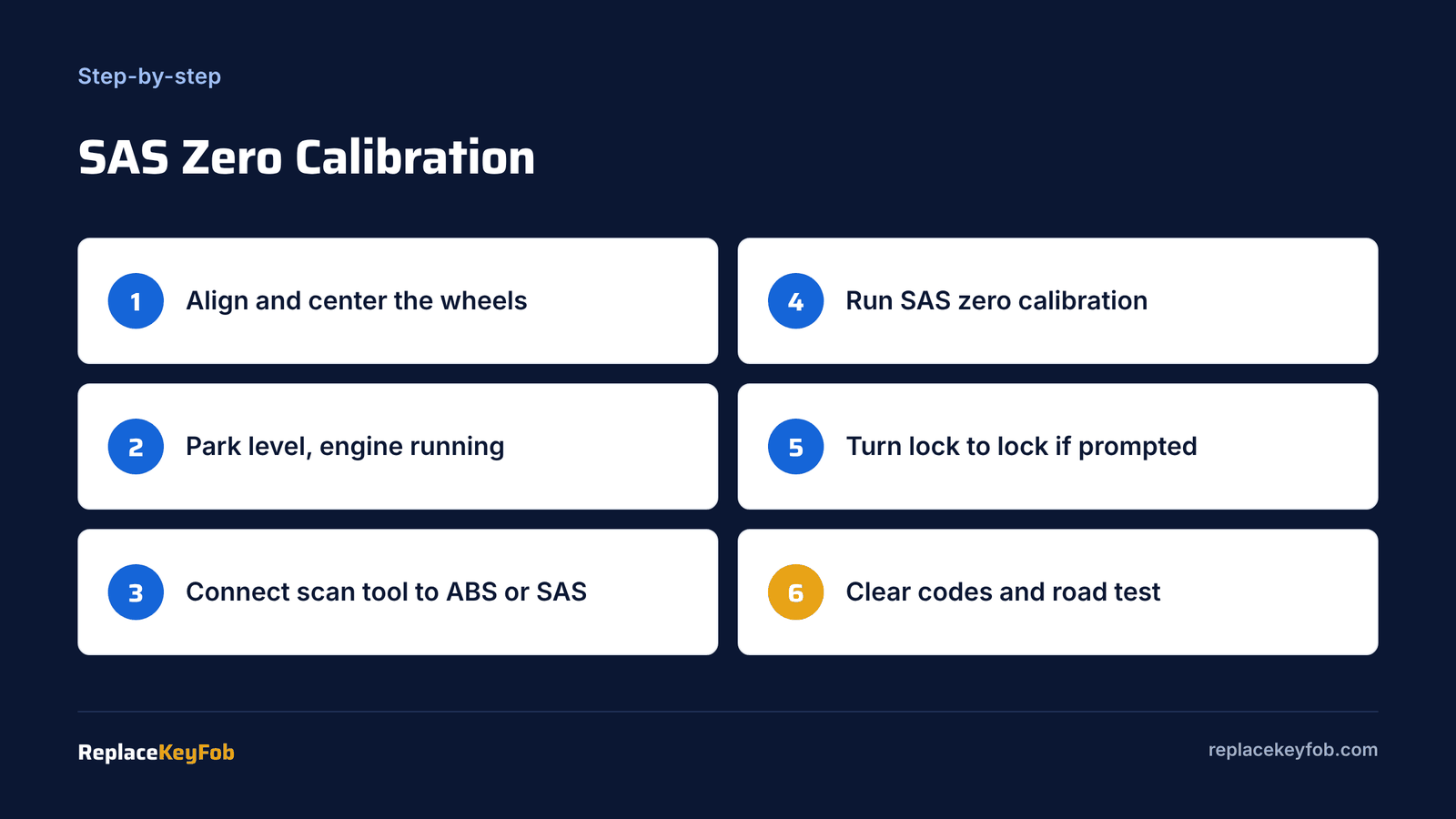
- Plug the scan tool into the OBD2 port and turn the ignition on, engine running if the tool asks.
- Select the vehicle and open the ABS, ESC, brake or chassis module. Some tools list the SAS under its own module or under power steering.
- Choose special functions, then “SAS calibration”, “steering angle reset” or “zero point calibration”.
- Hold the steering wheel centered and follow the prompts. Some tools ask you to turn the wheel full left, full right and back to center.
- Confirm the success message, then clear any codes in the ABS and ESC modules.
- Turn the ignition off for about 10 seconds, restart and confirm the warning lights are off.
How to Calibrate Without a Scan Tool
Some vehicles self-calibrate or offer a manual method. These are common approaches; check your service information, because many cars do not support them.
Lock-to-lock self-calibration
On many vehicles that relearn on their own:
- Start the engine with the wheels straight.
- Turn the steering wheel slowly to full left lock, then full right lock, then back to center.
- Turn the engine off for about 10 seconds, then restart.
- Drive straight for a short distance at low speed, often above about 10 to 20 mph, and make a few gentle turns.
The ESC light should go out once the system sees a consistent straight-ahead position.
Cars that need a tool
Many European models and many newer vehicles with lane-keeping or driver assistance systems require a scan tool calibration. If the lock-to-lock method does not clear the light after a short drive, use a tool or visit a shop.
How to Test a Steering Angle Sensor
- Connect a scan tool that shows ABS or chassis live data.
- Find the steering angle reading, shown in degrees.
- With the wheels straight, it should read very close to 0 degrees, often within a few degrees.
- Turn the wheel slowly to full left and full right. The reading should change smoothly, with no jumps or dropouts, and reach similar numbers on each side.
- Turn the wheel exactly one full turn. The reading should change by about 360 degrees.
| Reading | Meaning |
|---|---|
| Zero at center, smooth and symmetric | Sensor good; calibrated |
| Several degrees off at center | Needs calibration or alignment |
| Jumps or drops to zero while turning | Sensor, clock spring or wiring fault |
| No reading at all | Sensor not communicating; check fuses and connector |
| Correct center, wrong full-turn value | Sensor fault or wrong part fitted |
Common steering angle sensor codes include C0710 and C0455 on many GM vehicles, and U-codes when the sensor loses communication. Our guide on whether an OBD2 scanner can read ABS codes explains which tools reach these modules.
How to Calibrate a Bendix Steering Angle Sensor
On heavy trucks and many commercial vehicles with Bendix electronic stability, such as systems using the Bendix SAS-60 sensor, calibration after an alignment or steering repair is done with Bendix ACom diagnostic software or a heavy-duty scan tool that supports Bendix stability systems. The process is similar: center the wheels, connect to the ABS/ESP module, run the SAS calibration and verify the angle reads near zero. Follow Bendix’s service data for your system, because heavy-duty procedures and safety checks differ from passenger cars.
Troubleshooting After Calibration
| Problem | Likely cause |
|---|---|
| ESC light returns after a short drive | Wheel not truly centered, alignment off, or sensor fault |
| Calibration fails on the scan tool | Engine not running, wrong module, low battery voltage |
| Car pulls and the wheel is off center | Alignment needed, not SAS |
| ABS light also on | Separate wheel speed fault; see how to reset the ABS light |
| Lane-keep camera warning | Camera calibration may also be needed |
Low battery voltage can make calibration fail on many cars. If the battery is weak, charge it first or use a maintainer.
Mistakes to Avoid
- Calibrating with the wheel crooked.
- Skipping the alignment after replacing tie rods or control arms.
- Turning the wheel during the calibration step.
- Assuming a battery disconnect resets the SAS. It may erase calibration on some cars, which then need a new calibration.
- Confusing SAS with a steering wheel lock. A steering wheel lock is an anti-theft device that clamps the wheel; it has nothing to do with the sensor.
When to Call a Pro and What It Costs
| Service | Typical 2026 US cost |
|---|---|
| SAS calibration only | About $50 to $150 |
| Four-wheel alignment with SAS calibration | About $120 to $250 |
| Steering angle sensor replacement | About $200 to $600 installed |
| ADAS camera calibration (if needed) | About $250 to $600 |
If other dash lights came on at the same time, see how to reset the airbag light for SRS faults that can share the clock spring area with the SAS.
Frequently Asked Questions
Center the steering wheel with the wheels pointing straight, ideally after an alignment. Then use a scan tool’s SAS calibration in the ABS or stability module. Some cars self-calibrate by turning lock to lock and driving straight.
On some vehicles, yes. Turning the wheel fully left, fully right and back to center, restarting, then driving straight can let the system relearn. Many cars, especially newer and European models, require a scan tool.
The stability or traction control light can come on, stability control may switch off or act at the wrong time, and features like lane keeping may stop working.
Read the steering angle in live data with a scan tool. It should read near 0 degrees with the wheels straight, change smoothly as you turn, and show about 360 degrees for one full turn of the wheel.
A scan tool with an SAS calibration or reset function for your make. Heavy trucks with Bendix systems use Bendix ACom software or a heavy-duty tool that supports Bendix.