
How to Reset the ABS Light (and Why It Comes Back)

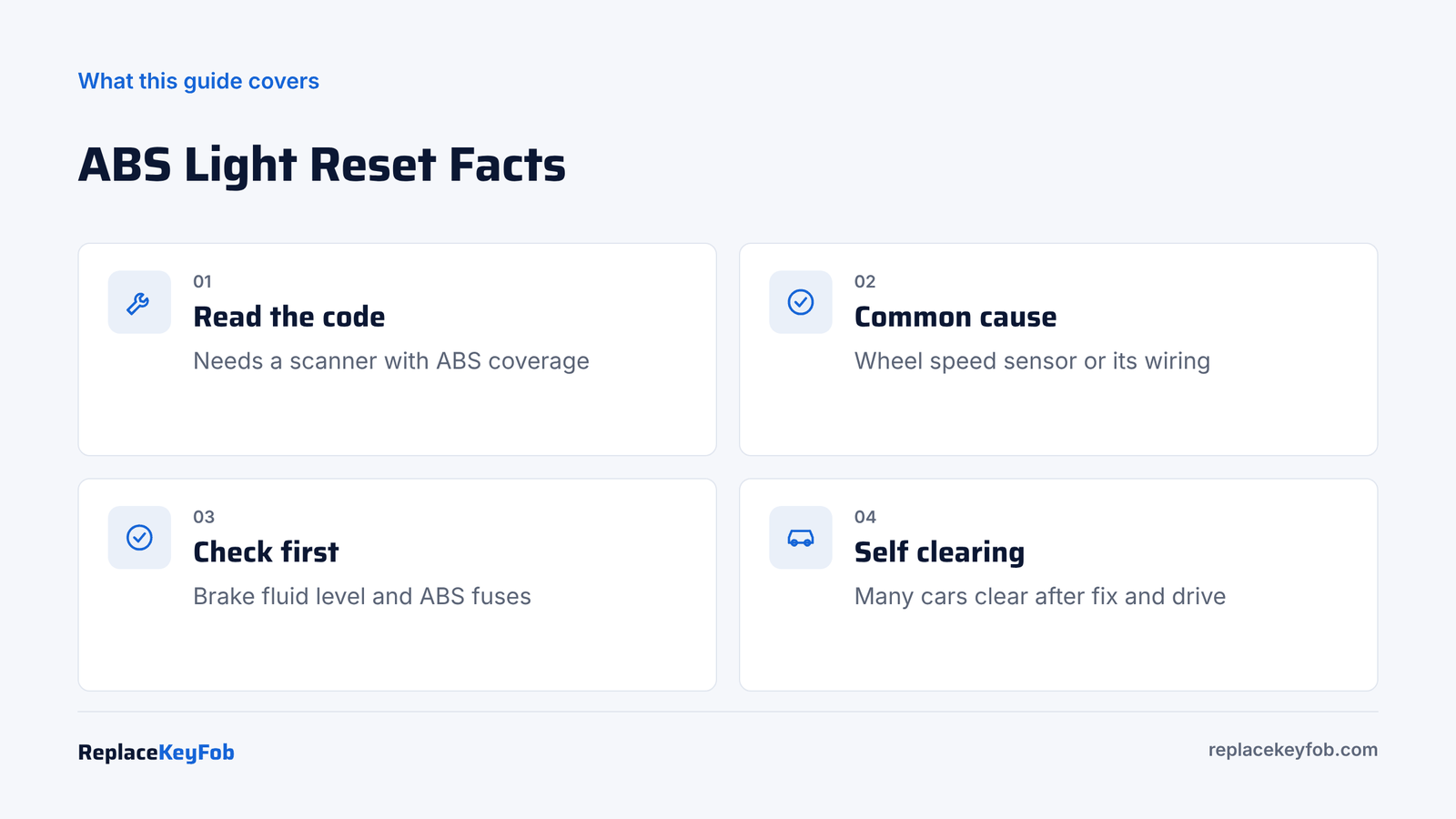
To reset the ABS light, read the ABS trouble code with a scan tool that covers the ABS module, fix the cause, then clear the code and test drive. Most ABS lights come from a wheel speed sensor, its wiring or a dirty tone ring. Without a scanner, check brake fluid and fuses; many cars clear the light after the fault is fixed and the car is driven.
The ABS light is different from the red brake warning light. Amber ABS means the anti-lock system has found a fault and turned itself off. Your normal brakes still work, but the wheels can lock in a hard stop, and on most cars stability and traction control switch off too.
That is why “resetting” the light is the wrong goal on its own. The light is a symptom. Clear it without fixing the cause and it returns, often within the first mile. This guide shows how to find the cause, how to clear the light properly, and which no-scanner methods actually work.
What Turns the ABS Light On
The ABS module runs a self-test every time you start the car and keeps watching each wheel speed sensor while you drive. Any reading that does not make sense sets a code and turns on the light.
| Cause | How common | Typical clue |
|---|---|---|
| Wheel speed sensor failed | Very common | Code for one wheel; light comes on after a few mph |
| Damaged sensor wiring | Common | Light flickers over bumps or after suspension work |
| Rusty or cracked tone ring | Common on older trucks and rust-belt cars | Light at low speed, ABS activates on dry roads |
| Low brake fluid | Common | Red brake light may also be on |
| Blown ABS fuse | Occasional | Light on at startup, no ABS codes may store |
| Failing ABS module or pump | Less common, expensive | Communication or pump motor codes |
| Mismatched tire sizes | Occasional | Light after new tires or a temporary spare |
| Weak battery or low voltage | Occasional | ABS, traction and other lights all come on together |
What You Need
- An OBD2 scanner that can read ABS codes (a basic code reader only reads engine codes)
- A flashlight
- Brake fluid of the type printed on your reservoir cap (often DOT 3 or DOT 4)
- A multimeter for sensor and wiring checks
- Jack, jack stands and lug wrench if you replace a sensor
OBD2 scanner with ABS and SRS coverage
Confirm the scanner lists ABS for your make and year, not only engine codes. Live wheel speed data makes finding the bad sensor much faster.
As an Amazon Associate, ReplaceKeyFob earns from qualifying purchases.
Most cheap code readers cannot see the ABS module. Our guide on whether an OBD2 scanner can read ABS codes explains what to look for, and the best OBD2 scanner for ABS diagnostics compares tools.
Step 1: Check the Simple Things
- Brake fluid level. Open the hood and look at the reservoir. If the level is below MIN, top it up with the correct fluid, but also look for leaks and worn pads. Low fluid often means the pads are worn.
- ABS fuses. The ABS pump and module usually have large fuses in the under-hood box. A blown pump fuse turns the light on immediately.
- Battery voltage. A weak battery can cause the ABS module to set low-voltage faults. A healthy battery reads about 12.4 to 12.7V at rest and about 13.5 to 14.7V running.
- Tires. Make sure all four tires are the same size and similar wear. A small spare can turn the light on.
Step 2: Read the ABS Code
- Plug the scanner into the OBD2 port under the driver-side dash.
- Turn the ignition on.
- Choose the ABS or brake module, not just “OBD2/engine”.
- Write down every code and its description.
- If your scanner shows live data, watch all four wheel speeds while driving slowly in a safe area. The bad sensor reads zero, jumps around or drops out.
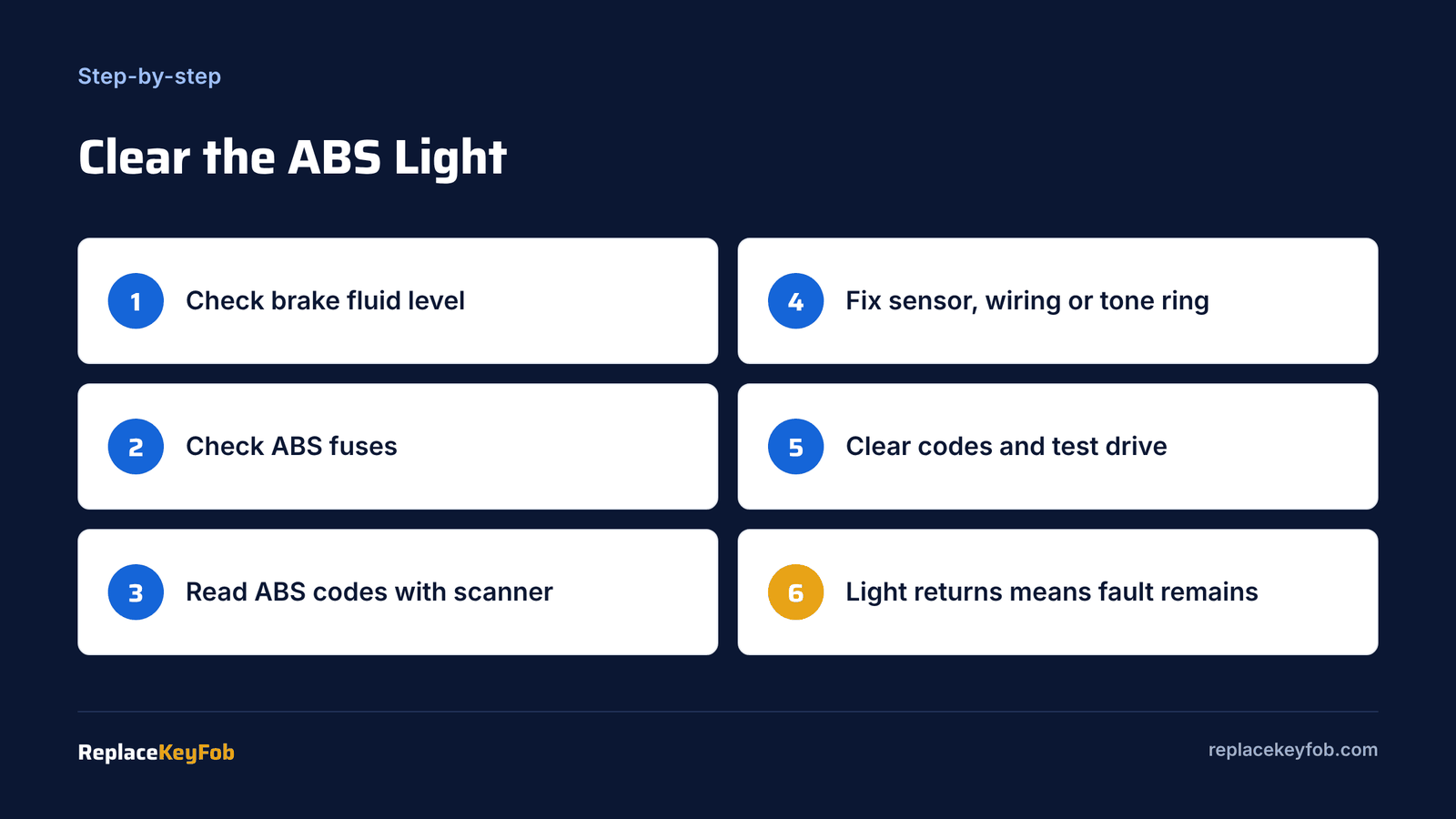
Step 3: Fix the Cause
Wheel speed sensor
A sensor code for one wheel, such as “left front wheel speed sensor circuit”, points to that sensor or its wiring.
- Raise and support the car safely on jack stands.
- Follow the sensor wire from the hub to its connector. Look for cuts, melted spots near the exhaust or a connector full of corrosion.
- Unplug the sensor and check its resistance with a multimeter if it is a passive (two-wire) sensor. Many read roughly 800 to 2,500 ohms; check your service data, because many newer cars use active sensors that cannot be tested this way.
- Remove the sensor bolt, twist the sensor out, and clean rust from the bore before fitting the new one.
Tone ring
The toothed ring on the axle or hub gives the sensor its signal. Rust buildup, cracks or missing teeth cause erratic readings, especially at low speed. On some trucks the ring is part of the hub bearing, so the fix is a new hub.
Module and pump
Codes for the pump motor, a valve or “internal module failure” usually need professional diagnosis. Rebuilt modules exist for many vehicles, but some must be coded or bled with a scan tool afterward.
Step 4: Clear the ABS Light
Once the fault is fixed:
- Connect the scanner and enter the ABS module.
- Select “Clear codes” or “Erase DTCs”.
- Turn the ignition off, wait about 10 seconds, then start the engine.
- Drive above about 10 to 20 mph. Many ABS modules finish their self-test only after the car moves.
If the light stays off after a test drive, the repair worked.
How to Reset ABS Light Without a Scan Tool
There is no universal trick, but these methods can work:
- Let it self-clear. On many cars, once the fault is gone, the light turns off on the next start or after the car reaches a set speed. Some codes stay stored in memory even though the light is off.
- Battery disconnect. On some older vehicles, disconnecting the negative battery cable for 15 to 30 minutes clears the ABS memory. Many modern modules keep codes, so this often does nothing. Follow how to disconnect a car battery safely and expect to reset clocks, windows and radio presets.
- Older manual flash-code methods. Some older GM, Toyota and Honda systems could show ABS codes by jumping diagnostic connector terminals. These are model specific; use only the procedure from your service manual.
If the light comes back, the fault is still there. A parts store or shop can scan the ABS module for you.
How to Reset ABS Light on a Ram 1500
On many Ram 1500 trucks, the ABS light comes from a wheel speed sensor, a damaged sensor connector or rust on the sensor mounting area. Read the code to find which wheel, check the wiring near the steering knuckle or the rear axle, and replace the sensor if needed. Most Ram ABS modules clear the light after the fault is repaired and the truck is driven; a scan tool with ABS access clears stored codes right away.
If the ABS Light Comes Right Back
| When it returns | What it suggests |
|---|---|
| Immediately at startup | Module, fuse, power or ground fault |
| After driving a few mph | Wheel speed sensor or tone ring |
| Only over bumps | Chafed wire or loose connector |
| Only in wet weather | Water in a connector |
| With traction and brake lights together | Low voltage or a communication problem |
Safety and Mistakes to Avoid
- Do not treat a red brake light like ABS. A red BRAKE light means low fluid or a hydraulic problem. Stop and check before driving.
- Leave longer stopping distances while the ABS light is on, especially on wet or icy roads.
- Do not open the ABS hydraulic unit without knowing the bleed procedure. Air trapped in the module can make the pedal soft, and many cars need a scan tool bleed routine to purge it. Clearing codes does not fix air in the system.
- Do not keep clearing codes to pass an inspection. Many states fail a car with the ABS light on.
Cost to Fix an ABS Light
| Repair | Typical 2026 US cost |
|---|---|
| ABS scan at a shop | About $50 to $150 |
| Wheel speed sensor, one wheel | About $150 to $400 installed |
| Wiring repair | About $100 to $300 |
| Hub bearing with tone ring | About $250 to $600 per side |
| ABS module repair or replace | About $400 to $1,500+ |
Many parts stores read engine codes for free, but not all can read ABS codes, so call first.
Frequently Asked Questions
Yes. Read the ABS code with a scanner that covers the ABS module, fix the cause, then clear the code and test drive. On many cars the light also turns off by itself after the fault is repaired.
Fix the fault first, then drive the car; many systems clear the light on their own. On some older vehicles, disconnecting the battery for 15 to 30 minutes clears ABS memory, but most modern cars keep the code until a scanner clears it.
Your normal brakes still work, but anti-lock and usually stability control are off. Drive gently, leave more stopping distance and get it checked soon. If the red brake light is also on, stop and check the brake fluid.
The fault is still there. A bad wheel speed sensor, damaged wiring, rusty tone ring or failing module will turn the light back on as soon as the system tests itself again.
Yes. Many cars turn on the ABS light, the red brake light or both when the fluid is low. Low fluid often means worn pads or a leak, so find the reason before topping up.