
Lost Car Key? Here’s What to Do Next, Step by Step

Losing a car key or key fob is one of those problems that feels urgent because it is urgent. You may be locked out, stranded, or unsure whether the key is truly gone or just hidden in the wrong place. The fastest path back to normal is to avoid guessing and move through a simple decision process: confirm whether the key is nearby, identify the type of key your vehicle uses, and then choose the replacement route that fits your situation.
If your key is missing right now, the goal is not to solve everything at once. The goal is to avoid wasting time on the wrong fix.
Do this now
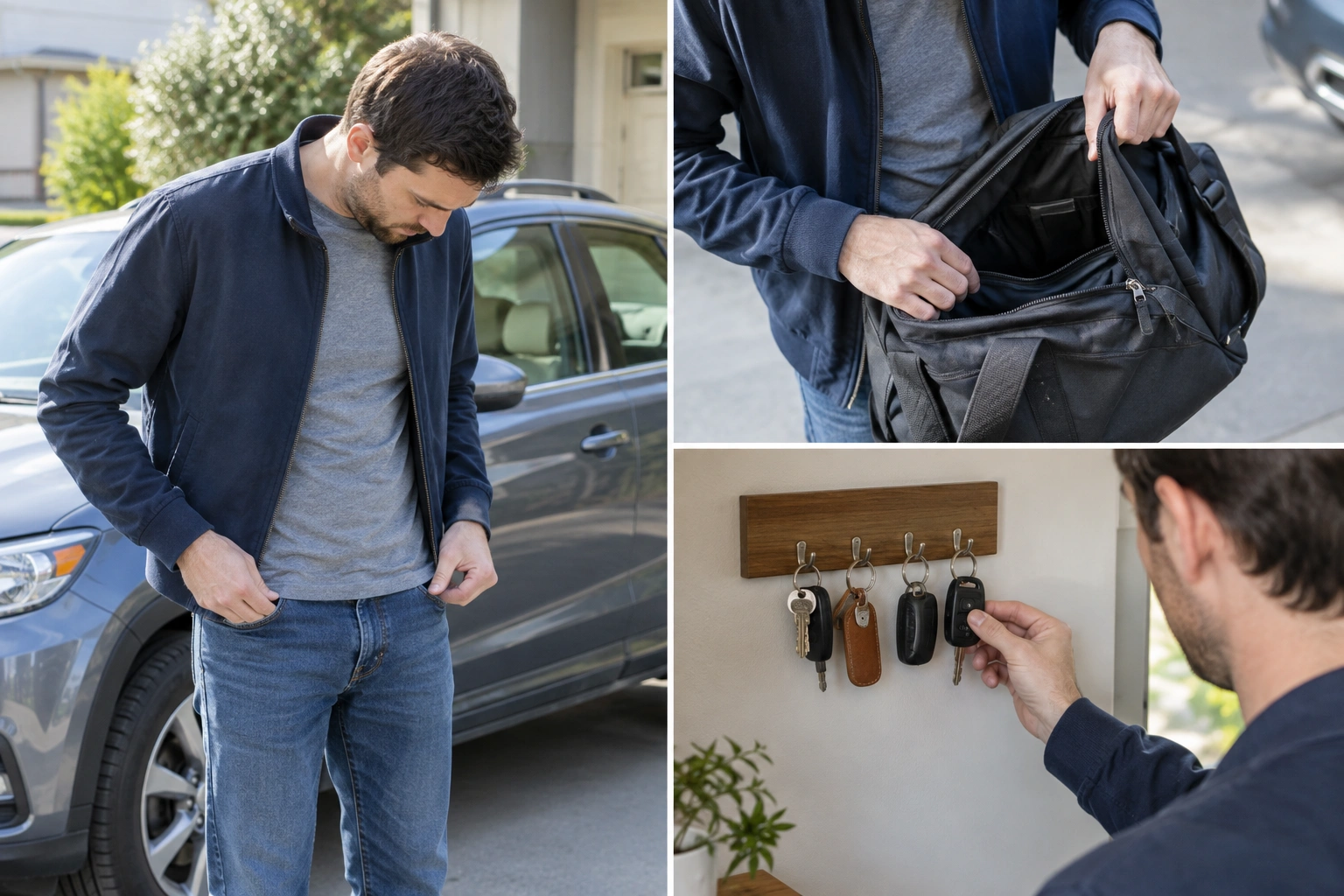
- Check your pockets, bag, coat, and the last place you remember using the key.
- If the car is locked, look first for a spare or anyone who can bring one to you.
- If you do not find the key in about 10 minutes, stop searching and move to lockout or replacement options.
- Confirm whether this is a missing key, a dead fob battery, or a key locked inside the car.
- If you need access now, call roadside assistance or an automotive locksmith.
What to do first when your car key goes missing
Before you call anyone, do a focused search. Check your pockets, empty your bags, and look in the places you used most recently. A simple retrace of your day is often the fastest way to find a key that was misplaced rather than truly lost.
If you are at home, check common spots like a key rack, a drawer, a kitchen counter, or even under a potted plant. If you use a magnetic hide-a-key, look under the vehicle where it may be attached. If you are away from home, contact a partner, roommate, or friend who might have a spare or who can bring one to you.
If you still have the car in front of you, do one more check before moving on: look under the car and, if it is unlocked, inspect the inside carefully, especially the driver’s side floor area.
That sequence matters because it separates “misplaced” from “truly lost.” If the key turns up during this search, you avoid replacement costs, programming fees, and the chance of ordering the wrong part.
Is the key actually lost, inside the car, or just dead?
A dead fob can feel like a missing key. So can a key that is locked inside the car or buried in a bag. Before you assume replacement, use the symptoms to narrow it down.
Signs the key is probably just misplaced
- You remember having it recently, but not the exact location.
- The remote worked earlier today and then vanished.
- You can hear or feel the fob in a bag or coat pocket.
- The car unlocks manually, but the remote functions are inconsistent.
Signs the fob battery may be dead
- The physical fob is still with you, but buttons do nothing.
- Your car starts with a backup method or emergency slot, but the remote unlock fails.
- The problem appeared suddenly, without any sign the key was missing.
Signs the key is truly gone
- You have searched your usual places and clothing.
- The car is locked and no spare is available.
- You cannot find the fob anywhere in the house, bag, or vehicle.
- You may have dropped it outside, left it at a store, or had it stolen.
That distinction matters because a battery replacement is cheap and fast, while a lost or stolen key can require cutting, programming, and possibly deactivating the missing key from the vehicle’s system.
If the key is locked inside the car, the next step is usually a lockout service, not replacement. If the key is simply dead but still in your hand, a battery swap may be enough.
For a deeper look at battery-related symptoms, see how to reset a car key fob without guesswork.
Why your key type changes everything
Not all car keys behave the same way. The replacement path depends on whether you have a traditional metal key, a transponder key, a remote key fob, or a smart/proximity key.
Traditional metal key
This is the simplest type. It usually only needs to be cut correctly. If you have a spare or the key code, replacement is often more straightforward.
Transponder key
A transponder key contains a chip that communicates with the car’s immobilizer system. The blade may unlock the door, but the engine may not start unless the chip is programmed to the vehicle.
Remote key fob
A remote fob controls lock, unlock, trunk release, and sometimes panic functions. Some versions also contain a transponder chip, so replacement may involve both cutting and programming.
Smart key or proximity key
This is the most complex common type. The car detects the key nearby and may allow push-button start without inserting anything. Replacement usually requires correct matching and programming, and some vehicles are more restrictive than others.
The practical takeaway: the more your vehicle relies on electronic authentication, the less likely a generic replacement will work out of the box.
Fastest ways to get back into your car
If the car is locked and you need access now, use a legitimate service that matches the situation.
Roadside assistance
Roadside assistance can often help if the issue is a lockout. This is useful when you are stranded and need the car opened, but it may not solve replacement or programming by itself.
Automotive locksmith
A locksmith is often the fastest option for many lost-key situations because the service can come to the car. In many cases, a locksmith can cut a key, program a transponder, or replace a fob on-site if your vehicle supports it.
Dealership
The dealer is sometimes necessary, especially for certain smart keys, newer security systems, or vehicles that require brand-specific programming. The trade-off is usually cost and turnaround time. If a special-order key is needed, you may wait longer.
Online replacement
Ordering online can work if you already know the exact key type and programming requirements. The risk is buying the wrong part. This route makes the most sense when you have time, a spare key, and confidence that the replacement is compatible.
If you do not have a spare and the vehicle uses a transponder or smart key, some cases may require towing to the dealership for ordering and pairing. That is not true for every vehicle, but it is a real possibility when on-site programming is not available.
Dealer vs locksmith vs roadside assistance vs online replacement
Here is the simplest way to compare the main options.
| Option | Best for | Pros | Trade-offs |
|---|---|---|---|
| Roadside assistance | Lockout only | Fast help getting into the car | Usually does not replace or program keys |
| Automotive locksmith | Most lost-key emergencies | Mobile service, often same-day, can cut and program many keys | Not every vehicle is supported |
| Dealership | Brand-specific or restricted systems | Direct access to OEM parts and vehicle-specific procedures | Often slower and more expensive |
| Online replacement | Planned replacement | Can be cheaper for the part itself | Wrong part risk, programming still needed |
If your priority is speed, call a locksmith first. If your priority is factory parts and your vehicle is known to be dealer-restricted, call the dealer. If you only need the car opened, roadside assistance is the right first call.
What you need before ordering a replacement
Having the right information ready can save a full day of delays. Most providers will ask for:
- Vehicle year, make, and model
- VIN
- Proof of ownership, such as registration or title
- A driver’s license or government-issued ID
- Your current location if mobile service is coming to you
The VIN is especially useful because it helps identify the correct key blank and, in some cases, the correct programming path. Proof of ownership is not optional with reputable services. If a seller does not ask for it, that is a red flag.
Keep in mind that some providers may also ask for the trim level or whether the car has push-button start. That detail can change the key type entirely.
How replacement works by key type
Traditional key
A locksmith or dealer cuts a new blade to match the lock. If you lost the only key, the provider may need to decode the lock or use the VIN to determine the cut.
Transponder key
The blade is cut first, then the chip is programmed so the immobilizer recognizes it. Without programming, the car may unlock but not start.
Remote key fob
The replacement may need to be cut, paired, or both. Some cars allow limited DIY pairing, but that is model-specific and usually only applies to a small set of vehicles. It also still requires access to the vehicle.
Smart/proximity key
These usually require the most precise matching. The vehicle must recognize the new key through a programming process that is often best handled by a locksmith or dealer with the right equipment.
If you are trying to decide whether to DIY, use this rule: if the key must communicate with the immobilizer or push-button start system, the room for error is much smaller than with a basic metal key.
Can you replace the battery yourself?
Usually, yes. If the fob is still with you and only the battery is dead, a battery swap is often a simple DIY job. The exact battery type and opening method vary by fob, but this is generally much easier than replacing the whole unit.
Can you replace the whole fob yourself?
Sometimes, but only if the replacement is compatible and the vehicle allows user pairing. For many transponder, remote, and smart keys, the fob can be purchased online, but programming still has to be done correctly. If the fob controls the immobilizer or push-button start, DIY gets riskier fast.
OEM vs aftermarket: which is better?
OEM parts are the factory option and are usually the safer choice when compatibility is critical. Aftermarket replacements can be acceptable for some older or simpler vehicles, but they are riskier for smart keys, proximity systems, and vehicles with tighter security programming. If you choose aftermarket, verify compatibility by exact year, make, model, and key type before buying.
How much replacement usually costs
There is no universal price because the cost depends on the key type, the vehicle, and whether programming is needed. A basic cut key is usually far less expensive than a smart key with programming. GEICO notes that some replacement keys can run upward of $320, and towing may add to that total.
A more useful way to think about cost is by typical low, mid, and high ranges:
- Basic metal key: low, often the least expensive option; mid if cutting is needed; high only if lock decoding or special-order work is required
- Transponder key: low for the blank itself; mid when cutting is included; high when programming is added
- Remote key fob: low to mid for the part; high once pairing or programming is needed
- Smart/proximity key: mid to high for the part; often highest overall once programming is included
Sometimes the programming fee is the bigger surprise, not the hardware. In some cases, programming can cost as much as or more than the key itself. That is why a cheap online fob can still become an expensive project if the vehicle needs special programming or dealer-only equipment.
How long it usually takes
Turnaround depends on whether a replacement is in stock and whether the vehicle can be programmed on-site.
- Same-day service is possible for many common keys and many locksmith jobs.
- Dealer orders can take longer if the part is not in stock.
- If all keys are lost and no spare exists, the process often slows down because the car may need to be accessed, identified, and programmed from scratch.
The best way to shorten the timeline is to have your VIN, registration, and ID ready before you call.
What to do if all keys are lost
This is the more expensive version of the problem, because there is no working key to copy. In many cases, the vehicle must be opened and a new key created from the lock code, VIN, or onboard programming procedure.
If the car uses a transponder or smart key system, the replacement usually has to be paired to the vehicle. If there is no spare, towing may be necessary in some cases, especially when the dealer must handle the programming.
If you are in this situation, do not buy the first key you see online. Confirm the exact key type, frequency, and programming method before ordering.
If the missing key may have been stolen
Treat a missing key differently if theft is possible. A lost key that fell behind a couch is a convenience problem. A stolen key is a security problem.
If someone may have taken the key, ask the provider whether the missing key can be removed from the vehicle’s memory during programming. That step can reduce the risk that the old key still works later. The right response depends on the vehicle, but the concern is valid: a missing programmed key can still be a threat if someone has it.
When to call an automotive locksmith
Call an automotive locksmith when:
– You need same-day access or replacement
– The car is locked and you are stranded
– You have a transponder, remote fob, or smart key
– You lost all keys and need mobile service
– You suspect the missing key was stolen and want the old one disabled if possible
For many drivers, this is the best balance of speed, convenience, and cost. If your vehicle is dealer-restricted, the locksmith can usually tell you that quickly and save you from guessing.
For related troubleshooting, this guide on a key fob not working after disconnecting the car battery can help you rule out a sync issue before you replace parts. If you suspect the vehicle battery itself is part of the problem, see how a bad car battery can cause key fob problems.
Common mistakes that waste time and money
The biggest mistakes are predictable:
– Buying the wrong key blank or fob frequency
– Replacing the battery when the key is actually missing
– Assuming any locksmith can handle every vehicle
– Ordering online before verifying compatibility
– Delaying ownership verification, which slows service
– Ignoring the possibility that the key was stolen
A little verification upfront is cheaper than paying twice.
Quick decision guide
If you are still deciding what to do, use this shortcut:
- If the key might be nearby: search your pockets, bags, car, and usual home spots.
- If you have a spare: use it and arrange replacement at a calmer pace.
- If the car is locked and you need access now: call roadside assistance or a locksmith.
- If you lost a transponder or smart key and have no spare: call a locksmith or dealer with your VIN ready.
- If theft is possible: ask about removing the missing key from the system.
That is usually enough to move from panic to a workable plan.
FAQ
Can I drive the car if I lost the key but have a spare?
Yes, if the spare is the correct programmed key and the car starts normally. If the spare is only a basic blade for a vehicle that also needs a transponder or smart key, it may unlock the door but still not start the engine.
What if the key is locked inside the car?
Treat that as a lockout, not a replacement problem. Roadside assistance or an automotive locksmith is usually the fastest fix.
Can I start my car without the original key?
Sometimes, but not in a simple universal way. Traditional keys are easier than transponder or smart keys. If the vehicle uses an immobilizer or push-button start, you usually need a programmed replacement.
Do I need the VIN to get a replacement key?
Usually, yes. The VIN helps identify the correct key type and reduces the chance of ordering the wrong part.
Can a locksmith replace a smart key?
Often, yes, but not always. It depends on the vehicle’s security system and whether the locksmith has the right programming equipment.
What if I only lost the fob battery?
If the fob is still physically present, battery replacement may solve the problem. If the fob is missing, a battery change will not help.
Is it cheaper to go to the dealer or a locksmith?
Not always the same answer. Dealers may be better for certain restricted systems, while locksmiths are often faster and more convenient for mobile service. The cheapest option is the one that actually fits your vehicle.
Should I keep using the car if I think the key was stolen?
If the missing key may be stolen, get the vehicle rekeyed or the key deactivated as soon as practical. That is the safer path.
If you want help figuring out the right replacement path for your vehicle, the key details to have ready are the VIN, your ownership documents, and the exact symptoms you are seeing.
