
How to Fix P0174: A Practical OBD2 Scanner Guide

Your Check Engine light is on, and your OBD2 scanner shows P0174: System Too Lean Bank 2. The code sounds serious, but it does not tell you which part has failed.
Learning how to fix P0174 starts with understanding why the engine computer is adding more fuel than expected. The cause may be a cracked vacuum hose, an intake leak, a dirty airflow sensor, low fuel pressure, or another issue.
This guide explains how to diagnose P0174 with an OBD2 scanner, inspect the most likely trouble spots, avoid unnecessary parts replacement, and decide when professional help is the smarter choice.
Quick Answer
To fix P0174, scan for related codes, inspect Bank 2 for vacuum or intake leaks, compare fuel-trim readings, check the mass airflow sensor, and test fuel pressure. Do not replace the oxygen sensor automatically. Find the source of excess air or insufficient fuel, repair it, clear the code, and confirm normal fuel trims.
What Does the P0174 Code Mean?
P0174 means the engine computer has detected a lean air-fuel condition on Bank 2.
A lean condition occurs when the engine receives:
- Too much unmeasured air
- Too little fuel
- Incorrect information from a sensor
- A false lean reading caused by an exhaust leak or sensor problem
The engine control module, or ECM, tries to correct the problem by increasing injector time. This correction appears on an OBD2 scanner as positive fuel trim.
The EPA’s explanation of onboard diagnostics describes OBD as the vehicle software that monitors emissions-related systems and turns on the Check Engine light when it identifies a malfunction. (nepis.epa.gov)
What Is Bank 2?
Bank 2 is the side of a V-shaped or horizontally opposed engine that does not contain cylinder number one.
Do not assume Bank 2 is always the driver or passenger side. Its location changes by manufacturer and engine design. Check the underhood emissions label, repair manual, firing-order diagram, or reliable vehicle-specific service information.
Most inline four-cylinder engines have only one cylinder bank. Therefore, a true P0174 code is usually associated with a V6, V8, V10, or another engine with two banks.
Manufacturer monitoring strategies vary, but Ford’s 2024–2025 OBD system operation summary identifies P0174 as a Bank 2 lean fault monitored while the engine is operating in closed-loop fuel control. (Ford Service Content)
Common Symptoms of P0174
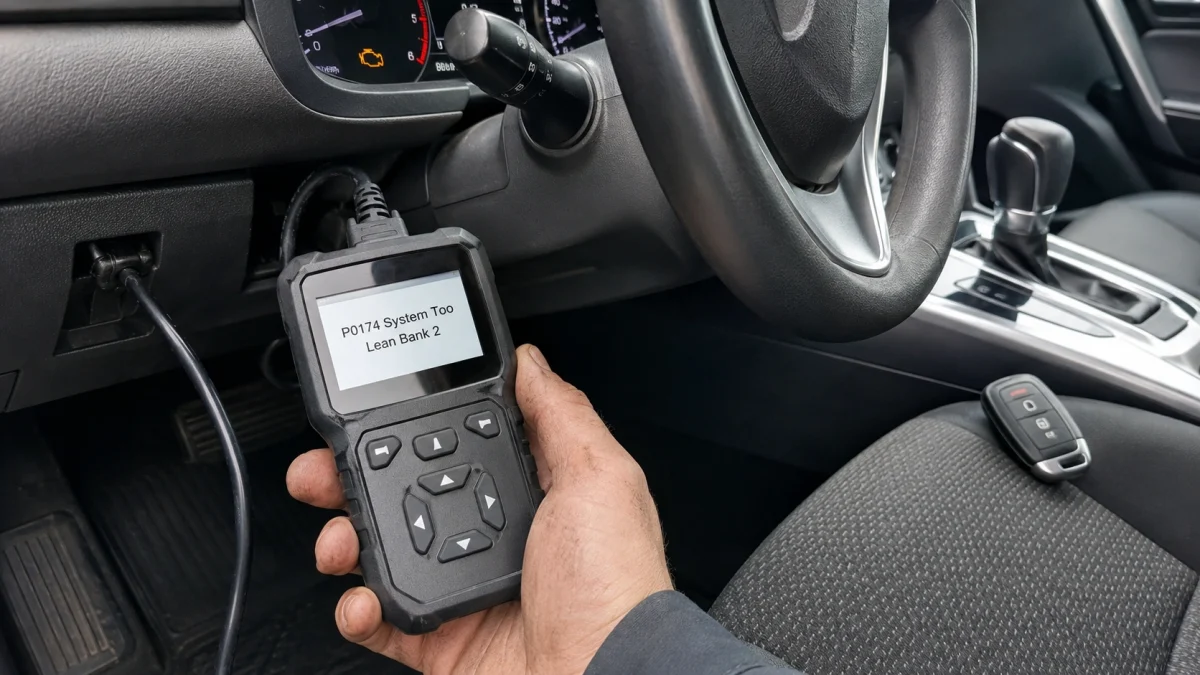
Some vehicles continue to drive almost normally. Others develop noticeable performance problems.
Common symptoms include:
- A steady Check Engine light
- Rough or unstable idle
- Hesitation during acceleration
- Reduced engine power
- Hard starting
- Engine surging
- Random or Bank 2 misfires
- Higher-than-normal idle speed
- Poor fuel economy
- Whistling or hissing from the engine compartment
A lean mixture can also increase combustion temperature. Continuing to drive with severe misfires may damage the catalytic converter.
A flashing Check Engine light needs immediate attention. EPA guidance explains that a blinking light can indicate a severe problem such as an active misfire. Reduce driving and arrange prompt diagnosis rather than continuing a normal trip. (nepis.epa.gov)
Most Common Causes of P0174
P0174 is not automatically an oxygen-sensor failure. The sensor may simply be reporting a real lean condition.
1. Vacuum or Intake Leak on Bank 2
A vacuum leak allows air to enter after the mass airflow sensor has measured the incoming air. Because the computer does not know about this additional air, the mixture becomes lean.
Possible leak points include:
- Split vacuum hoses
- Loose hose connections
- Damaged PCV hoses
- Intake manifold gaskets
- Brake-booster vacuum lines
- Cracked intake boots
- Injector O-rings
- Vacuum-operated accessories
A leak affecting only Bank 2 is especially likely when Bank 2 fuel trims are high but Bank 1 readings remain close to normal.
2. Dirty or Incorrect Mass Airflow Sensor Readings
The mass airflow sensor, commonly called the MAF sensor, measures how much air enters the engine.
Oil, dust, or residue can cause it to underreport airflow. The computer then supplies less fuel than the engine needs.
A MAF problem usually affects both banks, so look for P0171 and P0174 appearing together. However, engine design and airflow distribution can sometimes make one bank react more strongly.
3. Low Fuel Pressure
Low fuel pressure can result from:
- A weak fuel pump
- A restricted fuel filter
- A faulty pressure regulator
- A damaged fuel line
- Electrical voltage loss to the pump
- A failing fuel-pump control module
Fuel-delivery problems normally influence both banks. Confirm pressure with the correct gauge or scan data before replacing a pump.
4. Restricted or Faulty Fuel Injector
A weak, clogged, or electrically faulty Bank 2 injector may create a lean condition on one cylinder or one side of the engine.
Look for cylinder-specific misfire codes, unusual spark-plug color, injector balance differences, or abnormal cylinder contribution data.
5. Exhaust Leak Before the Upstream Oxygen Sensor
A leak near the exhaust manifold or upstream oxygen sensor can pull outside air into the exhaust stream. The sensor may then report excess oxygen even when the combustion mixture is not truly lean.
Listen for ticking during a cold start and inspect the manifold, gasket, fasteners, and nearby pipe connections.
6. Faulty Upstream Oxygen or Air-Fuel Ratio Sensor
An oxygen sensor can become slow, biased, contaminated, or electrically damaged. However, it should be tested before replacement.
Replacing the sensor without checking fuel trims, wiring, intake leaks, and exhaust leaks is one of the most common P0174 mistakes.
7. PCV or EVAP Purge System Problem
A stuck-open purge valve can introduce too much fuel vapor and airflow at the wrong time. A damaged PCV valve or hose can act like a large vacuum leak.
These faults may be most noticeable at idle or shortly after refueling.
How to Fix P0174 Step by Step
Step 1: Scan All Engine Codes
Connect the OBD2 scanner with the ignition off, then switch the ignition on and read every stored, pending, and permanent code.
Record codes before clearing anything. Related codes can significantly narrow the diagnosis.
Pay attention to:
- P0171: Bank 1 too lean
- P0300: Random misfire
- P0301–P0308: Cylinder-specific misfires
- MAF sensor codes
- Oxygen-sensor circuit codes
- Fuel-pressure codes
- EVAP purge codes
Also save the freeze-frame data. This shows conditions such as engine speed, coolant temperature, load, and fuel trim when the fault was detected.
Step 2: Check for Obvious Air Leaks
With the engine off and cool, inspect the air-intake system from the air-filter housing to the throttle body.
Look for:
- Loose clamps
- Torn intake boots
- Disconnected vacuum lines
- Brittle plastic fittings
- Cracked PCV hoses
- Oil-soaked rubber
- Missing caps or plugs
Flex rubber hoses gently because cracks may hide underneath or open only when the hose moves.
Do not place your hands near belts, fans, or hot exhaust parts while the engine is running. Some electric cooling fans can start without warning.
Step 3: Read Short-Term and Long-Term Fuel Trims
Open the scanner’s live-data menu and find:
- STFT Bank 1
- STFT Bank 2
- LTFT Bank 1
- LTFT Bank 2
Short-term fuel trim changes quickly. Long-term fuel trim represents corrections the computer has learned over time.
Positive numbers mean the computer is adding fuel. Negative numbers mean it is removing fuel.
As a practical starting point:
| Fuel-trim pattern | Likely direction |
|---|---|
| Bank 2 high, Bank 1 close to normal | Bank 2 intake leak, injector issue, exhaust leak, or sensor problem |
| Both banks high at idle | Shared vacuum leak, PCV fault, or purge problem |
| Both banks high at idle and higher RPM | MAF error, low fuel pressure, or broad fuel-delivery problem |
| Trims improve noticeably above idle | Vacuum leak becomes more likely |
| One cylinder also misfires | Injector, ignition, compression, or localized intake leak |
Exact acceptable values vary by vehicle. A combined correction consistently above roughly +10% deserves investigation, while corrections near +20% or more indicate a substantial problem on many vehicles.
Step 4: Compare Idle and 2,500 RPM Readings
Warm the engine fully. Record fuel trims at idle, then hold the engine near 2,500 RPM in Park or Neutral for a short period.
If Bank 2 trim is very positive at idle but moves closer to normal at higher RPM, suspect a vacuum leak. The leak contributes a larger percentage of total airflow at idle.
If the readings stay high at both speeds, investigate fuel pressure, MAF accuracy, injector delivery, and sensor feedback.
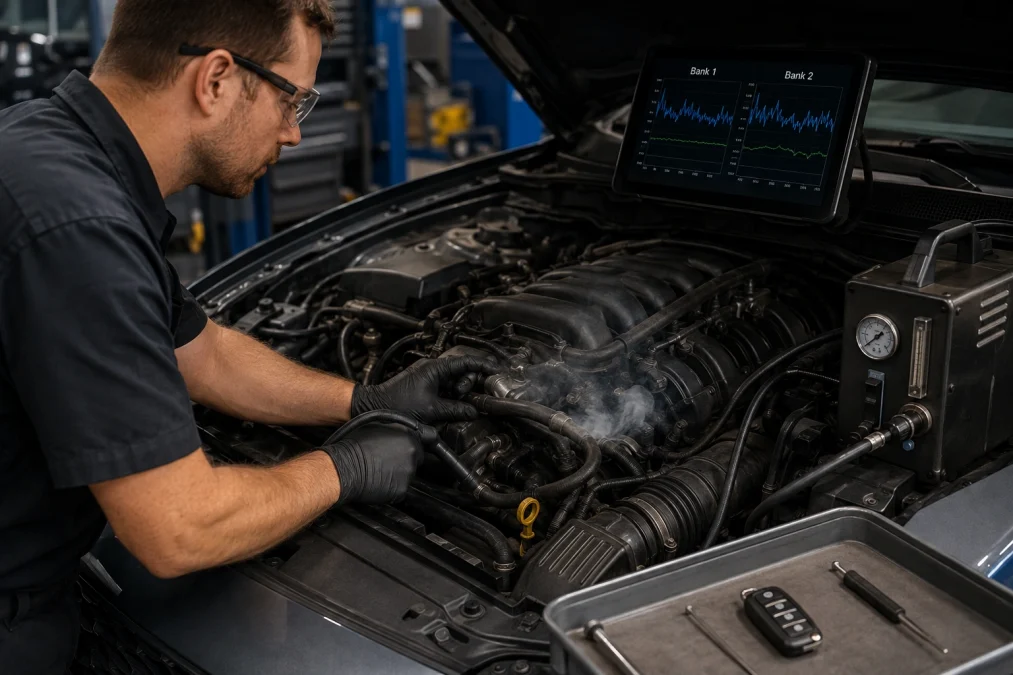
Step 5: Perform a Smoke Test
A smoke machine introduces low-pressure diagnostic vapor into the intake system. Smoke escaping from a hose, gasket, fitting, or seal reveals the leak.
A smoke test is often faster and safer than spraying flammable chemicals around a running engine.
Do not introduce excessive pressure into the intake or EVAP system. Use equipment intended for automotive leak testing and follow the vehicle manufacturer’s procedure.
Step 6: Inspect and Test the MAF Sensor
Check the MAF connector for loose pins, corrosion, damaged wiring, or oil contamination.
When cleaning is appropriate:
- Remove the sensor according to the service procedure.
- Use only cleaner labeled for MAF sensors.
- Do not touch the sensing element.
- Allow the sensor to dry completely.
- Reinstall it with the airflow arrow facing the correct direction.
Cleaning will not repair a failed electronic circuit or damaged sensing element. Compare MAF readings with vehicle-specific specifications before buying a replacement.
Step 7: Check Fuel Pressure and Injector Operation
Fuel systems can retain high pressure after the engine is switched off. Direct-injection systems may operate at extremely high pressure.
Do not loosen high-pressure fuel lines unless you have the correct training, tools, and depressurization procedure.
A technician may test:
- Low-side fuel pressure
- High-pressure rail readings
- Pressure under acceleration
- Residual pressure after shutdown
- Injector balance
- Injector pulse control
- Fuel-pump current and voltage
Low pressure should be traced to its cause rather than immediately blamed on the pump.
Step 8: Inspect the Exhaust and Upstream Sensor
Check Bank 2 for soot, broken studs, gasket damage, or ticking near the exhaust manifold.
Use the scanner to compare Bank 1 and Bank 2 upstream sensor behavior. A sensor that stays lean should not be condemned until the intake, fuel supply, exhaust, and wiring have been checked.
Step 9: Repair the Confirmed Fault
Replace only the failed hose, gasket, valve, sensor, injector, or fuel-delivery component that testing identifies.
Use parts that match the vehicle’s VIN, engine code, connector, calibration, and emissions package. Cheap universal sensors or incorrectly sized hoses may create new drivability problems.
Step 10: Clear the Code and Verify the Repair
Clear the codes after the repair, then complete a road test under conditions similar to the freeze-frame data.
Confirm that:
- Bank 2 fuel trims stay within a reasonable range
- Bank 1 and Bank 2 readings are balanced
- The engine idles smoothly
- No misfire codes return
- P0174 remains absent
- Readiness monitors begin completing normally
Turning off the Check Engine light is not enough. The live data must show that the lean correction has improved.
Expert Tip: Take screenshots of fuel trims at warm idle and 2,500 RPM before replacing anything. Comparing those readings after the repair gives you clear evidence that the actual problem was corrected.
P0174 Repair Cost and Difficulty
Prices vary by vehicle, engine access, labor rate, and the number of tests required. These figures are broad U.S. planning estimates, not guaranteed quotes.
| Possible repair | Approximate total cost | DIY difficulty |
|---|---|---|
| Replace a simple vacuum hose | $20–$150 | Easy |
| Professional smoke-test diagnosis | $100–$250 | Professional equipment helpful |
| Clean the MAF sensor | $10–$40 | Easy to moderate |
| Replace the MAF sensor | $150–$500 | Moderate |
| Replace a PCV valve or hose | $50–$350 | Easy to difficult |
| Replace an intake manifold gasket | $300–$1,000+ | Difficult |
| Replace an upstream oxygen sensor | $200–$600 | Moderate to difficult |
| Service or replace one injector | $250–$800+ | Difficult |
| Repair a fuel-pressure problem | $300–$1,500+ | Professional diagnosis recommended |
Do not choose a repair based only on the lowest price. A correct diagnosis is often cheaper than replacing several good parts.
Can You Drive With P0174?
A short, gentle drive to a repair facility may be reasonable when:
- The Check Engine light is steady
- The engine runs smoothly
- There is no overheating
- There is no strong hesitation
- There are no active misfires
- Fuel pressure appears normal
Stop driving and arrange assistance when:
- The Check Engine light flashes
- The engine shakes or misfires heavily
- Power drops suddenly
- The engine stalls
- You hear severe knocking
- The catalytic converter becomes unusually hot
- Other warning lights indicate oil-pressure or temperature problems
Even when the vehicle feels normal, do not ignore P0174 for weeks. A persistent lean condition can increase emissions, reduce performance, and place extra stress on engine and exhaust components.
When to Call a Professional Locksmith or Dealership
P0174 is an engine air-fuel fault, not normally a key fob, transponder, immobilizer, or door-lock problem. An automotive locksmith is therefore not the correct professional for a confirmed P0174 diagnosis.
Call an automotive locksmith when the vehicle will not authorize the key, the security light flashes, the key fob has lost programming, or a transponder-related code prevents starting.
For P0174, contact a qualified repair shop or dealership when:
- You cannot locate Bank 2 correctly
- A smoke test is required
- Fuel-pressure testing is needed
- The vehicle uses gasoline direct injection
- Removing the intake manifold is necessary
- Sensor data conflicts or appears unreliable
- The code returns after a basic hose repair
- The vehicle is under an emissions or powertrain warranty
- Manufacturer software, calibration updates, or technical procedures are needed
A dealership may offer deeper manufacturer-specific scan functions. A good independent shop may provide the same mechanical diagnosis for a lower labor rate.
Before authorizing repairs, ask for the test results that support the recommendation. The FTC’s Auto Repair Basics guide recommends understanding the proposed work, choosing a reputable shop, and getting a written estimate when appropriate. (Consumer Advice)
Common Mistakes Car Owners Should Avoid
- Replacing the Bank 2 oxygen sensor first. A working sensor may only be reporting a real air or fuel problem.
- Clearing the code before recording freeze-frame data. This removes useful evidence about when the fault occurred.
- Replacing a fuel pump without testing pressure. Wiring, regulators, filters, or control modules can produce similar symptoms.
- Cleaning the MAF with brake or carburetor cleaner. Harsh solvents may damage the sensing element.
- Using flammable spray to search for vacuum leaks. A professional smoke test is safer and usually more accurate.
- Assuming Bank 2 is always on one side. Cylinder-numbering layouts vary by manufacturer.
- Ignoring related misfire codes. A single-cylinder problem can point directly toward an injector, ignition, compression, or gasket fault.
- Buying the cheapest sensor available. Incorrect calibration can create new fuel-trim problems.
- Disconnecting the battery as a repair. This may reset learned values and readiness monitors, but it does not fix the cause.
- Calling a locksmith for an engine-management code. Choose a locksmith for key and security faults and an engine technician for P0174.
FAQs
Can a dirty air filter cause P0174?
A severely restricted filter can affect airflow, but it is not one of the most common causes of a lean code. Check the filter, intake duct, MAF sensor, vacuum hoses, fuel pressure, and Bank 2-specific leaks.
Does P0174 mean the oxygen sensor is bad?
No. The upstream oxygen sensor may be correctly detecting excess oxygen. Test for intake leaks, exhaust leaks, injector problems, fuel-pressure issues, and wiring faults before replacing the sensor.
Why do I have P0171 and P0174 together?
Both codes indicate that Bank 1 and Bank 2 are lean. Shared causes become more likely, including a large vacuum leak, dirty MAF sensor, low fuel pressure, PCV failure, or purge-system problem.
Can a bad spark plug cause P0174?
A spark plug or ignition-coil problem can cause a misfire that leaves extra oxygen in the exhaust. However, it usually creates a misfire code as well. Inspect the affected cylinder before assuming the fuel system is at fault.
Will cleaning the MAF sensor fix P0174?
It may help when contamination is causing the sensor to underreport airflow. It will not fix a cracked hose, intake gasket leak, weak fuel pump, damaged wiring, or failed MAF electronics.
How long does it take for P0174 to return after clearing it?
A serious fault may return during the first warm drive. A smaller problem may need several trips and the correct speed, load, and temperature conditions before the monitor detects it again.
Can a weak key fob battery cause P0174?
No. A weak key fob battery may reduce remote range or prevent passive-entry features from working, but it does not control the engine’s air-fuel mixture. P0174 requires engine and emissions-system diagnosis.
Conclusion
Learning how to fix P0174 means diagnosing the system instead of guessing which part to replace. Start by saving the codes and freeze-frame information. Compare Bank 1 and Bank 2 fuel trims, inspect for intake leaks, test the MAF and fuel supply, and check for exhaust or injector problems.
A basic hose fault may be an easy repair. Fuel-pressure, direct-injection, intake-manifold, or sensor-diagnosis work often requires professional equipment.
Most importantly, choose the correct service provider. A locksmith is the right choice for key fob, transponder, immobilizer, and lock problems. A qualified engine technician or dealership is the right choice for a P0174 lean code. Use your OBD2 data, request evidence for recommended repairs, and fix the confirmed cause before spending money on unnecessary parts.
