
How to Fix P0340 Without Replacing the Wrong Part

Quick Answer
To fix P0340, confirm the code with an OBD2 code reader, inspect the camshaft position sensor connector and wiring, verify the sensor’s power, ground, and signal, then check mechanical timing if the electrical circuit tests correctly. Do not replace the camshaft sensor simply because P0340 appears.
Quick P0340 Repair Order
- 1. Confirm the code: Record P0340 plus pending codes, freeze-frame data, and any related cam/crankshaft codes.
- 2. Inspect the connector: Look for loose pins, corrosion, engine oil, water, broken locks, or poor terminal tension.
- 3. Check the harness: Look for chafed, melted, stretched, or repaired wires near the cylinder head and timing components.
- 4. Test the circuit: Verify the correct power, ground, and signal according to your vehicle’s service information.
- 5. Verify the sensor: Test the camshaft sensor signal instead of assuming the sensor has failed.
- 6. Check timing: Investigate the timing chain, belt, reluctor, or cam-to-crank relationship if electrical tests pass.
Most Important Tip
- Clear P0340 only after repairing the cause, then rescan the vehicle and confirm the code does not return.
P0340 can turn a simple sensor problem into an expensive guessing game. I see the same mistake often: someone reads the code, installs a camshaft sensor, and discovers the check engine light is still on.
The better approach is diagnosis first. This guide walks through the circuit, wiring, sensor, timing components, and final verification in the order I would check them.
In This Guide
What Does P0340 Mean?
P0340 means the engine computer detected a problem with the camshaft position sensor “A” circuit on Bank 1 or a single-sensor engine. It is a circuit-related diagnostic trouble code, so it does not prove the sensor itself has failed.
A camshaft position sensor tracks camshaft position and speed. The engine computer uses that information with the crankshaft position signal to control functions such as fuel injection and ignition timing.
Definition: The camshaft position sensor is an electronic sensor that reports where the camshaft is during engine rotation. P0340 appears when the computer cannot reliably use the expected signal from that circuit.
What do “Sensor A” and “Bank 1” mean?
Bank 1 is the cylinder bank containing cylinder number one on engines with two cylinder banks. On an inline engine, the bank designation usually does not create the same left-versus-right distinction.
Sensor A commonly refers to an intake-side camshaft sensor, but manufacturers can use different naming conventions. Always confirm the correct sensor in VIN-specific service information before buying a replacement.
What symptoms can P0340 cause?
The exact symptoms depend on how the engine computer responds when it loses the camshaft position signal. Some vehicles continue running, while others become difficult or impossible to start.
- Check engine light: P0340 commonly illuminates the malfunction indicator lamp.
- Long cranking: The engine may take longer than normal to start.
- Intermittent no-start: The vehicle may start sometimes and fail at other times.
- Stalling: A disrupted signal can contribute to unexpected engine shutdown.
- Rough operation: The engine may hesitate, idle poorly, or feel weaker than normal.
- Reduced performance: Some engine-management strategies limit performance when camshaft position information becomes unreliable.
AAA explains that a diagnostic trouble code provides clues to the affected system rather than automatically identifying the failed part. That distinction matters with P0340 because wiring can create the same code as a failed sensor.
What Causes the P0340 Code?

P0340 can be caused by the sensor, its electrical circuit, a damaged trigger component, or an engine-timing problem. Start with the electrical possibilities because they can often be checked without opening the engine.
Common P0340 causes
- Failed camshaft position sensor: The sensor may stop generating a usable signal.
- Loose electrical connector: Poor terminal contact can interrupt the signal during vibration.
- Corroded terminals: Moisture can increase resistance or create intermittent contact.
- Oil contamination: Oil inside the connector or harness can interfere with reliable electrical contact.
- Damaged wiring: Chafing, heat, stretching, rodent damage, or previous repairs can open or short the circuit.
- Power or ground problem: A sensor cannot operate normally without the correct electrical supply and ground.
- Damaged reluctor or trigger wheel: The sensor needs a correct physical target to produce the expected pattern.
- Incorrect camshaft timing: A slipped timing belt or chain can create a signal relationship the computer considers implausible.
- Installation problem: An incorrectly fitted sensor or damaged mounting area can affect the signal.
- Control-module issue: PCM or ECM faults are possible, but they should be considered only after the circuit and mechanical system are properly tested.
Does P0340 mean the timing chain is bad?
No. P0340 by itself does not prove that the timing chain or belt has jumped.
Mechanical timing becomes more suspicious when P0340 appears with camshaft-to-crankshaft correlation codes such as P0016 through P0019. Engine noise, poor compression, or a recent timing repair can also justify a closer mechanical inspection.
Pro tip: do not authorize major timing work from P0340 alone. Confirm cam and crankshaft synchronization using the manufacturer’s diagnostic procedure.
How Do You Diagnose P0340 Before Replacing Parts?
Diagnose P0340 by starting with scan data and visual inspection, then move into electrical testing. This sequence reduces the chance of replacing a working sensor.
Start with a complete OBD2 scan
Connect an OBD2 scanner and record every stored, pending, and permanent code before clearing anything. Save freeze-frame data when your scanner supports it.
Freeze-frame data can show engine speed, temperature, load, and other conditions present when the fault was detected. That context can help separate a cold-start problem from a fault that appears only after the engine warms up.
- Record P0340 and its status.
- Look for P0341, P0342, P0343, or related camshaft sensor codes.
- Check for crankshaft sensor codes.
- Check for P0016-P0019 cam/crank correlation codes.
- Note battery or system-voltage codes.
- Save freeze-frame information before clearing codes.
AAA’s check engine light guidance also recommends paying attention to how the vehicle behaves instead of treating every illuminated light as the same level of urgency.
Inspect the sensor connector and wiring
Locate the correct camshaft position sensor using service information for your engine. Do not assume a sensor’s location based only on an online picture from another model year.
Then inspect the circuit carefully.
- Check whether the connector lock is fully engaged.
- Look for bent, pushed-back, loose, or green terminals.
- Check for oil or water inside the connector.
- Follow the harness away from the sensor.
- Look for wires touching hot exhaust or sharp brackets.
- Inspect previous splices or repairs.
- Gently move the harness while watching live data if appropriate.
What does each diagnostic result suggest?
| Finding | Likely Direction | Next Step |
|---|---|---|
| Loose or corroded connector | Connection fault | Repair terminals or connector, then retest |
| Missing sensor power or reference | Supply circuit problem | Trace the circuit using the correct wiring diagram |
| Poor sensor ground | Ground circuit fault | Repair excessive resistance or damaged wiring |
| Correct power and ground but no usable signal | Sensor, trigger, or signal-wire problem | Test signal and inspect the trigger system |
| P0340 plus correlation code | Possible synchronization problem | Verify mechanical timing and cam/crank relationship |
| Code returns when harness moves | Intermittent wiring fault | Inspect the affected harness section closely |
Locksmith’s note: never probe unfamiliar PCM or sensor terminals blindly. Use the correct wiring diagram and connector pinout for the exact vehicle.
Section Takeaway: A scan code identifies a diagnostic direction. Testing the circuit tells you which part actually needs repair.
How Do You Fix P0340 Step by Step?
The correct P0340 repair depends on what your diagnosis reveals. Follow this order instead of starting with a new sensor.
- Scan and document the fault. Record P0340, companion codes, and freeze-frame information.
- Check basic engine condition. Pay attention to abnormal cranking, timing noise, stalling, or recent engine work.
- Inspect the camshaft sensor connector. Repair loose terminals, contamination, damaged locks, or corrosion.
- Inspect the wiring harness. Repair open, shorted, melted, pinched, or chafed wires using an appropriate automotive repair method.
- Verify the electrical circuit. Test the required supply, ground, and signal values using manufacturer specifications.
- Test the sensor output. A scope is often the most useful tool when the fault is intermittent or signal quality matters.
- Replace the sensor only when justified. Install the correct part for the vehicle and follow the manufacturer’s installation instructions.
- Check the trigger and mechanical timing. Do this when electrical tests pass but the code remains, especially with correlation codes.
- Clear codes and verify the repair. Restart the engine, rescan, and complete an appropriate drive cycle when safe.
How do you test a camshaft position sensor?
Testing depends on the sensor design. Some camshaft sensors are three-wire Hall-effect sensors, while others use different circuit designs.
That means there is no universal voltage or resistance procedure that safely applies to every P0340 vehicle. Follow the wiring diagram and test procedure for your exact year, engine, and sensor.
Can you fix P0340 by cleaning the sensor?
Sometimes contamination at a connector or sensor area can contribute to a poor signal. Cleaning cannot repair an internally failed sensor, broken wire, damaged reluctor, or incorrect mechanical timing.
Use only electrical-contact products that are safe for the connector material. Do not spray aggressive solvents into sealed electronic components.
What should you do after replacing the sensor?
Reconnect everything securely, clear the diagnostic codes, and rescan after starting the engine. A code that immediately returns needs more diagnosis.
Some permanent OBD codes cannot simply be erased with a scan tool. The vehicle may need to complete its own successful monitor before that code disappears.
Section Takeaway: The best P0340 repair is the one supported by test results, not the part most closely named in the code description.
Can You Drive With P0340?
You should treat P0340 as a fault that needs prompt diagnosis. Whether the vehicle can be driven safely depends on its symptoms and the underlying cause.
A car that runs normally with a steady check engine light may still move under its own power. That does not mean ignoring the fault is a good idea.
Stop driving if these symptoms appear
- The engine repeatedly stalls.
- The engine loses significant power.
- The vehicle struggles to restart.
- The check engine light begins flashing.
- You hear abnormal timing-chain, belt, or engine noises.
- Other warning lights appear with serious driveability problems.
If the check engine light flashes or the engine begins running abnormally, move to a safe location when possible. AAA advises treating a flashing check engine light as a condition requiring immediate attention.
If P0340 appears unexpectedly, checking your VIN for an unrelated or relevant open campaign is also sensible before paying for major repairs. The official NHTSA recall lookup lets owners search safety recalls by VIN.
Safety note: a recall is vehicle-specific. P0340 does not automatically mean your vehicle has a recall.
How Much Does It Cost to Fix P0340?
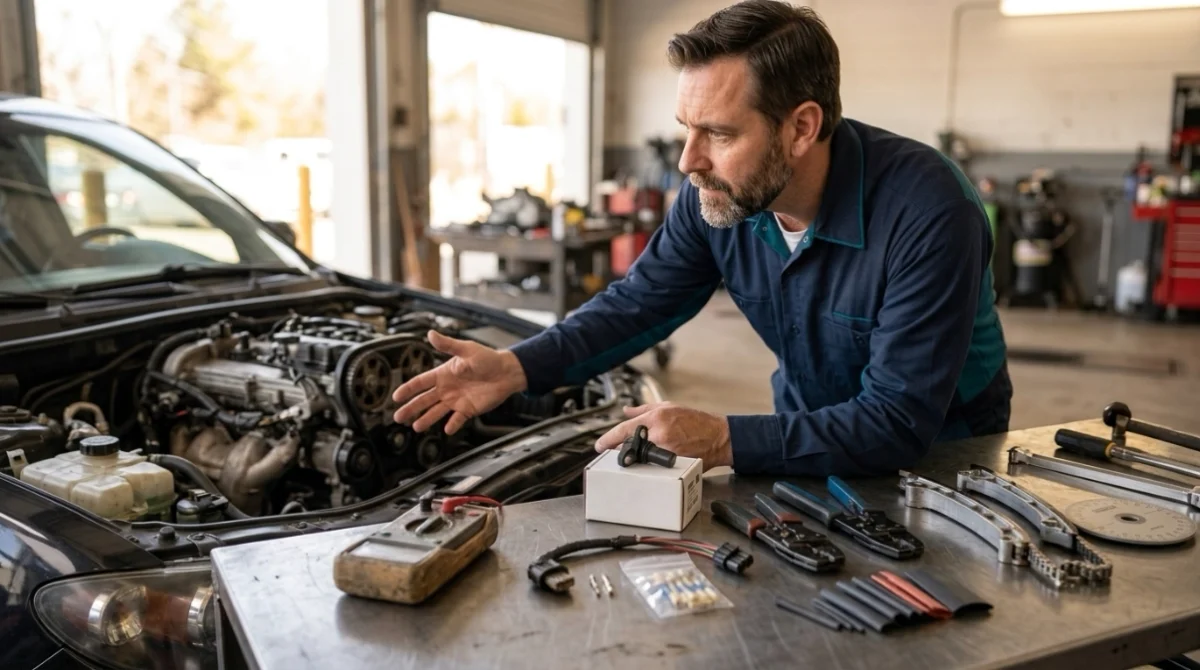
P0340 repair cost varies widely because the code can represent anything from a connector problem to mechanical timing work. Your make, model, engine, labor rate, and the actual failure determine the final bill.
A straightforward sensor replacement may remain in the lower hundreds of dollars. Extensive wiring diagnosis or timing-system repairs can cost substantially more.
| Possible Repair | Typical Relative Cost | Why Cost Varies |
|---|---|---|
| Connector cleaning or minor repair | Low | Damage level and access |
| Camshaft position sensor replacement | Low to moderate | Sensor price and labor access |
| Harness or wiring repair | Moderate | Diagnostic time and harness location |
| Reluctor or trigger repair | Moderate to high | Engine design and disassembly required |
| Timing belt or chain repair | High | Engine layout, parts, labor, and related damage |
As of 2026, parts and shop labor vary too much by vehicle and region for one P0340 price to be reliable. Get a diagnosis before comparing repair quotes.
Pro tip: ask the shop what test confirmed the failed component. A code number alone should not be the entire diagnosis.
P0340 Frequently Asked Questions
Will a bad camshaft position sensor always cause P0340?
No. A failed camshaft position sensor can cause P0340, but damaged wiring, poor connector contact, missing power or ground, trigger-wheel problems, and incorrect mechanical timing can produce the same code.
Can a weak battery cause P0340?
Low system voltage or poor cranking performance can interfere with electronic diagnosis on some vehicles. If the engine cranks slowly or battery-related codes are present, test the battery and charging system before condemning the camshaft sensor.
Can I clear P0340 with an OBD2 scanner?
Most scanners can clear a stored P0340 after repairs, but clearing the code does not fix the underlying fault. If the problem remains, the engine computer can detect it again and reset the code.
Where is the P0340 camshaft position sensor located?
The location depends on the engine. It is commonly mounted near a cylinder head or camshaft area, but engines can have multiple camshaft sensors, so confirm the correct Bank 1 Sensor A location using vehicle-specific service information.
Is P0340 a bad sensor or bad wiring?
Either is possible. Inspecting the connector and wiring before replacing the sensor is usually the smarter diagnostic order because an open, short, corroded terminal, or poor connection can make a good sensor appear faulty.
Can P0340 cause a no-start?
Yes, on some vehicles. The engine computer may need a reliable camshaft position signal for correct synchronization, so a missing signal can cause long cranking, intermittent starting, or a complete no-start depending on the engine strategy.
Why did P0340 return after I replaced the sensor?
The replacement may not have addressed the real problem. Check the connector, harness, circuit power and ground, sensor signal, trigger wheel, mechanical timing, part compatibility, and any companion diagnostic codes before replacing another component.
P0340 is best fixed with evidence, not guessing. Confirm the code, inspect the circuit, test the sensor signal, and only then move toward mechanical timing checks or component replacement.
