
How to Open a Car Hood (Release Lever and Safety Catch)

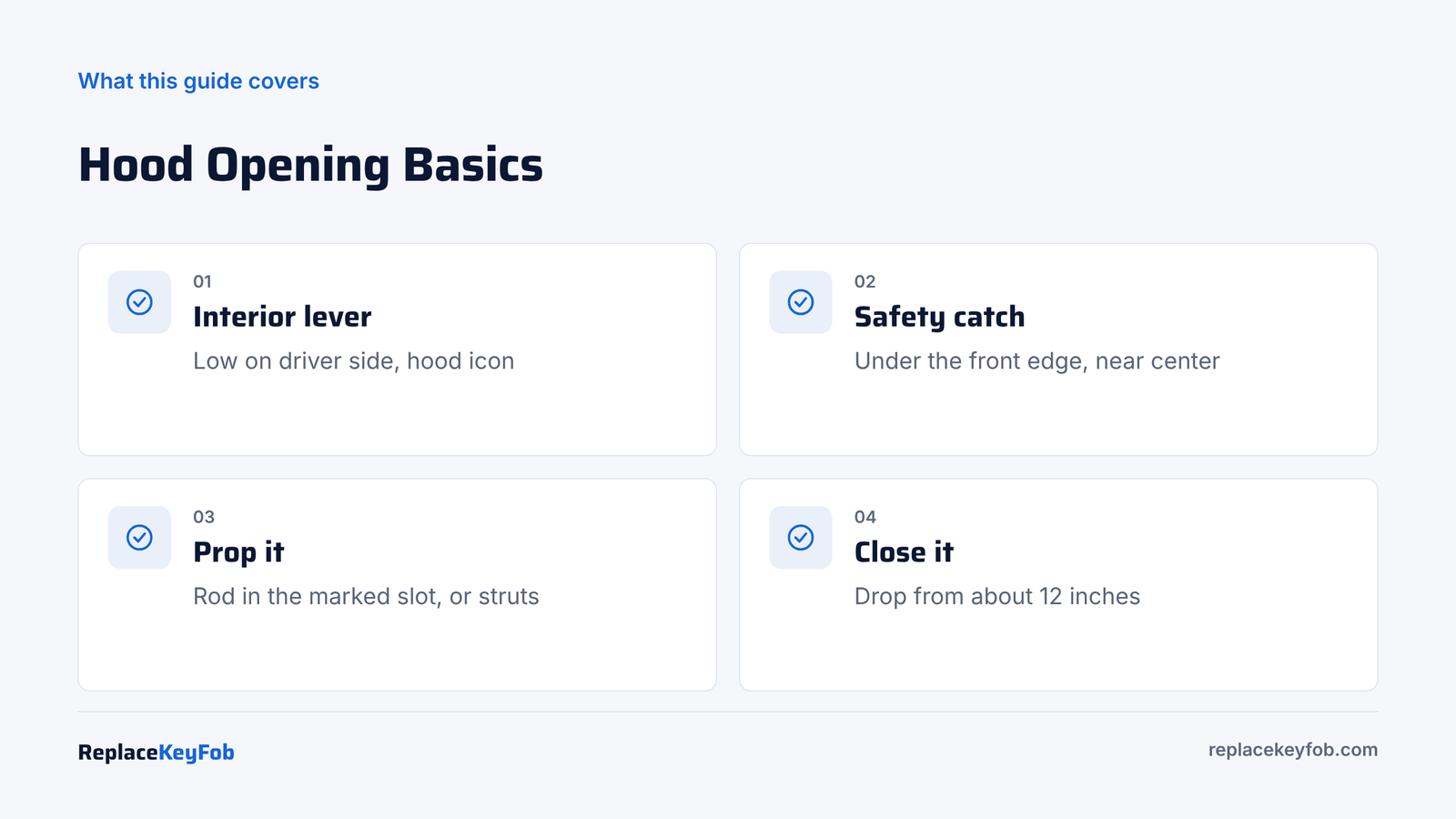
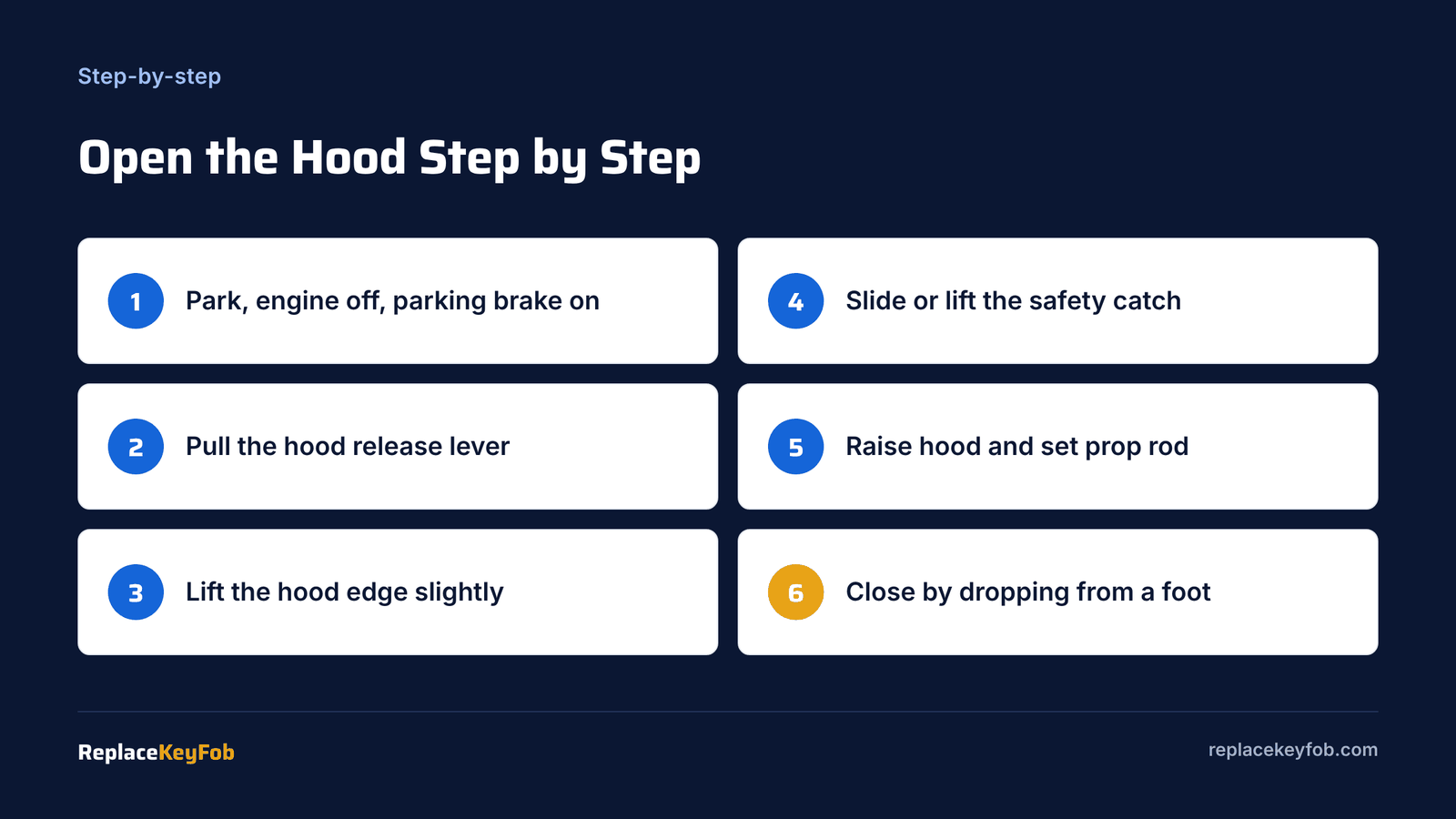
To open a car hood, pull the hood release lever inside the car, usually low on the driver side near the door or under the dash, marked with an open-hood icon. The hood pops up an inch. Then reach under the front edge of the hood, find the safety catch near the center, push or lift it, and raise the hood.
Every car hood has two locks for a reason. The main latch holds the hood down, and the secondary safety catch stops it from flying up into the windshield if the main latch lets go at speed. That is why pulling the lever only raises the hood a little.
This guide covers the normal way to open a hood on most cars and trucks, with brand differences. If your lever pulls but nothing happens, or the cable feels loose, the hood latch or cable is likely broken, and a different set of steps applies. If the car is dead, a mechanical hood release still works on most cars; the main exceptions are some cars with an electrically released front trunk.
Before You Start
- Park on level ground, set the parking brake and turn the engine off.
- Let a hot engine cool for a few minutes. The hood skin, radiator cap and exhaust parts get very hot.
- Keep loose sleeves, ties and long hair clear of the engine bay, especially if you plan to check something with the engine running.
- If you have an electric cooling fan, know that it can start on its own after shutdown on some cars. Keep fingers out of it.
Rechargeable Under-Hood Work Light
A bar light that hooks under the hood makes finding the safety catch and checking fluids easy at night. Check that the hooks fit your hood width and the light is rechargeable.
As an Amazon Associate, ReplaceKeyFob earns from qualifying purchases.
Step 1: Pull the Hood Release Lever
The lever is almost always on the driver side. Look in these spots, in this order:
- The kick panel by your left foot, low on the side wall near the door hinge. This is the most common place on Toyota, Honda, Nissan, Hyundai, Kia, Subaru and many GM and Ford models.
- Under the dashboard, left of the steering column, often next to the fuel door release.
- On the floor beside the driver seat, on some older cars, sometimes paired with the trunk release.
- Inside the driver footwell on the door sill, on some European models.
Pull the lever firmly toward you until you hear a thud from the front. The hood should rise about an inch. Some Audi models ask you to pull the lever twice, once to release and again to free the catch, so the next step happens from inside the car. Check your manual if one pull does not lift the hood edge.
Step 2: Find the Safety Catch
Go to the front of the car. Slide your fingers into the gap under the front edge of the hood, starting at the center and moving slowly side to side. You are feeling for a small lever or tab.
| Catch type | How it works | Seen on |
|---|---|---|
| Side lever | Push it left or right | Many Toyota, Honda, Nissan models |
| Lift tab | Push it up toward the hood | Many GM and Ford trucks and SUVs |
| Pull handle | Pull it toward you | Some Hyundai and Kia models |
| Grille slot | Reach through a gap in the grille | Some trucks and older sedans |
| No outside catch | Second pull of the inside lever | Some Audi and BMW models |
Push or lift the catch while raising the hood with your other hand. If you cannot find it, use a flashlight and look through the gap. The catch is usually painted or has a small arrow.
Step 3: Support the Hood
- Prop rod hoods: lift the hood fully, unclip the rod from its holder, and set the tip in the marked hole or slot on the hood underside. The slot is often outlined or labeled. Placing it elsewhere can bend the hood or let it slip.
- Gas strut hoods: the struts hold the hood up on their own. If the hood creeps down, the struts are worn. Prop it with a sturdy stick or replace the struts before working under it.
- Spring hinge hoods: some older cars use spring-loaded hinges. Lift the hood fully and it stays.
Never work under a hood held only by a weak strut. A hood that falls on your head or hands causes real injury.
Brand and Vehicle Differences
- Jeep Wrangler and Gladiator: there is no interior lever. Release the two rubber or metal latches on the outside sides of the hood, then use the safety catch at the front.
- Tesla and other EVs with a frunk: the front trunk opens from the touchscreen, the phone app or a double press of the fob trunk button on some models. There is no traditional release lever.
- Some early 2000s Fords: certain European-designed models, such as early Focus models, opened the hood with the ignition key in a lock hidden behind the grille badge.
- Porsche 911, Boxster and Cayman: the front lid is usually released electrically from inside the car.
- Pickup trucks: the catch is often tall and easy to reach, but the hood is heavy and high. Use a step stool if needed and lower it carefully.
How to Close a Hood Properly
- Check that no tools, rags or lights are left in the engine bay.
- Put the prop rod back in its clip.
- Lower the hood to about 12 inches above the latch and let it drop. The weight should be enough to latch it.
- If it does not latch, lift it again and drop it from slightly higher. Do not press down on the middle of the hood with your palms; that dents the hood skin.
- Pull up on the front edge to confirm it is locked.
If the Hood Will Not Open
| Symptom | Likely cause |
|---|---|
| Lever pulls easily with no resistance | Cable broken or popped off the lever |
| Lever is stiff and hood stays down | Seized latch or stretched cable |
| Hood pops but catch will not move | Dirty or rusted safety catch |
| Hood pops up then locks again | Latch spring sticking |
Try the two-person trick first: one person holds the lever pulled while the other presses down on the hood above the latch, then lets it spring up. This takes load off the latch and frees many sticky ones. Spray white lithium grease on the latch and catch once open.
Quick Checks Once the Hood Is Open
The hood is usually opened for a reason, so a few quick checks make the trip worthwhile:
- Battery terminals: white or green crust on the posts causes slow starts and electrical glitches. See battery terminal corrosion for safe cleaning.
- Fluid levels: oil dipstick (usually a yellow or orange handle), coolant overflow tank (check only when cold), brake fluid and washer fluid.
- Belts and hoses: look for cracks, fraying or wet spots.
- Battery age: a date sticker or code on the case tells you how old it is.
If the car clicks when you try to start it, the battery and its cables are the first things to check; our guide on car clicks but won’t start walks through it.
Mistakes to Avoid
- Forcing the safety catch with a screwdriver before the main latch has released. You can bend the catch.
- Using the wrong prop rod slot. It can let the hood slip or bend the metal.
- Slamming the hood. It cracks the latch area paint and bends the hood over time.
- Driving with the hood not fully latched. If the main latch is open, the safety catch alone can fail at speed.
When to See a Mechanic
If the hood will not open after the two-person trick and grease, a mechanic can open it from underneath or through the grille. Typical 2026 US costs are about $100 to $300 for a hood release cable and about $150 to $400 for a latch replacement. Keep your car battery in good shape too, since you need hood access to jump it. Our guide on how to jump start a car shows where to connect once the hood is up, and how to test a car battery with a multimeter explains how to check it.
Related guides: How to Jump Start a Car: Step-by-Step Guide (2026) | Safe & Easy; Car Won’t Start? What to Do When the Key Fob Battery Is Dead.
Frequently Asked Questions
Low on the driver side, either on the kick panel by the door or under the dashboard left of the steering column. It is marked with a car icon with an open hood.
That is normal. The interior lever releases the main latch, and a safety catch under the front edge must then be pushed or lifted by hand.
If the cable is still attached at the latch, you may reach it from under the car or through the grille and pull it. Otherwise a mechanic can release the latch from below.
On most cars, yes, because the hood release is a mechanical cable. Cars with an electric front trunk release, such as some Tesla and Porsche models, need a 12V supply.
Lower it to about a foot above the latch and let it drop. Avoid pushing down on the middle of the hood with your hands.