
How to Rekey a Car Door Lock to Match Your Key

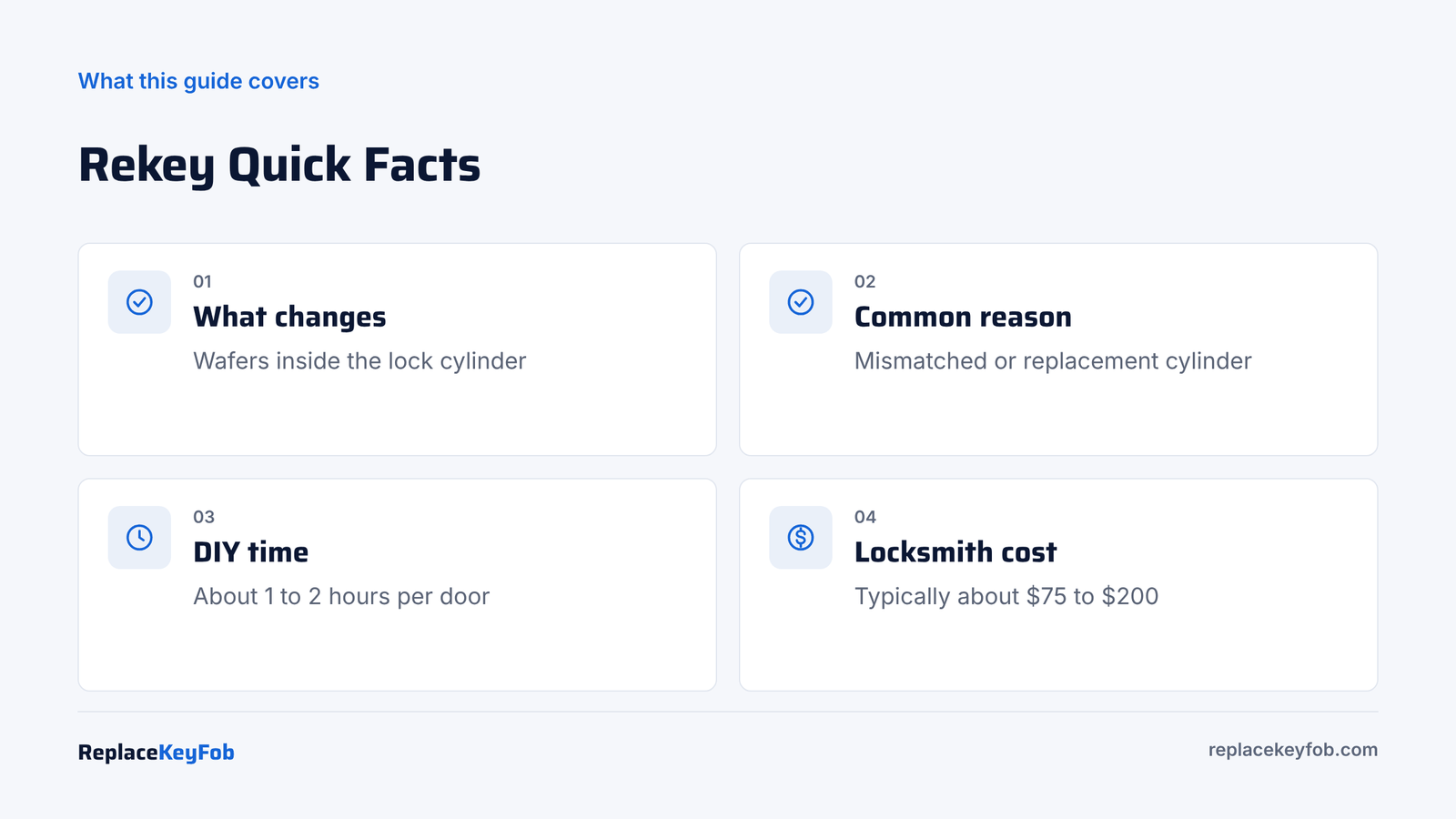
To rekey a car door lock, remove the lock cylinder, release its retaining cap or clip, and slide out the plug with the old key still in it. Remove the old wafers and fit new ones that match each cut on the key you want to use. Test it before reinstalling. Allow one to two hours.
Rekeying changes which key operates a lock without replacing the lock. Inside a car door cylinder is a row of small flat wafers, each with a slot at a certain height. When the right key goes in, each cut on the key lifts its wafer to exactly the right point and the plug can turn. Swap the wafers for ones with different slots, and the lock now matches a different key.
On cars, rekeying is most useful when you have keys that do not match: a used car with a replaced door lock, a new cylinder that came with its own keys, or a car where you want the ignition key and door key to be the same. It is not a way to stop a lost smart key from starting the car; that needs key programming.
When Rekeying Makes Sense
| Situation | Rekey? | Better option if not |
|---|---|---|
| New door cylinder came with different keys | Yes | |
| Used car where the door key differs from the ignition key | Yes | |
| Worn lock with sticky wafers | Often | Replace cylinder if body is worn |
| Lost key and worried about theft | Partly | Also erase the lost key from the immobilizer |
| Lost smart key on a push-button car | Rarely | Reprogram keys; mechanical blade is only a backup |
| Lock cylinder cracked or broken | No | Replace the cylinder |
If your car uses a smart key, the door lock only matters when the fob battery dies. A thief with your old fob does not need the door lock. Have the dealer or a locksmith erase lost keys from the car; see can you deactivate a lost car key for how that works.
How a Car Door Lock Cylinder Works
- Housing: the outer shell fixed into the door handle or door.
- Plug: the inner part that turns when you twist the key.
- Wafers: spring-loaded flat plates in the plug. Each has a slot cut at a set height.
- Springs: push each wafer down (or up) out of the shear line when no key is in.
- Retainer: a cap, clip or pin that keeps the plug inside the housing.
- Tailpiece or lever: connects the plug to the lock rod.
Wafer heights are numbered, often 1 to 4 or 1 to 5 depending on the system. Your key has a cut depth at each position that matches one wafer number. Rekeying means choosing the right wafer for each position.
Tools and Parts
- A wafer rekey kit for your lock type, or wafers taken from a matching cylinder
- The key you want the lock to use
- Small flat screwdrivers and a pick
- Needle-nose pliers and snap-ring pliers if your cylinder uses a clip
- A follower tube or a short dowel close to the plug’s diameter
- A key gauge or caliper to read the cut depths
- A tray with compartments and a phone camera for photos
- Trim tools and sockets to remove the door panel and handle
Automotive key gauge and decoder
A key gauge or decoder card for your car’s key profile lets you read each cut depth, so you know which wafer goes in each position. Check that it covers your key type.
As an Amazon Associate, ReplaceKeyFob earns from qualifying purchases.
Step 1: Remove the Door Lock Cylinder
The cylinder is usually held in the outside door handle.
- Remove the inner door panel and peel back the moisture barrier.
- Disconnect the lock rod from the cylinder tailpiece.
- Remove the retaining clip, bolt or the handle itself.
- Pull the cylinder out.
On many newer cars, the cylinder sits in a cap at the end of the outside handle, held by a screw on the door edge under a rubber plug. Loosening that screw releases the cap and cylinder. Our guide on replacing a car door lock cylinder shows both styles in detail.
Step 2: Remove the Plug
- Insert the key that currently works the lock.
- Remove the retaining cap, clip or pin at the back of the cylinder. Take a photo first.
- With the key in, slide the plug out of the housing. If you have a follower tube, push it in behind the plug as it comes out so nothing pops loose.
- Keep the key in the plug. It holds the wafers in position.
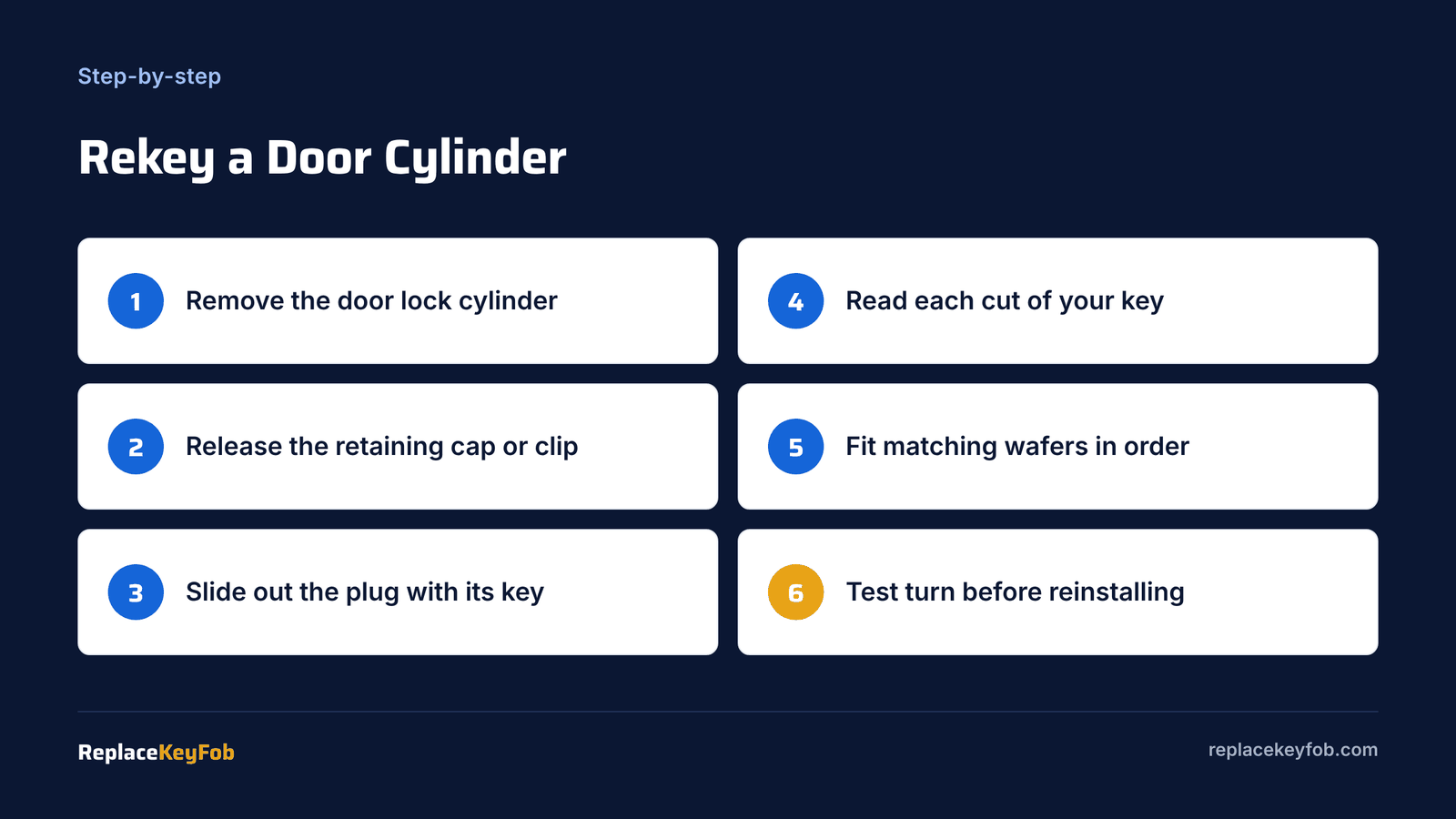
Step 3: Read Your Key
- Lay the key you want to use on a key gauge, or measure each cut with a caliper.
- Write down the depth number for each wafer position, from the bow (head) to the tip.
- Compare them to the numbers stamped or color coded on the wafers in your kit.
On wafer locks with wafers on both sides of the plug (common with laser-cut or double-sided keys), read and record both sides separately.
Step 4: Swap the Wafers
- Pull the old key out slowly. The wafers will spring out of the shear line.
- Remove each wafer and spring with a pick. Keep them in order in your tray.
- Insert new wafers in each slot that match your recorded key numbers. Make sure the springs sit in their pockets.
- Insert your target key. Every wafer should sit flush with the plug surface. If one sticks up or sits low, it is the wrong number. Swap it.
- With the key in, slide the plug back into the housing and refit the retainer.
Step 5: Test Before Reinstalling
- Turn the key both ways several times. It should turn smoothly with no catching.
- Pull the key out and try turning the plug with a screwdriver. It should not turn.
- Try a wrong key. It should not turn.
- Lube the cylinder with dry graphite, then reinstall it in the handle and reconnect the rod.
- Test with the door open before closing it.
Variations by Car Type
- Older cars with edge-cut keys: single-sided wafer locks, the easiest to rekey.
- Laser-cut or sidewinder keys: wafers on both sides and tighter tolerances. Many owners prefer a locksmith.
- Smart key cars: the hidden driver keyhole is often the only lock. Rekeying it to match the emergency blade is common after a cylinder replacement.
- Cars with door cylinder switches: some driver cylinders have a switch for alarm disarm or one-touch windows. Keep the switch connected and oriented correctly.
- Trucks with tailgate locks: the tailgate cylinder can usually be rekeyed the same way.
Rekeying house door locks is different
House locks usually use pin tumblers instead of wafers, and kits for brands like Kwikset and Schlage are sold for home use. Some home locks even let you rekey with a learn tool without removing the cylinder. Car door locks are smaller, use wafers, and need the door panel off, so home rekey kits do not fit cars.
Mistakes to Avoid
- Pulling the key out before the plug. The wafers and springs will shoot out.
- Losing the order. Use a tray and photos.
- Forcing the plug back in. A wafer is sticking up; recheck it.
- Grease inside the cylinder. Use dry graphite only.
- Expecting rekeying to block a lost key. Erase the lost key from the immobilizer as well.
When to Call a Locksmith and What It Costs
An automotive locksmith can rekey a car door cylinder quickly, often while you wait, and can cut a new key from your code. Typical 2026 US costs:
| Service | Typical cost |
|---|---|
| Rekey one door cylinder | About $75 to $200 |
| Rekey door plus ignition to one key | About $150 to $350 |
| New uncoded cylinder plus rekey | About $150 to $350 |
| New mechanical key cut by code | About $10 to $90 |
Call a pro if your key is laser-cut, if you do not have a wafer kit for your lock, or if the cylinder is worn. Our locksmith guide explains what to expect. If the ignition also needs replacing, see ignition lock cylinder replacement.
Frequently Asked Questions
Yes. You remove the cylinder, take out the plug and replace the wafers so they match the cuts on a different key. It is a common locksmith service.
Typically about $75 to $200 per cylinder at a locksmith in 2026. Matching the door and ignition to one key usually costs about $150 to $350.
Rekeying is usually cheaper if the cylinder is in good condition. If it is worn, cracked or damaged, replacing it with a new cylinder coded to your key is better.
No. Modern cars use a transponder or smart key. To stop a lost key starting the car, it has to be erased from the immobilizer system.
No. Most house locks use pin tumblers, while car door locks use wafers of different sizes. You need a car-specific wafer kit.