
How to Test a MAF Sensor (OBD2 Live Data and Multimeter)

This post contains affiliate links. As an Amazon Associate, ReplaceKeyFob earns from qualifying purchases, at no extra cost to you.
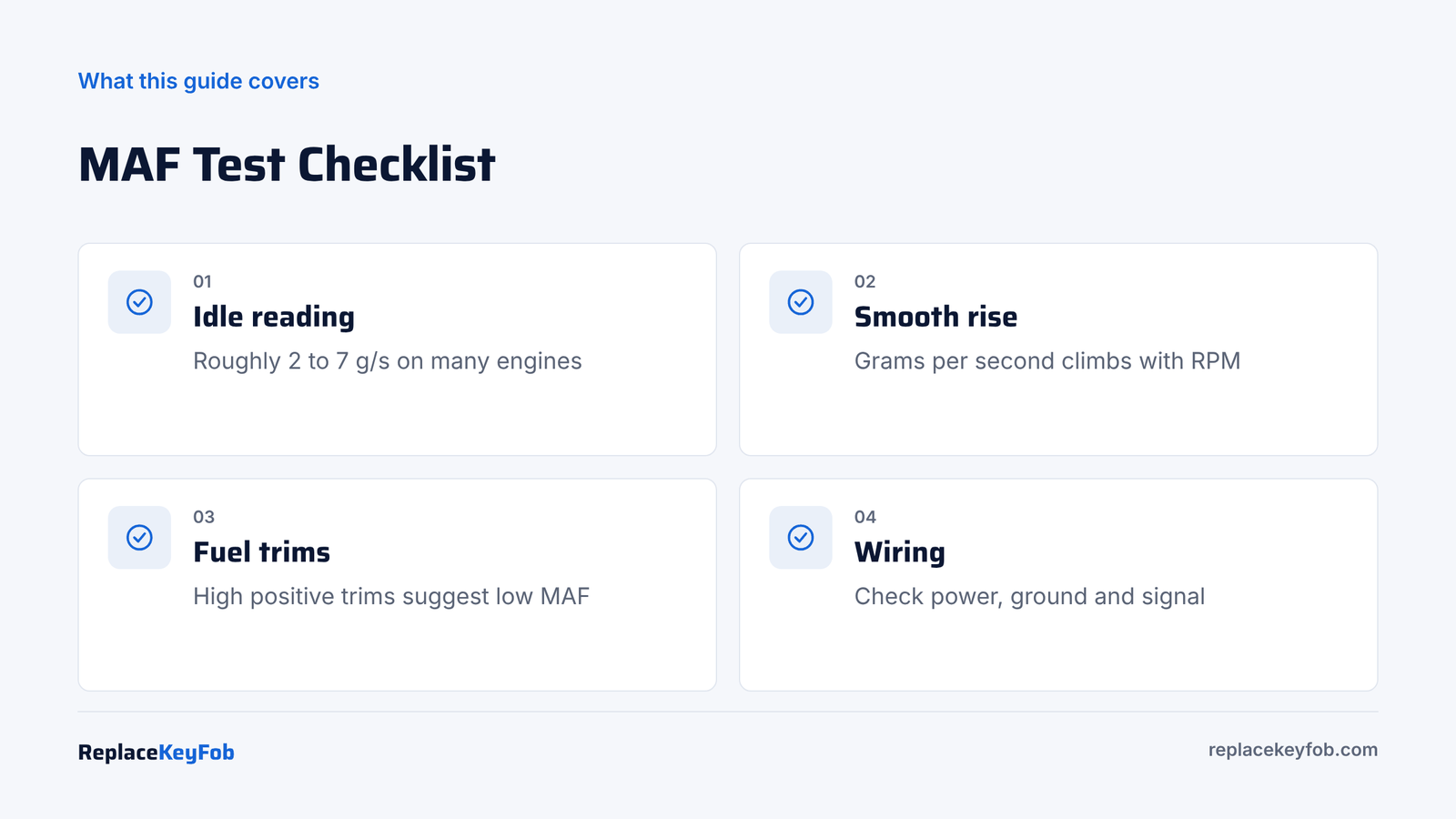
To test a MAF sensor, read live data with an OBD2 scanner. At warm idle, many engines read roughly 2 to 7 grams per second, often close to 1 g/s per liter of engine size, and the value should rise smoothly as RPM increases. High positive fuel trims suggest a low reading. Then check the sensor’s power, ground and signal wires with a multimeter.
The mass airflow (MAF) sensor measures how much air enters the engine, and the computer uses that number to decide how much fuel to inject. When the sensor gets dirty or starts to fail, it under-reports airflow. The engine runs lean, sets codes such as P0171 and P0174, hesitates on acceleration and may stall.
The tricky part is that a vacuum leak, a cracked intake boot or a weak fuel pump can cause the same symptoms. Testing the MAF properly tells you whether to clean it, replace it or look somewhere else. This guide covers three methods: scan tool live data, a multimeter test and a wiring check. If you have already tested the oxygen sensors, our guide on testing an oxygen sensor with an OBD2 scanner pairs well with this one, since O2 data helps confirm MAF faults.
Signs of a Bad MAF Sensor
| Symptom | Why it happens |
|---|---|
| P0171 / P0174 lean codes | Sensor reads low, computer adds too little fuel |
| P0100 to P0104 MAF codes | Circuit fault or reading out of range |
| Hesitation or stumble on acceleration | Airflow reading lags the real airflow |
| Rough idle or stalling | Idle fuel mixture wrong |
| Poor fuel economy | Computer compensates poorly |
| Black smoke (less common) | Sensor reads high, too much fuel |
| Runs better unplugged | Computer falls back to a calculated airflow |
What You Need
- An OBD2 scanner with live data (MAF in g/s, RPM, fuel trims)
- A digital multimeter with DC volts and, ideally, frequency (Hz)
- Back-probe pins or thin test leads that slide into the back of the connector
- MAF sensor cleaner (not carb or brake cleaner)
- A screwdriver or Torx bits to remove the sensor if cleaning
Mass airflow sensor cleaner
Use a cleaner made for MAF sensors that dries fast and leaves no residue. Carb or brake cleaner can damage the sensing wire or film.
As an Amazon Associate, ReplaceKeyFob earns from qualifying purchases.
Method 1: How to Test MAF Sensor With a Scan Tool
This is the easiest and most useful test.
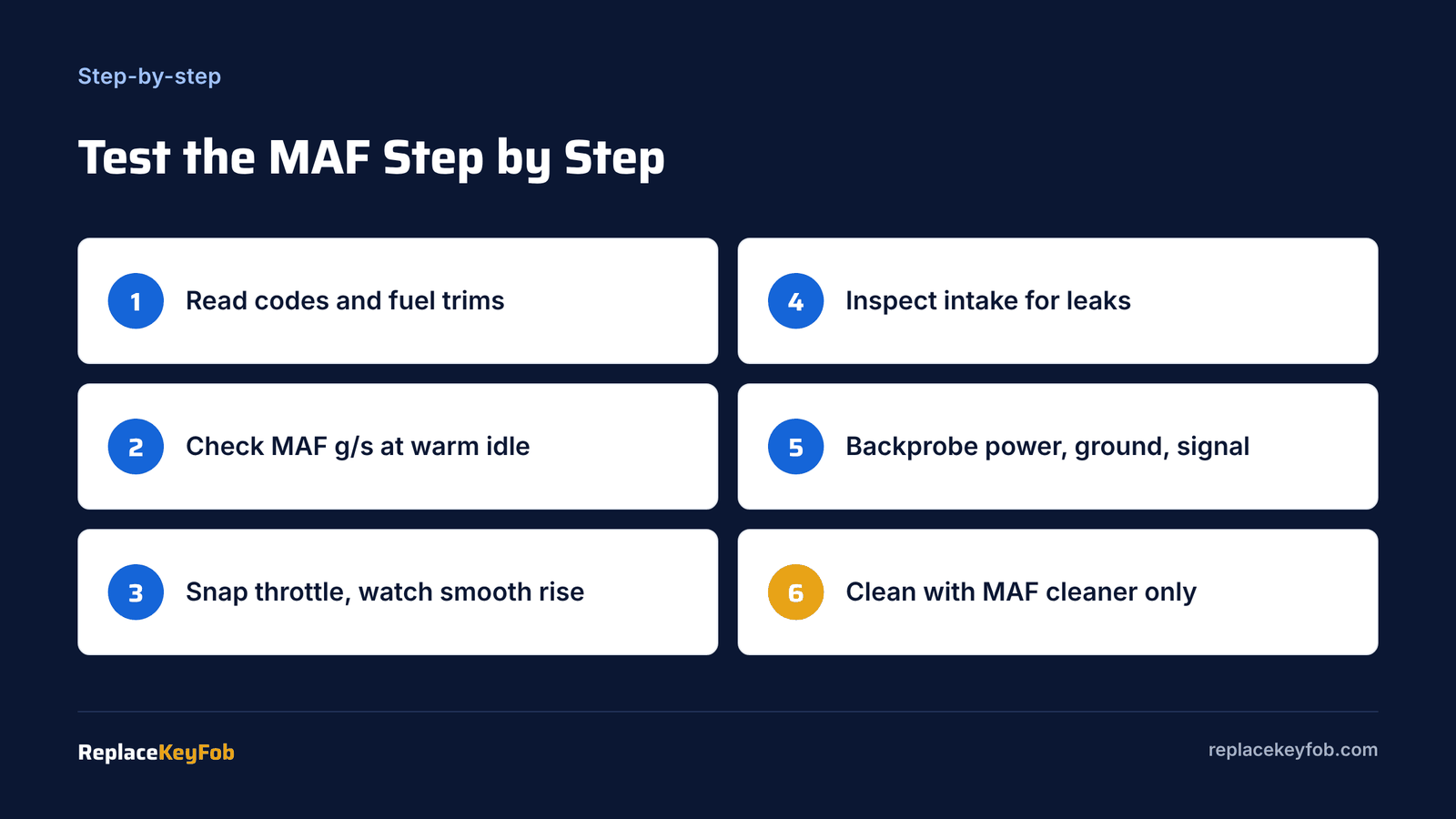
- Warm the engine fully and turn off the A/C and other loads.
- Connect the scanner and open live data.
- Select MAF (g/s or lb/min), RPM, coolant temperature, and short and long-term fuel trims for each bank.
- Idle check: at warm idle, many engines read roughly 2 to 7 g/s. A common rule of thumb is about 1 g/s per liter of displacement, so a 2.0L engine might show around 2 to 3 g/s and a 5.0L around 4 to 6 g/s. Compare with a known-good value for your engine if you can find one.
- Rev check: slowly raise RPM to about 2,500. The MAF reading should rise smoothly, often to roughly two to three times the idle value. No jumps, flat spots or dropouts.
- Snap throttle: quickly open the throttle and release. The reading should jump instantly and fall back cleanly.
- Fuel trim check: add short and long-term trims together. Near 0 is ideal; within about plus or minus 10% is normal. If the total is above about +10 to +15% at idle and gets better at higher RPM, suspect a vacuum leak. If it is high at all RPM and especially under load, suspect a low-reading MAF or fuel delivery.
For a deeper look at the data, see how to read live data and how to read fuel trims.
Road test with the scanner
A better test is a wide-open throttle run in a safe place, in a low gear from about 2,000 RPM to near redline. Many technicians use a rough rule that peak airflow in g/s is close to the engine’s horsepower multiplied by about 0.8. A reading far below that suggests a dirty or failing MAF, or a restriction such as a clogged air filter.
Method 2: How to Test MAF Sensor With a Multimeter
MAF sensors come in different types. Know which one you have before testing.
| Sensor type | Signal output | Typical behavior |
|---|---|---|
| Analog voltage (many older and some current) | DC voltage | Low voltage at idle (often under about 1.5V), rising toward about 4 to 4.5V at full throttle |
| Frequency output (many GM and some others) | Hz | Frequency rises with airflow; a low kHz value at idle on many sensors |
| Digital (newer, some brands) | Pulse width or digital | Best tested with a scan tool or scope |
Voltage-type MAF test
- With the key off, find the MAF connector and identify the power, ground and signal wires from a wiring diagram.
- Slide back-probe pins into the back of the connector. Do not pierce the wire insulation.
- Set the meter to DC volts. Connect the black lead to the battery negative.
- Start the engine and measure the signal wire at idle. Note the reading.
- Slowly raise the RPM. The voltage should rise smoothly. Snap the throttle; it should jump quickly.
- Gently tap the sensor body with a screwdriver handle at idle. If the reading jumps or drops out, the sensor has an internal fault.
Frequency-type MAF test
Set the meter to frequency (Hz) and connect the same way. The frequency should rise smoothly with RPM. Erratic jumps or a flat reading point to a bad sensor.
Method 3: How to Test MAF Sensor Wiring
A MAF circuit fault (P0102, P0103) is often wiring.
- Power: with the key on, the power wire should show battery voltage (about 12V) on many sensors, or 5V on some.
- Ground: measure between the ground wire and battery negative with the key on. It should read under about 0.1V.
- Signal: with the key on and the engine off, many voltage-type sensors show a small voltage on the signal wire. Check for an open or short to ground or power.
- Connector: look for corrosion, bent pins and a broken locking tab. Oil from an over-oiled aftermarket air filter can contaminate the sensor and connector.
Clean or Replace?
Cleaning fixes many MAF problems.
- Turn the engine off and disconnect the MAF connector.
- Remove the sensor from the intake tube (usually two screws).
- Spray the sensing element with MAF cleaner from a few inches away, about 10 to 15 sprays. Do not touch the wires or film.
- Let it air dry fully, about 10 to 20 minutes.
- Refit and retest.
If the readings are still low or erratic after cleaning and the wiring tests good, replace the sensor with an OE-quality part. After installation, an ECU reset helps the computer relearn fuel trims faster.
Rule Out Other Causes First
| What you find | More likely cause |
|---|---|
| Lean at idle, normal at higher RPM | Vacuum leak after the MAF |
| Lean everywhere, MAF reading normal | Low fuel pressure or clogged injectors |
| MAF reads high, rich codes | Contaminated sensor or air leak before the MAF (rare) |
| Cracked intake boot | Unmetered air; replace boot |
| Clogged air filter | Low airflow at high RPM |
Mistakes to Avoid
- Using carb or brake cleaner. It can destroy the sensing element.
- Touching the sensor wire or film.
- Replacing the MAF for every lean code without checking for a vacuum leak.
- Over-oiling a reusable air filter. Oil mist can coat the sensor.
- Using a poor-quality replacement. Many cheap MAFs read differently from OEM and cause new codes.
Cost
| Item | Typical 2026 US cost |
|---|---|
| MAF cleaner | About $8 to $15 |
| New MAF sensor (part only) | About $80 to $350 |
| Shop replacement | About $150 to $450 installed |
| Diagnostic fee | About $100 to $180 |
If a rough idle remains after cleaning or replacing the MAF, see how to do a throttle body relearn.
Frequently Asked Questions
Warm the engine, open live data and watch MAF grams per second, RPM and fuel trims. At idle, many engines read roughly 2 to 7 g/s. The reading should rise smoothly with RPM, and fuel trims should stay within about plus or minus 10%.
Back-probe the signal wire with the engine running. On a voltage-type sensor, the voltage should be low at idle and rise smoothly as you raise the RPM. On a frequency-type sensor, use the Hz setting and watch the frequency rise.
With the key on, check for battery voltage or 5V on the power wire, under about 0.1V on the ground wire, and continuity on the signal wire. Inspect the connector for corrosion and bent pins.
Usually there is no sound. You feel hesitation on acceleration, rough idle, stalling or poor fuel economy, and you may see lean codes such as P0171 and P0174.
Often yes. Spray the sensing element with MAF sensor cleaner, let it dry fully and retest. Replace it if readings are still low or erratic and the wiring is good.