
How to Unlock a Car When the Key Is Lost: Safe Steps, Smart Choices, and What to Do Next

Losing your car key is stressful enough. Being locked out on top of it can turn a bad moment into a full-blown problem. The good news: in many cases, you can get back into the car without damaging it, and you usually do not need to guess your way through the lock.
The safest path depends on what kind of key you lost, whether a spare exists, and whether your vehicle uses a mechanical lock, transponder key, key fob, or push-to-start system. If you choose the wrong approach, you can bend weatherstripping, scratch paint, damage wiring, or create a bigger repair than the lockout itself.
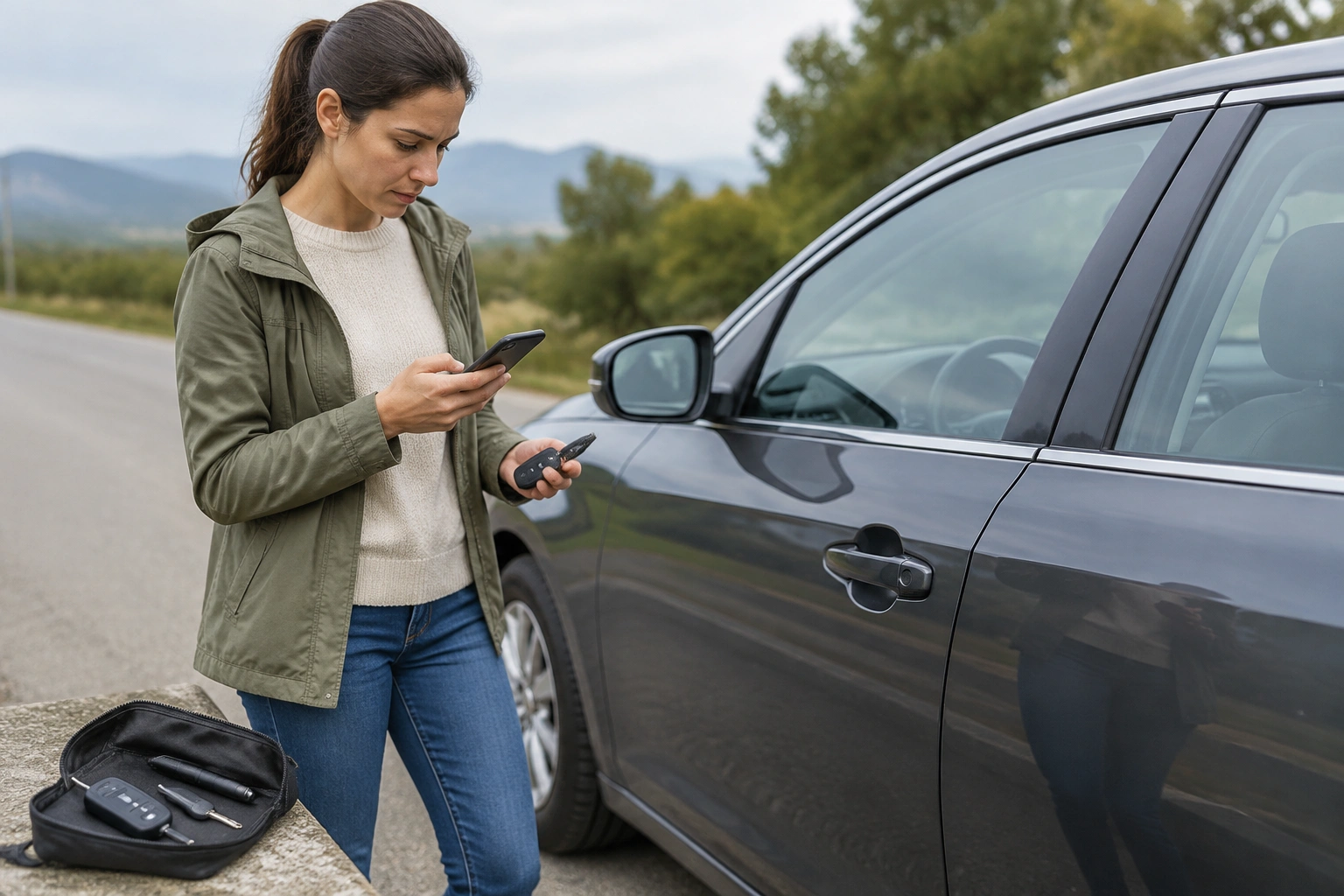
This guide walks you through the fastest decision path, the safest unlock options, and what to do after you regain access.
What to Do First in the First 5 Minutes
Before you try anything, slow the situation down just enough to avoid a costly mistake.
1. First decide: are the keys locked inside, or are they truly lost?
This is the fastest split because it determines the next call.
- If the keys are locked inside the car: call roadside assistance or an automotive locksmith for entry only.
- If the keys are truly lost: call an automotive locksmith first if you want the fastest on-site help, then plan for replacement as well.
2. Check for a spare key.
If a spare is nearby, it is often the fastest and least expensive solution. A family member, roommate, neighbor, or coworker may have it. If the spare is at home and you are close enough to retrieve it safely, that may beat waiting for service.
3. Identify your key type.
Look at the vehicle and think about what you normally use:
– Mechanical key: a plain metal key
– Transponder key: a key with a chip inside
– Key fob: a remote that may still have a hidden mechanical blade
– Smart key / push-to-start: a proximity key that lets the car start without inserting a key
That detail matters because the unlock method and replacement path are not the same for every vehicle.
4. Decide whether you need entry only or entry plus replacement.
If the key is locked inside, you only need the car opened. If the key is lost, you need both access and a replacement plan. That second part is where many drivers lose time by calling the wrong provider first.
What You Need Before You Try to Unlock the Car
Having the right information ready saves time and helps you avoid dead ends.
Gather these details
- Vehicle year, make, and model
- Whether the car uses a key, fob, or push-to-start system
- Your exact location
- Proof of ownership, such as registration or title
- A photo ID
- The vehicle identification number, or VIN, if available
- The location of any spare key
A locksmith, roadside assistance provider, or dealer may ask for these before they help. That is normal. It protects you from delays and helps verify the vehicle belongs to you.
Why the key type matters
A mechanical lock can often be opened more simply than a modern electronic system. A transponder key may unlock the door but still need programming to start the car. A smart key may allow entry through a connected app or manufacturer service in some cases, but not always. The more electronic the system, the more likely you are to need a professional who can handle both unlocking and replacement.
If you drive a Ford
Some manufacturers offer vehicle-specific unlock options through an app, an access code, or roadside assistance. Whether that is available depends on the model and the services tied to your account, so check the manufacturer’s support information for your exact vehicle.
That is a useful example of why vehicle-specific support matters. Some brands have app access or keypad codes; others do not.
Safe Ways to Unlock a Car If the Key Is Lost
There are four practical paths, and the safest one is not always the cheapest one.
1. Use a spare key if you can get it quickly
If the spare is close by, this is usually the cleanest solution. It avoids damage, avoids towing, and may solve the problem in minutes. The trade-off is time: if the spare is 30 miles away, waiting for it may cost more in lost time than calling help.
2. Use roadside assistance for a lockout
Roadside assistance can be the fastest “call and wait” option if you are already covered. Some plans include lockout help, but coverage for lost keys is not always the same as coverage for keys locked in the car. That distinction matters.
If the keys are simply locked inside, roadside assistance may unlock the vehicle. If the key is lost and replacement is needed, they may only solve the entry problem, not the full problem.
3. Call an automotive locksmith
This is often the best balance of speed, convenience, and damage control. A mobile locksmith can usually come to you, verify ownership, open the vehicle, and in many cases help with replacement afterward.
A locksmith is especially useful when:
– You need on-site service
– You do not want to tow the car
– You have a transponder key or fob issue
– You are unsure whether the key is lost or locked inside
4. Call the dealer when replacement or programming is likely
Dealers are often the right choice when the vehicle needs brand-specific programming, special ordering, or a manufacturer-only process. The downside is that a dealer may require you to bring the car in, which can mean towing if you cannot start it.
That makes the dealer a stronger option for replacement than for emergency entry.
Roadside Assistance vs Locksmith vs Dealer
Here is the practical comparison most drivers need.
| Option | Best for | On-site service | Likely speed | Towing needed? | Cost trade-off |
|---|---|---|---|---|---|
| Roadside assistance | Simple lockouts, especially if covered by your plan | Often yes | Can be fast, but depends on provider availability | Usually no for unlocking | May be included in membership or policy |
| Automotive locksmith | Lost key lockouts, damaged keys, replacement help | Yes | Often the most flexible for emergency help | Usually no for unlocking | Often paid out of pocket, but can avoid towing |
| Dealer | Replacement keys, fobs, and brand-specific programming | Usually no | Can be slower due to scheduling and parts | Sometimes yes | Often higher total cost once towing is included |
How to choose
- If your only problem is that the key is inside the car, roadside assistance may be enough.
- If the key is lost and you want the car opened without damage, a locksmith is often the most practical first call.
- If the key, fob, or smart key must be replaced and programmed by the manufacturer, the dealer may be necessary.
Step-by-Step: Get Back Into the Car Without Damaging It
This is the damage-aware decision path I would use with a customer standing next to the car.
Step 1: Check the easiest non-damaging option first
If you have a spare, use it. If you have a manufacturer app or vehicle-specific access feature, use that next. If you have roadside assistance, call and ask whether lockout service is included.
Step 2: Look at the lock type before touching the door gap
If your car has modern electronic locks, side airbags, or tight weatherstripping, avoid improvising. The cost of a bent seal or damaged wiring can quickly exceed the cost of a locksmith.
Step 3: If you do not have a safe access method, stop and call a pro
That is the point where most DIY damage starts. A trained automotive locksmith has the right tools to open many vehicles with far less risk than a hurried attempt with household items.
Step 4: Once the door opens, do not rush the replacement decision
If the key is missing, the next step is not just “get a new key.” First figure out whether you need:
– A replacement mechanical key
– A transponder key
– A new fob
– A smart key replacement
– Reprogramming for a push-to-start system
That choice affects whether the vehicle can be fixed on-site or whether a dealer visit is needed.
What Not to Do
A lockout is not the time to experiment.
Avoid wedges and improvised tools
Forcing a wedge too far can damage weatherstripping, paint, or internal door parts. On some vehicles, it can also create issues with wiring or airbags. Air bladders can be safer than rigid tools in some situations, but they are still risky on modern vehicles if used incorrectly or in the wrong door gap.
Avoid a slim jim on modern vehicles
Slim jims are not a universal answer. On newer cars, they can interfere with side airbags, rods, and electronic lock mechanisms. What worked on an older sedan may be a bad idea on a newer SUV.
Avoid coat hangers, screwdrivers, and other improvised tools
These tools can scratch paint, deform the door frame, damage lock rods, or interfere with wiring. They are especially inappropriate on vehicles with electronic locks, tight seals, or side airbags.
Avoid breaking glass unless there is a true emergency
A broken window creates a larger safety issue, more cleanup, and a more expensive repair than the lockout itself.
Avoid “maybe it’ll work” methods on smart-key vehicles
Push-to-start systems are built differently from older door-and-key setups. If the key is truly lost, the problem is usually not just opening the door. It is also about getting a valid replacement that the vehicle will recognize.
Troubleshooting by Key Type and Vehicle Type
Mechanical key
If your vehicle uses a basic metal key, unlocking is usually simpler. A locksmith can often help quickly, and replacement is often more straightforward than with electronic systems.
Transponder key
A transponder key may open the door, but the vehicle may not start without the chip being recognized. If the key is lost, you may need both a replacement key and programming. In many cases, a locksmith can cut and program the key on-site, but some vehicles require dealer programming or special equipment, especially if the system is brand-specific or access to programming data is restricted.
Key fob
If you lost the fob but still have a mechanical key blade or spare key, you may be able to unlock the car and deal with replacement afterward. If the fob is the only key device you had, replacement becomes the next priority. Depending on the vehicle, a locksmith may be able to replace and pair the fob on-site, but some models require dealer programming.
Smart key / push-to-start
With smart-key systems, the key is often tied to both entry and starting. That makes replacement more involved. In some cases, a locksmith can handle the whole job on-site. In others, dealer programming is the better route, and if the vehicle cannot be started for a dealer-only procedure, towing may be required.
What Information a Locksmith or Dealer Will Ask For
Have this ready before you call:
- Year, make, and model
- VIN
- Your exact location
- Proof of ownership
- Photo ID
- Whether the key is lost or locked inside
- Whether the car uses a key, fob, transponder, or smart key
If you already know the trim level or whether the vehicle has push-to-start, mention that too. It helps the provider bring the right tools and reduces back-and-forth.
Typical Costs and Wait Times
Costs vary by location, time of day, and vehicle type, so I would avoid anyone who promises a universal price over the phone.
A few practical rules:
– Roadside assistance may be the lowest out-of-pocket option if your plan covers lockouts.
– A locksmith may cost more than a basic roadside call, but can be faster and more flexible.
– A dealer may be the most expensive overall once towing and programming are included.
The same goes for timing:
– A nearby locksmith can sometimes solve the problem on-site faster than a dealer appointment.
– Roadside assistance may be convenient, but arrival time depends on provider availability.
– Dealer replacement can take longer, especially if the key or fob must be ordered.
If you are stranded in a parking lot, speed often matters more than squeezing out the lowest possible price.
After You Unlock the Car: Replace the Lost Key or Fob
Once you are back inside, do not stop at “problem solved.” If the key is missing, the vehicle is still vulnerable.
Decide what needs replacing
- Mechanical key only: you may only need a cut key
- Transponder key: you may need cutting plus programming
- Key fob: you may need a replacement fob and pairing
- Smart key: you may need a manufacturer-compatible replacement and programming
Think about the missing key’s security risk
If the lost key could be linked to your vehicle, ask whether the old key or fob should be disabled. That is especially important if the key was stolen rather than simply misplaced.
Consider whether the car needs to be towed
If the replacement requires dealer-only programming or special equipment, towing may be part of the plan. If a locksmith can do it on-site, you may avoid that extra step.
Practical replacement path by key type
- Mechanical key: a locksmith or dealer can often cut a replacement without much delay.
- Transponder key: on-site locksmith service is often enough if the vehicle can be programmed in the field; dealer programming may be needed if the system is restricted or the locksmith cannot access the required data.
- Key fob: some locksmiths can supply, cut, and pair a replacement on-site, but certain vehicles require dealer programming or ordering.
- Smart key: on-site service may work for some models, but dealer-only programming or towing is more likely when the system is tightly integrated with the vehicle’s security system.
Real-World Examples
Older sedan, spare key at home
If the car is an older model and the spare is at home, the fastest move is often to retrieve the spare rather than force the door. If no one can bring it, a locksmith may still be the better option than trying to pry the door open.
Push-to-start SUV with a lost fob
If the fob is gone, the vehicle may need more than a simple unlock. A locksmith may be able to open the car, but replacement and programming may still need dealer support depending on the model.
Keys locked in the car at a grocery store
If the key is visible inside the car, roadside assistance may be enough. That is a very different situation from a truly lost key, where replacement becomes part of the job.
Transponder key lost after errands
If you lost a transponder key during the day, a locksmith may be able to unlock the car and help with a replacement. That can save you from towing the vehicle to a dealer just to regain access.
When to Call an Automotive Locksmith
If you want the shortest path to safe entry, call a locksmith when:
– You do not have a spare
– The key is truly lost
– You want to avoid damage
– The vehicle has a transponder key, fob, or smart key
– You need help at your location instead of at a shop
That is usually the best middle ground between speed and cost.
FAQs
Can I unlock my car without the original key?
Often, yes. If the key is locked inside the car, a locksmith, roadside assistance, or a vehicle-specific access feature may help. If the key is lost, you may still be able to get in, but replacement becomes part of the job.
Will roadside assistance help if I lost my key?
Sometimes. Some plans cover lockouts, but coverage for a lost key may be different from coverage for keys locked inside the car. Ask before you wait for service.
Can a locksmith unlock my car without damaging it?
A trained automotive locksmith can often do it with minimal risk, especially compared with improvised DIY methods. No one should promise zero risk on every vehicle, but professional entry is usually the safer route.
Do I need the dealer for a lost key fob?
Not always. Some locksmiths can replace and program fobs on-site. A dealer may still be needed for certain models or brand-specific programming.
What if my spare key is at home?
If it can be brought to you quickly, that may be the simplest fix. If not, roadside assistance or a locksmith may save time.
Can I replace the key after getting the car unlocked?
Yes, and you should. If the key is truly lost, replacing it right away is the smart move so you are not locked out again.
If you are stuck and need a practical next step, the safest move is usually simple: identify the key type, check for a spare, and call the option that can unlock the vehicle without damage and handle replacement if needed.
