
How to Use a Trickle Charger on a Car Battery

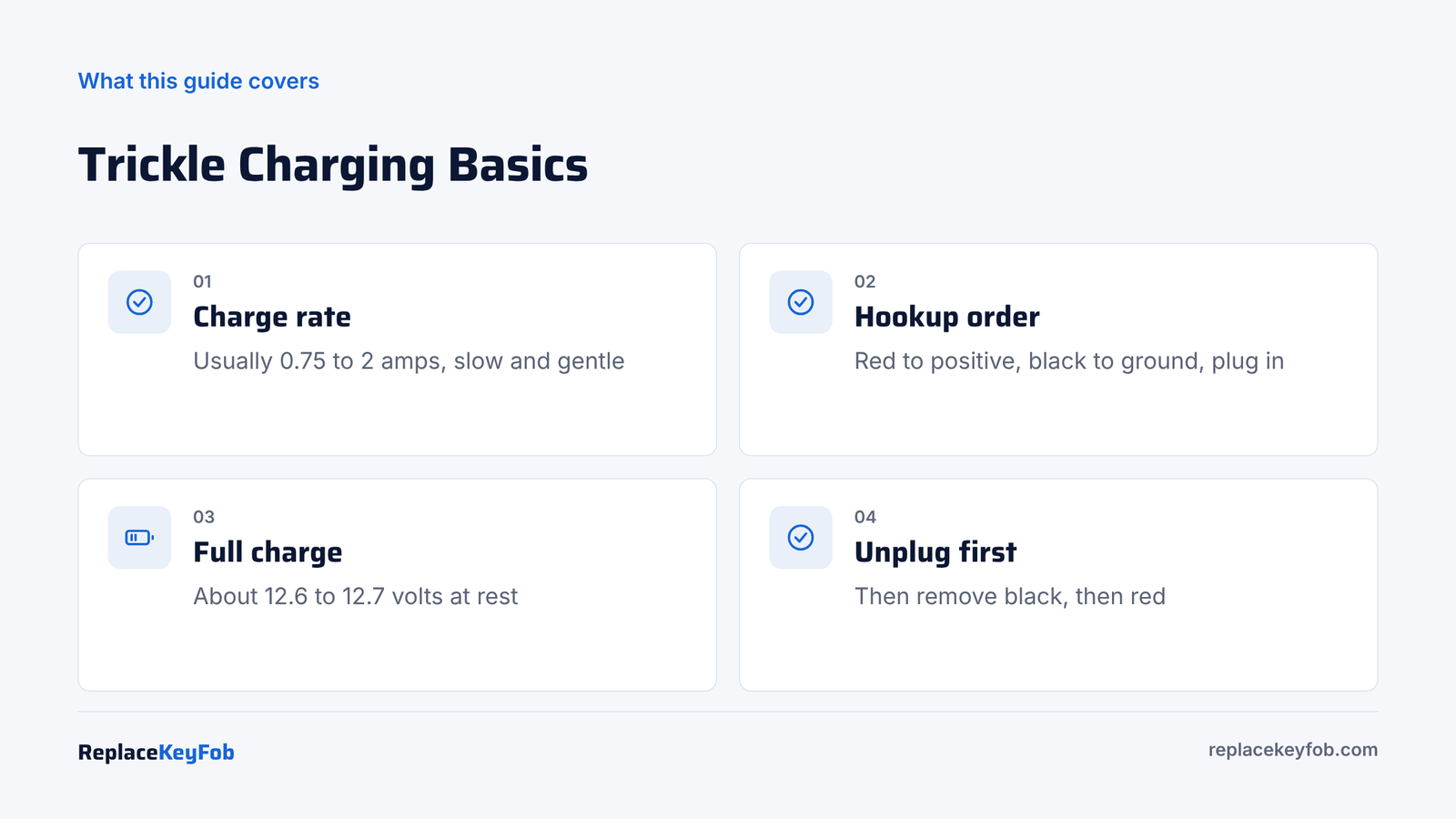
To use a trickle charger, switch the car off, clip the red clamp to the battery’s positive post, clip the black clamp to bare metal on the engine or chassis, choose the right battery type, then plug the charger in. A 1 to 2 amp charger needs about 12 to 48 hours to refill a weak car battery. Unplug before removing the clamps.
A trickle charger is the slow, gentle option for a car battery that is weak but not ruined. It pushes a small current, usually between 0.75 and 2 amps, which keeps heat down and lets the battery absorb charge evenly. That makes it a good fit for a car that sat for a few weeks, a battery that drained from a dome light left on, or a motorcycle that spent the winter in the garage.
The catch is that “trickle charger” covers two very different products. Older basic units push current nonstop and can overcharge if forgotten. Most chargers sold today are smart chargers that stop at full and drop to a float voltage. Knowing which one you have changes how long you can leave it connected. If you are still choosing a unit, our roundup of the best trickle chargers for car batteries covers the models worth buying.
What You Need Before You Start
Gather these before you touch the battery:
- The trickle charger and its manual, so you know whether it has automatic shutoff or float mode
- Safety glasses and gloves, because lead-acid batteries vent hydrogen and can spit acid
- A digital multimeter to check voltage before and after charging
- A wire brush if the terminals show white or green crust
- A grounded outlet close enough that you do not need a long, thin extension cord
Smart Trickle Charger (1 to 2 Amp)
Look for automatic float mode, settings for flooded, AGM and lithium batteries, and reverse-polarity protection so a wrong hookup does not spark.
As an Amazon Associate, ReplaceKeyFob earns from qualifying purchases.
Check the battery first
Measure resting voltage with the engine off for at least an hour. A battery reading about 12.4 volts is roughly 75 percent charged. At 12.0 volts it is close to empty, and below about 10.5 volts many smart chargers will refuse to start because they cannot detect a battery. That is normal, not a fault. Our guide on how to test a car battery with a multimeter shows how to read these numbers.
Never charge a battery that is cracked, swollen, leaking or frozen. A frozen battery can explode when current is applied. Let it thaw indoors first, then inspect the case.
How to Use a Trickle Charger Step by Step
These steps assume the battery stays in the car, which is how most people do it.
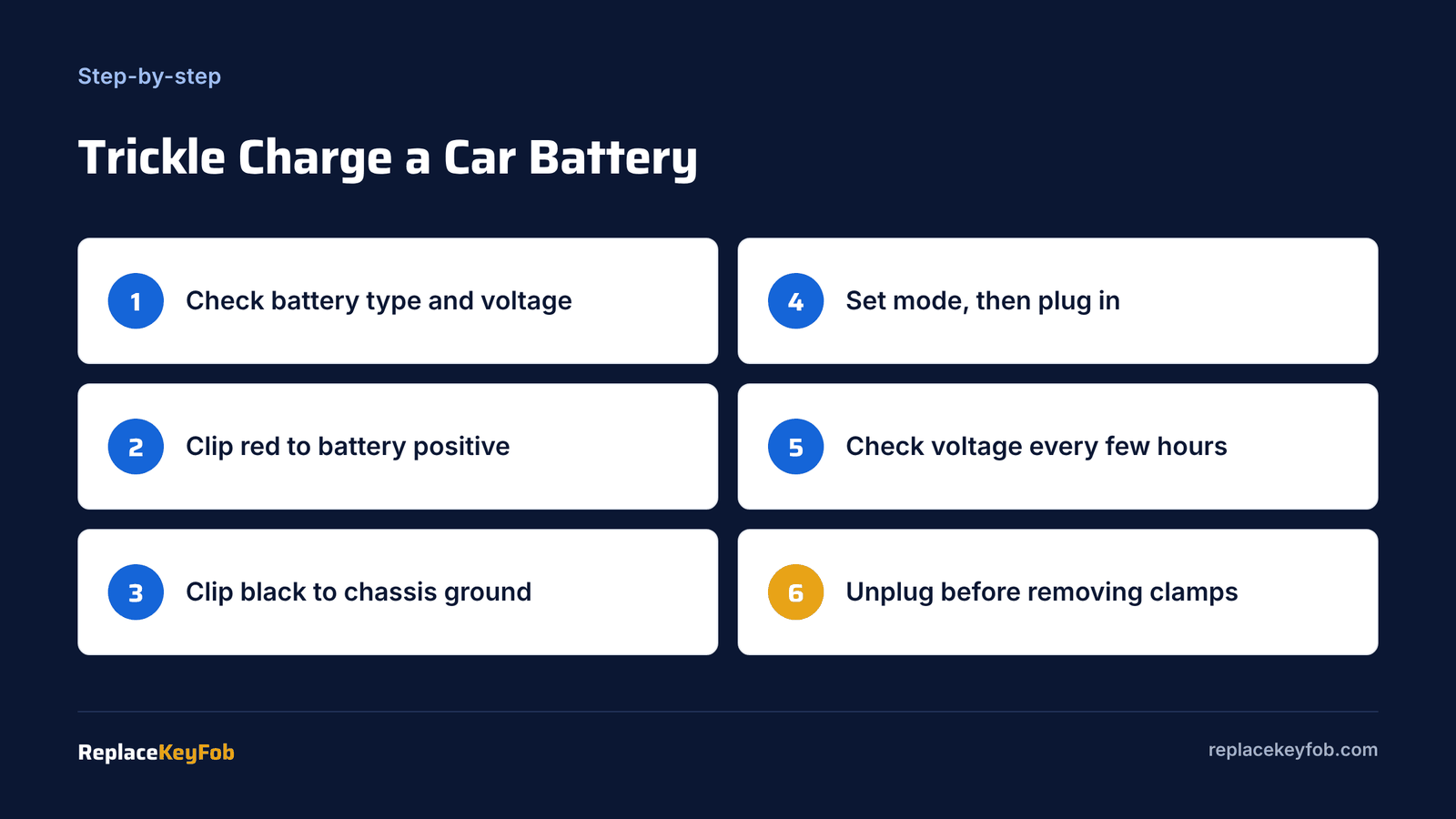
- Park in a ventilated space. An open garage or driveway is fine. Charging releases a small amount of hydrogen gas, so keep sparks, cigarettes and open flames away.
- Turn everything off. Remove the key or move the smart key away from the car. Lights, radio and climate control should be off so the charger is not fighting a load.
- Make sure the charger is unplugged. Connecting clamps to a live charger is the most common cause of sparks at the battery.
- Clean the terminals if needed. Corrosion blocks current. A quick scrub with a brush helps; our post on battery terminal corrosion explains the baking soda method.
- Clip the red clamp to the positive (+) post. The positive post is usually marked with a plus sign and a red cover.
- Clip the black clamp to a bare metal ground. Use an unpainted bolt on the engine block or a strut tower, at least a foot away from the battery. Connecting away from the battery means any spark happens far from the vent caps. If the battery is out of the car, clip black straight to the negative (-) post.
- Pick the mode. Choose flooded, AGM or lithium to match the battery label. Lithium batteries need a lithium mode; a lead-acid profile can damage them.
- Plug the charger in and switch it on. The display or LEDs should show that charging has begun.
- Monitor it. Check the charger every few hours the first time. A smart charger will show “full” or a green light when it switches to float.
- Disconnect in reverse. Unplug the charger from the wall first, then remove the black clamp, then the red clamp.
Why the hookup order matters
The last connection in any circuit is where a spark can happen. By making that last connection at the wall outlet, far from the battery, you keep any spark away from hydrogen gas. Clamping black to chassis ground instead of the negative post is the same idea, and it is what most charger manuals and carmakers recommend for batteries left in the vehicle.
How Long to Leave a Trickle Charger On
A simple estimate is the amp-hours you need to replace divided by the charger’s amp rating, plus about 20 percent for losses.
| Battery condition | 1 amp charger | 2 amp charger |
|---|---|---|
| 75 percent charged (about 12.4 V), 50 Ah battery | About 15 hours | About 8 hours |
| 50 percent charged (about 12.2 V), 50 Ah battery | About 30 hours | About 15 hours |
| Nearly flat (about 12.0 V), 60 Ah battery | About 50+ hours | About 25 to 36 hours |
| Motorcycle, 12 Ah, half charged | About 7 hours | Not recommended over 1 to 2 A |
These are rough numbers. Cold batteries accept charge more slowly, older batteries hold less, and AGM batteries usually finish a little faster than flooded ones.
Can you leave it on overnight or for weeks?
- Smart charger with float mode: yes. Once full, it holds the battery at roughly 13.2 to 13.6 volts and tops up only when voltage falls. This is how most people keep stored cars and bikes ready.
- Basic manual trickle charger: only overnight with supervision. Without automatic shutoff, it keeps pushing current and can boil off electrolyte. Unplug it once the battery reaches about 12.6 to 12.7 volts at rest.
If your goal is long-term storage rather than recovery, read battery maintainer vs trickle charger. A maintainer is built to stay connected for months.
Trickle Charging Different Vehicles
Cars and trucks
Most cars can be trickle charged right in the engine bay. Some models, including many BMWs, Mercedes and Chrysler products, put the battery in the trunk or under a seat and provide remote positive and ground posts under the hood. Use those posts; they are designed for charging and jump starting.
Motorcycles, ATVs and lawn tractors
Small batteries need small current. Use a charger rated around 0.75 to 1.5 amps, or one with a motorcycle mode. Many bike chargers come with a ring-terminal pigtail you bolt to the battery once, so future charging is just a plug. Lithium motorcycle batteries are common now and need a lithium-compatible charger.
Start-stop cars with AGM or EFB batteries
These cars often have a battery sensor on the negative terminal. Clip the black clamp to a chassis ground point, not the negative post, so the sensor sees the charge current and keeps its battery-state estimate accurate. Do not clip onto the sensor body.
Hybrids and EVs
The 12-volt battery in a hybrid or EV can be trickle charged, but use the jump or charging points in the manual. Some sit far from the battery itself.
If the Trickle Charger Does Not Work
| Symptom | Likely cause | What to do |
|---|---|---|
| Charger shows error or no battery | Voltage under about 10.5 V, or bad clamp contact | Clean contact points; use a charger with a repair or force mode, or test the battery |
| Charger runs for days and never says full | Shorted cell or heavy sulfation | Load test the battery; it is likely worn out |
| Battery full but dead next morning | Parasitic drain or failed battery | Test for drain; see car clicks but won’t start |
| Battery gets hot or smells of rotten eggs | Overcharging or internal short | Unplug at once, ventilate, replace battery |
| Clamps spark when connecting | Charger was plugged in | Always connect clamps before plugging in |
Mistakes to Avoid
- Charging a frozen battery. Thaw it first and check for cracks.
- Using a lead-acid mode on lithium. It can trigger the battery’s protection or damage cells.
- Forgetting a basic charger for a week. Without float mode, it will overcharge.
- Clipping onto painted metal. Paint is an insulator; the charger may not detect the battery.
- Running a thin extension cord. Use a 14 gauge or heavier cord if you must extend.
- Assuming charging fixes everything. If the battery is old, charging only buys time.
When to Replace Instead of Charge
If the battery reads full after charging but drops below about 12.4 volts within a day, or it cannot crank the engine after a full charge, it has lost capacity. Most car batteries last about 3 to 5 years. A parts store will usually load test it for free, and a new battery typically costs about $150 to $400 installed. Our guide to car battery replacement cost breaks down the price by type.
Related guides: How to Store a Car Battery for Winter or Vacation; How to Keep a Car Battery Charged When You Don’t Drive; 6 Best Battery Maintainers for Cars (2026): Storage and Winter Picks.
Frequently Asked Questions
No. Most cars can be charged with the battery connected. Turn everything off, clip red to positive and black to chassis ground. Remove the battery only if the manual says so or you are charging it indoors.
Most trickle chargers deliver about 0.75 to 2 amps. That low rate is gentle on the battery but slow, so a flat car battery can take a day or two to refill.
Sometimes. If the battery dropped below about 10.5 volts, many smart chargers will not start without a special mode. Even if it charges, a battery that sat fully flat for weeks often has permanent sulfation.
Use a low-amp charger with a motorcycle or small-battery mode, connect red to positive and black to negative or frame ground, then plug in. Many riders install a quick-connect pigtail for easy winter charging.
A smart charger with float mode is safe to leave on overnight and longer. A basic unit without automatic shutoff should be checked and unplugged once the battery is full.