
Why Your Key Fob Battery Dies Overnight: Causes, Tests, and Fixes

If your key fob battery dies overnight, that usually points to more than normal battery aging. A coin cell can wear out over time, but losing power in a day or two often means something is actively draining it: a stuck button, corrosion, water intrusion, a bad battery contact, or in some cases the car itself waking the fob repeatedly.
I’ve seen plenty of car owners replace the battery twice and still have the same problem. That’s the clue. When a fresh battery fails fast, the issue is often in the fob hardware or the vehicle’s proximity system—not just the battery brand.
Here’s the practical way to sort it out without guessing.
Quick comparison: battery, fob, or vehicle?
| Symptom pattern | Most likely cause | What to do next |
|---|---|---|
| First battery is old, weak, or cheap; new battery lasts normally | Battery problem | Replace with a quality coin cell and monitor it |
| New battery dies again within days or overnight | Fob hardware problem | Inspect buttons, contacts, moisture, and case damage |
| Both key fobs act up the same way | Vehicle-side issue or environment | Check the car’s receiver/proximity system and battery condition |
| Fob works only when pressed hard or button feels sticky | Stuck or worn button | Clean or repair the fob case and button pad |
| Fob was exposed to rain, a spill, or condensation | Corrosion or internal short | Open and inspect immediately; dry or replace as needed |
| Battery drains only when fob is stored near the car | Proximity wake-up behavior | Move the fob farther from the vehicle overnight |
Why a key fob battery can drain so fast
A normal key fob battery should not usually die overnight just from sitting in a drawer. When it does, something is likely making the fob transmit or stay “awake” more often than it should.
One common pattern is proximity-key behavior. Modern smart keys can communicate with the vehicle when you get close, and if the fob is stored near the car, it may keep trying to connect. That matters most with push-button-start systems and passive entry setups.
A damaged fob can also drain batteries quickly. Moisture, corrosion, a cracked shell, or a faulty button can create intermittent current draw or repeated wake-ups that shorten battery life much faster than normal.
For a broader look at how a weak vehicle battery can confuse the picture, see our guide on how a bad car battery can cause key fob problems and how a weak car battery can affect your key fob.
The most likely causes, from easiest to check to more serious
1) The battery itself is weak or low quality
If the coin cell is old, sat on a shelf for a long time, or came from a bargain pack, it may fail sooner than expected. That said, a bad battery usually shows up as weak range or intermittent operation—not repeated overnight death unless another issue is present.
What to look for: no visible fob damage, normal button feel, and no moisture signs.
2) A button is stuck or partially pressed
A worn button can stay slightly engaged inside the shell. That can make the fob transmit repeatedly, which drains the coin cell faster than normal.
Common clue: the lock or unlock button feels mushy, sits lower than the others, or responds only when pressed from one angle.
3) Corrosion or water damage inside the fob
Moisture can create a path for current to leak where it shouldn’t. Even a little corrosion around the battery contacts can cause trouble, especially after rain, a spilled drink, or a fob that got washed in clothing.
Common clue: green or white residue near the battery terminals, fogging inside the case, or a musty smell.
4) The battery contacts are loose or bent
If the battery can shift, lose pressure, or touch the contacts unevenly, the fob may behave erratically. This can look like a dead battery when the real problem is the connection.
Common clue: the battery rattles, sits crooked, or the fob works when squeezed.
5) Proximity-key wake-up behavior
Some smart keys communicate more than older remotes do. If the fob is stored very close to the vehicle, it may keep waking up or trying to connect.
Common clue: the battery only dies when the fob is parked near the car, especially in a garage.
6) Vehicle receiver, BCM, or electrical fault
If the car’s receiver or body control module is keeping the system active, the fob may be pulled into a constant communication loop. This is less common than a bad fob battery or a damaged case, but it becomes more likely when multiple fobs are affected.
Common clue: both fobs drain quickly, or the vehicle has other electrical oddities like erratic locking behavior.
What to do first: simple checks you can do at home
Inspect the fob case and buttons
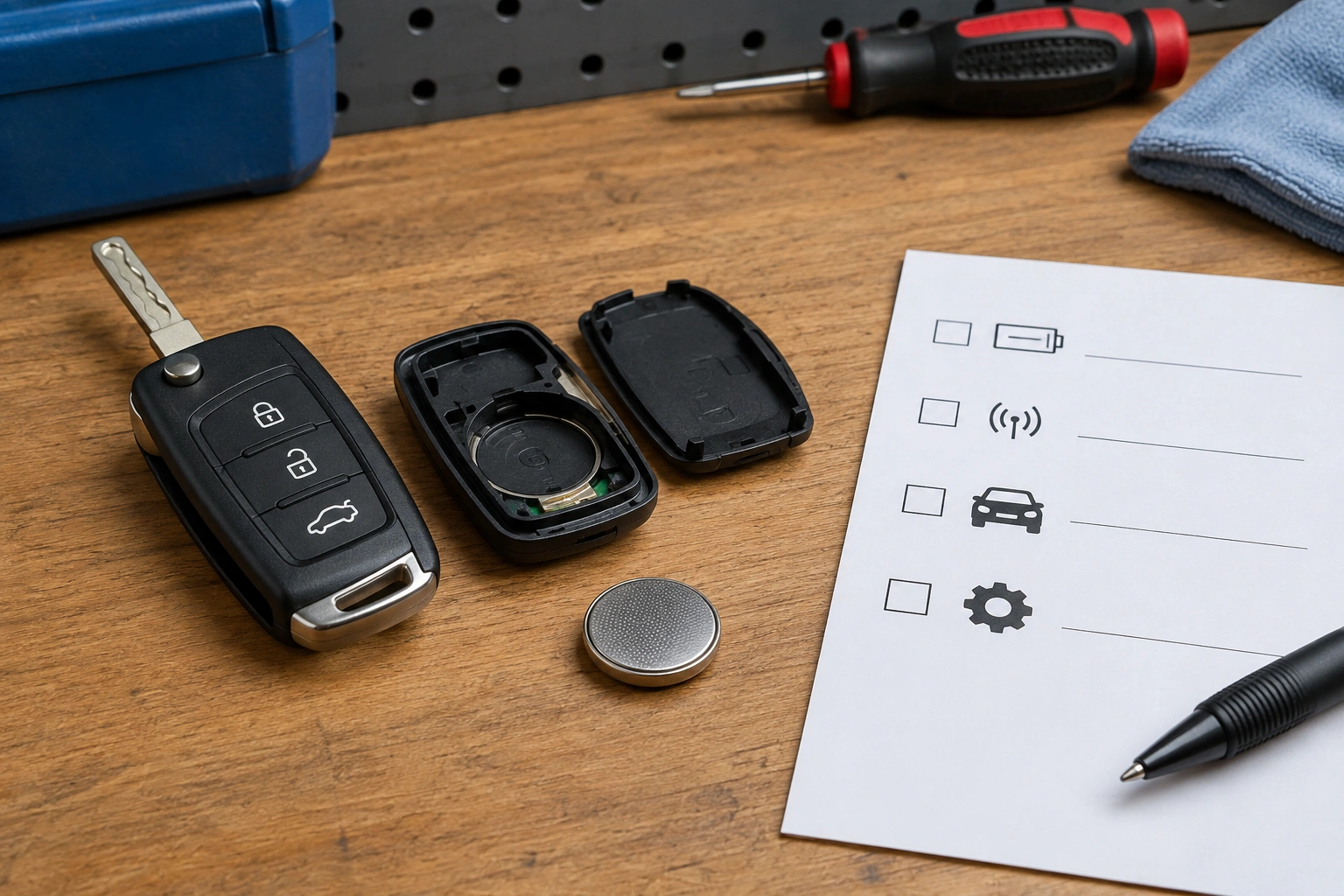
Open the fob carefully. Don’t pry so hard that you crack the housing or damage the circuit board. Look for:
– sticky or sunken buttons
– moisture marks
– corrosion on the battery contacts
– a warped or cracked shell
If the buttons feel off, that’s a strong sign the fob itself is the problem.
Replace the battery with a known-good one
Use a fresh coin cell from a reputable source. In repeated-drain cases, an OEM battery is often a better diagnostic step than the cheapest aftermarket pack. A low-cost battery can confuse the diagnosis because it may fail early for its own reasons.
If the new battery lasts normally, the old battery was probably the issue. If it dies again quickly, move on.
Test the fob overnight with the battery removed
This is one of the simplest ways to isolate the problem.
- Remove the battery from the fob.
- Leave the fob away from the car overnight.
- Reinstall the battery the next day and test it.
If the battery is still fine after sitting out of the fob, but dies when installed, the fob is likely draining it. If the battery dies even while removed, the battery itself is likely defective.
Compare with a second key fob
If you have a spare fob, use it for a day or two. If only one fob drains batteries, the problem is in that specific fob. If both do it, the car or the storage location is more suspicious.
How to test whether the fob is draining the battery
A multimeter helps, but you don’t need one to get useful clues.
Simple battery check
Measure the coin cell before installing it, if you have a multimeter. Then check it again after the overnight test. A battery that reads fine before installation but is empty the next morning is being drained somewhere.
Button pressure test
Press each button and listen or feel for one that sticks. A button that doesn’t spring back cleanly can keep the fob active longer than it should.
Storage-location test
Move the fob far from the car for one night. If the battery survives, proximity wake-up behavior may be involved.
Swap-test with another fob
If the same battery behaves differently in two fobs, that’s a strong sign the fob hardware is the issue, not the battery.
Use the vehicle’s proximity-key disable or fob-sleep mode if available
Some vehicles let you temporarily disable passive entry or put the smart key to sleep. If your model has that feature, turn it off for one night and compare results. If the drain stops, the car’s wake-up behavior is more likely; if it continues, the fob itself is more suspect.
When the car is the real problem
A vehicle-side issue is more likely when:
– both fobs drain quickly
– the problem happens only with smart keys or passive entry
– the car has other electrical symptoms
– the fob seems fine, but batteries still vanish
That can point to the vehicle receiver, BCM, or a related module staying active. A weak vehicle battery or charging problem can also make the system behave unpredictably and make a key fob drain look worse than it really is.
If you suspect the car instead of the fob, a professional diagnosis is usually the best move. For a deeper comparison of symptoms, our article on whether a weak car battery affects your key fob is a good next stop.
For general vehicle safety information and recalls, the NHTSA is a reliable reference point.
Fixes you can try right now
Clean the contacts
Use a dry, lint-free cloth first. If you see corrosion, clean only as much as needed and let the fob dry fully before reassembly. If the corrosion is heavy, the board may already be damaged.
Dry the fob thoroughly
If the fob got wet, open it and let it dry in a warm, dry place. Don’t use high heat. Heat can warp the case or damage the board.
Replace the battery with a better-quality coin cell
If you’ve been using an inexpensive aftermarket battery, try an OEM or reputable brand battery next. That won’t fix a damaged fob, but it removes one variable.
Stop using a suspect fob until you inspect it
If one fob is clearly acting up, set it aside. Repeatedly feeding it new batteries can waste money and delay the real repair.
Move the fob away from the car
If the battery only dies when the fob is near the vehicle, store it farther away overnight. That’s a practical workaround while you diagnose the root cause.
When to repair the fob versus replace it
Repair makes sense when:
– the case is cracked but the board looks clean
– a button is worn or sticky
– the battery contacts need cleaning
– the fob got damp but wasn’t soaked for long
Replacement makes more sense when:
– the circuit board shows corrosion
– the housing is badly damaged
– the same fob keeps killing batteries after a fresh battery and cleaning
– the internal electronics behave inconsistently even after inspection
In short: if the problem is on the outside, repair may be enough. If the board is damaged, replacement is usually the more dependable path.
When to consult a locksmith
A locksmith is often the right next step when the problem looks like fob hardware, not a vehicle module. They can usually inspect the shell, contacts, buttons, and internal damage faster than a dealer for many common remotes. If the issue traces to the vehicle’s receiver, BCM, or other module, dealer-level diagnostics are usually needed.
Go to a dealer when:
– multiple fobs are affected
– the car has smart-key or BCM-related symptoms
– you need vehicle-specific diagnostics
– the system may need module-level testing
If the issue is clearly a damaged fob, a locksmith may be the simpler route. If the car itself seems to be waking the fob or draining it, dealer diagnostics are more appropriate.
How to keep overnight drain from coming back
Store the fob away from the car when possible. Don’t leave it where the vehicle can keep waking it up.
Also, pay attention to early warning signs:
– buttons that start feeling sticky
– shorter range
– intermittent lock/unlock response
– moisture or corrosion around the battery
Those are the hints that a “battery problem” may actually be a fob problem in the making.
If your fob is acting up after exposure to moisture or the battery keeps dying again after replacement, don’t keep cycling coin cells and hoping for the best. That usually means the fob needs inspection, not another battery.
For owner-manual guidance on smart-key behavior and storage recommendations, Edmunds and your vehicle’s manual are both useful places to compare model-specific advice.
FAQ
Why does my key fob battery die overnight?
The most common reasons are a stuck button, corrosion or moisture inside the fob, a weak or poor-quality coin cell, or a proximity system that keeps waking the fob when it is stored near the vehicle.
How can I tell if it’s the battery or the fob?
If a fresh battery works normally in the fob, the old battery was likely the issue. If a fresh battery dies again quickly in the same fob, the fob is more likely draining it.
What does it mean if both key fobs drain fast?
If both fobs are affected, the vehicle side becomes more likely: the receiver, BCM, passive entry system, or even a weak vehicle battery may be contributing.
Can a locksmith fix a draining key fob?
Often yes, if the issue is limited to the fob case, battery contacts, buttons, or internal damage that can be repaired. If the car’s module or receiver is causing the drain, dealer diagnostics are usually needed.
Should I replace the fob if the battery keeps dying?
If the same fob keeps killing good batteries after cleaning and inspection, replacement is often the more practical choice.
