
Key Fob Battery Replacement Didn’t Fix It? Here’s What to Check Next

If you replaced the battery and your key fob still won’t unlock the doors, start the car, or respond consistently, don’t assume the fob is beyond saving. In most cases, the problem is one of a few practical issues: the battery is the wrong type, it’s installed poorly, the fob needs to be resynced, the internal electronics are damaged, or the car itself has a receiver or fuse issue.
The good news is you can narrow it down pretty quickly without special tools. I’m Jason Carter, and after years in the shop, I can tell you that a lot of “dead” key fobs turn out to be a simple contact problem or a vehicle-side fault that looks like a fob failure.
First, confirm the battery change was actually correct
A fresh battery only helps if the fob can use it properly. That sounds obvious, but this is where a lot of people get stuck.
Check the battery type
Many fobs use a CR2032 coin-cell battery, but not all do. Some use a different size or thickness, and even a battery that “almost fits” can cause weak or no contact. The battery compartment should match the exact type listed in your owner’s manual or on the old battery.
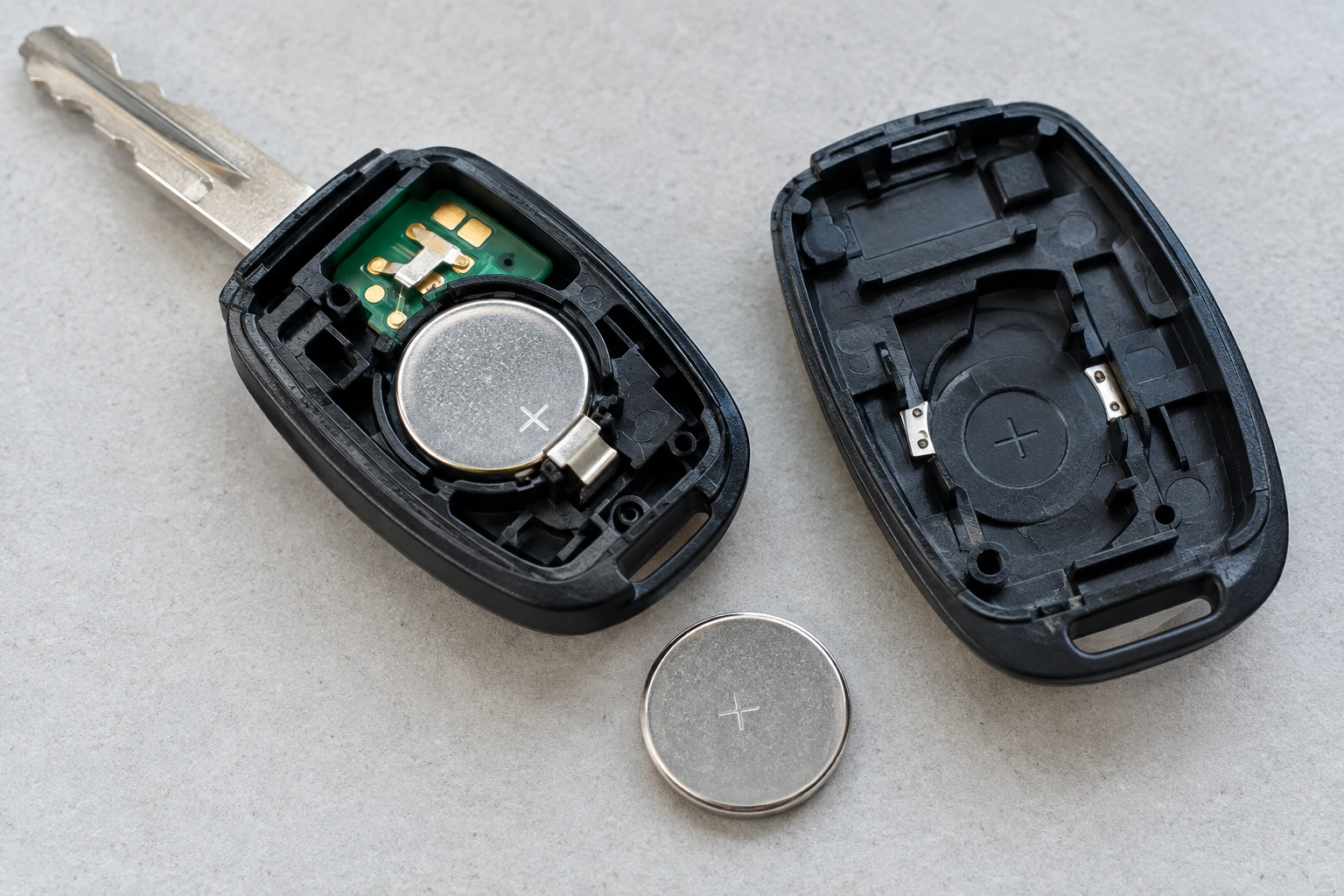
Check polarity
A coin-cell battery can fit in the holder upside down. If the positive and negative sides are reversed, the fob will usually do nothing at all. Compare the new battery to the old one before you close the case.
Check contact pressure
Even with the right battery installed correctly, the metal contacts inside the fob may not press firmly enough against the battery. If the battery rattles, sits crooked, or only works when you squeeze the case, the issue may be a loose contact or a worn battery tray.
A quick test: remove the battery, inspect the contacts, and reinstall it so it sits flat and tight. If the case won’t close cleanly, forcing it can crack the shell or shift the battery out of place again.
Use a spare battery or spare key fob to isolate the problem
The fastest way to avoid guessing is to compare the problem fob against something known to work.
Try a known-good battery
If you have another new battery from the same pack, test it. If the fob suddenly works with the second battery, you found the issue.
Try the spare key fob
If your spare fob works normally, the car is probably fine and the original fob is the problem. That points you toward the fob shell, buttons, battery contacts, or internal circuit board instead of the vehicle.
If neither fob works, that’s a strong clue the car-side system is involved.
Match the symptom to the likely cause
Not every key fob problem means the same thing. The symptom matters.
| Symptom | Likely direction to check first |
|---|---|
| Fob does nothing at all | Battery installation, contact issue, internal fob damage |
| Fob works only when pressed hard | Worn buttons, cracked case, weak contact pressure |
| Locks/unlocks sometimes, but not always | Weak battery contact, worn buttons, intermittent board fault |
| Fob unlocks doors but won’t start car | Transponder, immobilizer, or push-to-start recognition issue |
| Neither of two fobs works | Vehicle receiver, fuse, or central locking issue |
That last line is the big one. If both fobs fail after a battery replacement, the odds shift away from the fob itself and toward the car.
Inspect the fob for visible damage
If the battery checks out and the spare doesn’t settle the question, look closely at the fob body.
Water intrusion or corrosion
Open the fob and inspect the circuit board and battery terminals. Green or white corrosion, water spots, or rust on the contacts is a bad sign. In those cases, another battery usually won’t help because the current can’t move through damaged metal or a compromised board.
Worn or stuck buttons
Buttons that feel mushy, stick down, or require excessive pressure can prevent the fob from sending a clean signal. Sometimes the rubber pad inside the shell wears out before the battery does.
Cracked case or loose board
If the case is cracked or the circuit board shifts around inside, the fob may work only at odd angles. That usually means the shell or internal mount is failing.
If you see corrosion or board damage, repair or replacement is usually a better next step than another battery swap.
Try resyncing or reprogramming the fob
If the fob looks physically fine but still won’t respond, it may need to be resynced with the vehicle. This is more likely after a battery change on some models, but the exact procedure varies by make and model.
Some vehicles allow a DIY resync or reprogramming routine, while others require dealer or locksmith tools. If the fob was working before the battery change and now acts out of sync, a resync is worth trying before you replace the fob.
If you want a model-specific walkthrough, the article Key Fob Not Working After Battery Replacement? Here’s How to Fix It covers the common reset path, and Key Fob Not Detected With a New Battery: What to Check and How to Fix It is useful when the car still won’t recognize the fob.
Check the vehicle-side causes
When a new battery doesn’t change anything, the car may be the part that’s failing.
Fuse or central locking issue
If the doors won’t respond to either fob, check whether the interior lock switch works. If the switch also fails, the problem may be farther inside the vehicle’s locking circuit or a blown fuse.
Receiver module problem
The receiver module has to detect the fob signal. If it is faulty, the fob can be fine and still go nowhere. This is especially likely if the fob works only at very short range, works intermittently, or both fobs act the same way.
Dead car battery or low system voltage
A weak car battery can sometimes prevent push-to-start recognition even when the fob itself is fine. If the car cranks slowly, shows other electrical issues, or behaves oddly with the key fob nearby, check the vehicle battery as part of the diagnosis.
Interference
Sometimes the fob is fine, but the environment is not. Other electronic devices, nearby radio interference, or even parking in a location with a lot of signal noise can reduce range. If the fob works normally in one place and not another, note whether it seems like a range problem or a total failure before you replace anything.
For a broader safety and vehicle-information reference, NHTSA is a solid starting point for consumer vehicle guidance: NHTSA.
Battery issue vs. fob failure vs. car problem
Here’s the simplest way to think about it:
- Battery issue: New battery works, but only after correcting orientation or contact fit.
- Fob hardware failure: Spare battery doesn’t help, the case is damaged, or the buttons feel worn.
- Vehicle-side problem: Two fobs fail the same way, or the car’s locks/receiver behave strangely too.
That distinction saves time and money. If you keep buying batteries when the receiver is the real problem, you’ll never get a result.
Repair, replace, or diagnose?
Once you know where the failure is pointing, the next step gets easier.
Repair the fob if:
- The case is cracked but the board is intact
- The battery contacts are bent or weak
- The buttons are worn but the electronics still work
This is the middle ground. It can be cheaper than a full replacement if the board is still healthy.
Replace the fob if:
- There is corrosion on the circuit board
- The board is damaged by water or impact
- The fob no longer responds even with a known-good battery and no visible contact problem
At that point, replacement is usually more practical than trying to revive a failing board.
Diagnose the car if:
- Both fobs fail
- The locks act up from the interior switch too
- The car shows “key not detected” or similar symptoms across multiple keys
That points away from the battery and toward the vehicle’s receiver, fuse, or programming system.
When to consult a locksmith
If the problem isn’t solved by battery checks, a spare fob, or a basic resync, an automotive locksmith is often the most efficient next call. A locksmith can usually test the fob, program a replacement, and determine whether the issue is the key or the vehicle.
A dealer is often the better first call for newer vehicles, proximity-entry systems, or models that require dealer-only programming tools. A locksmith is often the better first call for older vehicles, standard remote systems, or when you want a faster on-site diagnosis and replacement option.
For a general comparison of vehicle service guidance and ownership resources, Edmunds is a helpful consumer reference: Edmunds car ownership resources.
Quick troubleshooting checklist
Before you spend money, run through this order:
- Confirm the battery type matches the fob.
- Recheck battery polarity and contact fit.
- Test a second known-good battery.
- Try the spare key fob.
- Look for corrosion, water damage, or cracked parts.
- Try a model-specific resync or reprogramming step.
- Check whether the car’s interior lock switch, receiver, or vehicle battery may be the real issue.
- Call a locksmith or dealer if the fob still won’t respond.
If you’ve made it through that list, you’ve already done the most useful diagnosis work. At that point, the answer is usually clear enough to decide between repair, replacement, or vehicle-side service.
FAQ
Why did my key fob stop working right after I changed the battery?
Usually because of a battery installation issue, a weak contact, or a fob that needs to be resynced. Less often, the battery change simply exposed an existing problem like worn buttons or corrosion.
Can a battery replacement erase key programming?
Usually no, but some vehicles may need a resync or reprogramming step after a battery change. If the fob worked before and now doesn’t, don’t assume the key is erased; check the physical fit and programming path first.
What if the fob unlocks the car but won’t start it?
That can point to a transponder or immobilizer recognition issue rather than a lock/unlock signal problem. The remote portion and the start-authorization portion are not always the same system.
Should I replace the fob or try to repair it?
Repair makes sense if the shell, contacts, or buttons are the only problems. Replace it if the board is corroded, water-damaged, or completely unresponsive with a known-good battery.
When should I stop DIY troubleshooting?
If both fobs fail, the car shows no response from the locks, or the fob still won’t work after a proper battery check and resync attempt, it’s time for a locksmith, dealer, or mechanic to diagnose the vehicle-side system.
