
Key Fob Dropped and Now Not Working? Here’s How to Diagnose It Fast

If your key fob dropped now not working, the good news is that the drop did not automatically kill it. In a lot of cases, the impact simply jarred the battery loose, cracked a contact, or shifted an internal part just enough to stop the signal from reaching the car.
The tricky part is that a dropped fob can look perfectly fine on the outside while the battery, circuit board, or shell inside has moved out of place. That means the fastest fix is usually not guessing — it’s narrowing the problem down step by step.
Here’s the useful shortcut: if the fob stopped working immediately after the drop, suspect impact damage or a battery connection issue first. If it still works sometimes, that often points to a loose battery, worn contacts, or a cracked solder joint rather than a completely dead unit.
Quick diagnosis flow: what to check first, second, and third
- Test the spare key fob first. If the spare works, the car is probably fine and the dropped fob is the problem.
- Check the battery and battery contacts. A loose coin cell or bent contact is one of the most common drop-related failures.
- Separate remote-button failure from start-authority failure. If the doors unlock but the car will not start, the remote side may still work while the transponder chip or immobilizer side has failed.
That order keeps you from wasting time on reprogramming when the real issue is a broken battery contact, damaged shell, or cracked board.
Why a dropped key fob stops working
A key fob is small, but it is not delicate in the way a phone might be. It still has a battery, a circuit board, button contacts, and often a transponder chip that all need to stay aligned. A hard drop can disturb any of those parts.
The most common failure modes are:
- Battery movement or dislodgement: the coin cell shifts and loses contact
- Weak or dying battery: the drop exposes an already marginal battery
- Loose internal contacts: the metal tabs no longer press firmly on the battery
- Cracked circuit board (PCB): impact damage can break a solder joint or trace
- Broken shell or buttons: the case may flex enough to keep a button pressed or prevent one from making contact
- Moisture damage: if the fob was dropped into water or a wet area, the failure may show up later
- Lost synchronization: less common, but some fobs may need to be resynced after an interruption
The important distinction is that remote-button failure and start-authority failure are not always the same problem. The remote buttons mainly rely on the battery, PCB, and button contacts. The ability to start the car on many push-to-start systems also depends on a transponder chip or related immobilizer function. A drop can damage one side without fully killing the other.
First, identify the symptom pattern
Before opening the fob, pay attention to what actually stopped working. The symptom usually tells you where to look next.
1) Nothing works at all
If lock, unlock, panic, and remote start all fail, the battery or battery connection is the first suspect. If a battery swap does nothing, the problem may be internal damage.
2) It works only sometimes
Intermittent function usually means a loose battery, weak contact, or a cracked solder joint. A fob that works after you squeeze the case or tap it lightly is rarely “fine” inside.
3) Doors unlock, but the car will not start
That split matters. On a push-to-start system, the remote buttons can still work while the transponder chip or vehicle recognition side fails. In that case, the issue may be communication, sync, or chip damage rather than the button side of the fob. A drop can damage the transponder chip or the part of the fob that supports start authorization even if the lock and unlock buttons still respond.
4) Only one button fails
If lock works but unlock does not, or the trunk button is dead while the others respond, the problem may be a worn button pad, dirty contact, or a damaged trace on the board. That kind of partial failure is often repairable.
If the trunk function is the only one acting up, this guide on key fob trunk button problems can help you compare symptoms.
Most likely causes, in order
When a fob quits after being dropped, I’d think about the causes in this order:
- Battery dislodgement or weak battery
- Loose or bent battery contacts
- Internal PCB damage
- Broken shell or button assembly
- Moisture intrusion
- Lost synchronization or programming issue
- Vehicle-side problem
That order matters because it keeps you from jumping straight to replacement. A battery problem is cheap and easy to rule out. A board problem is much more serious.
Quick checks you can do in under 5 minutes
These checks do not require special tools, and they often tell you whether the fob is worth opening.
Check 1: Try the spare key fob
This is the fastest way to separate fob trouble from car trouble.
- If the spare works normally, the car battery and receiver are probably fine.
- If both fobs fail, the issue may be the vehicle battery, receiver, or another car-side problem.
If your spare starts the car and unlocks the doors, that is a strong sign the dropped fob itself is the problem.
Check 2: Look for physical damage
Inspect the shell, seams, and buttons.
- Cracks near the battery cover can let the battery shift
- A loose button can stick or stop making contact
- A bent seam can mean the inside moved during impact
Check 3: Test response distance
Stand close to the car and press the buttons.
A weak or failing battery often still works only when you are very close. A fob that used to work from across the driveway but now only works inches from the door usually needs a battery or contact check.
Check 4: Watch for moisture signs
If the fob was dropped in a puddle, sink, snow, or wet garage floor, moisture may be the real cause. Water damage is common because the outside shell can look normal while the inside corrodes.
Check 5: Check for a dead car battery
If the car is slow to crank, the dash lights are dim, or the vehicle acts weak in general, the car battery may be part of the problem. A weak vehicle battery can make a good fob seem bad.
For a deeper look at start-side symptoms, see what to do when a key fob is not detected.
Step-by-step fixes to try first
Once you’ve done the quick checks, work through the simplest fixes in order.
1) Replace or reseat the battery
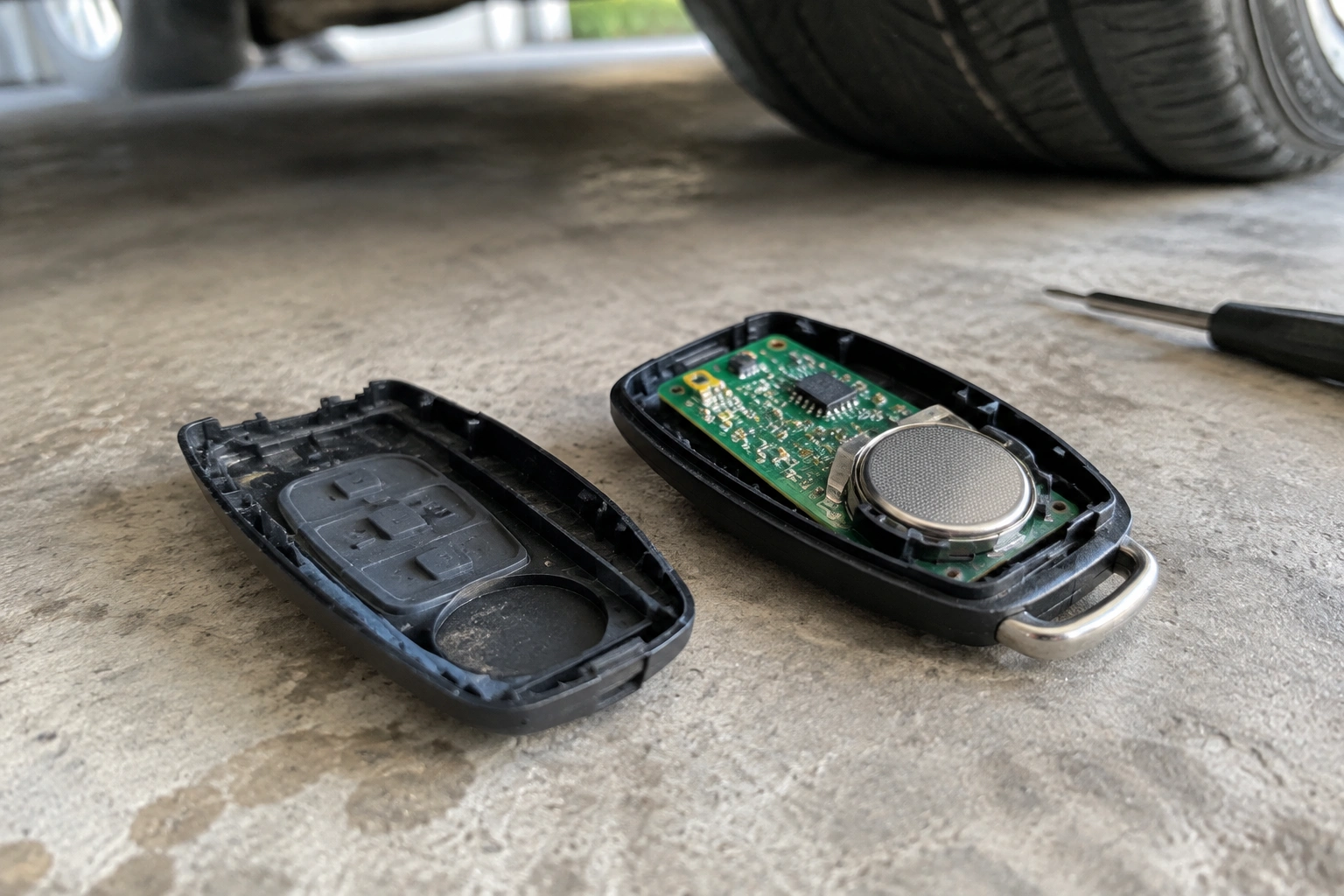
Open the fob carefully and remove the coin cell. If it looks loose, put it back in firmly and make sure the contacts hold it snugly.
If the battery is old, replace it with the correct type for your fob. A drop can expose a battery that was already near the end of its life. That is why a fresh battery is often the best first repair, even when the fob broke right after impact.
2) Inspect the battery contacts
Look for bent tabs, dirt, corrosion, or a contact that no longer presses against the battery.
A contact issue can cause a dead fob that comes back to life when you press the battery in place. If the metal tabs are slightly out of position, they may need to be gently adjusted. Be careful here — force can snap a tab or crack the board.
3) Check the circuit board and button pad
If the battery looks fine, inspect the PCB for obvious cracks, loose components, or signs that something shifted inside the case.
A board that has a cracked solder joint may still work intermittently. That is one reason a fob can seem “half dead” after a drop. If the board is visibly broken, repair becomes less practical.
4) Dry it out if moisture is involved
If the fob got wet, remove the battery right away and let the housing dry fully before testing again. Moisture trapped under the battery can corrode contacts and make the failure worse.
5) Reassemble and retest
After re-seating the battery and checking the contacts, close the fob fully and test it from a few feet away. If it starts working again, the issue was likely a loose connection rather than a major electronic failure.
How to tell if the problem is the fob or the car
This is where the spare fob earns its keep.
If the spare works
The car side is probably okay. That points back to the dropped fob, its battery, or its internal electronics.
If both fobs fail
Now look at the vehicle battery, receiver, or keyless entry system. A dead car battery can cause strange remote behavior, and some vehicles will act as if the key fob is at fault when the car is the real issue.
If the fob unlocks but won’t start the car
That often points to the transponder or immobilizer side of the system. The remote buttons and the start authorization system are related, but they are not always the same component. In a push-to-start vehicle, this difference matters a lot.
If the doors unlock but the dash says the key is not detected, the remote side may still be fine while the start-authority side needs attention. That can mean a damaged transponder chip, a board issue near the chip, or a vehicle-side recognition problem.
The National Highway Traffic Safety Administration has general consumer guidance on vehicle safety systems and recalls, which is useful if you suspect a broader vehicle issue rather than a simple remote problem.
When reprogramming or resynchronizing may help
A dropped fob can occasionally lose sync, especially if the battery was interrupted or the electronics glitched during the impact. Reprogramming is worth trying when:
- the battery is good
- the shell is intact
- the fob still shows some life
- the car has stopped recognizing it after the drop
Reprogramming is unlikely to help when the problem is physical, such as:
- a cracked PCB
- loose or bent battery contacts
- a broken button pad
- corrosion from moisture
- a damaged transponder chip
In those cases, the fob may need hardware repair or replacement instead of a reset. Some vehicles let you resync a fob at home, while others require manufacturer or dealer equipment. That is why it helps to check the vehicle’s procedure before assuming the fob is beyond saving.
Repair versus replacement: what makes sense after a drop?
A dropped fob is not automatically disposable. The right choice depends on what actually broke.
Repair often makes sense when:
- the battery contacts are loose or bent
- the shell is cracked but the board still works
- a button pad is worn or shifted
- the battery simply came loose inside the case
Replacement often makes more sense when:
- the PCB is cracked
- the transponder chip or board-mounted components are damaged
- the fob is badly water-damaged
- the fob still fails after a battery change and contact inspection
- the shell is broken in a way that no longer holds the battery securely
A damaged shell is often a repair job; a cracked PCB is usually a replacement job. If the board is intact but the case is broken, a shell replacement may be enough. If the board itself is damaged, trying to keep the fob alive may cost more time than it is worth.
Safe DIY opening and inspection
If you decide to open the fob yourself, do it gently.
- Use the correct pry point if the case has one
- Avoid forcing the seam, since clips can snap
- Keep track of small seals or rubber pieces
- Do not scrape the circuit board with metal tools
- Remove the battery before inspecting for moisture or corrosion
A careful opening is usually enough to check the battery, contacts, and board without causing extra damage. If the shell resists, stop and reassess rather than prying harder.
When to Consult a Locksmith, Dealer, or Repair Service
A locksmith is the right next step when the fob still does not work after a new battery, contact check, and spare-fob test — especially on a push-to-start vehicle. Locksmiths often have the tools to diagnose, program, and test fobs without the dealership wait.
A dealership may be the better option if:
- the vehicle uses specialized programming or security procedures
- the fob is tied to a high-security immobilizer system
- the model requires dealer-only programming equipment
- you need an exact OEM replacement
A repair service may be useful if:
- the shell is broken but the electronics are likely salvageable
- the board needs component-level inspection
- the fob has moisture or impact damage but may still be repairable
Call a professional sooner if:
- the car will not start and you are unsure whether the fob or vehicle is at fault
- the fob is tied to an immobilizer system
- the board looks damaged
- you need a replacement programmed
- the vehicle only accepts the fob through a backup reader or special procedure
That said, if the spare fob works and the dropped one does not, you already have a strong diagnosis. At that point, the question becomes repair versus replacement, not whether the car is the problem.
How to prevent repeat damage
Once you get the fob working again, protect it so you do not repeat the same failure.
- Use a protective case to soften future drops
- Keep the battery cover snapped on tightly
- Replace weak batteries before they start causing intermittent issues
- Avoid carrying the fob with heavy metal items that can stress the case
- Don’t toss it into cupholders, consoles, or bags where it can take repeated hits
A small case or cover is not just cosmetic. It can keep the battery seated and reduce the chance that another hard drop will shift the internal parts again.
Bottom line
If your key fob dropped now not working, the most likely causes are still the simplest ones: a loose battery, a bad contact, or internal impact damage. Use the spare fob first, then check the battery and contacts before assuming the whole unit is dead. If the fob is wet, cracked, or still intermittent after a battery swap, you may be looking at repair or replacement rather than a quick reset.
FAQ
Can a dropped key fob damage the transponder chip?
Yes, it can. The transponder chip is separate from the remote buttons on many vehicles, so a drop may affect start authorization even if lock and unlock still work.
If my key fob still unlocks the doors, is the battery definitely fine?
Not always. A weak battery can still power the remote buttons but fail when the fob needs more reliable communication, especially for push-to-start systems.
Will reprogramming fix a key fob that was dropped?
Sometimes, but only if the issue is sync-related. If the battery contacts, PCB, or transponder chip are damaged, reprogramming usually will not help.
Is it better to repair or replace a dropped key fob?
Repair makes sense for loose contacts, a cracked shell, or a battery issue. Replacement is usually better if the PCB is cracked, the chip is damaged, or the fob is water-damaged.
Should I open the fob myself?
You can, but do it carefully. Use the proper pry point, avoid forcing clips, and remove the battery before inspecting for corrosion or loose parts.
When should I call a locksmith instead of the dealer?
A locksmith is often a good first call for diagnosis and programming. A dealer is usually the better choice for specialized programming or vehicles that require OEM-only procedures.
