
Key Fob Not Working? A Practical Troubleshooting Guide for Dead, Damaged, and Unresponsive Fobs

A key fob problem usually falls into one of four buckets: the battery is dead, the fob is damaged, the car is not receiving the signal, or the vehicle is blocking the start because it cannot verify the fob. That order matters, because the fastest fix is usually the cheapest one.
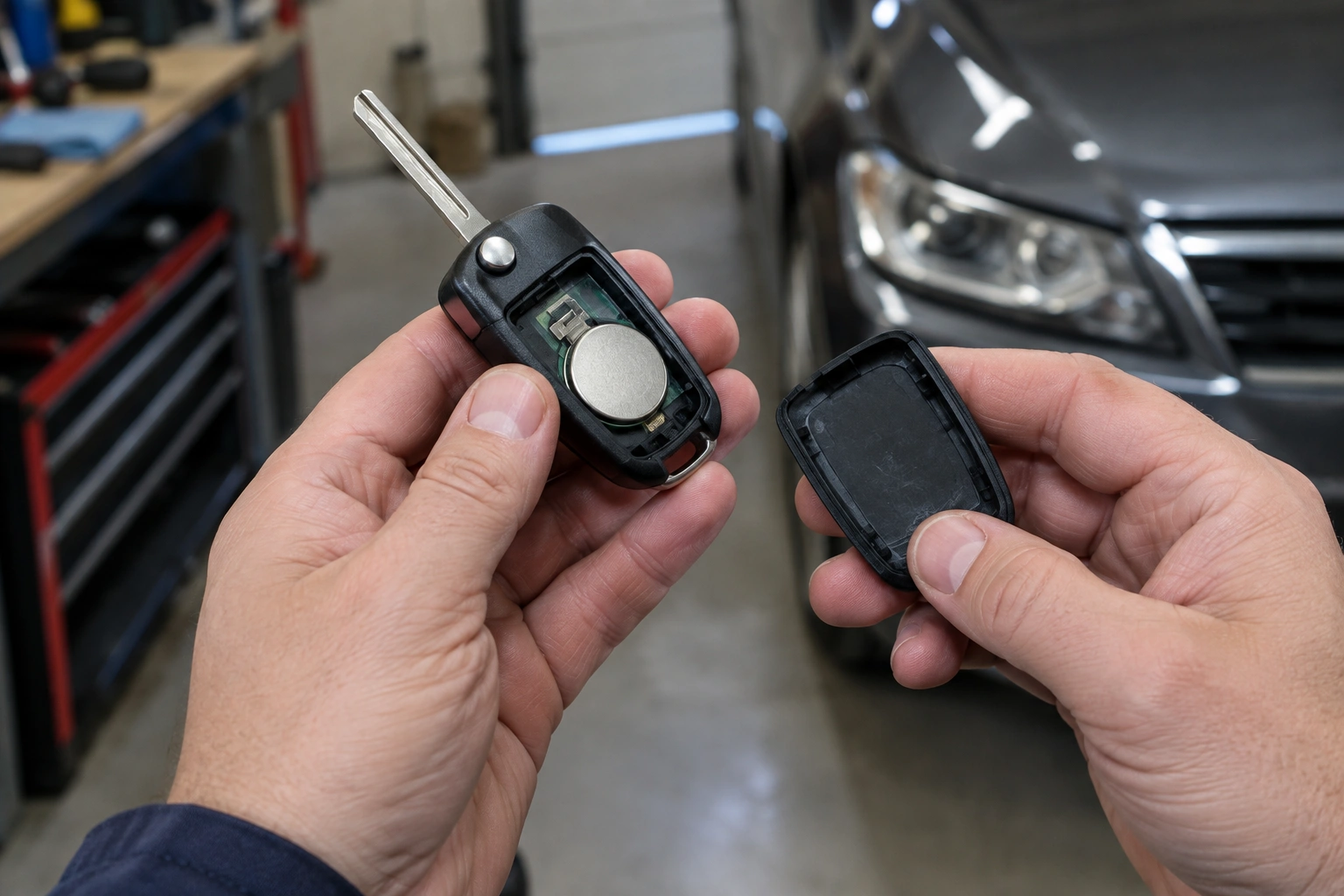
If you are standing next to the car with a fob that suddenly stopped unlocking, locking, or starting the engine, resist the urge to replace the whole thing right away. In my shop, the first question I ask is simple: did the fob go completely dead, or did it become weak and intermittent first? That symptom pattern often tells you whether you are looking at a battery issue, a worn button, moisture damage, or a vehicle-side problem.
The Fastest Likely Causes
A dead key fob battery is still the most common starting point, especially if the remote had been working normally and then suddenly became unreliable. But “dead” does not always mean the battery alone. A cracked case, worn button pad, corroded battery contacts, or a weak vehicle receiver can create the same symptoms.
Use this quick decision path:
- Fob is completely dead: replace the battery first, then check the battery orientation and contacts.
- Fob is intermittent: look for a weak battery, worn buttons, loose contacts, or moisture damage.
- Fob has short range: try a fresh battery first; if range stays poor, suspect interference or a failing fob.
- Car will not start with the fob: try the backup start method, then compare against a spare fob if you have one.
A few more useful comparisons:
- One fob works and another does not usually means the problem is inside the bad fob, not the car.
- Multiple fobs fail the same way points more toward the vehicle, receiver, fuse, antenna, or immobilizer side.
- Doors unlock but the car will not start often means the remote portion still works, but the transponder or smart-key side does not.
That one-fob-vs-multiple-fobs check is the fastest way to avoid replacing the wrong part.
Match the Symptom Before You Replace Anything
The quickest diagnosis comes from the pattern, not the guess.
If the fob worked yesterday and is dead today
That often means the battery finally gave out, but it can also happen if the battery tabs inside the fob slipped or oxidized. If the fob was dropped recently, the coin cell may still be fine while the case or contact points are not.
If the buttons work only when pressed hard
That usually points to worn button contacts or a failing rubber keypad. The battery may still be good.
If the fob works only close to the car
A weak battery is common, but interference matters too. Parking garages, nearby radio equipment, and even a metal structure can reduce range enough to look like a bad fob.
If the car unlocks but won’t start
That is a different failure path. The remote-locking side of the fob and the transponder or smart-key side are not always the same circuit. A fob can still unlock doors while the vehicle refuses to authorize starting.
If the fob was dropped, cracked, or exposed to water
Do not assume a battery swap will fix it. Physical damage often means the circuit board, button contacts, or battery holder has already been compromised.
Try the Easiest Fix First: Replace the Key Fob Battery
Battery replacement is the first move because it is cheap, fast, and often enough to bring the fob back to life. Many fobs use a CR2032 or CR2025 coin cell, but the exact battery depends on the vehicle and the fob design. Do not guess if you can avoid it.
How to confirm the correct battery
Open the fob carefully and look at the existing battery marking before buying a replacement. If the old battery is unreadable, check the owner’s manual, the inside of the fob shell, or the battery itself after removal. A CR2032 and a CR2025 can look similar, but they are not identical in thickness, and the wrong one may not make proper contact.
Basic replacement steps
- Remove the emergency mechanical key if your fob has one.
- Use a small plastic pry tool or a non-marring tool to open the shell.
- Note the battery orientation before removing it.
- Replace it with the same type and polarity.
- Snap the case back together firmly, without forcing it.
- Test lock, unlock, and start functions.
If the battery compartment shows green residue, white crust, or rust-colored corrosion, clean contact damage may be part of the problem. In that case, a new battery alone may not restore reliable function.
Battery replacement vs. full replacement
Battery replacement makes sense when the case is intact, the buttons feel normal, and the fob was only recently acting weak. Full replacement makes more sense when the shell is cracked, the button pad is worn through, or the board has visible damage.
Test Whether the Fob Is Actually Transmitting
Before you blame the car, check whether the fob is sending a signal at all.
Stand close to the vehicle and try each function deliberately: lock, unlock, panic, remote start if equipped, and push-to-start detection if applicable. If nothing works from very close range, the signal may not be leaving the fob.
Another useful clue is the indicator light on the fob, if your model has one. A light does not guarantee the radio signal is strong, but no light at all after a battery change can mean the battery was installed incorrectly or the fob has internal damage.
For a better diagnosis, compare it with a second fob if you have one. If the spare works and the original does not, the original is the likely failure point. If both fail the same way, the issue may be on the car side.
Use the Backup Unlock or Emergency Start Method
If the fob is dead and you need to get in or drive, most vehicles still have a backup path.
Use the mechanical key
Many smart keys hide a small mechanical key inside the fob. That key can usually unlock the driver’s door even when the remote electronics are dead. If you have not used it before, look for a release switch or button on the fob shell.
Use the emergency start method
Many push-to-start vehicles have a backup way to read a dead fob. Common methods include holding the fob directly against the start button, placing it in a designated slot, or holding it near a marked reader area. Exact placement and button behavior vary by make and model, so if you are unsure, check the owner’s manual for the specific reader location or start-button method.
If the manual is not available, look for obvious markings near the steering column, center console, cupholder area, or start button, and try the fob in the most likely reader spot. If the vehicle starts only when the fob is placed in the backup position, that usually points to a weak or dead fob battery rather than a completely failed transponder. If it still will not start, the problem may be deeper than the battery.
For official guidance on your specific starting and keyless-entry setup, the manufacturer’s manual is the safest source. For example, Toyota’s owner resources and Ford’s owner support both direct drivers to model-specific instructions.
What to Do If a New Battery Did Not Fix It
A fresh battery that changes nothing is a useful clue. It tells you the problem is probably not just power.
Check for a resync or reprogram step
Some vehicles may need a resync after a battery replacement or after the fob has been left disconnected long enough to lose its pairing behavior. This is not universal, and many fobs do not need reprogramming after a battery swap. But if the fob worked before and went silent after a battery change, a sync issue is worth checking before you buy a new remote.
Inspect the buttons and case
A cracked shell can shift the internal board out of alignment. A worn button pad can press unevenly, so one function may work while another fails. If the plastic is separating or the buttons feel mushy, the fob may be mechanically failing even if the battery is fine.
Look for water damage
Water damage is often sneaky. A fob may work for a day or two after drying, then fail again because corrosion continues on the circuit board. Signs include fogging, residue, green or white corrosion, and a battery compartment that looks stained.
Check the battery contacts
If the battery is loose, the contacts may not be pressing firmly enough. A fob can look fine from the outside and still lose power every time it is bumped.
How to Tell Whether the Problem Is the Fob or the Car
This is the decision point that saves the most money.
If one fob works and one does not, the bad fob is the likely culprit.
If neither fob works, look harder at the vehicle. The issue could be a fuse, receiver, antenna, or immobilizer-related fault.
If the doors unlock but the car will not start, the problem may be in the transponder or smart-key verification side rather than the remote-locking side.
If the problem happens only in one location, interference is worth considering. A weak signal environment can make a healthy fob seem dead.
If the problem started after a battery change in the car, a repair, or a low-voltage event, the vehicle may need a resync or diagnosis of the keyless-entry system.
A useful rule: if the symptom follows the fob, blame the fob first. If the symptom follows the car, especially across multiple fobs, suspect the vehicle.
When the Fob Can Be Repaired vs When It Should Be Replaced
Some fobs are worth saving. Others are not.
Repair is reasonable when:
- The shell is intact or only lightly damaged
- The battery contacts need cleaning
- The battery was simply dead
- The buttons work intermittently but the board is not visibly corroded
- The fob only needs a new case or button pad
Replacement is usually smarter when:
- The circuit board has water damage
- The case is cracked and no longer closes properly
- Buttons are worn through or missing
- The fob has been repaired before and keeps failing
- The internal board is loose or visibly damaged
Repairing a badly damaged fob can cost time without giving a reliable result. If the electronics are corroded, replacement is usually the more dependable path.
Dealer vs Locksmith vs Online Replacement
This is where people often overpay or buy the wrong part.
| Option | Best for | Trade-off |
|---|---|---|
| Dealer | OEM certainty, brand-specific programming, warranty comfort | Usually the highest cost and may require an appointment |
| Automotive locksmith | Faster service, often lower cost, on-site programming in many cases | Availability varies by vehicle and location |
| Online replacement | Cheapest upfront parts price | Compatibility and programming risk are higher |
Practical cost and turnaround
Battery replacement is usually the fastest and least expensive option, often something you can do yourself in minutes or have done quickly at a shop. Locksmith programming and replacement is often the middle ground for both cost and turnaround, sometimes same-day if the right blank or fob is available. Dealer replacement is usually the most expensive and may take longer because of parts ordering and appointment timing. Online fobs can be the cheapest upfront, but shipping, compatibility checks, and programming uncertainty can stretch the real turnaround.
Dealer
Choose the dealer when your vehicle uses a complex smart-key system, needs OEM-only parts, or you want the safest fitment path and are willing to pay more for it.
Locksmith
Choose a locksmith when you want a practical balance of cost and speed. A good automotive locksmith can often diagnose, supply, cut, and program a replacement in one visit.
Online replacement
Online fobs can make sense when you already know the exact part number and your vehicle is compatible. The risk is that a cheap-looking fob may not program correctly, may have poor button feel, or may fail early.
OEM vs aftermarket
OEM usually gives the cleanest compatibility path. Aftermarket can save money, but fitment and programming reliability vary more. If you do not have the exact part number and vehicle match, the savings can disappear fast.
If you are comparing replacement paths, our diagnostic scanner reviews can also help if you need a tool for deeper vehicle-side checks rather than a simple fob swap.
When to Call an Automotive Locksmith
Call an automotive locksmith when the fob still fails after a battery replacement, the vehicle will not recognize the remote, or you need a replacement fast and do not want the dealer timeline.
A locksmith is also the right call when:
– The backup mechanical key is missing or broken
– The fob was water-damaged and needs replacement plus programming
– You have lost the only working fob
– The vehicle needs a transponder or smart-key programmed
– You suspect the issue is not just the fob, but you do not want to guess at the repair path
A locksmith can often diagnose whether the problem is a dead battery, a damaged fob, a bad transponder, or a vehicle-side recognition issue. In some cases, though, dealer-only programming, OEM parts, or brand-specific security access may still be required. If the car has a no-start condition tied to the key system, a locksmith can often separate a fob fault from a vehicle-side receiver or immobilizer issue faster than trial-and-error replacement.
A Simple Decision Framework
Use this order:
- Try the battery first if the fob is old, weak, or intermittently working.
- Test the spare fob if you have one.
- Use the backup key or emergency start method to keep moving.
- Inspect for damage if the battery did not help.
- Decide between repair and replacement based on the condition of the case and circuit board.
- Escalate to a locksmith or dealer if the vehicle still will not recognize the fob.
That sequence avoids the most common mistake: replacing parts before you know which side of the system failed.
FAQs
Do I need to reprogram the key fob after replacing the battery?
Usually, no. Many fobs keep their programming after a battery change. If the fob stops working right after the swap, check battery orientation, contact pressure, and whether your vehicle needs a resync.
How long should a key fob battery last?
It varies by vehicle, usage, and fob design. If your fob starts acting weak, intermittent, or short-range, the battery is one of the first things to check.
Why does my key fob work sometimes and not others?
That pattern often points to a weak battery, worn buttons, loose contacts, or internal damage rather than a completely dead fob.
Can water-damaged key fobs be repaired?
Sometimes, but not reliably. If corrosion has reached the board, replacement is usually the safer long-term choice.
What if my car still won’t start with a new battery in the fob?
That points to a possible transponder, receiver, immobilizer, or programming issue. At that stage, professional diagnosis is usually faster than more parts swapping.
Is a locksmith cheaper than a dealer for key fob replacement?
Often, yes. A locksmith can frequently be a lower-cost and faster option, especially when on-site programming is available. The right choice still depends on the vehicle and the exact fob system.
Can I use an aftermarket key fob?
Sometimes, but only if it is confirmed compatible with your exact vehicle. The lower price can be offset if programming fails or the fob does not behave like the original.
What if the battery is new but the fob still does nothing?
Then the battery is probably not the whole problem. Look at the case, contacts, button wear, water damage, and whether the car recognizes any fob at all.
How do I know if the problem is the car and not the fob?
If multiple fobs fail the same way, the vehicle-side receiver, fuse, antenna, or immobilizer becomes more likely than the remote itself.
If you want, I can also turn this into a more conversion-focused version for ReplaceKeyFob.com with internal links, a stronger call to action, and a tighter local-service angle.
