
Why Your Key Fob Unlocks the Car Only at Close Range

If your key fob only unlocks the car when you’re standing right next to it, you’re usually dealing with a range problem, not a total failure. That matters because a weak-range fob often still sends a signal — just not a strong enough one to reach the car reliably.
In plain terms, the fob is still talking, but something is making that conversation short and weak. The cause can be as simple as a dying battery in the fob, or it can point to a problem on the vehicle side, like a weak car battery or a receiver issue. Keyless remotes are short-range devices; they send a coded radio signal to a receiver in the car, and the usable distance varies by vehicle and setup.
A quick example: if your fob unlocks the car only when you’re at the driver door handle, but not from a normal walking distance, that’s a classic reduced-range complaint. If the fob won’t work at all, even when you’re inches away, that’s a different problem and usually points to a dead battery, damaged fob, or lost sync.
The Most Likely Causes, in the Right Order
When troubleshooting, it helps to separate the likely causes into three buckets: fob-side, vehicle-side, and environment-side. That makes it easier to decide where to look first.
Here’s the usual order of suspicion:
-
Weak key fob battery
This is the most common place to start. A tired battery often reduces range before it fails completely. -
Worn or damaged fob hardware
Cracked cases, worn buttons, loose battery contacts, or water intrusion can weaken the signal even with a fresh battery. -
Weak vehicle battery
A low car battery can affect modules that support keyless entry and reduce how well the system responds. -
RF interference or signal-blocking conditions
Nearby electronics, parking garages, buildings, or even where you park at home can shorten range. -
Vehicle-side receiver or antenna issues
If both fobs act the same, the car’s receiver, antenna, or related module becomes more likely.
The trick is not guessing. Compare symptoms, test one thing at a time, and let the results point you toward the next step.
| Likely cause | What it usually looks like | Simple test | Next step |
|---|---|---|---|
| Weak fob battery | Range has gradually gotten worse | Replace the battery with the correct type | Retest range |
| Worn fob hardware | Buttons feel mushy, case is cracked, or signal is inconsistent | Inspect the fob closely and try a spare battery | Repair or replace the fob |
| Weak car battery | Multiple electronic oddities, not just the fob | Check whether the vehicle starts and behaves normally | Test vehicle battery |
| RF interference | Problem happens only in one location | Try the fob in a different area | Move the car or identify the source |
| Receiver/antenna issue | Both fobs have the same poor range | Test both fobs on the same car | Seek professional diagnosis |
Step 1: Replace or Test the Key Fob Battery
This is the first move because it’s fast, inexpensive, and often the fix.
If your fob battery is weak, you may notice:
– shorter unlock range
– delayed response
– needing to press the button more than once
– better performance when standing very close to the car
Open the fob carefully, remove the battery, and check the battery type and orientation before replacing it. Use the exact battery spec listed in your owner’s manual or on the old battery. If the battery contacts look dirty or bent, clean them gently and make sure the battery sits firmly in place.
After the swap, test the fob from the same spot where it used to fail. If range returns to normal, you’ve likely found the issue. If the range is still poor, don’t assume the battery was useless — it may still have been part of the problem, but not the whole story.
A practical rule: if the fob range has been fading gradually, a battery replacement is worth doing early. If the fob suddenly stopped working at normal distance, especially after a drop or water exposure, the battery is less likely to be the only cause.
One useful clue: some cars will still start if the fob is held near the start button or designated backup area even when unlock range is poor. That can happen because the start system and unlock system don’t always behave exactly the same.
Step 2: Check for Physical Damage, Worn Buttons, or Water Exposure
A fob can look fine from the outside and still have internal damage. A new battery does not rule out a damaged circuit board or a battery terminal that no longer holds tension.
Look for:
– a cracked shell
– loose seams
– buttons that feel soft, sticky, or uneven
– corrosion around the battery compartment
– signs the fob got wet
If the button you use most is visibly worn, that matters. A button can still “click” while the internal contact underneath no longer makes a solid connection. In that case, the fob may work only when you press hard, angle it a certain way, or stand very close to the vehicle.
If the fob has been dropped repeatedly, the internal battery contact can also shift just enough to create an intermittent range problem. That’s one reason a fob may work one day and act weak the next.
Step 3: Try the Spare Key Fob
This is one of the cleanest tests you can do.
If the spare fob works normally from a normal distance, the car is probably fine and the problem is isolated to the original fob. That points you toward battery, hardware, or reprogramming.
If both fobs only work at close range, the problem is more likely on the vehicle side. That doesn’t prove the receiver is bad, but it makes the car battery, antenna, or keyless entry module more suspicious.
A good comparison looks like this:
– One fob works well, one doesn’t: problem likely follows the bad fob
– Both fobs act the same: problem likely sits with the vehicle or the environment
That simple split saves a lot of guesswork.
Step 4: Rule Out RF Interference and Signal-Blocking Conditions
Sometimes the fob is fine, and the location is the problem.
Radio-frequency interference can come from nearby electronics or from the environment itself. A garage full of equipment, a parking structure, a worksite, or even a driveway near strong wireless devices can all make the signal behave badly. The issue may be so location-specific that the fob works perfectly somewhere else.
Try this:
1. Walk the car to a different location.
2. Test the fob away from your home, garage, or workplace.
3. Try unlocking from several spots around the vehicle.
4. Compare the result with another day or another location.
If the range improves somewhere else, you’ve learned something important: the fob may not be broken at all. In that case, the next move is usually to identify the interference source, not replace parts.
A more specific test is to use the same fob from multiple distances and locations with the same vehicle. If it works normally in one parking lot but not another, or near one side of the car but not the other, that points away from the fob and toward the environment or a vehicle-side antenna issue.
For security-minded readers, it’s also worth knowing that a key fob’s signal can be affected by its environment. A simple Faraday pouch can block signals when the fob is stored, which is useful for theft prevention, but it should not be used during normal unlocking because it will block the signal you need.
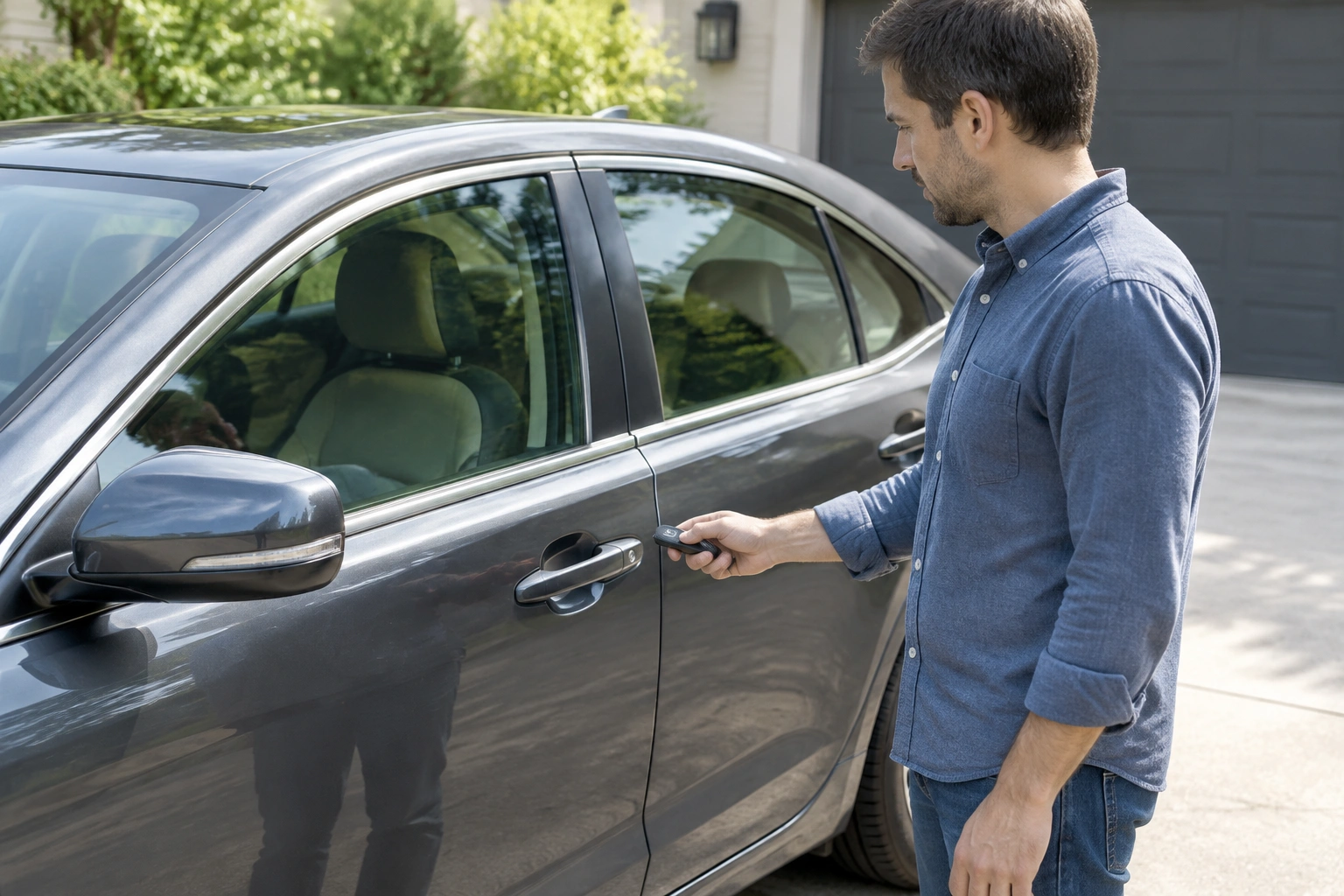
Step 5: Check the Car Battery and Vehicle-Side Keyless Entry System
If the fob battery is new and both remotes have poor range, the car itself deserves attention.
A weak vehicle battery can create electrical behavior that is not obvious at first. If the battery voltage is sagging, modules and receivers may not wake up or respond normally.
Before using a scan tool, there are a few things a reader can observe directly:
– Does the car start normally, or does it crank slowly?
– Are other electrical features acting oddly, such as dim lights or intermittent electronics?
– Does the key fob work better right after driving, then worse after the car sits?
– Does the problem affect one door or zone more than another?
Also consider the vehicle-side hardware:
– receiver/antenna module
– body control module
– wiring to the keyless entry system
If unlocking only works when you’re standing right beside the car, the receiver may be struggling to pick up the signal at normal distance. Some vehicles also use separate antennas or receivers for different doors or zones, which can explain partial-range problems — for example, one side of the car may respond better than another.
If both fobs behave the same way and the car battery is old, weak, or recently jumped, vehicle-side diagnosis becomes more likely.
The NHTSA is a good starting point for general vehicle safety and maintenance guidance if you’re unsure whether a broader electrical issue is developing.
When the Key Fob May Need Reprogramming or Resyncing
Sometimes the fob isn’t damaged — it just lost sync.
That is more likely when the problem starts right after:
– a battery replacement
– a jump start
– a dead car battery
– electrical work on the vehicle
In those cases, the fob may still have a battery and may not look damaged, but the vehicle and remote are no longer communicating normally.
Resyncing is more likely to help when:
– the fob worked before the battery was disconnected
– the problem started immediately after a jump start or battery swap
– the spare fob shows the same behavior
– the vehicle still recognizes the fob intermittently
Resyncing is less likely to help when:
– the fob was dropped, cracked, or water-damaged
– the battery compartment is corroded
– the buttons are physically worn out
– the fob has no response even at very close range
– both fobs have the same issue and the car shows other electrical symptoms
Some models allow simple resync steps; others require professional programming. The owner’s manual is the best place to confirm what your vehicle supports.
Replace the Battery, Repair the Fob, or Replace the Whole Unit?
Here’s the decision path I’d use:
- Replace the battery if the range faded gradually and the fob casing is in good shape.
- Repair the fob if the shell, buttons, or battery contacts are damaged but the electronics still appear usable.
- Replace the whole fob if the board is water-damaged, the case won’t stay closed, or a battery change does nothing and the spare works fine.
There’s a trade-off here. Battery replacement is the cheapest and quickest step, but it only helps if the problem is actually power-related. Full replacement is more convenient, but it can be unnecessary if the real issue is just a worn case or loose contact.
If you’re comparing options, remember this: a fob with a healthy battery but broken internal hardware can still act weak at close range. That’s why “new battery” is not the same thing as “fixed.”
When to Consult a Locksmith
Call a locksmith, dealer, or qualified mechanic when:
– both fobs have the same poor range
– the car battery is weak or suspicious
– you’ve replaced the fob battery and nothing changed
– the fob was exposed to water or physical damage
– the vehicle needs programming or receiver diagnosis
If the issue points to the vehicle’s receiver or antenna system, a mechanic or dealer may be better equipped for that side of the job.
Practical Troubleshooting Order
If you want the shortest path, use this sequence:
- Replace the fob battery.
- Test the spare fob.
- Try the fob in a different location.
- Check the car battery.
- Consider resyncing or professional diagnosis.
That order works because it moves from cheapest and most likely to more involved and more vehicle-specific. It also helps you avoid the most common mistake: replacing the entire fob before proving the battery wasn’t the real issue.
FAQs
Why does my key fob only unlock the car at close range?
Usually because the signal is weak, the fob battery is low, or the car-side system is not receiving the signal as well as it should. Interference and physical damage can also shorten range.
Can a weak car battery affect key fob range?
Yes. A weak vehicle battery can cause electronic modules to behave unpredictably, including parts of the keyless entry system.
How do I know if it’s the fob or the car?
Test the spare fob. If both fobs behave the same way, the vehicle or the environment is more likely at fault. If only one fob has the problem, the fob itself is the likely culprit.
Does a new battery always fix a short-range fob?
No. A new battery helps only when the battery was the problem. If the fob is damaged, out of sync, or the car-side system is weak, the range may stay poor.
Can interference really make a fob work only nearby?
Yes. Nearby electronics, garages, buildings, and other radio sources can reduce how far the signal reaches.
When should I replace the whole fob?
Replace the whole unit when the case is damaged, the buttons are worn out, there’s moisture damage, or the battery and resync steps don’t help.
Should I go to a dealer or a locksmith?
A locksmith can be a good first call for fob replacement or programming. If the car-side receiver or antenna seems faulty, dealer or mechanic diagnosis may be the better route.
