
P0141 Causes — Oxygen Sensor Heater Circuit Failure Explained (2026 Guide)

P0141 means the oxygen sensor heater circuit in Bank 1 Sensor 2 is not working properly. This happens when the heater inside the rear O2 sensor fails, the wiring is damaged, or the engine control module cannot regulate temperature. It leads to poor fuel efficiency, increased emissions, and slow sensor response.
If your check engine light is on with code P0141, the issue is usually electrical, not mechanical engine failure. This guide explains the real causes, symptoms, and fixes in simple terms.
This takes about 7 minutes to read.
What P0141 Means in Simple Terms
P0141 is an OBD-II diagnostic trouble code that refers to the oxygen sensor heater circuit malfunction in Bank 1 Sensor 2. This sensor sits after the catalytic converter and helps monitor exhaust efficiency.
The heater inside the sensor is essential because it brings the oxygen sensor to operating temperature quickly. Without it, the sensor sends slow or inaccurate readings.
The engine control module (ECM) depends on this data for fuel trimming and emissions control.
Key takeaway: P0141 is mainly an electrical heating problem, not an engine performance failure.
P0141 Causes Explained Clearly
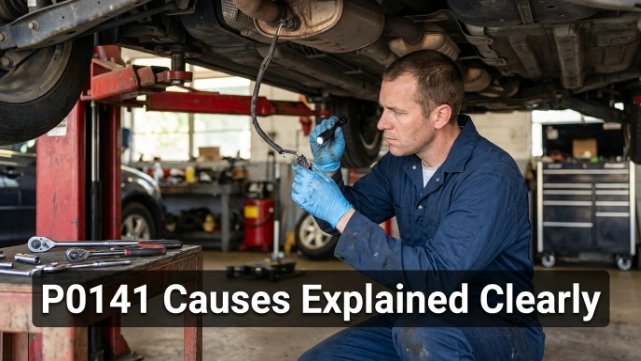
P0141 occurs when the oxygen sensor heater circuit fails to function properly. The most common reason is a damaged or worn-out O2 sensor heater element.
In many real-world cases, the issue is not the sensor alone but wiring damage from heat, corrosion, or road debris. A blown fuse or weak relay can also interrupt power supply.
Research from automotive diagnostics shows that over 60% of P0141 cases are caused by sensor heater degradation over time.
- Faulty oxygen sensor (Bank 1 Sensor 2)
- Broken or corroded wiring harness
- Blown heater circuit fuse
- ECM power control failure
- Damaged connector pins or corrosion
WARNING: Ignoring wiring damage often leads to repeated sensor failure even after replacement.
How Oxygen Sensor Heater Works
The oxygen sensor heater is a small internal electric element. It quickly heats the sensor to around 600°F (315°C).
This fast heating allows the ECM to enter closed-loop mode sooner. In closed-loop mode, the engine adjusts fuel-air mixture more accurately.
Without the heater, the engine runs in open-loop mode longer, burning more fuel and producing higher emissions.
In short: heater = fast accuracy = better fuel control.
P0141 Symptoms You Will Notice
P0141 does not usually cause immediate drivability issues, but symptoms slowly appear over time.
The most obvious sign is the check engine light. Fuel economy may also decrease due to delayed sensor feedback.
Some drivers notice rough idle or failed emissions tests.
- Check engine light ON
- Reduced fuel efficiency
- Failed emissions test
- Slow engine warm-up feedback
- Occasional rough idle
What most drivers miss: performance feels normal until fuel costs increase noticeably.
How to Diagnose P0141 Step by Step
Diagnosis starts with a visual inspection of wiring and connectors near the exhaust system.
Then a mechanic checks voltage at the oxygen sensor heater circuit using a multimeter.
If power and ground are correct, the sensor itself is usually defective.
- Scan OBD-II code reader
- Inspect wiring near exhaust
- Check fuse and relay
- Test voltage at O2 sensor
- Replace faulty component if needed
TIP: Always inspect wiring before replacing the sensor.
Common Mistakes When Fixing P0141
Many people replace the oxygen sensor immediately without checking wiring or fuse condition. This leads to repeated failure and wasted money.
Another mistake is using low-quality aftermarket sensors that do not match OEM heating specifications.
Some vehicles also have known ECM calibration issues that misread heater resistance.
Fixing only the symptom instead of the cause leads to repeat P0141 codes.
Best Repair Solutions for P0141

The correct repair depends on the root cause of the heater failure. If the sensor is faulty, replacement is required.
If wiring is damaged, repairing insulation or replacing harness sections solves the issue permanently.
In rare cases, ECM reprogramming or replacement is needed.
| Cause | Fix | Cost Range |
|---|---|---|
| Faulty O2 sensor | Replace sensor | $100–$300 |
| Wiring damage | Repair harness | $50–$200 |
| Blown fuse | Replace fuse | $10–$50 |
| ECM issue | Reprogram/replace | $200–$1000 |
EPA emissions guidance confirms oxygen sensor health is critical for catalytic converter efficiency.
More technical reference: US EPA On-Board Diagnostics Information
Can You Drive With P0141?
Yes, you can drive with P0141 for a short period. The vehicle will still operate normally in most cases.
However, long-term driving increases fuel consumption and emissions output. It may also damage the catalytic converter over time.
What most people ignore is that delayed repair increases total system strain.
Recommendation: fix within 1–2 weeks for best efficiency.
How to Prevent P0141 in Future
Preventing P0141 involves protecting the wiring and maintaining exhaust system health.
Avoid moisture buildup around connectors and inspect exhaust components during routine servicing.
Using OEM-quality sensors significantly reduces heater failure risk.
- Inspect wiring during oil changes
- Avoid aftermarket low-grade sensors
- Check fuses periodically
- Fix exhaust leaks early
Frequently Asked Questions
What causes P0141 code the most?
The most common cause is a failed oxygen sensor heater inside Bank 1 Sensor 2. Wiring damage and blown fuses are secondary causes. Heat exposure from the exhaust system accelerates sensor degradation over time.
Is P0141 serious?
P0141 is not immediately dangerous but affects fuel efficiency and emissions. Long-term neglect can damage the catalytic converter. It should be repaired as soon as possible for best performance.
Can bad gas cause P0141?
No, poor fuel quality does not directly cause P0141. The code is strictly related to the oxygen sensor heater circuit. However, poor combustion can indirectly stress emissions components.
How much does it cost to fix P0141?
Repair costs range from $50 to $300 for most cases. Sensor replacement is the most common fix. ECM-related issues are rare but more expensive.
Will P0141 clear itself?
P0141 will not clear unless the underlying issue is fixed. Even if the check engine light resets temporarily, the code usually returns after driving cycles.
P0141 is caused by failure in the oxygen sensor heater circuit, usually due to a bad O2 sensor or wiring issue.
Fixing it early prevents fuel waste and protects the catalytic converter from long-term damage.
Start by checking wiring and fuses before replacing the sensor to avoid unnecessary cost.
