
P0174 Repair Cost: What Car Owners Can Expect to Pay

A P0174 code can be frustrating because an OBD2 scanner identifies the engine condition but does not tell you which part caused it. You may be dealing with a loose vacuum hose, a dirty airflow sensor, a fuel-delivery problem, or another issue that creates too much air or too little fuel on Bank 2.
The P0174 repair cost can range from about $100 for a simple hose or cleaning service to $1,800 or more for a fuel-pump or major intake repair. This guide explains the likely costs, what affects the final bill, which checks are safe to perform yourself, and when professional diagnosis is the better value.
Quick Answer
The typical P0174 repair cost is $150 to $500, including diagnosis, for common problems such as a vacuum leak, dirty mass airflow sensor, or faulty PCV component. More complex repairs involving intake gaskets, injectors, or the fuel pump may cost $500 to $1,800 or more, depending on the vehicle and labor required.
What Does Code P0174 Mean?
P0174 means “System Too Lean, Bank 2.” A lean condition occurs when the engine computer detects more air and less fuel than expected on the side of the engine called Bank 2.
Bank 2 is the side that does not contain cylinder number one. The code normally applies to engines with two cylinder banks, such as V6 and V8 engines.
The computer stores P0174 when oxygen-sensor and fuel-trim data show that it must keep adding too much fuel to correct the mixture.
The EPA’s explanation of on-board diagnostic systems notes that OBD software monitors emissions-related components and engine systems. In practical terms, the code is a diagnostic starting point—not proof that an oxygen sensor or any other named part has failed. (EPA NPDES)
Average P0174 Repair Cost by Cause
The table below gives practical U.S. price ranges for common P0174 repairs. These are broad estimates for parts, labor, and normal shop pricing. Luxury vehicles, tightly packed engine bays, rust, local labor rates, and additional codes can raise the total.
| Possible cause or service | Typical estimated cost | What the repair may involve |
|---|---|---|
| Diagnostic testing | $100–$220 | Code scan, live-data review, visual inspection, smoke test, or fuel-pressure test |
| Loose or damaged vacuum hose | $100–$250 | Finding the leak and replacing a hose, elbow, clamp, or connector |
| PCV valve or PCV hose | $100–$350 | Replacing a stuck valve, cracked tube, or integrated assembly |
| MAF sensor cleaning | $50–$160 | Inspecting and cleaning the mass airflow sensor with approved cleaner |
| MAF sensor replacement | $250–$500 | Installing a quality sensor and confirming fuel-trim readings |
| Intake manifold gasket | $350–$1,000 | Removing intake components and replacing leaking seals or gaskets |
| Oxygen sensor replacement | $250–$600 | Testing and replacing a slow or biased sensor if it is truly faulty |
| Exhaust leak repair | $150–$900 | Repairing a pipe, flange, gasket, manifold, or damaged fasteners |
| Fuel injector cleaning | $120–$300 | Professional cleaning or fuel-system service where appropriate |
| Fuel injector replacement | $300–$900+ | Replacing one or more injectors, seals, and related hardware |
| Fuel-pressure regulator | $250–$650 | Testing fuel pressure and replacing the regulator or module |
| Fuel pump replacement | $900–$1,800+ | Replacing the pump or module, often inside the fuel tank |
Important: Do not add every number in the table together. A properly diagnosed vehicle usually needs one main repair, although an older car may have more than one air or fuel problem.
Why P0174 Repair Prices Vary So Much
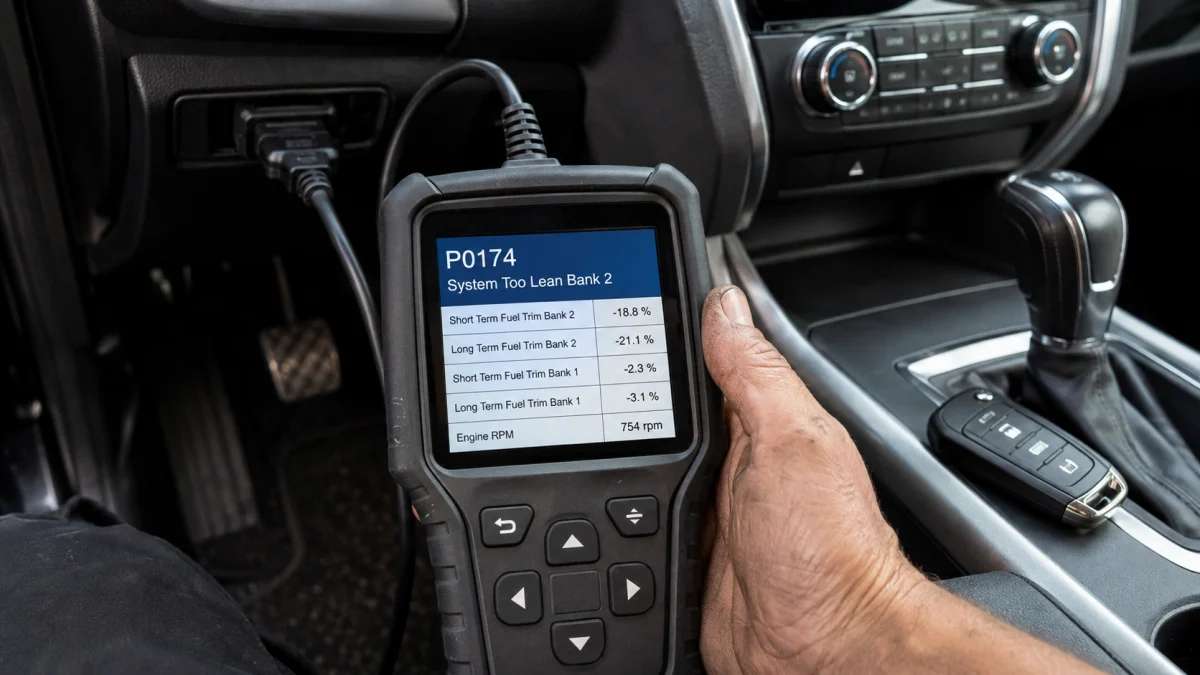
The Code Describes a Condition, Not One Failed Component
A cracked vacuum elbow may cost little to replace. A leaking intake manifold gasket or weak fuel pump requires more labor and more expensive parts. Both can trigger the same code.
This is why replacing the oxygen sensor simply because the scanner mentions a lean condition is risky. The oxygen sensor may be reporting the problem correctly.
Diagnostic Time Matters
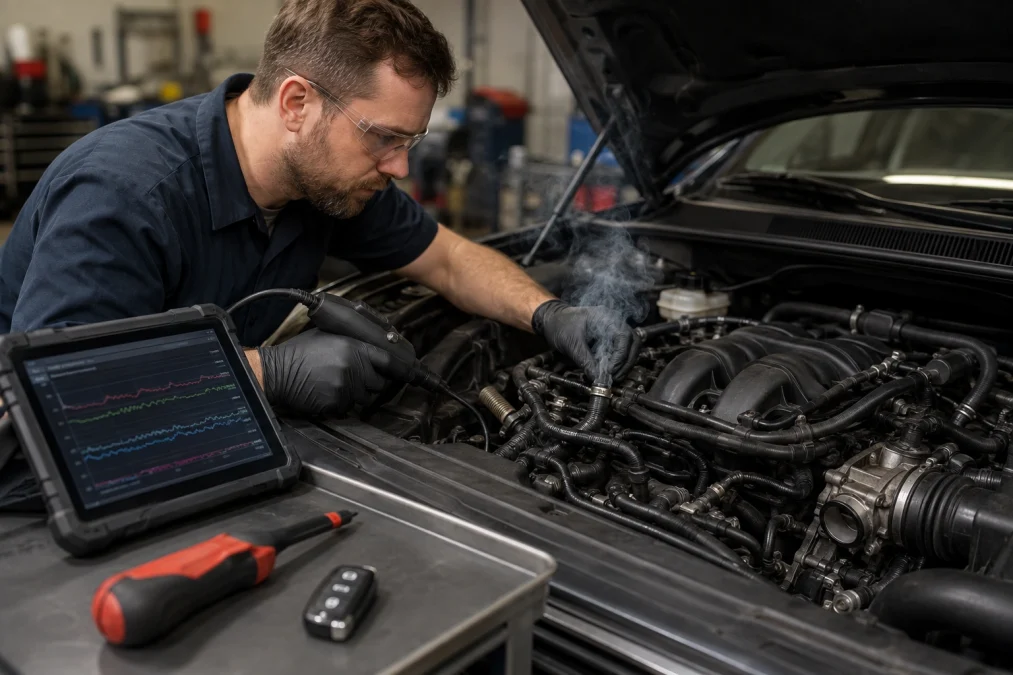
A visible split hose may be found quickly, while a hidden intake or fuel-delivery fault can require smoke, pressure, and live-data testing. Diagnostic labor can save money by preventing incorrect repairs.
The FTC’s auto repair guidance recommends asking whether there is a diagnostic fee, requesting a written estimate, and considering a second opinion for expensive or complicated work. (Consumer Advice)
Labor Rates and Vehicle Design Differ
Labor costs vary by city and shop. Some engines provide easy access, while others require intake components to be removed. Luxury vehicles and large trucks may also use more expensive sensors or integrated assemblies.
Parts Quality Affects the Price
Low-cost aftermarket sensors may not match the original calibration. For parts that directly control fueling, OEM or proven original-equipment-quality components are often worth the higher price.
Common Symptoms That May Appear With P0174
Some vehicles show only a steady check engine light. Others may develop noticeable driving problems, including:
- Rough or unstable idle
- Hesitation during acceleration
- Reduced engine power
- Surging at steady speed
- Hard starting
- Stalling when stopping
- Pinging or spark knock under load
- Lower fuel economy
- P0171 appearing with P0174
- Misfire codes such as P0300 or cylinder-specific misfires
Stop driving and arrange professional help if the check engine light flashes, the engine misfires heavily, power drops suddenly, or you smell raw fuel. A flashing light can indicate a catalyst-damaging misfire.
A key fob that works intermittently, a “key not detected” message, or a no-crank condition is normally a separate electrical or security issue. P0174 is an engine air-fuel code and is not usually fixed by replacing or programming the key fob.
How a Technician Diagnoses P0174
A careful diagnosis generally follows this order:
- Confirm the code and freeze-frame data. This records engine conditions when the fault appeared.
- Check related codes. P0171 with P0174 may point to a problem affecting the whole engine.
- Inspect the intake system. Hoses, clamps, boots, PCV lines, brake-booster connections, and manifold seals are checked.
- Review live fuel trims. Changes between idle and higher rpm help separate air leaks from fuel or sensor faults.
- Smoke-test the intake. Low-pressure smoke can reveal hidden leaks.
- Test fuel pressure and volume. A weak pump or regulator may create a lean condition under load.
- Evaluate sensor and exhaust data. MAF and oxygen-sensor readings are compared with expected values, and upstream exhaust leaks are ruled out.
- Repair and verify. The code is cleared, followed by a road test and another fuel-trim check.
Expert Tip: Ask the shop to explain what test confirmed the failure. “The scanner showed P0174” is not the same as proving that a specific sensor needs replacement.
Can You Fix P0174 Yourself?
A car owner with basic mechanical knowledge can safely perform a few preliminary checks:
- Make sure the air-filter box is closed correctly.
- Inspect the intake tube for splits or loose clamps.
- Look for disconnected or visibly cracked vacuum hoses.
- Check electrical connectors at the MAF sensor.
- Read stored and pending codes with an OBD2 scanner.
- Review the vehicle’s service information before removing parts.
Cleaning a MAF sensor may be reasonable when service information allows it. Use only MAF cleaner. Do not touch the sensing element or use compressed air, brake cleaner, or general solvent.
Never use propane or flammable spray to search for leaks. Professional help is safer when smoke testing, fuel-pressure equipment, advanced scan data, or intake removal is needed.
Is It Safe to Drive With P0174?
A short, gentle drive to a repair facility may be reasonable when the light is steady, the engine runs smoothly, and there is no major power loss, overheating, fuel smell, or loud noise.
Do not ignore the code for weeks. A persistent lean condition can cause misfires, failed emissions testing, and catalytic-converter damage.
The EPA notes that early diagnosis and timely repair of OBD-related faults can help prevent more expensive repairs and performance problems. (EPA NPDES)
When to Call a Professional Locksmith or Dealership
For P0174 itself, call a qualified automotive repair shop, diagnostic technician, or dealership service department. An automotive locksmith specializes in keys, locks, immobilizers, and vehicle access—not engine fuel-trim diagnosis.
A dealership may be the better choice when:
- The vehicle is still under factory or emissions warranty.
- A manufacturer technical service bulletin may apply.
- Software updates or factory scan tools are required.
- The vehicle has a complex direct-injection or turbocharged system.
- An open recall or manufacturer campaign may cover the issue.
Before authorizing paid work, check your VIN through the NHTSA recall lookup tool. Recall repairs are normally completed by the manufacturer’s dealership at no charge when the vehicle is covered. (NHTSA)
An independent shop can be a good choice when it has proper test equipment and strong engine-performance experience. ASE’s Advanced Engine Performance Specialist information covers OBD II, computerized powertrain controls, fuel and air induction, and emissions diagnosis. (ASE)
Call an automotive locksmith only for a separate problem such as an unrecognized transponder key, damaged ignition lock, lockout, lost key, or replacement remote programming.
Do not approve key programming as a repair for P0174 unless a separate security-system fault has been diagnosed.
How to Keep the Final Repair Bill Under Control
Ask for a written estimate that separates:
- Diagnostic labor
- Parts
- Repair labor
- Shop supplies
- Taxes and fees
- Warranty terms
- Any additional recommended work
Ask what test confirmed the failure, whether both banks are lean, whether smoke and fuel-pressure tests were performed, what grade of part will be used, and how the shop will verify the repair.
A second opinion makes sense when several expensive parts are recommended without test results.
Common Mistakes Car Owners Should Avoid
- Replacing the oxygen sensor first. It may be accurately reporting a lean condition caused elsewhere.
- Clearing the code before recording data. Freeze-frame and pending-code information can help identify the cause.
- Buying the cheapest MAF sensor. Incorrect calibration can create new drivability problems.
- Ignoring P0171 when it appears with P0174. Both banks running lean often changes the diagnostic direction.
- Using flammable spray to find leaks. This creates an avoidable fire and injury risk.
- Driving with a flashing check engine light. Severe misfires can quickly damage the catalytic converter.
- Confusing a starting problem with P0174. A dead key-fob battery or immobilizer fault is normally unrelated.
- Authorizing multiple parts without test results. Diagnosis should identify why the engine is lean before expensive components are replaced.
FAQs
How Much Does It Usually Cost to Fix Code P0174?
Many common P0174 repairs cost $150 to $500, including diagnosis. A simple vacuum leak may be near the lower end. Intake gasket, injector, or fuel-pump repairs can raise the bill to $500–$1,800 or more.
Can a Dirty MAF Sensor Cause P0174?
Yes. A contaminated or inaccurate MAF sensor can underreport incoming air, causing the computer to deliver too little fuel. However, the sensor should be tested before it is replaced.
Will Replacing an Oxygen Sensor Fix P0174?
Only when testing proves the oxygen sensor is biased, slow, or damaged. In many cases, the sensor is working correctly and reporting a real vacuum leak or fuel-delivery problem.
What Is the Difference Between P0171 and P0174?
P0171 means the system is too lean on Bank 1. P0174 means it is too lean on Bank 2. When both appear together, the cause may affect the entire engine.
Can a Bad Fuel Pump Cause P0174?
Yes. A weak pump can reduce fuel pressure or volume, especially during acceleration. This often affects both banks, but vehicle design and operating conditions can influence which code appears first.
Can I Clear P0174 With an OBD2 Scanner?
You can clear the code, but that does not repair the cause. The light will usually return after the vehicle completes its self-tests if the lean condition remains.
Is P0174 Related to the Car Key Fob or Immobilizer?
Usually not. P0174 concerns the engine’s air-fuel mixture. Key-fob and immobilizer faults more commonly cause “key not detected,” no-crank, or start-and-stall symptoms and require separate diagnosis.
Conclusion
The P0174 repair cost depends on what caused Bank 2 to run lean. A small vacuum leak or MAF cleaning service may be relatively inexpensive, while an intake gasket, injector, or fuel-pump problem can cost much more.
The smartest next step is not to replace the part mentioned by a generic scanner description. Record the codes, check for obvious intake problems, and pay for proper diagnosis when the cause is not clear. Request a written estimate, ask what test confirmed the repair, and choose qualified engine-diagnostic help rather than guessing.
Use your OBD2 scan results as a starting point, then compare a clear diagnosis and written quote before approving the work.
