
P0201 Repair Cost: What Car Owners Should Expect to Pay

A P0201 code can be worrying, especially when your engine runs roughly or the check engine light starts flashing. You may wonder whether the vehicle needs a new fuel injector, an electrical repair, or an expensive engine computer.
The P0201 repair cost typically ranges from about $150 to $1,200, depending on the actual cause. Some repairs involve nothing more than fixing a damaged connector. Others require a direct-injection fuel injector, wiring harness, or engine control module.
This guide explains the likely costs, common causes, diagnostic process, and signs that professional help is needed. It will also help you avoid paying for parts your vehicle may not need.
Quick Answer
The average P0201 repair cost is approximately $150 to $1,200. A connector or wiring repair may cost less than $500, while replacing a fuel injector commonly costs $300 to $1,000. Direct-injection, diesel, luxury, and hard-to-access engines may cost considerably more.
What Does the P0201 Code Mean?
P0201 means “Injector Circuit Malfunction—Cylinder 1.”
Your vehicle’s engine control module, commonly called the ECM or PCM, controls each fuel injector through an electrical circuit. The injector for cylinder 1 must receive proper voltage and a correctly timed control signal.
The computer may store P0201 when it detects an electrical reading outside the expected range.
The problem could involve:
- A failed cylinder 1 fuel injector
- A loose or corroded injector connector
- Broken, melted, or damaged wiring
- An open circuit with no electrical continuity
- A wire that has shorted to power or ground
- Low system voltage
- A failed PCM injector driver
- Rodent damage inside the engine compartment
P0201 does not automatically prove that the fuel injector itself is bad. It only tells you that the computer detected a problem in the injector circuit.
The vehicle’s onboard diagnostic system stores codes that help technicians identify the affected system. According to the EPA’s explanation of onboard diagnostics and check engine lights, an OBD code provides a starting point for diagnosis rather than a complete repair answer. (EPA NERL)
How Much Does It Cost to Fix P0201?
The following estimates are general U.S. price ranges. Your final bill will depend on the vehicle, engine design, local labor rate, parts quality, and repair facility.
| Possible repair | Estimated cost |
|---|---|
| Professional diagnosis | $120–$250 |
| Clean and secure injector connector | $100–$250 |
| Repair damaged wiring or connector | $150–$500 |
| Replace one standard port fuel injector | $300–$800 |
| Replace one gasoline direct injector | $500–$1,500 |
| Replace injector wiring harness | $400–$1,200 |
| Replace multiple injectors | $800–$3,000+ |
| Replace or repair PCM/ECM | $900–$2,500+ |
These figures are planning estimates rather than guaranteed quotes. A domestic four-cylinder engine with accessible injectors may be near the lower end. A luxury vehicle, diesel engine, or direct-injection system can be much more expensive.
Labor rates are also important. Recent AAA information about auto repair labor rates notes that many U.S. repair shops charge roughly $120 to $159 per labor hour, although rates vary by location and facility type. (AAA International Relations)
P0201 Cost Breakdown by Repair Type
Diagnostic Testing: $120 to $250
A basic code scan may take only a few minutes. Proper P0201 diagnosis requires more than reading the code.
A technician may need to:
- Confirm P0201 and record related codes.
- Review freeze-frame information.
- Inspect the cylinder 1 injector and connector.
- Measure injector resistance.
- Check power and ground.
- Test the PCM’s injector control signal.
- Inspect the harness for an open or short.
- Compare cylinder 1 readings with another cylinder.
Some shops charge one hour of labor for these tests. More time may be needed if the fault is intermittent or the wiring is difficult to reach.
Ask whether the diagnostic fee will be applied toward the repair. Some facilities credit all or part of it when you approve the work.
Injector Connector or Wiring Repair: $150 to $500
A damaged connector is one of the less expensive P0201 causes.
Engine heat can make plastic connectors brittle. Oil, water, road salt, vibration, and previous repairs may also damage the terminals. Rodents sometimes chew through injector wiring.
A minor repair might involve:
- Cleaning corrosion
- Tightening a loose terminal
- Replacing the connector pigtail
- Repairing one damaged wire
- Restoring a poor ground
The cost rises when the technician must unwrap a large section of the harness or remove engine components to reach the damaged area.
Standard Fuel Injector Replacement: $300 to $800
Many traditional gasoline engines use port fuel injectors mounted in the intake manifold near the intake valves. These injectors are often less expensive and easier to access than direct injectors.
The repair may include:
- One replacement injector
- New injector seals or O-rings
- Fuel rail removal and installation
- A leak inspection
- Code clearing and a road test
Replacing only the failed injector may be reasonable when the other injectors test correctly.
Gasoline Direct Injector Replacement: $500 to $1,500
Gasoline direct-injection systems operate at much higher fuel pressures. Their injectors can be more expensive and may require special tools or procedures.
Some vehicles also require:
- Intake manifold removal
- New high-pressure fuel lines
- Injector calibration codes
- Special seal installation tools
- Computer relearning or adaptation
- Additional cleaning for carbon buildup
High-pressure fuel systems can cause serious injuries. Do not loosen direct-injection fuel lines unless you have the correct service information, tools, and training.
Wiring Harness Replacement: $400 to $1,200
A complete injector harness may be recommended when several wires are brittle, oil-soaked, burned, or damaged in multiple places.
Replacing the harness can be more reliable than making several small repairs. However, it costs more because larger engine components may have to be removed.
Ask the shop to show you the damaged section before approving a complete harness replacement.
PCM or ECM Repair: $900 to $2,500 or More
The PCM contains electronic drivers that switch the injectors on and off. A failed driver can set P0201 even when the injector and wiring are good.
PCM failure is possible, but it is less common than an injector, connector, or wiring problem.
Before replacing the module, the technician should confirm:
- The injector has the correct resistance.
- The circuit is not shorted.
- Injector power is available.
- The control wire has continuity.
- Connector terminals have proper tension.
- The PCM is receiving stable voltage and ground.
A replacement module may require vehicle-specific programming, security initialization, and key relearning. This work may need dealership-level software.
Do not approve PCM replacement based only on the trouble code.
Why P0201 Repair Costs Vary So Much
Vehicle and Engine Design
Injector access differs greatly between vehicles. On one engine, cylinder 1 may be visible at the top of the engine. On another, it may be under the intake manifold.
More disassembly means more labor.
Port Injection Versus Direct Injection
Port injectors are generally simpler and less costly. Direct injectors operate under high pressure and often require special seals, lines, tools, or calibration.
Diesel injectors may cost substantially more than either type.
OEM Versus Aftermarket Parts
An original equipment manufacturer injector may cost more, but it should match the vehicle’s original flow rate and electrical specifications.
A quality aftermarket injector can offer good value. Very cheap, unbranded injectors may have inconsistent fuel delivery, poor seals, or short service life.
Ask which brand and part number will be installed.
Local Labor Rate
Repair prices are normally higher in large metropolitan areas and at dealerships. Independent repair facilities may charge less, but they still need suitable diagnostic equipment and technical information.
Additional Damage
A failed injector circuit may cause a cylinder misfire. Continued driving can overheat the catalytic converter or contaminate engine oil, especially if an injector leaks fuel.
Related repairs may include spark plugs, an oil change, or catalytic converter service.
Common P0201 Warning Signs
A vehicle with P0201 may show one or more of these symptoms:
- Check engine light
- Rough or uneven idle
- Engine shaking
- Cylinder 1 misfire
- Reduced acceleration
- Hesitation under load
- Stalling
- Difficult starting
- Poor fuel economy
- Fuel odor
- Limp mode
- Flashing check engine light
The symptoms depend on how the circuit failed. An injector that does not open may create a fuel-starved cylinder. An injector that remains open or leaks may add too much fuel.
Stop driving if the check engine light flashes, the vehicle shakes severely, or you smell raw gasoline. A flashing light commonly indicates an active misfire that can damage the catalytic converter.
Is P0201 Related to the Key Fob?
P0201 is normally an engine fuel-injection problem, not a key fob problem.
A weak key fob battery, damaged remote, or programming error may cause symptoms such as:
- “Key not detected” message
- Security light remaining on
- Remote buttons not working
- Push-button start not responding
- Engine not cranking
- Doors not locking or unlocking
P0201 is more likely when the engine cranks and starts but runs roughly, misfires, or loses power.
Replacing the key fob battery will not repair an injector circuit. However, a vehicle can have a key recognition problem and P0201 at the same time. Diagnose the symptoms separately instead of assuming one code explains everything.
How a Technician Diagnoses P0201
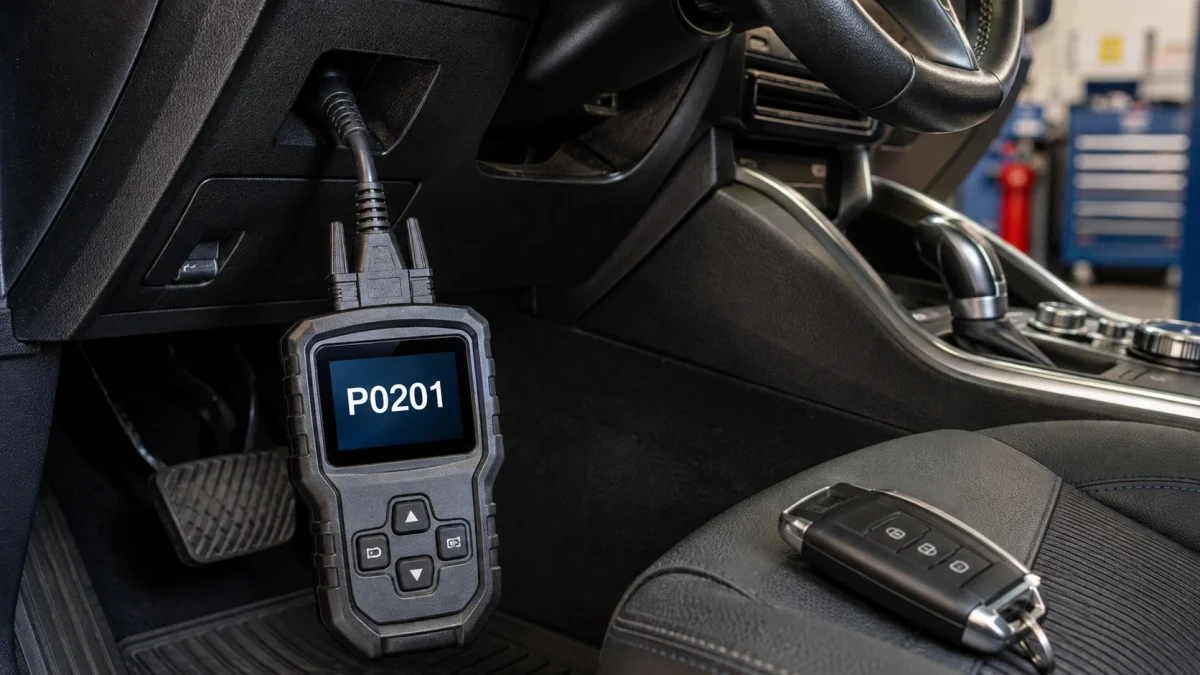
A careful diagnostic process helps prevent unnecessary injector replacement.
1. Scan All Stored Codes
The technician checks for related codes, such as a cylinder 1 misfire, low system voltage, or additional injector circuit faults.
Several injector codes may point toward a shared power supply, fuse, relay, harness, or PCM issue.
2. Inspect the Connector and Wiring
The cylinder 1 injector connector should be checked for:
- Loose fit
- Bent or pushed-back terminals
- Green or white corrosion
- Broken locking tabs
- Melted insulation
- Oil contamination
- Rodent damage
- Wires rubbing against metal
A visual inspection can reveal a problem that does not require injector replacement.
3. Test the Injector Electrically
A digital multimeter can measure injector resistance. The reading should be compared with the manufacturer’s specification or with a known-good injector on the same engine.
An open circuit or significantly different reading may indicate a failed injector coil.
4. Verify Power and PCM Control
Most injectors receive power on one wire. The PCM controls the injector through the other wire.
A noid light, oscilloscope, or suitable test equipment can confirm whether the injector receives a control pulse. Technicians must avoid damaging sensitive computer circuits during testing.
5. Perform a Wiggle Test
An intermittent fault may disappear while the car is at the shop. Moving the harness while monitoring the circuit can expose a broken wire or loose terminal.
6. Confirm the Repair
After repairing the fault, the technician should:
- Clear the stored code
- Start the engine
- Check for fuel leaks
- Monitor misfire data
- Complete a road test
- Rescan the vehicle
The repair is not complete until P0201 stays off and cylinder 1 operates normally.
Expert Tip: Ask the shop to identify the failed component and explain the test that confirmed it. “The scanner showed P0201” is not enough proof that the injector needs replacement.
Can You Fix P0201 Yourself?

Some basic checks may be reasonable for an experienced DIY owner.
You may be able to:
- Confirm the code with an OBD2 scanner
- Check whether the connector is loose
- Look for damaged wiring
- Inspect relevant fuses
- Compare injector resistance
- Replace an accessible connector pigtail
However, DIY work has important limitations.
You may need professional tools to test the PCM signal, view injector waveforms, safely release high fuel pressure, install special seals, or program a replacement module.
Never probe a connector carelessly or apply battery voltage directly to a PCM control wire. Doing so may damage the engine computer.
Also avoid opening a pressurized fuel system on a hot engine. Escaping fuel can cause burns, eye injuries, or fire.
Can You Drive With a P0201 Code?
Driving with P0201 is not recommended for long periods.
A short, gentle trip to a repair facility may be possible when:
- The check engine light is steady
- The engine runs reasonably smoothly
- There is no fuel smell
- The vehicle is not losing significant power
Stop driving and arrange a tow when:
- The check engine light is flashing
- The engine shakes strongly
- The vehicle stalls repeatedly
- Raw fuel is visible or noticeable
- The engine overheats
- Acceleration is unsafe
- You hear unusual knocking
Continuing to drive with a severe misfire can increase the eventual repair bill.
When to Call a Professional Locksmith or Dealership
For P0201 alone, an experienced automotive repair technician is usually the correct professional. An automotive locksmith generally does not repair fuel injectors or engine wiring.
Choose a qualified independent repair shop when:
- You need injector and circuit testing
- The vehicle is out of warranty
- The shop has suitable scan and electrical equipment
- You want a lower-cost alternative to a dealership
- The repair does not require restricted factory programming
Choose a dealership when:
- The vehicle is under warranty
- A technical service campaign may apply
- PCM programming or security initialization is required
- The independent shop cannot access manufacturer-specific tests
- The vehicle has a complex direct-injection or diesel system
Before authorizing work, follow the FTC’s auto repair guidance by requesting a written estimate, understanding what the shop will repair, and asking how additional charges will be approved. (Consumer Advice)
It is also worth checking your VIN through the NHTSA recall lookup tool. An open recall may allow an affected component to be repaired by the manufacturer at no cost. (NHTSA)
Call an automotive locksmith when:
- The security light remains on
- The car says “key not detected”
- The engine will not crank because the key is not recognized
- A replacement key needs programming
- The remote or transponder key has failed
- You are locked out of the vehicle
A locksmith can test the key, transponder, remote, and immobilizer system. However, those services will not normally resolve a true P0201 injector circuit fault.
How to Evaluate a P0201 Repair Estimate
Before approving the repair, ask these questions:
- Was the injector electrically tested?
- Were the connector and wiring inspected?
- What test confirmed the recommended repair?
- Is the diagnostic charge included in the total?
- Is the replacement part OEM or aftermarket?
- Are new seals and required fuel lines included?
- Does the injector require coding or calibration?
- What warranty covers the part and labor?
- Will the vehicle be rescanned and road-tested?
- Why are multiple injectors being recommended?
A complete set of injectors should not be replaced merely because cylinder 1 has an electrical code. There may be valid reasons to replace a set, but the shop should explain them clearly.
Common Mistakes Car Owners Should Avoid
- Replacing the injector without testing it. Damaged wiring can produce the same code.
- Assuming an inexpensive code reader gives a complete diagnosis. It identifies the circuit, not the failed part.
- Clearing the code repeatedly. This removes useful freeze-frame information without fixing the fault.
- Buying the cheapest injector available. Poor flow matching or weak seals may cause new problems.
- Ignoring a flashing check engine light. An active misfire can damage the catalytic converter.
- Opening a high-pressure fuel system without training. Direct-injection systems can be dangerous.
- Approving PCM replacement too early. The wiring and injector must be tested first.
- Confusing P0201 with a key fob failure. A key battery or remote replacement will not repair the injector circuit.
- Ignoring recall or warranty coverage. Check eligibility before paying for major work.
- Accepting a verbal estimate only. Request a written breakdown of diagnosis, parts, labor, taxes, and programming.
FAQs
How much does it usually cost to fix code P0201?
A typical P0201 repair costs approximately $150 to $1,200. Wiring repairs may fall near the lower end, while direct-injection injector replacement can reach or exceed the upper end.
Does P0201 always mean the fuel injector is bad?
No. P0201 can be caused by the injector, connector, wiring, power supply, or PCM control circuit. Testing is necessary before replacing the injector.
Can a bad spark plug cause P0201?
A bad spark plug can cause a misfire code, but it does not normally cause an injector circuit code. P0201 specifically points to an electrical problem involving the cylinder 1 injector circuit.
Can a weak battery cause P0201?
Low system voltage can interfere with electronic controls and may contribute to unusual codes. However, a persistent P0201 normally requires inspection of the injector circuit after battery and charging voltage are verified.
Is it safe to drive with P0201?
A short trip may be possible if the engine runs smoothly and the check engine light is steady. Stop driving if the light flashes, the engine shakes, power drops sharply, or you smell fuel.
Should all fuel injectors be replaced together?
Not always. Replacing only the failed injector may be appropriate when the others test correctly. Full-set replacement may make sense on some high-mileage engines, but the shop should provide a clear technical reason.
Will replacing my key fob fix P0201?
No. P0201 is generally an engine injector circuit code. Key fob replacement is relevant only when the vehicle has separate key-recognition, immobilizer, remote-entry, or push-button-start problems.
Conclusion
The P0201 repair cost can range from roughly $150 for a minor connector repair to $1,200 or more for a direct injector, wiring harness, or computer-related repair. The most important step is confirming what failed before buying parts.
Do not assume the cylinder 1 injector needs replacement simply because a scanner displays P0201. Ask for electrical testing, a written estimate, the replacement-part details, and a clear explanation of the diagnosis.
If the engine is shaking, the check engine light is flashing, or you smell fuel, stop driving and arrange professional service. For injector and wiring problems, contact a qualified repair facility or dealership. For a separate “key not detected,” immobilizer, or remote failure, contact a reputable automotive locksmith who can diagnose the vehicle’s security and key system.
