
P0305 Causes: What Makes Cylinder 5 Misfire?

Quick Answer
The most common P0305 causes are a worn spark plug, weak ignition coil, damaged plug wire or boot, faulty fuel injector, intake or vacuum leak, low compression, or a valve-timing problem affecting cylinder 5. Use an OBD2 scanner and basic testing to identify the failed system before replacing parts, and use trusted vehicle maintenance resources from AAA when deciding whether professional diagnosis is needed.
Common P0305 Causes
- Worn spark plug: A fouled, worn, or incorrectly gapped plug can weaken combustion in cylinder 5.
- Weak ignition coil: A failing coil may produce intermittent or insufficient spark, especially under load.
- Injector problem: A restricted, electrically faulty, or leaking injector can disturb fuel delivery to cylinder 5.
- Air leak: An intake-manifold or vacuum leak near cylinder 5 can create a mixture that is too lean to burn consistently.
- Low compression: A leaking valve, worn piston ring, head-gasket problem, or other mechanical fault can prevent proper combustion.
- Wiring or control issue: Damaged coil or injector wiring can interrupt spark or fuel even when the component itself is good.
Best First Check
- Save all codes and freeze-frame data, inspect cylinder 5 ignition parts, and test before clearing the code.
P0305 means your vehicle’s computer detected a misfire on cylinder 5. An OBD2 scanner identifies the affected cylinder, but the code does not tell you which component failed.
I’ve seen drivers replace coils, injectors, and sensors because they treated a misfire code like a parts list. A better approach is to separate ignition, fuel, air, wiring, and mechanical causes and test each category in order.
In This Guide
What Does P0305 Mean?
P0305 is an OBD-II diagnostic trouble code for a misfire detected on cylinder 5. The powertrain control module, or PCM, has identified irregular crankshaft acceleration associated with that cylinder.
Definition: A cylinder misfire happens when combustion in that cylinder is weak, incomplete, mistimed, or absent during one or more firing events.
A gasoline engine needs the correct amount of air, fuel, compression, and spark at the right time. A problem with any of those can create P0305.
The number “5” identifies the cylinder involved. It does not mean the fifth spark plug, coil, or injector automatically needs replacement.
What symptoms usually appear with P0305?
Symptoms vary with the severity and frequency of the misfire. Some vehicles feel nearly normal at idle but stumble during acceleration.
- Check engine light: The light may remain steady or flash during an active severe misfire.
- Rough idle: The engine may shake, vibrate, or sound uneven at a stop.
- Hesitation: Power may drop when accelerating or climbing a hill.
- Poor fuel economy: Inefficient combustion can increase fuel use.
- Difficult starting: A severe cylinder problem may make the engine harder to start.
- Fuel smell: Unburned fuel may enter the exhaust when spark or compression is missing.
You may also find P0300 or another cylinder-specific misfire code stored with P0305. Those additional codes can change the diagnostic direction.
Locksmith’s note: an ordinary key fob battery, remote-entry, or keyless-entry problem does not usually create a cylinder-specific P0305 code. Once the engine is running, diagnose the misfire as an engine-management issue.
What Are the Most Common P0305 Causes?
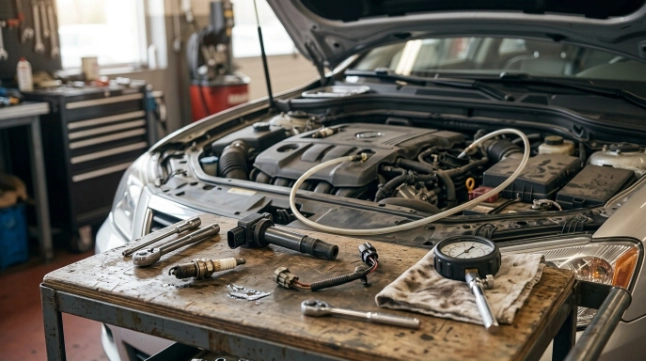
The most common causes fall into five groups: ignition, fuel, air, electrical, and mechanical problems. Ignition faults are often among the simplest possibilities to test first.
1. Worn or fouled spark plug
A worn spark plug may have excessive electrode wear, carbon deposits, oil contamination, or an incorrect gap. Any of these conditions can weaken the spark.
A plug can also reveal clues about the cylinder. Heavy oil deposits, unusual coloring, or fuel wetness may point toward a deeper problem.
2. Weak or failed ignition coil
Many modern engines use one ignition coil for each cylinder. A weak coil may work at idle but break down when cylinder pressure rises during acceleration.
Heat can also make an intermittent coil problem more noticeable. This is why a car may run well cold and begin misfiring after several minutes.
3. Damaged coil boot or spark plug wire
Not every ignition problem is inside the coil. Cracked boots, deteriorated plug wires, corrosion, moisture, or damaged terminals can let ignition voltage escape before reaching the plug.
Look closely for carbon tracking, which often appears as a thin dark line on insulating surfaces. It can indicate voltage has been taking an unwanted path to ground.
4. Faulty cylinder 5 fuel injector
The injector must deliver the correct amount of fuel at the correct time. A restricted injector may run the cylinder lean, while an electrically failed injector may stop fuel delivery entirely.
A leaking injector can create a different problem. Too much fuel can foul the plug and make combustion unstable.
5. Injector or ignition wiring damage
A good coil or injector cannot operate without the correct electrical supply and control signal. Broken wires, loose pins, corrosion, or damaged connectors can imitate a failed component.
Rodent damage and harness rubbing are worth checking on vehicles with unexplained intermittent misfires. Don’t overlook the connector because the component looks new.
6. Intake manifold or vacuum leak near cylinder 5
An air leak can create a lean mixture by allowing unmetered air into the engine. A leak close to cylinder 5 may affect that cylinder more than the others.
Intake gasket leaks can sometimes be temperature-sensitive. The misfire may be worse during a cold start and improve as the engine warms.
7. Low compression
Combustion cannot happen correctly without enough cylinder pressure. Low compression may come from a burned valve, leaking valve seat, worn rings, damaged piston, head-gasket failure, or another sealing problem.
This category becomes more important when swapping ignition parts does not move the misfire. Mechanical faults should be measured instead of guessed.
8. Valve timing or valvetrain problem
A worn cam lobe, sticking valve, broken valve spring, collapsed lifter, or timing problem can reduce cylinder filling and compression. These faults may also create unusual ticking or mechanical noise.
| Possible Cause | Typical Clue | Useful Test | Likely Repair |
|---|---|---|---|
| Spark plug | Wear, deposits, fuel wetness | Visual inspection and specification check | Replace plug if confirmed faulty or due for service |
| Ignition coil | Misfire worse under load | Coil swap test where appropriate | Replace confirmed faulty coil |
| Fuel injector | Cylinder stays on 5 after ignition checks | Injector electrical, balance, or flow testing | Repair circuit, clean, or replace injector |
| Intake leak | Lean condition or cold-start misfire | Smoke test and fuel-trim analysis | Repair hose, gasket, or intake leak |
| Low compression | Misfire remains after spark and fuel tests | Compression and leak-down testing | Mechanical engine repair |
Section Takeaway: P0305 does not identify a bad part. Start with the easiest cylinder-specific ignition checks, then move toward fuel, air, wiring, and compression testing.
How Do You Know Which P0305 Cause Is Responsible?
The fastest diagnosis follows evidence instead of replacing the most common part. Start by recording what the vehicle’s computer already knows.
Step 1: Save every code and freeze-frame record
Connect your OBD2 scanner before disconnecting the battery or clearing anything. Record stored, pending, and permanent codes when your scanner supports them.
Freeze-frame data can show engine speed, load, coolant temperature, and other conditions present when the fault was recorded. Those details help you reproduce the problem.
Step 2: Confirm where cylinder 5 is located
Never assume cylinder numbering starts on the driver’s side or front of the engine. Manufacturers use different cylinder-numbering layouts.
Check reliable service information for the exact engine. Testing the wrong cylinder wastes time and can create a second problem.
Step 3: Inspect the plug, coil, boot, and connector
Look for obvious problems before using advanced equipment. A loose connector, cracked boot, damaged wire, or oil-filled spark-plug well may explain the misfire immediately.
- Check the spark plug for wear, deposits, damage, or contamination.
- Inspect the coil boot for cracking and carbon tracking.
- Check electrical terminals for looseness, corrosion, or pushed-back pins.
- Look for oil or water inside the spark-plug well.
- Inspect nearby wiring for rubbing, heat damage, or rodent marks.
Step 4: Use a controlled swap test when appropriate
On a coil-on-plug engine, a technician may move the suspected coil from cylinder 5 to another compatible cylinder. If the misfire follows the coil, that is strong evidence the coil is defective.
The same logic can sometimes be applied to spark plugs. Do not swap injectors casually because fuel-system work brings additional safety and sealing concerns.
Pro tip: use identical, known-compatible components during a swap test, and follow manufacturer service information. Do not force connectors or interchange parts simply because they look similar.
Step 5: Check fuel delivery and injector control
If spark is good and P0305 stays on cylinder 5, test the injector and its circuit. A technician may check injector resistance, command, current pattern, pressure balance, or flow depending on the vehicle.
A clicking injector is not automatically a good injector. It can operate electrically while still delivering too much or too little fuel.
Step 6: Check for an air leak
A smoke test can reveal leaks around hoses, gaskets, intake runners, and other induction components. Scan-data fuel trims can add another useful clue.
If fuel trims show a strong lean correction at idle that improves with engine speed, an intake leak becomes more suspicious. Interpretation still depends on engine design and other stored codes.
Step 7: Measure compression
Move to mechanical testing when spark, fuel, wiring, and air checks do not explain the misfire. Compare cylinder 5 with the other cylinders instead of focusing only on one absolute number.
A leak-down test can help identify where pressure escapes. Air heard at the intake, exhaust, crankcase, or cooling system points toward different mechanical faults.
Technician’s note: compression specifications and allowable cylinder-to-cylinder differences vary by engine. Use the manufacturer’s service data before condemning internal parts.
Section Takeaway: A good P0305 diagnosis narrows the problem one system at a time. If the misfire moves during a controlled component swap, follow it; if it stays on cylinder 5, keep testing that cylinder.
Can You Drive With a P0305 Code?
You should not ignore P0305, especially when the check engine light flashes or the engine shakes severely. A strong active misfire can reduce power and send unburned fuel into the exhaust.
If the engine is running badly, avoid hard acceleration and high-load driving. Stop in a safe place when continuing could be unsafe or the warning light is flashing.
Why a severe misfire can damage the catalytic converter
When a cylinder fails to burn its mixture, fuel may enter the exhaust system. The catalytic converter can become excessively hot while trying to process that fuel.
Continued driving may turn a relatively simple ignition repair into a more expensive exhaust-system problem. Diagnose an active misfire promptly.
When should you arrange a tow?
- The check engine light flashes continuously.
- The engine shakes violently or repeatedly stalls.
- Acceleration is dangerously weak.
- You smell strong raw fuel.
- The engine develops abnormal knocking or mechanical noise.
- Other oil-pressure or overheating warnings appear.
For broader road and vehicle-safety information, you can review NHTSA’s vehicle safety resources. A diagnostic code itself is not proof of a safety defect, but severe drivability symptoms should never be dismissed.
How Do You Fix P0305, and What Can It Cost?

The correct P0305 repair depends entirely on the confirmed cause. Clearing the code, disconnecting the battery, or installing random new parts does not fix an active fault.
Possible P0305 repairs
- Replace worn or damaged spark plugs.
- Replace a confirmed failed ignition coil.
- Repair a damaged coil boot, plug wire, connector, or harness.
- Repair or replace a faulty fuel injector.
- Repair an intake or vacuum leak.
- Correct fuel-pressure or mixture problems affecting combustion.
- Repair valve, compression, head-gasket, or valvetrain problems.
- Correct a confirmed camshaft or valve-timing fault.
Typical P0305 repair cost ranges
Costs vary widely by vehicle, engine layout, labor rate, parts quality, and the test results. The following ranges are broad U.S. planning estimates, not fixed quotes.
| Repair or Service | Broad Planning Range | Why It Varies |
|---|---|---|
| Diagnostic testing | About $100-$250 | Testing time, local labor rate, and required equipment |
| Spark plug service | About $150-$500 | Plug count, accessibility, and engine layout |
| Single ignition coil repair | About $150-$500 | Coil price, access, and manufacturer |
| Fuel injector repair or replacement | About $300-$1,000+ | Direct injection, access, parts, and fuel-system labor |
| Vacuum or intake leak repair | About $150-$800+ | Simple hose versus intake-manifold disassembly |
| Internal mechanical repair | $1,000 to several thousand dollars | Valve, cylinder-head, piston, timing, or engine damage |
A shop should be able to explain what testing led to the recommended repair. Paying for diagnosis can be cheaper than replacing several good components.
Pro tip: ask for a diagnosis and written estimate before authorizing expensive injector, cylinder-head, or internal engine work. Prices can change substantially by make, model, year, region, and engine design.
Could P0305 be related to a recall?
Most P0305 cases are ordinary repair issues rather than recalls. However, a manufacturer campaign involving injectors, engine hardware, wiring, or control software could sometimes produce similar symptoms.
You can use NHTSA’s VIN recall lookup to check whether your specific vehicle has an unrepaired safety recall. Search by VIN rather than assuming a generic misfire code proves recall coverage.
Section Takeaway: Fix the tested cause, not the code number. Repair cost can range from routine ignition service to major mechanical work, so diagnosis matters before parts are ordered.
Frequently Asked Questions About P0305
Can a bad spark plug cause P0305?
Yes. A worn, fouled, damaged, or incorrectly gapped spark plug can prevent reliable combustion in cylinder 5 and trigger P0305.
Inspect the plug rather than assuming it is bad. Its deposits can also provide clues about oil consumption, excess fuel, or another underlying condition.
Can a bad ignition coil cause P0305?
Yes. A weak or failed cylinder 5 ignition coil is a common possible cause, especially when the engine misfires under acceleration or when hot.
A controlled coil swap can sometimes confirm the fault. If the misfire moves to the cylinder receiving the suspect coil, the coil becomes the leading suspect.
Can a fuel injector cause P0305?
Yes. A restricted, leaking, electrically failed, or poorly controlled cylinder 5 injector can create a misfire.
Injector diagnosis should include electrical and fuel-delivery checks. Hearing an injector click does not prove its flow is correct.
Can low compression cause P0305?
Yes. A burned valve, leaking valve seat, piston-ring problem, head-gasket failure, or valvetrain issue can reduce compression enough to cause P0305.
Compression and leak-down testing help separate mechanical faults from ignition and fuel problems.
Will changing the spark plugs always fix P0305?
No. Spark plugs are only one possible cause of a cylinder 5 misfire.
If the plug is good, replacing it may change nothing. Test the ignition coil, injector, wiring, air leaks, and cylinder compression as needed.
Can P0305 clear itself?
An intermittent misfire may stop temporarily and the warning light may eventually turn off after enough fault-free driving cycles. That does not prove the underlying problem is repaired.
Pending or permanent diagnostic information may remain available. Save scan data before clearing codes manually.
Is P0305 caused by a bad key fob or immobilizer?
Normally, no. A key fob or immobilizer fault may prevent starting or authorization on some vehicles, but it does not normally create an isolated cylinder 5 combustion misfire after the engine is running.
If you have both security-system symptoms and P0305, treat them as separate problems until testing proves a connection.
What Should You Do Next?
Start with your OBD2 scanner and save every stored code, pending code, and freeze-frame record. Then identify the correct cylinder 5 location for your exact engine.
Inspect the spark plug, coil, boot, connector, and wiring before buying anything. If a safe component swap does not move the misfire, continue with injector, air-leak, and compression testing.
- Steady light and mild symptoms: Arrange diagnosis soon and avoid unnecessary hard driving.
- Flashing light or severe shaking: Reduce load, stop safely, and consider towing.
- Misfire follows a swapped coil: Confirm compatibility and replace the failed component.
- Misfire stays on cylinder 5: Test fuel delivery, wiring, intake sealing, and compression.
- Mechanical test fails: Get a detailed repair estimate before authorizing internal engine work.
As of 2026, the most reliable way to handle P0305 is still the simplest: diagnose the cylinder instead of guessing at parts. An inexpensive scan can identify where the problem occurs, but careful testing determines why.
For additional general safety information before driving a vehicle with serious drivability symptoms, review National Highway Traffic Safety Administration resources. If the vehicle shakes badly, stalls, overheats, or shows other critical warnings, prioritize safety over completing the trip.
