
P0325 Repair Cost: What You’ll Pay to Fix a Knock Sensor Code

Quick Answer
P0325 repair cost can range from a relatively inexpensive wiring repair to more than $1,000 on vehicles where the knock sensor is difficult to reach. A broad 2026 benchmark puts average knock sensor replacement around $413 to $582, but you should diagnose the circuit before buying parts because a P0325 diagnostic trouble code does not automatically prove the sensor has failed.
What Determines Your Final Bill?
- Sensor access: A visible sensor may be quick to replace, while one beneath an intake manifold adds significant labor.
- Wiring damage: A damaged connector, broken wire, corrosion, or harness chafing may be the real problem.
- Vehicle design: Parts prices and required labor vary sharply by make, model, engine, and year.
- Diagnostic time: Testing the circuit first can prevent an unnecessary sensor replacement.
- Other faults: Certain vehicles can set P0325 because of software, harness, or engine-related problems.
Before Approving a Repair
- Ask what testing confirmed the failed component and whether any manufacturer service information applies to your VIN.
If your OBD2 scanner shows P0325, the repair estimate can be confusing because the code names a circuit rather than a guaranteed failed part. The same code can lead to a small wiring repair on one vehicle and a labor-heavy sensor replacement on another.
I’ve also seen drivers assume an engine warning after a starting problem must involve the key fob, smart key, or immobilizer. P0325 points in a different direction, so this guide explains what the code means, realistic 2026 repair costs, diagnosis, and when replacement makes sense.
In This Guide
What Does the P0325 Code Mean?
P0325 means the engine computer detected a problem in the Knock Sensor 1 circuit on Bank 1, or the single knock-sensor circuit on engines using one sensor. It is a generic OBD2 powertrain trouble code.
A knock sensor is an engine-mounted sensor that detects vibration associated with abnormal combustion or engine knock. The powertrain control module, or PCM, uses that signal when managing ignition timing.
On engines with two cylinder banks, Bank 1 normally identifies the side containing cylinder number one. An inline engine may instead use a single-sensor arrangement.
Does P0325 Mean the Knock Sensor Is Bad?
No. P0325 identifies a fault involving the sensor circuit, but it does not tell you which component has failed.
Possible causes include:
- Failed knock sensor: The sensor may no longer produce the expected signal.
- Damaged wiring: Heat, vibration, rubbing, or age can damage the harness.
- Poor connector contact: Corrosion, moisture, loose terminals, or damaged pins can interrupt the circuit.
- Software issue: Some manufacturer service bulletins document P0325 conditions corrected through control-module software.
- Harness routing problem: Vehicle-specific bulletins have documented wires chafing against nearby components.
- PCM or related fault: Control-module problems are possible, although they should not be assumed before circuit testing.
This distinction matters for your wallet. Replacing a sensor because its code appears on a scanner can leave you with the same check-engine light afterward.
Section Takeaway: P0325 tells you where to start testing, not which part to buy.
How Much Does It Cost to Fix P0325?
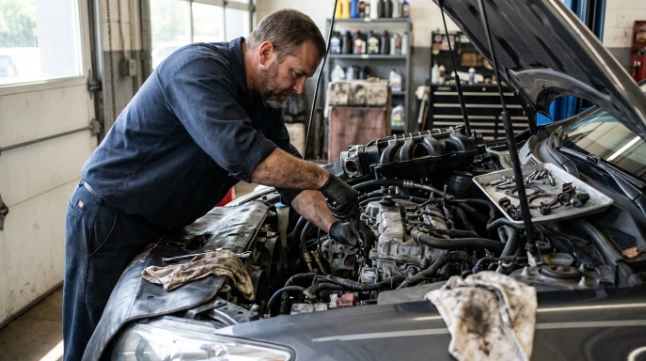
A typical P0325 repair can cost a few hundred dollars, while difficult sensor locations can push the total above $1,000. A 2026 national benchmark from RepairPal estimates average knock sensor replacement at about $413 to $582.
That benchmark includes roughly $125 to $160 for parts and $288 to $423 for labor. Taxes, fees, location differences, and related repairs can change the final invoice.
The most useful lesson is the spread between vehicles. Sensor access can matter more than the price of the sensor itself.
| 2026 Estimate Example | Estimated Replacement Cost | What It Shows |
|---|---|---|
| Average knock sensor replacement | $413–$582 | Useful nationwide benchmark |
| Chevrolet Silverado 1500 | $217–$305 | Some applications stay below the national average |
| Honda Civic | $278–$396 | Moderate parts and labor can keep costs manageable |
| Toyota Camry | $411–$629 | Falls close to the broad national benchmark |
| Ford F-150 | $758–$1,057 | More expensive applications can require much more labor |
| Nissan Frontier | $654–$943 | Vehicle design can make the same basic repair substantially more expensive |
These are reference estimates rather than quotes for your exact vehicle. Model year, engine choice, shop labor rate, region, and required related work can all change the price.
What If the Sensor Is Not the Problem?
A wiring or connector repair may cost less than replacing a difficult-to-access sensor. The opposite can happen if technicians must trace an intermittent electrical fault for several hours.
A software-related P0325 may require a completely different repair path. Manufacturer service information should therefore be checked before expensive parts are authorized.
*Locksmith’s note: ask the shop what test confirmed the failed part before approving a P0325 repair. Paying for diagnosis is often cheaper than paying twice for incorrect parts.*
Section Takeaway: Budget around the diagnosis, not just the sensor price, because labor and the actual root cause determine most of the final P0325 repair cost.
Why Can the P0325 Repair Cost Vary So Much?
The biggest P0325 cost differences usually come from sensor location, vehicle design, diagnosis time, and the actual failed component. Two cars with the same code can require completely different repairs.
Sensor Location and Labor
Some knock sensors are relatively accessible on the engine block. Others sit beneath an intake manifold or behind components that must be removed first.
That extra disassembly increases labor even when the replacement sensor itself is inexpensive. Reassembly can also require new seals or gaskets on certain applications.
OEM vs Aftermarket Parts
An OEM component comes from the vehicle manufacturer’s original-equipment supply chain. Aftermarket sensors come from independent manufacturers and can vary in price and quality.
The cheapest sensor is not always the least expensive repair. A poor signal or incorrect application can create repeat diagnostic work.
- Confirm fitment: Match the replacement to the exact year, engine, and vehicle specification.
- Check connector design: Similar-looking sensors are not automatically interchangeable.
- Follow torque specifications: Knock-sensor installation can be sensitive to mounting requirements.
- Avoid guessing: A new sensor will not repair damaged wiring or a software problem.
*Pro tip: use your VIN when confirming replacement parts and manufacturer procedures. Do not rely only on a generic online compatibility description.*
One Sensor vs Multiple Sensors
Some engines use one knock sensor, while others use multiple sensors. That changes both diagnosis and the amount of disassembly that may be required.
P0325 normally concerns Sensor 1, but the physical location is vehicle-specific. A service manual or manufacturer repair information should identify the correct component.
Section Takeaway: The code is standardized, but the repair is not. Vehicle-specific access and circuit design explain why P0325 estimates vary so widely.
How Is a P0325 Code Diagnosed?
A proper P0325 diagnosis starts with the scanner data and circuit inspection before anyone replaces the sensor. The technician should determine whether the problem is the sensor, connector, wiring, software, or another vehicle-specific condition.
1. Read Every Stored and Pending Code
I recommend saving all codes before clearing anything. Related engine or voltage codes may change the direction of the diagnosis.
Freeze-frame data is also useful. It records operating conditions from around the time the control module detected the fault.
2. Inspect the Sensor Circuit
The wiring near the engine lives in a harsh environment. Heat, vibration, oil contamination, moisture, and physical rubbing can all create problems.
A visual inspection should look for:
- Broken or frayed wiring
- Melted insulation
- Harness chafing
- Loose terminals
- Corroded connector pins
- Oil or water contamination
This step should not be skipped. Manufacturer bulletins have documented P0325 conditions caused by harness chafing rather than a failed sensor.
3. Check Vehicle-Specific Service Information
A generic scanner cannot tell you whether your particular model has a known service issue. Search the exact year, make, model, engine, and VIN when possible.
The NHTSA vehicle information search is a useful starting point for checking safety information and manufacturer records associated with a vehicle.
For example, manufacturer bulletins archived by NHTSA have documented P0325 conditions involving wiring problems and control-module software. That is strong evidence against automatically replacing every knock sensor that sets this code.
4. Test Against Manufacturer Specifications
Electrical testing must follow the specifications for your exact vehicle. Resistance, voltage, connector pin assignments, and test conditions are not universal.
A technician may inspect:
- Sensor response: Whether the knock sensor produces the expected signal.
- Circuit continuity: Whether wiring between the sensor and control module is intact.
- Shorts: Whether the signal circuit is shorted to voltage or ground.
- Connector integrity: Whether terminals maintain proper electrical contact.
- Module information: Whether manufacturer software updates or bulletins apply.
Only after those checks should the repair decision become clear. Parts replacement without testing is parts swapping, not diagnosis.
*Pro tip: don’t use a universal resistance value or internet pinout unless it matches the factory information for your exact engine. Electrical specifications can differ substantially between vehicles.*
5. Clear the Code and Verify the Repair
After the confirmed fault is repaired, the code can be cleared and the vehicle retested. The technician should verify that P0325 does not return under the appropriate operating conditions.
Section Takeaway: The cheapest P0325 diagnosis is often the one that proves the cause before parts are ordered.
Can You Fix P0325 Yourself?
A DIY P0325 repair is possible when the fault is accessible and you have the correct service information. Diagnosis becomes harder when the sensor sits under major intake components or the problem is intermittent wiring.
An OBD2 scanner can help you read stored and pending codes. More capable tools may also display useful live or freeze-frame information.
DIY Work That May Be Reasonable
- Reading codes: Record all DTCs before clearing the computer.
- Visual inspection: Look for obvious connector or harness damage without disturbing sensitive wiring.
- Checking service information: Verify whether your exact vehicle has known P0325-related bulletins.
- Accessible sensor replacement: Experienced DIYers may replace an easy-to-reach sensor using the factory procedure and torque specification.
When Professional Diagnosis Makes More Sense
- The intake manifold must be removed.
- The wiring fault appears intermittent.
- P0325 returns after sensor replacement.
- Several related engine codes are stored.
- The vehicle has significant pinging, power loss, overheating, or abnormal engine noise.
- Manufacturer-level software or control-module work may be required.
*Pro tip: don’t approve a second knock sensor simply because the first replacement failed to clear P0325. A repeat code is a reason to reconsider the diagnosis.*
Section Takeaway: DIY scanning and inspection can save money, but deeper circuit testing should follow vehicle-specific specifications.
Is It Safe to Drive With P0325?
A vehicle with P0325 may still drive normally, but the code should not be ignored. The knock-sensor system helps the engine computer respond to combustion knock, and a circuit fault can limit that information.
If the check-engine light is steady and the vehicle otherwise runs normally, arrange diagnosis soon. Avoid assuming that normal drivability means the circuit is healthy.
Stop Driving If the Symptoms Become Serious
Pay attention to the vehicle rather than the code alone. Serious symptoms can indicate another problem occurring at the same time.
- Flashing check-engine light
- Heavy engine shaking
- Severe loss of power
- Overheating
- Loud metallic knocking
- Smoke or a strong unusual odor
AAA’s check-engine light guidance treats a flashing light as more urgent than a steady one, especially when the vehicle is running abnormally.
If those symptoms appear, get to a safe location and arrange professional help. The additional symptom may be more urgent than P0325 itself.
Section Takeaway: A steady P0325 warning deserves timely diagnosis; severe drivability symptoms or a flashing check-engine light deserve immediate attention.
Frequently Asked Questions About P0325 Repair Cost
How much does it usually cost to repair P0325?
A broad 2026 benchmark places average knock sensor replacement around $413 to $582. Your bill can be lower for a simple wiring or accessible-sensor repair, or exceed $1,000 when the sensor requires extensive disassembly.
Can a bad knock sensor cause P0325?
Yes. A failed knock sensor is one possible cause of P0325, but the code can also result from wiring, connector, harness, software, or control-module problems. Testing the circuit before replacing the sensor reduces the chance of an unnecessary repair.
Can wiring cause a P0325 code?
Yes. Broken wires, chafed insulation, damaged connectors, corrosion, or poor terminal contact can interrupt the knock-sensor circuit. Manufacturer service information has documented wiring-related P0325 conditions on specific vehicles.
Why is knock sensor replacement expensive on some cars?
Labor is often the reason. Some sensors are easy to reach, while others sit beneath intake components that must be removed and reinstalled, increasing labor time and sometimes requiring additional gaskets or seals.
Will replacing the knock sensor automatically clear P0325?
Not necessarily. Replacement will only solve the code if the sensor itself caused the fault. P0325 may return when damaged wiring, a poor connector, software, or another circuit problem remains unresolved.
Can I clear P0325 with an OBD2 scanner?
A scanner can usually clear a stored trouble code, but clearing it does not repair the underlying fault. If the problem remains, the powertrain control module can detect it again and turn the check-engine light back on.
The Bottom Line
P0325 repair cost is best estimated after diagnosis, not from the code alone. A 2026 knock sensor replacement benchmark is roughly $413 to $582, but vehicle-specific totals range widely because access, labor, parts, wiring, and software all matter.
Before approving a repair, ask what testing identified the failed component and whether vehicle-specific service information was checked. That simple question can help you avoid replacing an expensive sensor when the real problem is somewhere else in the circuit.
