
What Should Short Term Fuel Trim Be at Idle?

Quick Answer
Short-term fuel trim (STFT) should generally stay near 0% at a warm, stable idle. Readings between -5% and +5% are a useful target, while brief fluctuations are normal. Persistent readings beyond approximately -10% or +10% may indicate a rich or lean condition, but you must compare long-term fuel trim, engine symptoms, and other live data before identifying the cause. See this OBD-II diagnostic data reference for more context.
Quick fuel-trim reference
- -5% to +5%: A useful target for a warm engine running steadily at idle.
- -10% to +10%: Often acceptable as a general diagnostic range, depending on the vehicle and operating conditions.
- Above +10%: The computer is adding fuel, which can indicate a lean condition.
- Below -10%: The computer is subtracting fuel, which can indicate a rich condition.
- Rapid movement: STFT can fluctuate as the computer continually adjusts the air-fuel mixture.
- Persistent abnormal readings: Compare STFT and LTFT at idle and higher engine speeds before replacing parts.
Before diagnosing a problem
- Warm the engine and confirm it has entered closed-loop fuel control.
- Check both fuel-trim values, if available, and compare them with stored or pending trouble codes.
- Compare idle readings with readings at a steady elevated RPM to help narrow down the cause.
If you’re looking at live data on an OBD2 scanner and wondering whether the numbers are normal, start with the direction and size of the correction rather than chasing a perfect zero. Small adjustments are part of normal engine operation.
In this guide, I’ll explain what short-term fuel trim means, what to look for at idle, and how to interpret readings that seem unusually high or low. You’ll also learn how to use long-term fuel trim to narrow down possible causes without guessing which part needs replacement.
In This Guide
- What Is a Normal Short-Term Fuel Trim at Idle?
- What Do Positive and Negative Fuel Trim Readings Mean?
- How Do You Check Short-Term Fuel Trim With an OBD2 Scanner?
- Why Is Fuel Trim High or Low at Idle?
- How Do You Compare Fuel Trim at Idle and Higher RPM?
- When Should You Investigate an Abnormal Reading?
- Frequently Asked Questions
What Is a Normal Short-Term Fuel Trim at Idle?
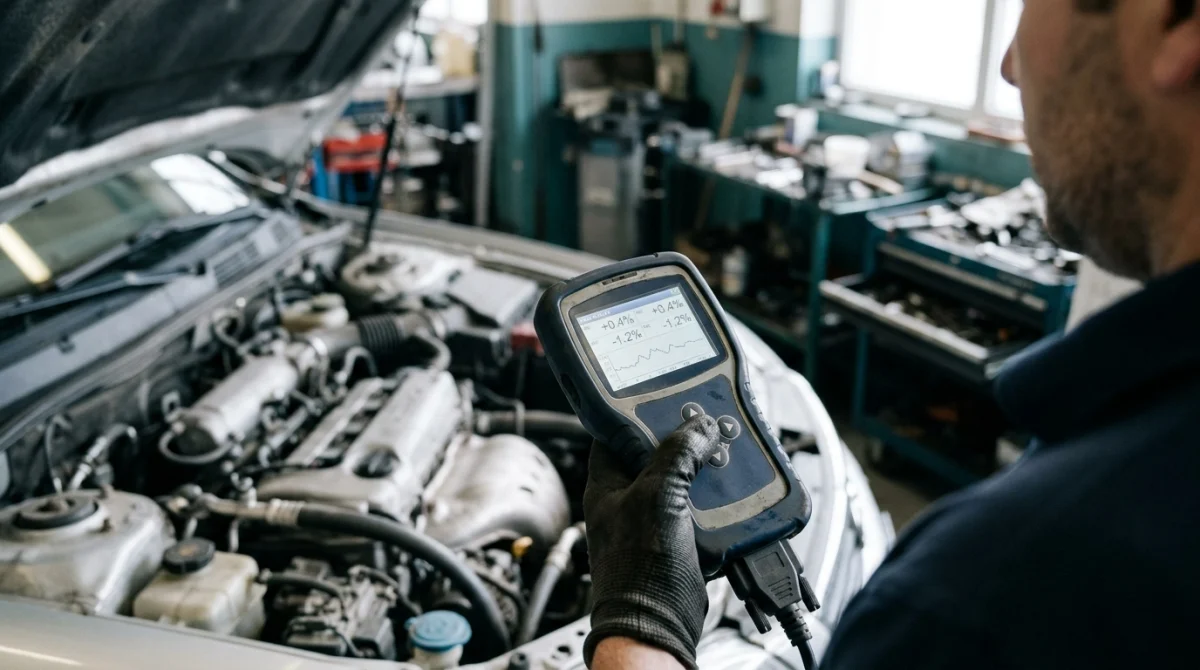
A normal short-term fuel trim reading at warm idle is generally close to 0%, with approximately -5% to +5% serving as a practical target. Readings within about -10% to +10% may still be reasonable, depending on the engine, fuel-control strategy, and operating conditions.
There isn’t one exact number that every vehicle must display. Always compare the reading with the manufacturer’s diagnostic specifications and the rest of the engine data.
What Does Short-Term Fuel Trim Mean?
Short-term fuel trim (STFT) is the percentage adjustment the engine control module makes to fuel delivery in response to feedback from the engine’s fuel-control system. It helps the engine maintain the intended air-fuel mixture as conditions change.
For example, if the engine computer detects a mixture that appears too lean, it may increase injector delivery. The STFT reading then moves into positive percentages.
If the mixture appears too rich, the computer may reduce fuel delivery. The reading moves into negative percentages instead.
The goal is to keep the mixture within the range required by the engine’s control strategy. Zero represents no short-term correction at that moment, not proof that every engine component is working perfectly.
Why Does STFT Change at Idle?
STFT can move up and down even when the engine sounds smooth. The computer continually responds to oxygen-sensor feedback and changing operating conditions.
Small fluctuations are normal in many gasoline engines operating in closed loop. A reading that moves between -3% and +4%, for instance, is generally less concerning than a sustained reading near +20%.
Fuel trims can also change when the air conditioning switches on, the engine load changes, or the computer activates its evaporative-emissions purge system. These changes need context before you label them a fault.
Section takeaway: Aim for fuel trim near zero, but judge the pattern rather than one isolated number. A stable reading within a few percentage points of zero is generally reassuring.
What Do Positive and Negative Fuel Trim Readings Mean?
Positive STFT means the engine computer is adding fuel, while negative STFT means it is subtracting fuel. The direction helps you identify whether the system is correcting toward a lean or rich mixture.
These readings describe the computer’s correction, not a direct measurement of how much fuel physically reaches each cylinder. A large correction is a diagnostic clue, not a complete diagnosis.
How Should You Interpret Positive STFT?
A positive reading means the control module is increasing fuel delivery to compensate for a mixture that appears lean. Small positive numbers can be normal, especially when the value changes briefly.
A sustained reading of +12%, for example, suggests the computer is adding more fuel than usual. If LTFT is also strongly positive, the engine may have a persistent lean-running problem.
Possible causes include:
- A vacuum leak that allows extra air into the intake.
- An intake duct leak or unmetered air entering the engine.
- A mass airflow sensor that under-reports incoming air, where fitted.
- Restricted fuel delivery or insufficient fuel pressure.
- An exhaust leak ahead of an oxygen sensor that affects its readings.
- A faulty sensor or another problem affecting fuel control.
Not every vehicle uses the same sensors or fuel-control strategy, so confirm which components apply to your engine before testing them.
How Should You Interpret Negative STFT?
A negative reading means the computer is reducing fuel delivery to compensate for a mixture that appears rich. A few percentage points below zero may be normal, but a persistent large negative value deserves investigation.
For example, an STFT reading of -14% indicates that the computer is removing fuel through its short-term correction. The underlying cause could involve excess fuel, incorrect airflow measurement, or a sensor signal that makes the mixture appear richer than expected.
Potential causes include:
- A leaking fuel injector or excessive fuel pressure.
- An airflow sensor that over-reports incoming air.
- An engine coolant temperature reading that incorrectly suggests the engine is cold.
- An evaporative-emissions purge problem under certain conditions.
- An oxygen sensor or related wiring fault that distorts the feedback signal.
These are possibilities, not a parts-replacement checklist. Check supporting data and test results before deciding which component is responsible.
Quick Interpretation Table
| STFT reading | General interpretation | What to do |
|---|---|---|
| -5% to +5% | Near the usual target | Compare with LTFT and symptoms. |
| +6% to +10% | Moderate positive correction | Watch the trend and compare operating conditions. |
| Above +10% persistently | Potential lean condition | Investigate air leaks, fuel delivery, and sensor data. |
| -6% to -10% | Moderate negative correction | Check whether the pattern persists. |
| Below -10% persistently | Potential rich condition | Investigate excess fuel and misleading sensor signals. |
These ranges are general screening guidelines rather than universal pass-or-fail limits. Some manufacturers specify different diagnostic thresholds.
Section takeaway: Positive trim means fuel is being added; negative trim means fuel is being removed. Persistent readings outside roughly ±10% deserve attention when other evidence supports a problem.
How Do You Check Short-Term Fuel Trim With an OBD2 Scanner?
To check STFT accurately, use your OBD2 scanner to view live engine data with the engine warm and the fuel system operating in closed loop. Then record STFT and LTFT at a stable idle instead of relying on a single changing display.
A basic scanner may show only generic data, while an enhanced scanner may offer additional manufacturer-specific information. The available readings depend on the vehicle and scan tool.
Follow These Diagnostic Checks
- Connect the scanner. Plug the OBD2 adapter into the vehicle’s diagnostic connector and switch on the ignition as instructed by the tool.
- Start the engine. Allow it to reach normal operating temperature, provided the vehicle is safe to run.
- Check fuel-system status. Confirm closed-loop operation where the scanner provides that information. Cold-engine readings may not represent normal warm operation.
- Open live data. Find STFT Bank 1 and LTFT Bank 1. On engines with multiple banks, check the corresponding values for each supported bank.
- Let the readings settle. Observe the values for several seconds and note their typical range rather than one momentary peak.
- Record related information. Note engine RPM, coolant temperature, oxygen-sensor data, and any stored or pending diagnostic trouble codes.
- Compare another operating condition. If safe and appropriate, compare the readings at a steady elevated RPM using the vehicle’s service guidance.
Don’t clear diagnostic trouble codes before recording them and any available freeze-frame data. That information may help explain the conditions present when a fault occurred.
What Else Should You Read Alongside STFT?
Fuel trim becomes more useful when you compare several related data points. Each reading helps answer a different diagnostic question.
- LTFT: Shows the longer-term correction learned by the engine computer.
- Engine RPM: Confirms whether the engine is idling steadily.
- Coolant temperature: Helps establish whether the engine has warmed up correctly.
- Oxygen-sensor or air-fuel-ratio sensor data: Helps assess the feedback used for mixture control.
- MAF or MAP data: Helps assess airflow measurement, depending on the engine design.
- Diagnostic trouble codes: Point toward systems that may need further testing.
For additional background, the MOTOR guide to generic OBD-II data explains how fuel trims fit into broader scan-tool diagnosis.
Section takeaway: Warm-engine readings, closed-loop status, LTFT, and trouble codes provide a much stronger diagnostic picture than STFT alone.
Why Is Fuel Trim High or Low at Idle?
Abnormal fuel trim at idle often points toward an air leak, fuel-delivery issue, or incorrect sensor signal. The most useful clue is whether the correction changes substantially when engine speed increases.
Idle is a particularly useful diagnostic condition because a small intake leak can represent a larger share of total airflow at low engine speed. However, the pattern varies by engine design and the type of fault.
High Positive Fuel Trim at Idle
If STFT rises well above zero at idle, check whether the engine computer is compensating for a lean condition. A vacuum leak is one possibility, particularly if the correction becomes smaller at higher RPM.
Potential areas to inspect include:
- Vacuum hoses and intake manifold sealing surfaces.
- Cracked intake ducting downstream of the airflow sensor, where applicable.
- Brake-booster vacuum plumbing, where fitted.
- Crankcase ventilation hoses and related connections.
- Airflow sensor readings and fuel-delivery performance.
A lean reading does not prove that a vacuum leak exists. Low fuel pressure, restricted injectors, exhaust leaks, and sensor faults can produce similar clues.
High Negative Fuel Trim at Idle
If STFT remains strongly negative, the computer may be correcting for a rich mixture. Look for evidence of excess fuel delivery or inaccurate sensor readings.
- Check whether the coolant temperature reading makes sense for the engine’s actual temperature.
- Review airflow sensor data for plausibility.
- Check fuel pressure and injector leakage using the correct service procedure.
- Review evaporative-emissions purge operation where relevant.
- Compare oxygen-sensor information with other engine data.
Fuel-system testing can involve pressurized fuel and hot engine components. Technician’s note: use the vehicle manufacturer’s service procedure and appropriate equipment when testing fuel pressure or injectors.
What If STFT Is Normal but the Engine Runs Rough?
Normal fuel trim does not rule out an engine problem. Misfires, ignition faults, compression problems, and mechanical issues can cause rough running without producing an obvious sustained fuel-trim abnormality.
Likewise, an STFT reading close to zero may be misleading when the engine is in open-loop operation or the scan tool is displaying unsupported or incomplete data. Confirm the operating state before drawing conclusions.
Section takeaway: Use abnormal fuel trim to choose the next test, not to select a replacement part. A lean or rich correction must be confirmed with supporting evidence.
How Do You Compare Fuel Trim at Idle and Higher RPM?

Comparing fuel trim at idle with readings at a steady elevated RPM helps distinguish faults that mainly affect idle from problems that affect the engine across a wider operating range. A comparison around 2,000–2,500 RPM is commonly used as a diagnostic reference, but follow the vehicle-specific procedure.
Use a safe, stationary test setup where appropriate. Secure the vehicle, keep clear of moving components, and never perform an under-hood RPM test in an unsafe location.
Understand the Main Patterns
| Observed pattern | Possible explanation | Next diagnostic step |
|---|---|---|
| Strongly positive at idle, closer to zero at higher RPM | An intake or vacuum leak may have a greater effect at idle. | Inspect intake plumbing and test for leaks. |
| Strongly positive at idle and higher RPM | Fuel delivery or airflow measurement may be incorrect. | Check fuel pressure, sensor plausibility, and related codes. |
| Strongly negative at idle | Excess fuel or a misleading sensor signal may be present. | Check temperature, airflow, purge, and fuel-system data. |
| One bank differs substantially from the other | A bank-specific intake, exhaust, injector, or sensor issue may exist. | Compare bank-specific data and follow the service manual. |
| Both trims appear normal, but symptoms remain | The fault may involve ignition, mechanical condition, or another system. | Expand diagnosis beyond fuel trim. |
Example: STFT of +18% at Idle
Imagine an engine showing STFT of +18% at idle and +4% at a steady 2,500 RPM. This pattern suggests that an idle-related air leak deserves investigation, although it does not confirm one.
The next step is to inspect the intake system and use an appropriate leak test. Replacing the oxygen sensor immediately would be premature without evidence that the sensor is faulty.
Don’t Forget Long-Term Fuel Trim
STFT and LTFT work together to describe fuel correction. STFT responds more quickly, while LTFT represents learned adjustments over time and may vary with operating conditions.
For example, STFT of +8% and LTFT of +7% suggest a combined correction of approximately +15% when the values refer to the same operating condition and correction strategy. That is more significant than looking at the +8% STFT value alone.
This simple addition is a useful screening method, but some vehicles use more complex adaptive strategies. Follow the manufacturer’s procedure when calculating total correction or interpreting bank-specific data.
Section takeaway: Compare the entire fuel-trim pattern across operating conditions. A change with RPM can help narrow the possibilities, but testing must confirm the fault.
When Should You Investigate an Abnormal Reading?
Investigate fuel trim when the correction stays outside the usual range, particularly when it approaches or exceeds ±10% and other symptoms or trouble codes support a problem. A single brief spike does not automatically mean the vehicle needs repair.
Consider the engine’s behavior, warning lights, and whether the reading repeats under similar conditions. Manufacturer-specific limits take priority over general guidelines.
Signs That Deserve Attention
- The check-engine light is illuminated or a relevant pending code appears.
- The engine idles roughly, stalls, or hesitates during acceleration.
- Fuel economy has noticeably worsened.
- The exhaust smells unusually rich or the engine runs poorly.
- Fuel trim remains strongly positive or negative after the engine warms up.
- One engine bank shows a persistent difference from the other.
If the engine misfires severely, stalls repeatedly, smells strongly of raw fuel, or shows other signs of a serious fault, stop driving when it is unsafe to continue and arrange professional diagnosis.
What Should You Do Before Replacing Parts?
Follow a diagnostic process rather than treating the scan-tool number as a parts recommendation. Start with the evidence you already have.
- Record stored and pending trouble codes along with freeze-frame data.
- Confirm the engine is warm and operating in the expected fuel-control mode.
- Record STFT and LTFT for each available bank.
- Compare readings at idle and a safe, steady elevated RPM.
- Inspect accessible intake connections and wiring for obvious problems.
- Use the appropriate tests to verify suspected air leaks, fuel-delivery faults, or sensor problems.
Expert note: avoid replacing an oxygen sensor, mass airflow sensor, or fuel injector solely because fuel trim is abnormal. Confirm the cause with appropriate testing and vehicle-specific service information.
For professional diagnosis, a technician can combine scan-tool data with smoke testing, fuel-pressure measurements, sensor checks, and other tests as appropriate. The correct test depends on the symptoms and the vehicle’s design.
Section takeaway: Persistent abnormal fuel trim deserves investigation, but the repair should follow a confirmed diagnosis. Record the data before clearing codes or changing parts.
Frequently Asked Questions
Should short-term fuel trim be exactly 0% at idle?
No. Zero represents no short-term correction at that moment, but the engine computer continually adjusts fuel delivery. A warm engine may show small positive and negative fluctuations. A reading near zero is generally reassuring, but it does not prove that every engine system is fault-free.
Is +10% short-term fuel trim bad at idle?
A sustained reading around +10% is worth investigating, especially if LTFT is also positive or the engine has symptoms. However, the number alone does not confirm a fault. Check closed-loop status, related sensor data, trouble codes, and how the reading changes at higher RPM.
Is negative fuel trim bad?
Not necessarily. A small negative reading means the computer is reducing fuel slightly, which can be normal. Persistent readings below approximately -10% may indicate a rich condition or inaccurate sensor feedback, so compare the value with LTFT and other diagnostic evidence.
Why does STFT jump between positive and negative numbers?
STFT responds to changing feedback from the engine’s fuel-control system, so it can move rapidly around zero during normal closed-loop operation. Brief changes are usually less concerning than a sustained large correction. Check the general trend over time rather than focusing on one update.
Should I check STFT or LTFT first?
Check both. STFT shows the current short-term correction, while LTFT reflects learned adjustments. Reading them together helps reveal whether the engine computer is making a small immediate correction or compensating for a longer-running condition.
Can a vacuum leak cause high fuel trim only at idle?
Yes. A vacuum leak can have a proportionally larger effect when the engine is drawing less air at idle. If positive fuel trim moves closer to zero at higher RPM, an intake leak becomes a useful diagnostic possibility. Confirm it with an appropriate inspection or leak test.
Can a cheap OBD2 scanner give inaccurate fuel-trim readings?
A basic scanner can display useful generic fuel-trim data, but supported parameters, update speed, and manufacturer-specific information vary. Confirm the correct bank and operating mode, and compare suspicious readings with other data. An enhanced scan tool may be needed for deeper diagnosis on some vehicles.
Final Takeaway: Keep Fuel Trim Near Zero, Then Check the Pattern
For most warm gasoline engines, short-term fuel trim near 0% is the goal, and approximately -5% to +5% is a useful practical target at idle. Small fluctuations are normal, while persistent readings beyond roughly ±10% deserve closer attention.
The most reliable interpretation comes from comparing STFT with LTFT, checking whether the engine is in closed loop, and observing how the readings change with RPM. These clues can help narrow the search for an intake leak, fuel-delivery issue, or sensor problem.
If you’re diagnosing a vehicle with an OBD2 scanner, save the codes and live data before making changes. A careful diagnosis is more reliable than replacing parts based on one number.
