
Signs Your Key Fob Is Broken: How to Tell What’s Really Going Wrong

If your car remote has started acting up, the first question is usually simple: is the key fob broken, or is something else to blame? Drivers often replace a fob too early when the real issue is a weak battery, a loose contact, or even the car itself.
Here’s the quick version: the most common signs your key fob is broken are buttons that do nothing, buttons that feel stuck or mushy, operation that works only sometimes, a sharp drop in range, and a fob that no longer unlocks, locks, or starts the car the way it should. But none of those symptoms proves the fob is dead on its own. A weak key fob battery, a weak car battery, or a vehicle-side receiver issue can look almost identical.
If you want the fastest path to the answer, compare the symptom to the cause before you buy anything. A dead battery usually causes weak range or no response. Physical damage, water exposure, or worn buttons points more toward a damaged fob. If the car still ignores a known-good spare fob, the problem may be on the vehicle side instead.
Quick Answer: The Most Common Signs a Key Fob Is Broken
A broken fob usually shows up in one of a few ways:
- The lock and unlock buttons do nothing at all.
- One button works while another fails.
- The fob works only when you stand very close to the car.
- The response is inconsistent from one press to the next.
- The casing is cracked, the buttons are worn, or the fob has been exposed to water.
- The car may still recognize the fob sometimes, but not reliably.
That last point matters. A fob does not always fail cleanly. It may work on Monday, fail on Tuesday, and then act normal again after you press the button a few extra times. That kind of inconsistency is a clue, not a coincidence.
If your car uses push-button start, a fob problem can also show up as a no-start condition even though the doors still unlock. The remote portion and the transponder chip inside the fob are related, but they do not always fail at the same time.
For a broader replacement decision, see our guide on when to replace a car key fob.
How to Tell a Broken Key Fob from a Dead Battery
This is the most useful comparison because battery failure is far more common than total fob failure.
Quick decision tree
Use this simple checklist to narrow it down:
- If the fob works better after a battery swap: the battery was likely the main issue.
- If the fob still has no response after a fresh battery: suspect the shell, contacts, circuit board, or transponder chip.
- If a spare fob works but the original does not: the original fob is likely the problem.
- If both fobs fail the same way: look at the car battery, receiver, fuse, or programming.
- If the doors unlock but push-button start fails: the issue may be the transponder chip, immobilizer communication, or vehicle-side recognition.
Signs it’s probably the battery
A weak or dead key fob battery often causes:
- reduced range
- delayed response
- needing to stand closer to the vehicle
- occasional success after several button presses
What this means: if the fob is still responsive but weaker than usual, start with the battery before assuming the whole remote is broken.
Signs it may be the fob itself
A damaged fob is more likely when you see:
- buttons that feel stuck, loose, or uneven
- a cracked shell
- visible corrosion around the battery contacts
- water damage
- a symptom that stays the same after a fresh battery is installed
What this means: if the battery is new and the fob still does not respond normally, the issue is no longer “probably the battery.” At that point, the shell, contacts, circuit board, or transponder chip may be the real problem.
Common Symptoms That Point to Key Fob Failure
No response from the lock or unlock buttons
When you press the button and nothing happens, that can mean a dead battery, but it can also mean the fob’s internal circuit is failing. If the panic or trunk button still works while lock and unlock do not, that usually suggests a button-specific issue rather than total failure.
What this means: one dead button is often a worn contact or pad, while every button failing points more toward power, electronics, or programming.
Works only at very short range
A fob that used to work from across the parking lot but now only works at the driver’s door is often running on a weak battery. If the range drops suddenly after a drop, a water spill, or a battery change, the fob itself may be damaged or the contacts may not be seated correctly.
What this means: weak range by itself usually points first to the battery, but a sudden change after damage suggests a hardware issue.
Intermittent operation
This is one of the clearest warning signs. A fob that works “sometimes” often has an internal contact problem, cracked solder joint, worn button pad, or corrosion issue.
What this means: inconsistent function is a strong clue that the fob is failing physically, not just running low on power.
One button fails while the others still work
If the lock button is fine but the trunk release is dead, or the panic button works but unlock does not, that usually points to localized wear. Dirt, debris, or a worn rubber button pad can make one function fail before the rest.
What this means: one-button failure usually points to a repairable button or contact issue rather than a fully dead fob.
Push-button start problems
If the doors unlock but the car won’t start, the remote portion may still be partly functional while the transponder chip or programming is not. That symptom deserves extra attention because it can be mistaken for a dead fob when the issue is actually in the immobilizer communication.
What this means: if remote locking still works but start does not, focus on the chip, programming, or vehicle-side start recognition.
What Physical Damage Means: Cracks, Worn Buttons, Water Exposure, and Corrosion
Visible damage matters because it often tells you whether the fob is repairable or on its way out.
Cracked casing
A cracked shell can let dirt and moisture reach the circuit board. A small crack does not always kill the fob immediately, but it raises the odds of internal damage over time. If the battery cover no longer sits tightly, the battery may shift and lose contact.
Worn or sticky buttons
Buttons that do not respond or feel stuck can signal physical wear, and dirt or debris can make them less effective. If a button feels mushy, sits lower than the others, or only works when pressed hard, the rubber pad or contact surface may be worn out.
Water exposure
A fob that got wet should be treated as a time-sensitive problem. Remove the battery as soon as possible if you can do so safely. Water and battery contact do not mix well, and corrosion can spread even after the fob seems dry on the outside.
Corrosion or loose battery contacts
Green or white buildup on the battery contacts is a bad sign. Sometimes cleaning the contacts helps, but if the metal is badly pitted or the spring contact is loose, the problem can keep coming back. If the issue persists after checking for corrosion or looseness, professional repair may be needed.
For a deeper look at repair choices, our article on key fob repair cost breaks down when repair is worth it.
Step-by-Step Troubleshooting to Try Before Replacing the Fob
1. Move close to the vehicle
This sounds basic, but it matters. Test the fob next to the driver’s door, not from inside the house or across a parking lot. If it only works at very short distance, battery strength is one of the first things to suspect.
2. Replace the key fob battery
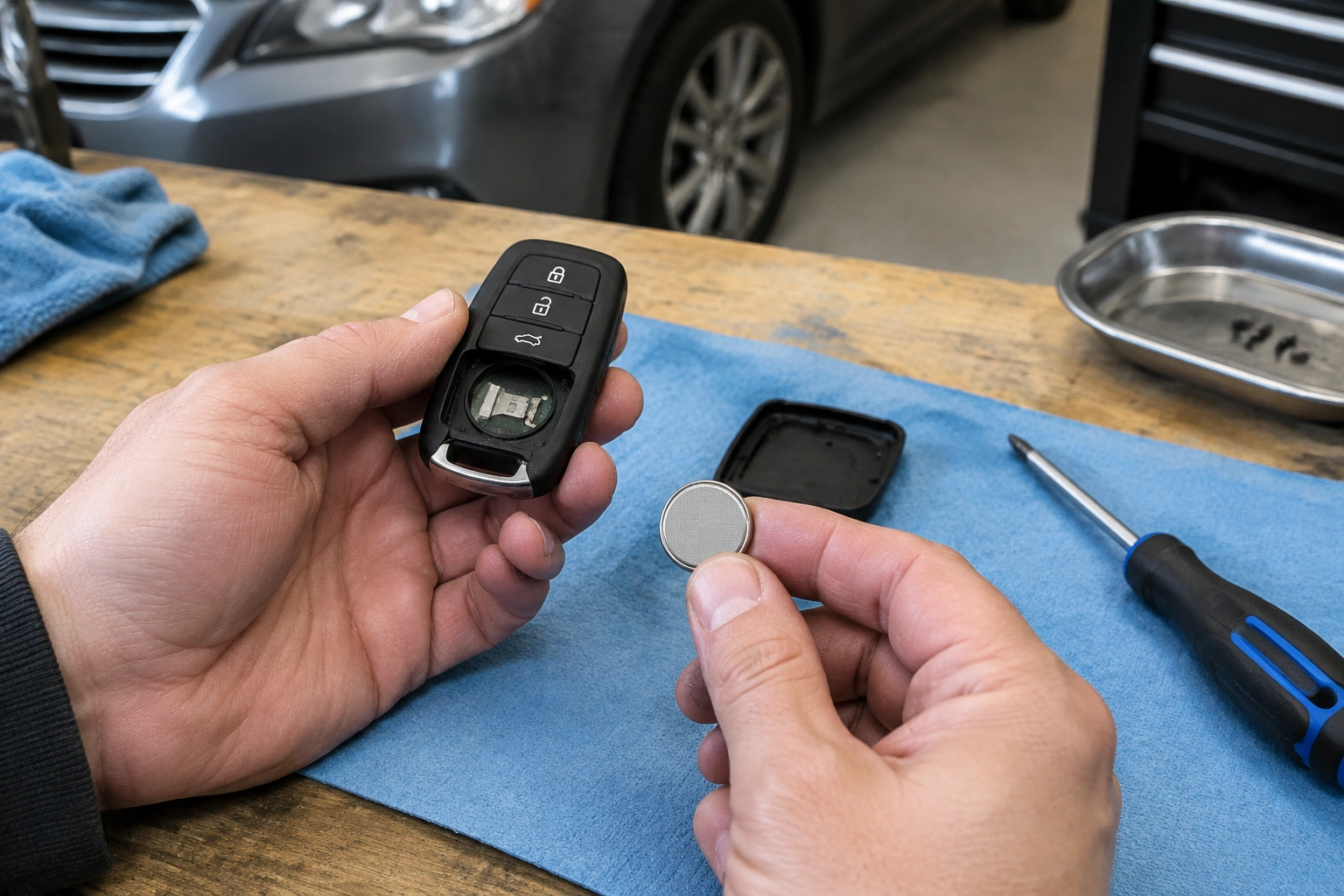
This is the first real test in most cases. If you have the correct replacement coin cell and know how to open the case without forcing it, swap the battery and retest. Make sure the battery is installed in the correct orientation and that the contacts are clean.
3. Check the battery contacts
Look for corrosion, a bent spring, or a battery that does not sit tightly. A fresh battery cannot help if it is not making solid contact.
4. Try the spare key fob
If your spare works normally, the car is probably fine and the original fob is the likely problem. If both fobs fail the same way, that points away from the fob and toward the vehicle side.
5. Test the car battery
A weak car battery can create strange remote and starting behavior. If the vehicle is slow to crank, the dash lights look weak, or multiple systems are acting odd, don’t blame the fob too quickly.
6. Pay attention to what changed
If the problem began after a battery swap, a drop, or a water spill, that timing is useful. It can point you toward a loose battery, damaged contacts, or internal electronic failure.
When the Problem Is Not the Fob: Car Battery, Receiver, or Reprogramming Issues
A lot of “bad fob” complaints turn out to be vehicle-side problems.
Weak car battery
If the car battery is weak, the vehicle may not respond properly to the fob, especially when starting. You may also see dim lights, slow cranking, or other electrical oddities. If the car battery is struggling, the fob can look guilty even when it isn’t.
What this means: if the car is sluggish overall, the battery or charging system may be the first thing to check.
Bad receiver or antenna issue
If the car does not respond to multiple known-good fobs, the receiver or related wiring may be the real problem. That is especially likely when both fobs fail the same way at the same time.
What this means: if every fob behaves the same way, the fault is more likely in the car than in the remote.
Reprogramming needed
Sometimes the fob still has power, but the car no longer recognizes it correctly. That can happen after a battery replacement, system reset, or other electrical issue. If a fresh battery does not restore normal function, reprogramming may be the next step.
What this means: if the fob powers up but the car ignores it, the fix may be pairing or reprogramming rather than replacement.
If you suspect the receiver rather than the fob, our guide on how to know if a key fob receiver is bad can help you narrow it down.
Repair, Reprogram, or Replace: How to Decide the Next Move
Replace the battery if:
- the range is weak
- the fob works inconsistently but not completely dead
- the battery is old or unknown
- the fob improves after a battery swap
Repair the fob if:
- the shell is cracked
- the button pad is worn
- the battery contacts are loose
- the damage is external and the board still appears intact
Reprogram the fob if:
- the battery is good
- the fob still powers on
- the car does not recognize it reliably
- the spare works but the original does not after a battery change
Replace the whole fob if:
- water damage reached the board
- the circuit board is visibly damaged
- the fob still fails after battery replacement and reprogramming attempts
- the casing and electronics are both failing
OEM and aftermarket fobs both have pros and trade-offs. OEM parts usually match the vehicle more closely, while aftermarket options can be cheaper. The downside is that fit, finish, and compatibility can vary, so it is worth checking carefully before buying.
When to Consult a Locksmith
A locksmith is often the best next stop when you have already tried a new battery, tested the spare, and still cannot isolate the issue. They can usually tell you whether the fob needs reprogramming, repair, or replacement without the dealership markup in some cases.
Go to a dealer if your vehicle uses a highly integrated system, if the fob is tied to advanced security features, or if the locksmith cannot program the unit for your make and model. If the problem is clearly on the vehicle side, a locksmith may still be able to help, but a dealer or qualified automotive technician may be the better route.
How Much a Broken Key Fob Usually Costs to Fix or Replace
Costs vary widely because the fix may be as simple as a battery or as involved as a full replacement and programming job. Typical U.S. price ranges are roughly:
- Battery replacement: about $5 to $20 for the battery itself, or around $10 to $40 if you have it replaced
- Shell or button repair: about $10 to $50 for parts, or roughly $25 to $100 if done as a small repair service
- Reprogramming: often around $50 to $150, depending on the vehicle and who does the work
- Aftermarket replacement fob: about $20 to $100 for the part, with programming sometimes adding more
- OEM replacement fob: often about $100 to $400+ for the part, with programming and cutting services adding to the total
If you are deciding between repair and replacement, compare the condition of the shell, the battery contacts, and the circuit board. A fob with minor external damage is often worth repairing. A water-damaged or dead board usually is not.
For a more detailed breakdown, see our guide on key fob repair cost.
Frequently Asked Questions About Broken Key Fobs
Can a key fob work sometimes and still be broken?
Yes. Intermittent function is one of the most common signs of trouble. It often means the battery is weak, the contacts are loose, or the internal electronics are failing.
Why does my key fob unlock the car but not start it?
That can happen when the remote portion still works but the transponder chip or programming is not communicating correctly with the vehicle’s start system.
How do I know if it’s the car and not the fob?
Test a spare key fob. If both fobs fail the same way, the problem is more likely the car battery, receiver, fuse, or programming than the fob itself.
Can I keep using a broken fob temporarily?
Sometimes, yes, if the car still recognizes it occasionally or you have a spare. But if the fob is becoming unreliable, don’t wait until you are locked out or stranded.
Is it worth repairing an old fob?
Usually yes if the issue is a battery, shell, button pad, or contact problem. If the circuit board is damaged, replacement may make more sense.
Do I need the dealer for every key fob problem?
No. Battery replacement, basic inspection, and some reprogramming can often be handled by a locksmith or on your own. Dealer service is more useful when the vehicle’s security system is tightly integrated or the fob is model-specific.
If the fob still fails after a battery swap, use the spare key fob to separate fob-side problems from vehicle-side issues. If both remotes act the same, move to the car battery, receiver, fuse, or reprogramming checks before buying a replacement.
