
What Does P0201 Mean? Causes, Symptoms, Diagnosis, and Repair Costs

Seeing the check engine light come on can be worrying, especially when an OBD2 scanner displays a code you have never seen before. If your scanner shows P0201, you may also notice rough running, weak acceleration, hard starting, or a strong fuel smell.
So, what does P0201 mean? It means the vehicle’s computer has detected an electrical problem in the fuel injector circuit for cylinder 1. The injector may have failed, but damaged wiring, a loose connector, corrosion, or a computer-control problem can cause the same code.
This guide explains what P0201 means, how serious it is, what symptoms to watch for, how technicians diagnose it, and what repairs may cost. It also explains why replacing the injector without testing the circuit can waste money.
Quick Answer
P0201 means the engine computer detected a fault in the electrical circuit controlling the fuel injector for cylinder 1. Common causes include a damaged injector connector, broken wiring, a failed injector coil, or, less commonly, a faulty engine computer. The vehicle should be diagnosed promptly, especially if it runs roughly or smells strongly of fuel.
What Does the P0201 Code Mean?
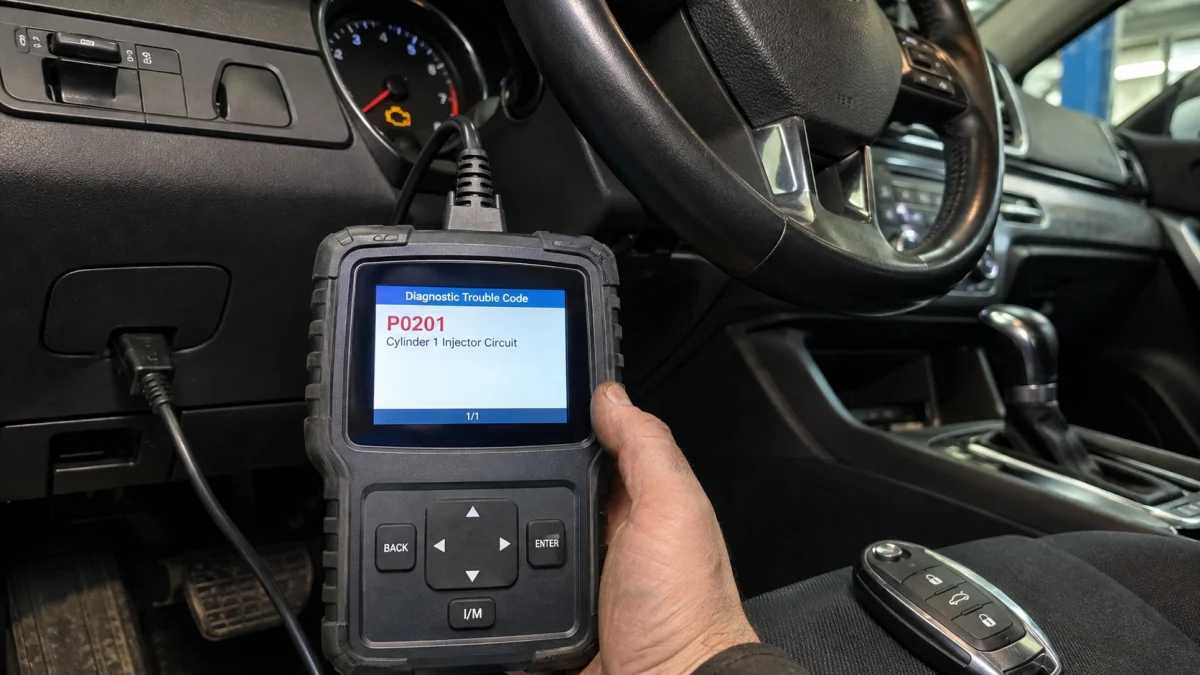
P0201 is a generic powertrain diagnostic trouble code. Its basic definition is “Cylinder 1 Injector Circuit” or “Injector Circuit/Open — Cylinder 1,” depending on the scanner and vehicle manufacturer.
A manufacturer technical document hosted by NHTSA, for example, identifies P0201 as a cylinder 1 injector-circuit fault. However, the exact testing procedure can vary by engine and model, so technicians should still follow vehicle-specific service information. (NHTSA)
The code can be divided into four parts:
- P: The problem is related to the powertrain, which includes the engine and transmission.
- 0: It is generally a standardized or generic OBD2 code.
- 2: It relates to the fuel or air-metering injector circuit.
- 01: The fault involves the injector circuit for cylinder 1.
The engine control module, often called the ECM or PCM, controls each fuel injector electronically. It switches the injector on and off many times per second so the engine receives the correct amount of fuel.
When the computer detects unexpected voltage, excessive resistance, an open circuit, or another electrical response outside the expected range, it may store P0201 and illuminate the check engine light.
The EPA describes OBD systems as part of the process used to identify vehicles with emission-related faults that may require repair. You can learn more through the EPA’s vehicle emissions inspection and OBD resources. (US EPA)
What Does “Injector Circuit/Open” Mean?
The word open usually refers to a break in the electrical path. Electricity cannot travel through the injector circuit as the computer expects.
An open circuit may be caused by:
- A disconnected injector plug
- A broken or cut wire
- A loose connector terminal
- Corrosion inside the connector
- A burned-out injector coil
- A damaged ECM connector
- An internal ECM injector-driver failure
This is different from a clogged injector. A clogged injector may have restricted fuel flow while its electrical circuit still works normally. P0201 is primarily an electrical circuit code, although the injector itself can be the source if its internal coil has failed.
Where Is Cylinder 1?
Cylinder 1 is not always located in the same place.
Its position depends on:
- The engine manufacturer
- Whether the engine is inline, V-shaped, or horizontally opposed
- The vehicle’s model year
- The engine size and design
On some engines, cylinder 1 is the front cylinder nearest the drive belt. On others, it may be on the left or right cylinder bank.
Do not guess which injector belongs to cylinder 1. Check the owner’s manual, an OEM repair manual, a reliable service database, or the cylinder-numbering diagram for your exact engine.
Disconnecting or replacing the wrong injector can create additional codes and unnecessary expense.
Common Symptoms of P0201
P0201 symptoms can range from a check engine light with mild drivability changes to severe misfiring and a no-start condition.
Check Engine Light
The check engine light is usually the first sign. It may remain steadily illuminated or flash if the engine is misfiring badly.
A flashing check engine light should not be ignored. It can indicate a severe misfire that may overheat and damage the catalytic converter.
Rough Idle
Cylinder 1 may not receive the correct amount of fuel. The engine may shake, vibrate, or sound uneven while idling.
The vibration may become more noticeable when the air conditioner is running or the transmission is placed in Drive.
Engine Misfire
A faulty injector circuit can stop the injector from opening. The cylinder may then misfire because it does not receive enough fuel.
You may also see a related misfire code, such as P0301, which identifies a misfire on cylinder 1.
Weak Acceleration
The vehicle may hesitate or feel underpowered because the engine is operating on fewer effective cylinders.
Passing, merging, and climbing hills may become more difficult.
Hard Starting or No Start
Some vehicles may crank longer than usual before starting. Severe circuit problems, multiple injector faults, or a shared power-supply failure can prevent the engine from starting.
Poor Fuel Economy
The engine computer may change fuel delivery in response to the misfire or unusual oxygen-sensor readings. Fuel economy can decrease.
Fuel Smell or Exhaust Smoke
If the injector is stuck electrically on rather than off, too much fuel may enter the cylinder. This can cause:
- A raw gasoline smell
- Dark exhaust smoke
- Difficult starting
- Contaminated engine oil
- Catalytic converter damage
Stop driving if you notice leaking fuel, heavy smoke, or a strong gasoline smell under the hood. Fuel vapor can create a fire hazard.
How Serious Is Code P0201?
P0201 should be treated as a moderately serious to potentially severe code.
A vehicle that runs smoothly with only a steady check engine light may be driven a short distance to a repair facility. However, continued driving is not recommended when the engine is shaking, misfiring, losing power, or producing a strong fuel smell.
Driving with an inactive cylinder can cause:
- Catalytic converter overheating
- Higher emissions
- Poor fuel economy
- Cylinder-wall fuel washing
- Engine-oil contamination
- Unexpected stalling
- Unsafe power loss in traffic
Arrange diagnosis as soon as reasonably possible. Tow the vehicle when it is running extremely poorly or presents a fuel-leak or fire risk.
Common Causes of P0201
1. Loose or Damaged Injector Connector
The connector on the cylinder 1 injector may be loose, cracked, contaminated, or partially disconnected.
Heat and vibration can weaken the locking tab. Moisture or engine-cleaning chemicals can also enter the connector and corrode its terminals.
2. Broken or Chafed Wiring
Injector wiring is exposed to engine heat, vibration, oil, moisture, and contact with surrounding components.
A wire may break internally even when the insulation looks normal. Wiring can also rub against a bracket, engine cover, or intake component until the conductor becomes exposed.
3. Failed Fuel Injector Coil
Inside an electronically controlled fuel injector is a coil that creates a magnetic field. If that coil burns open or develops incorrect resistance, the ECM may detect a circuit fault.
Replacing the injector may solve the problem in this situation, but the injector should be tested first.
4. Corroded or Spread Connector Terminals
A terminal can become loose and fail to grip the injector pin correctly. Corrosion increases resistance and interferes with the electrical signal.
Simply pushing the connector back into place may provide temporary improvement without correcting the damaged terminal.
5. Blown Fuse or Injector Power-Supply Problem
Some vehicles supply power to several injectors through one fuse, relay, or shared wire.
A shared power failure normally affects more than one cylinder, but wiring design varies. Check for additional injector codes before focusing only on cylinder 1.
6. Faulty Engine Control Module
An internal ECM injector driver can fail, but this is less common than an injector, connector, or wiring problem.
Do not replace the ECM based on P0201 alone. The circuit, injector resistance, power supply, grounds, and connector condition should be verified first.
7. Rodent or Previous Repair Damage
Rodents sometimes chew injector wiring under the hood. Wiring may also be pinched or left unsecured after intake, valve-cover, ignition, or engine repairs.
The timing of the code matters. If P0201 appeared immediately after recent engine work, inspect the repaired area first.
Can a Key Fob or Immobilizer Cause P0201?
A weak key fob battery, lost key programming, or immobilizer problem can prevent an engine from starting. However, those problems do not normally cause P0201.
An immobilizer-related no-start often has different signs:
- The engine cranks but immediately stops
- The security light flashes
- The dashboard displays “Key Not Detected”
- The starter does not operate
- A replacement key works while the original key does not
P0201 points toward the cylinder 1 injector circuit. A no-start vehicle can have both a key-related issue and an injector fault, but one should not automatically be blamed for the other.
Before paying for key programming, confirm whether the security indicator recognizes the key and whether the engine computer is reporting injector-circuit faults.
How P0201 Is Diagnosed
A proper diagnosis follows the electrical circuit instead of immediately replacing the injector.
1. Scan All Vehicle Codes
A technician begins by recording:
- Stored codes
- Pending codes
- Freeze-frame information
- Misfire data
- Battery voltage
- Fuel-system information
Related codes can reveal whether the problem affects only cylinder 1 or several injectors.
2. Inspect the Injector and Wiring
With the engine off, inspect the cylinder 1 injector connector and nearby wiring.
Look for:
- A loose plug
- A broken locking tab
- Green or white corrosion
- Bent or recessed terminals
- Melted insulation
- Oil inside the connector
- Wires rubbing against metal
- Rodent damage
A careful visual inspection can find problems that a basic code reader cannot.
3. Check the Injector Fuse and Power Supply
The technician checks the appropriate fuse and confirms whether the injector receives its required power supply.
The circuit design must be verified from the correct wiring diagram. Testing random wires can damage sensitive electronics.
4. Measure Injector Resistance
With the injector safely disconnected, a digital multimeter can measure the resistance of its internal coil.
The reading must be compared with the manufacturer’s specification and, when appropriate, the readings from the other injectors.
An infinite reading commonly suggests an open injector coil. A very low reading may indicate an internal short.
5. Test Circuit Continuity
The wiring between the injector and ECM may be checked for:
- Open circuits
- Short circuits
- High resistance
- Short-to-ground conditions
- Short-to-voltage conditions
A wire can pass a basic continuity test while failing under load, so experienced technicians may use voltage-drop or load testing when needed.
6. Check Injector Command
A technician may use a noid light, oscilloscope, current probe, or bidirectional scan tool to determine whether the ECM is commanding the injector correctly.
These tests can separate a failed injector from damaged wiring or a control-module problem.
7. Repair, Clear the Code, and Verify
After repairing the confirmed fault, the technician clears the codes and operates the vehicle under appropriate conditions.
The repair is not complete until:
- P0201 does not return
- The engine runs smoothly
- Misfire data is normal
- No fuel leak is present
- All disturbed connectors are secure
Expert Tip: Save the freeze-frame data before clearing P0201. It records operating conditions when the fault appeared and can help identify an intermittent connector or heat-related wiring problem.
Can You Fix P0201 Yourself?
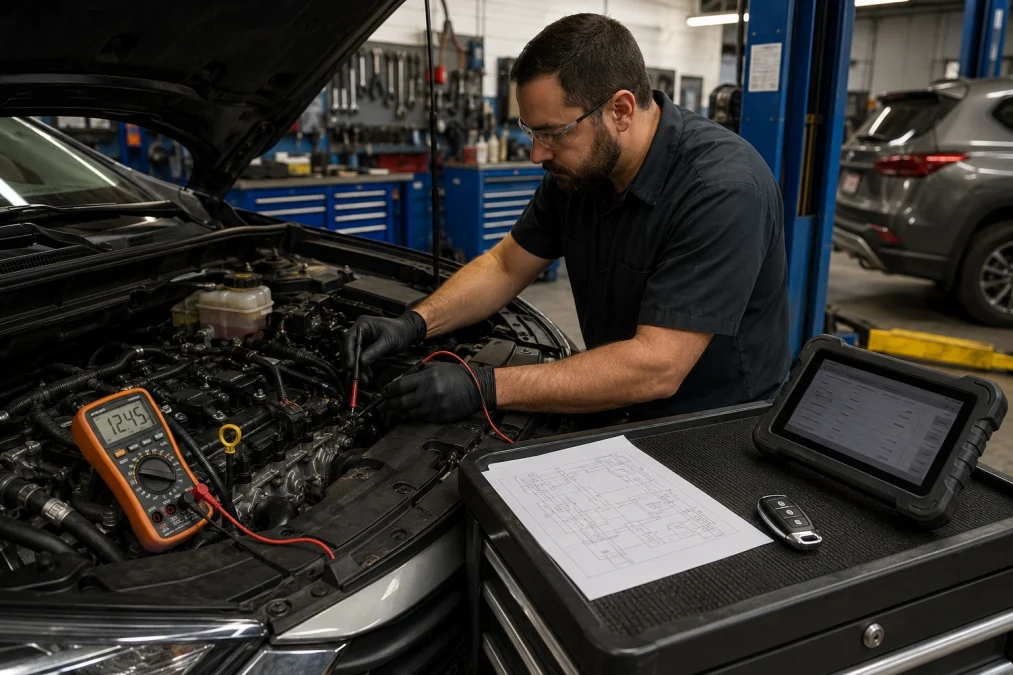
A basic visual inspection may be reasonable for a careful vehicle owner. You can check whether the connector is obviously loose or whether the wiring has visible damage.
More advanced diagnosis requires electrical knowledge and vehicle-specific specifications.
Reasonable DIY Checks
- Park safely and switch the ignition off.
- Allow hot engine components to cool.
- Identify cylinder 1 using trusted service information.
- Inspect the injector plug and visible wiring.
- Check the correct fuse using the owner’s manual.
- Record all codes before clearing anything.
Repairs Best Left to a Technician
Professional help is recommended for:
- Injector resistance testing without specifications
- ECM connector testing
- Circuit load testing
- Oscilloscope diagnosis
- Direct-injection fuel-system repairs
- Diesel injector repairs
- ECM replacement or programming
- Wiring repairs near hot or moving parts
Never open a high-pressure fuel system without the correct procedure and equipment. Gasoline direct-injection and diesel systems can retain extremely high pressure after the engine is turned off.
Estimated P0201 Repair Costs
Costs vary by vehicle, engine design, labor rate, part accessibility, and the confirmed cause. The following are broad U.S. planning ranges rather than guaranteed quotes.
| Repair or Service | Estimated Cost | Important Consideration |
|---|---|---|
| Diagnostic testing | $100–$220 | May be applied toward the repair by some shops |
| Connector cleaning or minor terminal repair | $50–$200 | Only appropriate when terminals are still serviceable |
| Injector connector replacement | $100–$300 | May require heat-resistant wiring repair |
| Injector wiring repair | $120–$600+ | Cost rises when damage is hidden inside the harness |
| Port fuel injector replacement | $180–$650 | Access and part quality affect the price |
| Direct-injection injector replacement | $350–$1,200+ | May require seals, calibration, or special tools |
| Diesel injector replacement | $500–$2,000+ | High-pressure systems require specialized service |
| ECM repair or replacement | $700–$2,500+ | Programming and immobilizer setup may be required |
Ask whether the estimate includes diagnostics, seals, labor, programming, taxes, and final verification.
The FTC’s auto repair guidance recommends asking how a shop calculates its charges and obtaining a written estimate for significant repairs. It also suggests considering a second opinion for complicated or expensive work. (Consumer Advice)
Should You Replace One Injector or All of Them?
P0201 does not automatically mean every injector needs replacement.
Replacing only the failed injector is often reasonable when:
- Testing confirms one injector has failed
- The other injectors perform normally
- The vehicle has moderate mileage
- There is no widespread contamination
- Labor access does not require extensive disassembly
Replacing several or all injectors may make sense when:
- Multiple injectors fail testing
- The engine has very high mileage
- A known batch failure affects the vehicle
- Contamination has damaged the fuel system
- Labor to reach the injector set is unusually high
- The manufacturer requires matched or coded injectors
Ask the technician to explain the test results supporting any recommendation to replace multiple injectors.
Parts Quality and Durability
The cheapest injector is not always the least expensive long-term option.
A poor-quality injector may have:
- Incorrect flow characteristics
- Weak electrical windings
- Poor sealing
- Unstable spray patterns
- A short service life
- Compatibility problems
OEM parts generally offer the closest match to the original component. High-quality aftermarket injectors may also be suitable when they come from a recognized manufacturer and meet the vehicle’s specifications.
Avoid unidentified injectors with no warranty, flow information, or application details.
When to Call a Professional Locksmith or Dealership
P0201 is normally an engine-repair issue, so an automotive technician is usually the correct professional. However, a locksmith or dealership may become relevant in specific situations.
Call an Automotive Repair Technician When:
- The check engine light shows P0201
- The engine shakes or misfires
- Injector wiring is damaged
- Fuel odor is present
- Electrical testing is needed
- A fuel injector requires replacement
Call an Automotive Locksmith When:
- The key is not recognized
- The security light flashes
- The vehicle displays “No Key Detected”
- A replacement key needs programming
- The ignition cylinder or key is damaged
- The doors unlock but the immobilizer prevents starting
Contact a Dealership When:
- The vehicle may have an injector-related recall
- OEM programming or calibration is required
- The ECM must be replaced
- Injector coding requires factory-level equipment
- The vehicle remains under factory warranty
- A manufacturer-specific diagnostic procedure applies
Before approving an expensive repair, enter the vehicle’s VIN into the official NHTSA recall lookup tool. An open safety recall may qualify for a no-cost repair at an authorized dealership. (NHTSA)
Common Mistakes Car Owners Should Avoid
- Replacing the injector based only on the code. P0201 identifies a circuit, not the failed part.
- Assuming cylinder 1 is in the same location on every engine. Verify the cylinder layout first.
- Clearing the code before saving freeze-frame data. Useful diagnostic evidence can be lost.
- Ignoring damaged connector terminals. A connector can look attached while making poor electrical contact.
- Using a test light on computer-controlled wiring without instructions. The wrong tool can damage the ECM.
- Installing a higher-rated fuse. This can overheat wiring and create a fire risk.
- Opening a pressurized fuel system at home. Direct-injection and diesel systems require specialized precautions.
- Confusing a no-start injector fault with a key fob problem. Check the security indicator and scan results before paying for key programming.
- Buying the cheapest injector available. Poor flow matching or weak construction may create new drivability problems.
- Replacing the ECM before testing the circuit. Control-module failure is possible, but it is not the most common cause.
FAQs
Can I drive with a P0201 code?
A short drive to a repair facility may be possible when the engine runs smoothly and the check engine light is steady. Do not continue driving if the engine shakes, loses significant power, smells strongly of fuel, leaks fuel, or has a flashing check engine light.
Does P0201 always mean the fuel injector is bad?
No. The injector may have an open internal coil, but damaged wiring, corrosion, loose terminals, a blown fuse, or an ECM driver problem can produce the same code.
Can a clogged injector cause P0201?
A clogged injector usually causes a fuel-delivery or misfire problem rather than an electrical circuit code. However, an injector can be both clogged and electrically faulty. Testing is necessary to confirm the cause.
Will replacing the key fob battery clear P0201?
No. A key fob battery affects remote functions and, on some vehicles, passive-key detection. It does not normally repair an electrical fault in the cylinder 1 injector circuit.
Can a weak vehicle battery cause P0201?
Low system voltage can sometimes create unusual electrical codes, especially during starting. However, a stored P0201 that returns after the battery and charging system test normally requires direct injector-circuit diagnosis.
How long does a P0201 repair take?
A loose connector may be corrected quickly. Hidden harness damage, difficult injector access, direct-injection work, or ECM diagnosis can require several hours. The technician should diagnose the circuit before estimating repair time.
Will P0201 clear itself?
The check engine light may turn off after several fault-free drive cycles if the problem was temporary. The code may remain stored in history, and an intermittent wiring fault can return. Inspecting and testing the circuit is safer than assuming the problem is gone.
Conclusion
What does P0201 mean? It means the engine computer has detected an electrical problem in the fuel injector circuit for cylinder 1. The injector itself may be faulty, but loose connectors, damaged wiring, corrosion, power-supply problems, and control-module faults are also possible.
Start by recording every code and verifying the location of cylinder 1. Inspect the connector and wiring, but avoid replacing parts without electrical testing. Stop driving if the engine misfires severely, the check engine light flashes, or you smell leaking fuel.
Choose a qualified automotive technician for injector-circuit diagnosis. Contact a locksmith only when the evidence points to key recognition, ignition, or immobilizer trouble. Request a written estimate, ask what testing confirmed the failure, and approve the repair that corrects the cause rather than simply replacing the first suspected part.
