
What Does P0301 Mean? Cylinder 1 Misfire Explained

Quick Answer
P0301 means your vehicle’s computer detected a misfire in engine cylinder 1. The code identifies the affected cylinder, but it does not identify the failed part. You need an OBD2 scanner and a few checks to confirm whether the cause is a spark plug, ignition coil, fuel injector, air leak, wiring fault, or internal engine problem. The AAA diagnostic code translator also explains why trouble codes should be treated as diagnostic clues.
What to check first
- Check the warning light: Stop driving if the check engine light flashes.
- Read every code: Related fuel, ignition, or sensor codes can reveal the real cause.
- Inspect cylinder 1: Look for a loose coil connector, damaged wiring, oil, water, or corrosion.
- Check ignition parts: A worn spark plug or weak coil is a common starting point.
- Confirm before replacing: Swap testing and mechanical tests can prevent wasted money.
Important safety tip
- A flashing check engine light can indicate a severe misfire that may overheat the catalytic converter.
When someone asks me, “What does P0301 mean?” they usually want to know whether the car is safe to drive. They also want to know which part needs replacement.
I have scanned plenty of vehicles while handling key, immobilizer, and no-start complaints. P0301 is an engine misfire code, not a key fob or transponder-chip fault, so the diagnosis must move toward the engine.
In This Guide
What Does P0301 Mean?
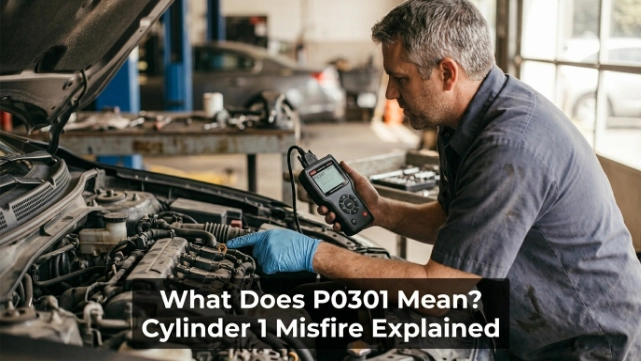
P0301 is a generic OBD2 powertrain code for “Cylinder 1 Misfire Detected.” It means the engine computer noticed that cylinder 1 was not contributing power as expected.
Definition: A misfire happens when the air-fuel mixture inside a cylinder fails to burn correctly. The cylinder may fire late, burn weakly, or fail to burn at all.
Here is how the five-character code breaks down:
- P: The fault involves the vehicle’s powertrain.
- 0: It is a generic OBD2 code used across many vehicle brands.
- 3: The fault relates to ignition or engine misfire monitoring.
- 01: The computer detected the misfire on cylinder 1.
The location of cylinder 1 depends on the engine design. It may sit at the front, rear, left, or right side of the engine.
Do not guess its position from a generic diagram. Check the manufacturer’s service information for your exact year, make, model, and engine.
How does the computer detect a misfire?
The engine computer watches tiny changes in crankshaft speed. A weak combustion event causes less acceleration during one cylinder’s power stroke.
The computer compares those changes with crankshaft and camshaft position data. When the pattern points to cylinder 1, it may store P0301.
A scan result does not prove that the spark plug failed. The computer can detect the uneven power event, but several different faults can create it.
Section Takeaway: P0301 identifies a cylinder 1 misfire. It does not automatically identify the part that caused it.
What Symptoms Can P0301 Cause?
P0301 can cause anything from a slight stumble to severe shaking. The symptoms depend on how often cylinder 1 misfires and when it happens.
Common signs include:
- A steady or flashing check engine light
- Rough idle or noticeable engine vibration
- Hesitation during acceleration
- Reduced engine power
- Hard starting or extended cranking
- Poor fuel economy
- A fuel smell near the exhaust
- Popping or uneven exhaust sounds
- Engine stalling at low speed
What does a flashing check engine light mean?
A flashing light usually indicates an active misfire severe enough to risk catalytic-converter damage. Unburned fuel can enter the exhaust and create extreme heat.
Reduce speed and pull over somewhere safe. Shut the engine off and arrange an inspection or tow if the light keeps flashing.
A steady light is normally less urgent, but it still deserves prompt attention. Continuing to drive can make a small ignition fault more expensive.
Locksmith’s note: A key fob, smart key, immobilizer, or remote-start problem can prevent starting. Those systems do not normally create a cylinder-specific P0301 code after the engine starts.
What Causes a P0301 Code?
A failed spark plug or ignition coil is a common cause, but it is not the only one. Cylinder 1 needs correct spark, fuel, air, compression, and timing.
Ignition-system problems
Ignition faults often provide the quickest starting point. Common possibilities include:
- Worn spark plug: A large gap, carbon buildup, or damaged insulator can weaken the spark.
- Failed ignition coil: A weak coil may misfire under load, during cold starts, or after warming up.
- Damaged coil boot: Cracks or carbon tracking can let voltage escape before reaching the plug.
- Loose connector: Poor pin contact can interrupt power or the coil-control signal.
- Plug wire fault: Older ignition systems may have a damaged or high-resistance wire.
Fuel and air problems
Cylinder 1 can misfire when it receives too much fuel, too little fuel, or unwanted air. These conditions may appear only at idle or under acceleration.
- Clogged fuel injector: Restricted flow can make the mixture too lean.
- Leaking injector: Excess fuel may foul the spark plug and cause rough starting.
- Injector wiring damage: An open circuit or poor connector can stop injector operation.
- Vacuum leak: A leaking intake gasket or hose near cylinder 1 can create a lean mixture.
- Low fuel pressure: A weak pump or restriction can affect several cylinders and trigger related codes.
Mechanical engine problems
Mechanical faults are less convenient to repair, so proper confirmation matters. Possible causes include:
- Low compression from a burned or leaking valve
- Worn piston rings or cylinder damage
- A failed head gasket
- A broken valve spring
- Incorrect valve timing
- A worn camshaft lobe or valvetrain part
Sensor, timing, and computer faults
A crankshaft sensor, camshaft sensor, or timing problem can confuse combustion control. However, those faults often affect several cylinders or store extra codes.
Computer failure is possible but uncommon. Check power, grounds, wiring, connectors, and basic engine condition before blaming the control module.
I once inspected a car after its owner installed a new plug and injector. The real problem was moisture inside the coil boot after an engine wash.
Drying the plug well and replacing the damaged boot solved the misfire. That simple inspection would have prevented two unnecessary parts purchases.
You can also check your VIN through the official NHTSA recall lookup. A recall will not be the usual cause, but checking helps rule out known safety-related defects.
Section Takeaway: Start with ignition checks, but do not ignore fuel delivery, air leaks, wiring, or low compression.
How Do You Diagnose P0301?
Diagnosis should confirm why cylinder 1 is weak before parts are replaced. Start with the simplest evidence and move toward mechanical testing.
- Scan every module code. Record P0301 and any fuel, injector, timing, or sensor codes.
- Save freeze-frame data. Note engine speed, temperature, load, and fuel-trim readings when the fault appeared.
- Find cylinder 1. Use reliable service information for the exact engine.
- Inspect the area. Check the coil, plug well, connector, wiring, hoses, oil, water, and corrosion.
- Examine the spark plug. Look for wear, cracks, fuel, oil, heavy carbon, or an incorrect gap.
- Test the ignition coil. If the design allows, move the coil to another cylinder and monitor which code returns.
- Check injector operation. Inspect its connector and use proper equipment to verify its command and performance.
- Look for intake leaks. A smoke test can reveal a leaking gasket, hose, or fitting.
- Test compression. Follow with a leak-down test if cylinder 1 produces a weak reading.
- Clear and verify. After the repair, road-test the vehicle and confirm that misfire data stays normal.
How does a coil swap test work?
Suppose cylinder 1 has its own removable coil. Move that coil to cylinder 2, clear the codes, and run the engine under similar conditions.
If P0301 changes to P0302, the moved coil is a strong suspect. If P0301 returns, continue testing cylinder 1.
Do not swap coils when parts differ by cylinder or the manufacturer warns against it. Label everything and keep dirt away from open plug wells.
Why should you check freeze-frame data?
Freeze-frame data captures operating conditions when the code set. It can show whether the misfire happened during a cold start, hot idle, cruise, or heavy load.
- Cold-start misfire: Consider moisture, coolant intrusion, injector leakage, or compression loss.
- Idle-only misfire: Check vacuum leaks, injector balance, and compression.
- Load-related misfire: Inspect the plug, coil, fuel pressure, and ignition insulation.
- Hot-engine misfire: Consider a heat-sensitive coil, connector, injector, or mechanical fault.
Pro tip: Never pull an ignition coil or injector connector with the engine running unless the approved service procedure permits it. High voltage, moving parts, and hot surfaces can cause injury.
Section Takeaway: A scan code starts the diagnosis. Swap tests, live data, compression testing, and visual evidence confirm the repair.
How Do You Fix P0301, and What Can It Cost?

The correct fix depends on the confirmed fault. Clearing the code without repairing the cause only erases the warning temporarily.
| Confirmed problem | Typical repair | Broad 2026 planning range | DIY suitability |
|---|---|---|---|
| Worn spark plug | Replace plugs as specified | About $100–$350 | Moderate |
| Failed ignition coil | Replace the confirmed bad coil | About $150–$500 | Easy to moderate |
| Fuel injector fault | Clean, repair wiring, or replace injector | About $250–$900 | Advanced |
| Vacuum or intake leak | Replace the leaking hose, seal, or gasket | About $150–$900 | Varies |
| Low compression | Repair the valve, head gasket, or engine | About $1,000–$5,000+ | Professional |
These are broad budgeting ranges, not quotes. Labor rates, engine access, parts quality, location, taxes, and vehicle design can change the final bill.
A diagnostic inspection may also cost about $100–$250. Ask whether that charge applies toward the completed repair.
Can you fix P0301 yourself?
You may handle a basic inspection, code scan, or accessible coil swap if you have the correct information. Spark plug replacement also requires the right socket and torque specification.
Seek professional help when the code returns after ignition checks. Fuel-system testing, compression loss, damaged wiring, and internal repairs require more equipment.
The AAA Approved Auto Repair locator can help you find inspected facilities with trained technicians. A dealership may be better when manufacturer software, warranty coverage, or a technical service bulletin applies.
Expert note: Request test results before approving expensive parts. Compression readings, leak-down percentages, injector tests, and moved misfire counts provide stronger evidence than a code alone.
Section Takeaway: Fix the verified cause, not the code description. Prices vary widely because P0301 can represent anything from a worn plug to internal engine damage.
P0301 Frequently Asked Questions
Can I drive with a P0301 code?
A short, gentle trip may be possible when the engine runs smoothly and the warning light stays steady. Stop driving if the light flashes, the engine shakes, power drops, or you smell raw fuel.
Is P0301 a bad spark plug?
A worn or fouled spark plug can cause P0301, but the code does not prove the plug failed. The coil, injector, wiring, intake system, fuel supply, or engine compression could produce the same code.
Can low oil cause P0301?
Low oil does not usually create only P0301. However, dangerously low oil can affect variable valve timing, damage valvetrain parts, or reduce oil pressure enough to contribute to poor engine operation.
Can bad fuel cause a cylinder 1 misfire?
Contaminated or incorrect fuel can cause misfires. It usually affects multiple cylinders, so a persistent cylinder 1 code still needs targeted ignition, injector, air-leak, and compression checks.
Will P0301 clear itself?
The warning light may turn off after enough successful drive cycles, but the code can remain stored in history. If the underlying fault returns, the computer will detect the misfire again.
Can a key fob or immobilizer cause P0301?
Normally, no. A key fob, transponder chip, or immobilizer problem may block engine starting, but it does not usually make only cylinder 1 misfire after the engine is running.
What if P0301 returns after replacing the spark plug?
Recheck the plug type, gap, torque, coil boot, and connector. Then test the coil, injector, intake sealing, wiring, compression, and valve operation instead of installing another plug.
What Should You Do Next?
Start by noting whether the check engine light is steady or flashing. Read every stored code and save the freeze-frame information before clearing anything.
Inspect cylinder 1 and test the ignition parts first. If the misfire stays on that cylinder, continue with injector, air-leak, compression, and leak-down tests.
Do not keep replacing parts until the code disappears. A clear test result will usually save time, reduce cost, and protect the catalytic converter.
