
What Does P0606 Mean? PCM/ECM Processor Fault Explained

Quick Answer
P0606 means your vehicle’s engine or powertrain control module detected a problem with its internal processor or processor monitoring. It can point to a failed PCM/ECM, but software, unstable electrical power, poor connections, or another control-system problem can also trigger it, so use your OBD2 scanner as a diagnostic starting point rather than proof that the computer needs replacement. For general diagnostic information, see AAA automotive guidance.
What to check first
- Save every code: Record P0606 and any accompanying voltage, communication, engine, or transmission codes before clearing anything.
- Check battery health: Low or unstable system voltage can interfere with electronic control modules.
- Inspect connections: Loose, corroded, wet, or damaged PCM power and ground connections deserve attention.
- Check software: Some vehicles have manufacturer updates that correct conditions associated with P0606.
- Don’t replace blindly: A stored processor code alone does not prove that the PCM or ECM has failed.
When to stop driving
- If the engine stalls, loses substantial power, enters limp mode, will not start, or behaves unpredictably, arrange professional diagnosis instead of continuing to drive.
I’ve seen plenty of drivers read one code with an OBD2 scanner and assume the words on the screen name the failed part. P0606 is exactly the kind of code where that assumption can become expensive.
This guide explains what P0606 means, how serious it can be, what commonly causes it, and what to check before approving a control-module replacement.
In This Guide
What Does Code P0606 Mean?
P0606 is a generic OBD-II powertrain diagnostic trouble code indicating a control-module processor fault. Your scan tool may display descriptions such as “ECM/PCM Processor,” “Control Module Processor,” or “Internal Control Processor.”
The exact wording can vary by manufacturer and scanner. The basic message remains similar: a control module detected that its processor or internal monitoring did not operate as expected.
What are the PCM and ECM?
The ECM, or engine control module, manages critical engine functions. These can include fuel delivery, ignition, emissions monitoring, sensor interpretation, and other engine-management tasks.
The PCM, or powertrain control module, may perform engine-control functions while also coordinating other powertrain systems. Manufacturers don’t always use these names in exactly the same way.
- ECM: Usually refers primarily to engine management.
- PCM: Often refers to broader powertrain management.
- TCM: A transmission control module handles transmission functions when it is a separate unit.
- OBD2 scanner: Reads diagnostic trouble codes and data stored by these modules.
A diagnostic trouble code is a clue, not a parts order. The control module still needs to be tested within the vehicle’s complete electrical and communication system.
Does P0606 always mean the PCM is bad?
No. A genuinely defective control module is one possibility, but P0606 can also appear when the module’s operating environment is compromised.
Manufacturer service information has associated P0606 with conditions corrected through software updates on some vehicles. Other vehicle-specific cases have required module replacement.
- Module software or calibration problems
- Internal processor or memory failure
- Unstable module power supply
- Poor power or ground connections
- Damaged connectors or wiring
- Other stored faults affecting module operation
That’s why I would never buy an expensive computer solely because a basic scanner displayed P0606.
Section Takeaway: P0606 identifies a processor-related control-module fault, but it does not identify the failed component by itself.
How Serious Is P0606, and Can You Keep Driving?
P0606 should be treated as an important code because the PCM or ECM manages essential vehicle functions. How urgent it is depends heavily on the symptoms accompanying the code.
Some vehicles may only show a steady check engine light. Others can experience substantial drivability problems.
Symptoms that may appear with P0606
- Check engine light: The malfunction indicator light may illuminate and P0606 may remain stored.
- Reduced power: Some vehicles may limit performance when the control system detects a serious fault.
- Limp mode: The vehicle may deliberately restrict operation to protect its systems.
- Hard starting: Starting may become intermittent or unreliable on some applications.
- No-start condition: Certain vehicle-specific module failures can prevent starting.
- Stalling or rough operation: Electronic control problems can affect drivability.
- Additional warning messages: Communication or transmission warnings may appear when other modules are involved.
These symptoms are not universal. The year, make, model, engine, transmission, software version, and accompanying codes matter.
Can I drive with P0606?
If the vehicle drives normally and the check engine light remains steady, a short, cautious trip for diagnosis may be reasonable. Don’t assume that means the problem is harmless.
If power drops, the engine stalls, the vehicle enters limp mode, or several warning systems appear together, stop using the vehicle until it is checked.
- Pull over if the vehicle becomes difficult to control.
- Stop if the engine repeatedly stalls.
- Don’t continue through severe loss of power.
- Treat a flashing check engine light as urgent.
- Arrange towing when normal operation isn’t dependable.
You can also check NHTSA vehicle-safety resources when you want to investigate recalls or manufacturer communications affecting your vehicle.
Locksmith’s note: when a control module affects starting or immobilizer operation, avoid repeated programming attempts until power, communication, and module health have been checked.
Section Takeaway: A P0606 code deserves prompt attention, especially when it appears with stalling, no-start, reduced-power, or communication symptoms.
What Causes a P0606 Code?

The most direct cause is a processor or internal control-module problem, but several conditions can lead to that result. Diagnosis should separate an actual failed computer from problems around it.
1. Internal PCM or ECM failure
The processor, memory, internal circuitry, or another component inside the control module can fail. When internal testing detects an unacceptable condition, P0606 may be stored.
Heat, age, moisture intrusion, electrical damage, or component deterioration can contribute to control-module problems. The specific failure mode depends on the vehicle.
2. PCM or ECM software problems
Software matters as much as hardware on modern vehicles. Manufacturers sometimes release revised calibrations that correct control-module faults under defined conditions.
That means replacing the computer before checking for applicable software information can waste money. A proper diagnosis includes checking manufacturer service information for your exact VIN and configuration.
3. Weak or unstable electrical power
Electronic modules need stable voltage and good grounds. A weak battery, charging problem, voltage drop, or poor electrical connection can disturb module operation.
- Weak or discharged battery
- Charging-system problem
- Loose battery terminal
- Poor engine or chassis ground
- High resistance in a module power circuit
Don’t confuse correlation with proof. Finding a weak battery still requires confirming whether it caused the code or is a separate issue.
4. Connector or wiring problems
A PCM can only work with the power, grounds, and network connections reaching it. Corrosion, water, damaged terminals, loose pins, or harness damage can interfere with those circuits.
This is one reason visual inspection still matters in computer-controlled vehicles. A sophisticated scan tool can’t repair a green, corroded terminal.
5. Another fault is influencing the diagnosis
Always read every stored code, not only P0606. Voltage codes, communication codes, or related module faults can change the diagnostic path.
I’ve seen the same mistake with immobilizer and key-programming work: one visible code gets all the attention while the supporting codes are ignored. The complete code list often tells the better story.
Pro tip: save a full scan report before clearing codes, disconnecting the battery, replacing a module, or starting any programming procedure.
Section Takeaway: Possible causes range from software and electrical problems to a genuine internal module failure, so confirm power, grounds, wiring, related codes, and manufacturer information first.
How Do You Diagnose P0606 Correctly?
Start by preserving the evidence, then test the electrical system before condemning the control module. A sensible diagnostic sequence reduces the chance of replacing an expensive PCM unnecessarily.
Step 1: Record the complete scan
Connect a capable OBD2 scanner and record all stored, pending, permanent, and manufacturer-specific codes the tool can access. Save freeze-frame information when available.
- Write down P0606 exactly as displayed.
- Record every additional code.
- Note which module reported each code.
- Save freeze-frame or event data when supported.
- Note whether the code is current, pending, or stored history.
Don’t clear the codes yet. Clearing them too early can remove useful diagnostic context.
Step 2: Evaluate battery and charging-system condition
Check battery health and system voltage using the correct procedure for your vehicle. Modern electronic systems can behave unpredictably when their power supply is unstable.
A battery that starts the engine isn’t automatically healthy under every load. Test results matter more than guessing from cranking speed.
Step 3: Inspect module power, grounds, connectors, and wiring
Use the correct service information to identify the PCM or ECM circuits for your vehicle. Generic pin locations should never be guessed.
- Check visible harness damage.
- Look for corrosion or moisture.
- Confirm connectors are fully seated.
- Inspect known ground connections.
- Test voltage drop where the service procedure requires it.
Pro tip: never probe an unfamiliar module connector or jump terminals based on a generic online diagram. Connector layouts can change by model year, engine, trim, and market.
Step 4: Look for related diagnostic codes
Communication, voltage, sensor-reference, or transmission-module codes may be significant. They can point toward a broader network or electrical problem.
The order in which codes appeared may also matter. Advanced diagnostic equipment can provide much more context than a basic handheld reader.
Step 5: Check manufacturer service information
This step is easy to skip and often valuable. Search by the exact vehicle year, model, powertrain, VIN, and software configuration.
Manufacturer information may identify an updated calibration or a known vehicle-specific diagnostic path. Owners of Ford vehicles can start with Ford’s official site, while Toyota owners can use Toyota’s official owner resources.
Step 6: Perform the manufacturer-directed tests
If power, grounds, wiring, and network communication check out, follow the factory diagnostic procedure. This may involve bidirectional testing, module self-tests, software verification, or other professional functions.
Don’t substitute a universal internet procedure for factory instructions. P0606 may have different diagnostic criteria on different vehicles.
Step 7: Reprogram or replace only when supported by the diagnosis
Some applications may require updated software. Others can require control-module replacement after internal failure has been confirmed.
A replacement PCM or ECM may also need vehicle-specific configuration, security authorization, VIN-related setup, or immobilizer synchronization. Those requirements vary considerably.
Locksmith’s note: module replacement can interact with the immobilizer and smart-key system. Verify the vehicle-specific programming requirements before disconnecting or replacing anything.
Section Takeaway: Read all codes, verify electrical integrity, check manufacturer information, and follow vehicle-specific tests before deciding that P0606 requires a new control module.
Can You Fix P0606 Yourself?
You can perform useful preliminary checks yourself, but many P0606 repairs require professional diagnostic or programming equipment. The dividing line is usually between observation and module-level intervention.
| Task | Basic DIY Scanner | Advanced Shop Scanner | Manufacturer-Level Service |
|---|---|---|---|
| Read generic P0606 | Usually | Yes | Yes |
| Save basic freeze-frame data | Tool-dependent | Usually | Yes |
| Read multiple control modules | Often limited | Usually | Yes |
| Run bidirectional tests | Rarely | Often | Yes |
| Check module calibration | Usually no | Tool-dependent | Yes |
| Program replacement PCM/ECM | No | Vehicle-dependent | Vehicle-dependent |
| Immobilizer/security setup | No | Vehicle-dependent | Vehicle-dependent |
Safe checks most owners can make
- Read and save the trouble codes.
- Photograph the scanner results.
- Check for obvious battery-terminal looseness or corrosion.
- Note recent battery, alternator, wiring, or repair work.
- Observe starting, stalling, warning lights, and reduced-power symptoms.
- Check whether your manufacturer has service or recall information for your VIN.
Jobs better left to a qualified technician
- Testing PCM power and ground circuits from wiring diagrams
- Diagnosing CAN or other network communication faults
- Updating PCM or ECM software
- Replacing and configuring a control module
- Performing immobilizer or security relearns
- Diagnosing intermittent processor faults
Pro tip: don’t repeatedly erase P0606 just to turn off the warning light. Preserve the evidence until the cause has been diagnosed.
Section Takeaway: A home OBD2 scanner is excellent for identifying and documenting P0606, but module programming and advanced electrical diagnosis usually require better equipment and vehicle-specific information.
What Repair Options Should You Expect for P0606?
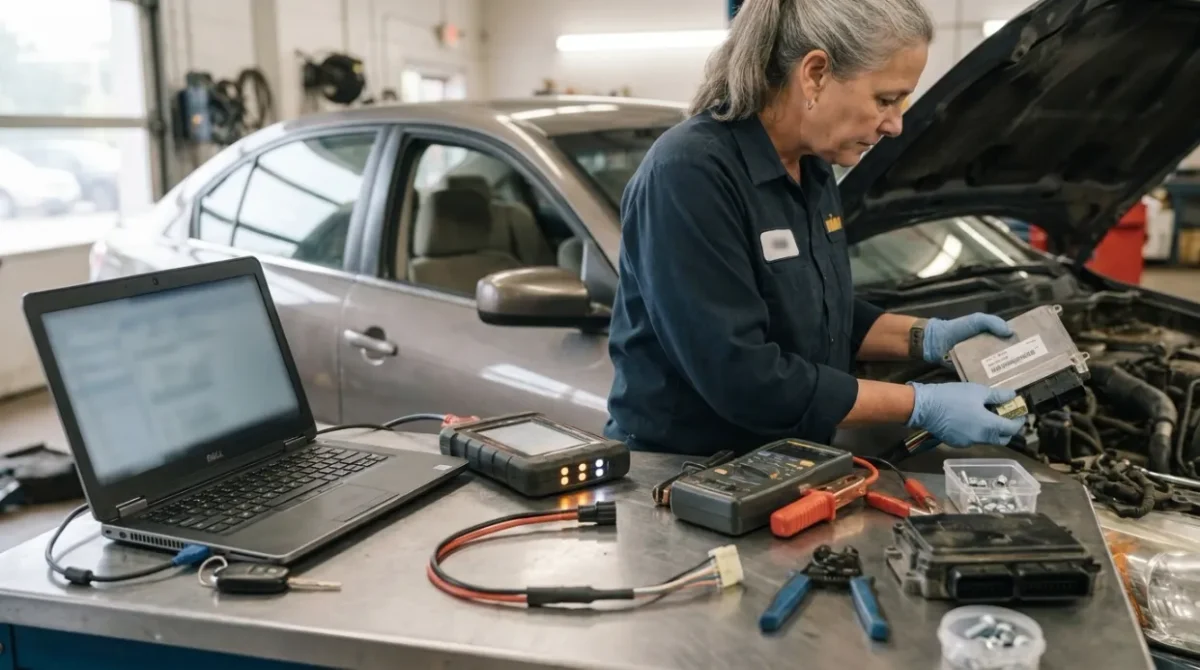
The correct repair depends on what caused P0606, so there is no honest one-price answer. A software correction, wiring repair, electrical problem, and failed PCM are completely different jobs.
Prices vary significantly by vehicle, region, labor rate, module availability, and programming requirements. Get a diagnosis before comparing replacement quotes.
Possible repair paths
- Battery or charging-system repair: Appropriate when unstable electrical power is confirmed as part of the problem.
- Power or ground repair: Required when excessive resistance, corrosion, loose connections, or damaged wiring is found.
- Connector repair: Necessary when terminals, seals, moisture intrusion, or harness damage prevents reliable module operation.
- Software update: Some vehicle-specific P0606 conditions can be addressed through manufacturer-directed reprogramming.
- PCM or ECM replacement: Appropriate when testing confirms an internal control-module failure.
- Programming and configuration: A replacement module may need coding, configuration, VIN-related setup, or security synchronization.
Dealership vs independent shop vs automotive locksmith
A dealership usually has direct access to its manufacturer’s diagnostic information and programming environment. That can be useful when the repair requires factory software or a vehicle-specific campaign.
A well-equipped independent diagnostic shop may handle many electrical, network, and module faults. Equipment and programming capabilities vary from shop to shop.
An automotive locksmith can be valuable when replacement-module work affects keys, immobilizers, smart keys, or security authorization. Not every locksmith performs PCM diagnosis or engine-control programming.
- Choose a dealership when manufacturer-only procedures or campaign coverage may apply.
- Choose a diagnostic specialist when you need advanced electrical fault-finding before replacing parts.
- Choose an automotive locksmith when key, immobilizer, or security programming is part of the repair.
Locksmith’s note: before paying for a PCM replacement, ask what tests confirmed the module itself failed and whether programming, immobilizer setup, and post-repair scanning are included.
As of 2026, control modules are deeply integrated with vehicle networks and security systems. A cheaper used or aftermarket module is not automatically compatible simply because its connector looks the same.
Verify compatibility using the vehicle’s VIN and manufacturer service information. Never rely on appearance alone.
Section Takeaway: Repair the diagnosed cause, not the code description. Confirm what is included before approving module replacement or programming.
P0606 Frequently Asked Questions
Does P0606 mean my car computer is definitely bad?
No. P0606 identifies a control-module processor problem, but it does not prove the PCM or ECM must be replaced. Software issues, unstable voltage, wiring, grounds, connectors, or related electrical faults should be checked before condemning the module.
Can a weak battery cause P0606?
Low or unstable electrical power can interfere with electronic modules, so battery and charging-system condition belong in the diagnostic process. A weak battery alone does not prove why P0606 was stored, however, and the complete system still needs testing.
Can I clear P0606 with an OBD2 scanner?
Many scanners can erase the stored code, but clearing it does not repair the cause. Save all codes and freeze-frame information first, because that data may help a technician diagnose the original failure.
Will P0606 make a car not start?
It can on some vehicles, especially when the affected control module can no longer perform essential functions. Manufacturer-specific cases have associated P0606 with intermittent or complete no-start conditions, but many vehicles with the code may still start normally.
Is P0606 related to the key fob or immobilizer?
P0606 itself is a control-module processor code, not a key-fob code. However, PCM replacement or configuration can interact with the immobilizer on some vehicles, so key or smart-key synchronization may become part of the repair process.
Can a PCM software update fix P0606?
Yes, on certain vehicle-specific applications where the manufacturer identifies software as the cause. That does not mean every P0606 needs a reflash, so check the service information for your exact year, model, powertrain, and VIN.
Should I buy a replacement PCM as soon as I see P0606?
No. First confirm battery condition, module power and grounds, connectors, wiring, related trouble codes, and applicable manufacturer information. Replacement should follow testing that supports an internal module failure.
The smartest next move is simple: save the complete scan report and diagnose P0606 before clearing codes or ordering parts.
If the vehicle is stalling, losing power, refusing to start, or entering limp mode, arrange professional service promptly. A properly diagnosed processor fault is much cheaper than guessing at an expensive control module.
