
Why Your Car Remote Works but the Spare Key Doesn’t: A Practical Troubleshooting Guide

If your main remote unlocks the car and the spare does nothing, that’s frustrating—but it’s also useful information. In many cases, the working key proves the vehicle’s receiver, locks, and immobilizer are at least partly functioning. That shifts the focus to the spare itself: its battery, its transponder chip, its programming, or simple physical damage.
The trick is not to guess. A spare can fail in a few different ways, and each one points to a different fix. A dead coin-cell battery, for example, can stop remote locking and unlocking, while a transponder issue may leave the door function alone but prevent the engine from starting. A mechanical spare may still turn the door lock even if the electronics are dead. Once you separate those functions, the problem gets much easier to pin down.
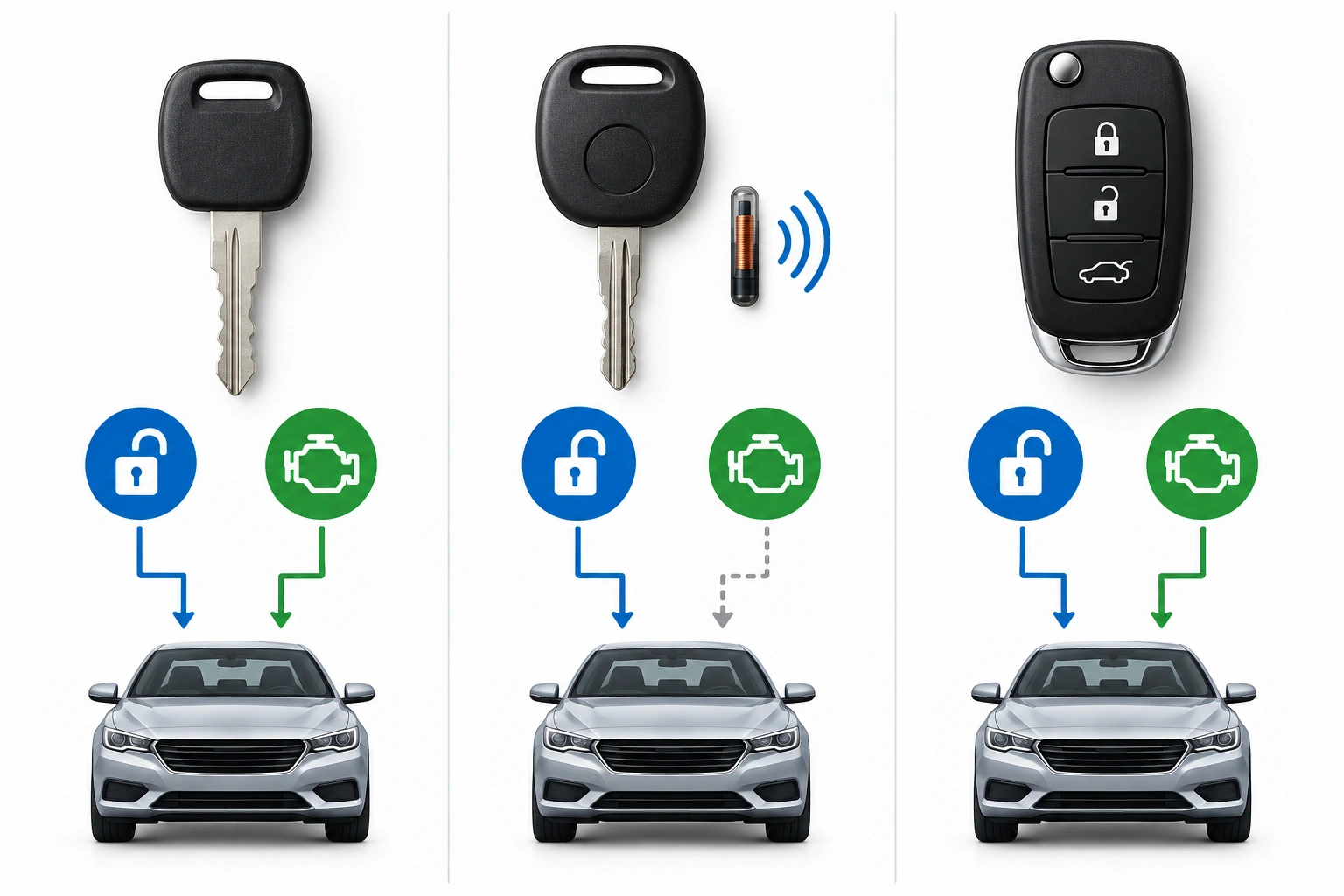
First, identify what kind of spare you have
Before you replace anything, figure out what your spare is supposed to do. “Spare key” can mean three very different things.
| Spare type | What it usually does | What can fail | What that failure looks like |
|---|---|---|---|
| Mechanical key only | Opens the door manually, sometimes starts older vehicles | Cut incorrectly, worn blade, lock cylinder wear | Key turns poorly or not at all in the door or ignition |
| Transponder key | Starts the car through a chip in the key head or fob | Chip not recognized, damaged chip, programming issue | Key may unlock doors but won’t start the engine |
| Remote key fob | Unlocks/locks doors remotely, may also contain a transponder | Dead battery, button wear, water damage, lost programming | Remote buttons do nothing or work inconsistently |
That distinction matters because not every spare has a battery. If your spare is only a mechanical key, replacing a battery won’t help. If it’s a push-button start fob, the battery may affect remote entry and sometimes proximity detection, but not always the same way on every vehicle.
If you’re not sure what your vehicle uses, check the owner’s manual or look at the spare itself. A plain metal blade is mechanical. A plastic head with no buttons may still contain a transponder chip. A fob with lock, unlock, and panic buttons is usually battery-powered.
What the symptom tells you
The way the spare fails is often the best clue.
Spare won’t unlock the doors at all
That usually points to one of three things:
- dead or weak fob battery
- damaged buttons or internal electronics
- programming or synchronization problem
If the main remote works but the spare is completely silent, the spare is more suspicious than the car.
Spare unlocks the doors but won’t start the car
That often points to a transponder or immobilizer issue. The key blade may be cut correctly and the remote may even work, but the car still refuses to recognize the chip that authorizes starting.
Spare works only when held very close
That’s a common clue on push-button start systems. Some vehicles will detect a weak fob battery only when the fob is placed near the start button or in a backup sensing area. If that happens, the battery is a strong suspect.
Spare works intermittently
Intermittent operation can mean a weak battery, worn button contacts, cracked solder joints, or a fob case that is no longer holding the circuit board securely. A fob that works one day and fails the next is rarely a “nothing wrong here” situation.
Most likely causes, from easiest to least likely
When one key works and the spare doesn’t, I’d think through the problem in this order.
1) Dead or weak battery in the spare fob
This is the easiest fix if your spare has a battery. A weak coin-cell battery can make the remote act dead or unreliable.
2) The spare needs programming
If the spare was recently cut, bought online, or never fully paired to the vehicle, it may look right but still be rejected by the car. This is especially common after battery changes, module resets, or replacement of a used fob that wasn’t programmed to your VIN.
3) Physical damage
A cracked shell, worn button pad, corrosion, or water damage can break a spare even when the main key still works. I’ve seen fobs that looked fine outside but had corroded battery contacts inside.
4) Worn key blade or damaged lock cylinder
If the spare is mechanical or has a blade for emergency entry, it may unlock one door poorly or not at all if the cut is off or the blade is worn.
5) Vehicle-side issue
This is less likely when one key works normally, but it’s still possible. A weak vehicle battery can cause a “Key Not Detected” message on some cars, and the receiver or immobilizer can sometimes be part of the problem. NHTSA’s vehicle safety information is a good place to start if you want general owner guidance on vehicle systems and safety-related warnings.
Step-by-step troubleshooting that actually narrows it down
Use the spare in more than one way. Testing only one function can send you in the wrong direction.
Step 1: Try the spare in the door lock
If it’s a mechanical blade, confirm that it turns smoothly. If it binds or only turns partway, the cut may be wrong or the blade may be worn.
If the blade works but the remote doesn’t, the mechanical side and electronic side are behaving differently—which is a good clue.
Step 2: Test the remote buttons
Stand close to the car and try lock, unlock, and panic if equipped. If nothing happens, replace the battery first if the fob uses one.
If the spare works only after multiple presses or only at very short range, that points toward a weak battery or failing electronics rather than a vehicle receiver problem.
Step 3: Try starting the car with the spare
On push-button start vehicles, attempt a normal start first. If the car says the key isn’t detected, use the backup method described in your owner’s manual. Many vehicles allow the fob to be placed in a designated sensing area or held near the start button.
If the car starts with the backup method but not normally, the fob battery is still a strong suspect. This article on why a car says “Key Fob Not Detected” but still starts goes deeper into that exact symptom.
Step 4: Compare behavior with the working key
If the main key unlocks, starts, and communicates normally, the vehicle is less likely to be the root cause. That comparison is one of the most useful diagnostics you have.
A working key doesn’t prove the car is perfect, but it does prove the system can recognize at least one valid key.
Step 5: Check for obvious physical damage
Look for:
- cracked case
- loose battery
- green corrosion
- worn or sticky buttons
- signs of water exposure
- bent or chipped blade
If the spare was dropped, washed, or stored in a damp glove box, internal damage is very plausible.
Battery failure vs programming failure
These two get confused constantly because both can make a spare seem dead.
Signs that point to a battery problem
- remote buttons do nothing or work weakly
- range is very short
- the fob works only when held close to the car or start button
- the spare used to work and gradually got worse
Signs that point to programming
- the fob has a fresh battery but still won’t lock or unlock
- the spare never worked after being cut or purchased
- the car starts recognizing the key only after a specific pairing process
- the working key functions normally, but the spare is ignored completely
A battery replacement is worth trying when the fob has a battery and the symptoms match. If the spare still fails after a known-good battery, move your attention to programming or damage.
When the problem is the transponder or immobilizer
A transponder chip is not the same thing as the remote buttons. On many vehicles, the chip is what tells the immobilizer, “This is an authorized key.”
That’s why a spare can sometimes unlock the door but still not start the car. The blade may fit, the remote may even work, and the car still refuses to crank or run because the chip isn’t recognized.
This is also where the vehicle’s anti-theft system comes in. If the immobilizer doesn’t accept the key, the car may crank and stall, refuse to start, or display a key warning. A weak vehicle battery can also trigger key-detection problems on some cars, so don’t ignore the car battery if the warnings started after a jump start, battery replacement, or low-voltage event. Edmunds explains common car battery warning signs and owner checks in a way that’s useful if you’re trying to separate a key issue from a low-voltage issue.
Can you reprogram the spare yourself?
Sometimes, yes. Sometimes, absolutely not.
Self-programming is only possible on some vehicles, and many newer smart-key systems cannot be programmed by the owner at all, even if you already have a working key. The exact procedure varies widely by make and model, so the owner’s manual is the deciding document here, not guesswork from a forum post.
DIY programming is worth trying when:
- the manual explicitly lists a self-programming procedure
- you already have a working key
- the spare is the correct type for your vehicle
- the battery is good and the key is not physically damaged
Stop trying DIY programming when:
- the vehicle rejects every attempt
- the manual does not describe owner programming
- the spare is a used fob from another car and won’t pair
- the immobilizer light or security warning stays on
- the key is clearly damaged or water-exposed
At that point, repeated attempts usually waste time without improving the odds.
When to replace the battery, repair the key, or replace the spare
Use the test results to choose the least expensive sensible fix.
Replace the battery when:
- the spare has a battery-powered remote
- the buttons are unresponsive or short-range
- the key works better near the car
- the battery is old, unknown, or visibly weak
Repair the key when:
- the case is cracked but the circuit board looks intact
- battery contacts are loose or corroded
- the buttons are worn but the electronics still have a chance of being saved
Replace the spare when:
- the transponder chip is damaged
- water intrusion caused corrosion
- the board is cracked
- programming fails repeatedly and the fob is not supported for repair
If you only need a backup for emergencies, a fully functional spare matters more than a cosmetically perfect one. A repaired shell is fine if the electronics are healthy. A pretty shell with a dead chip is not.
Locksmith vs dealership: which one makes sense?
Call a locksmith when the spare still won’t work after the obvious checks, especially if you need a cut key, a battery check, or programming help and your vehicle allows it. A dealership may be necessary for models with restricted programming access or newer smart-key systems that need dealer-level tools.
A locksmith is often the more practical first call when you want a second opinion and a faster turnaround. A dealer is usually the better fit when the vehicle uses security-restricted programming, you need an OEM-only fob, or the locksmith confirms they can’t service your exact year, make, and model. If you’re deciding between the two, ask whether they can handle your specific key type before you tow or travel.
How to avoid this problem with the next spare
A spare key is only useful if it still works when you need it.
Test it a few times a year instead of letting it sit for years in a drawer. Keep battery-powered fobs out of damp storage spots. If the spare has a coin-cell battery, replace it before it becomes a roadside surprise. And if you notice the remote range getting worse, don’t ignore it—that’s often the warning sign before the spare stops working altogether.
For related troubleshooting, you may also find these guides helpful: why a key fob can beep but not unlock the car and what to do when a key fob is not detected but the car still starts.
FAQ
Why does my main car remote work but my spare key does not?
Usually because the spare has a dead battery, lost programming, or internal damage. The fact that the main remote works is a useful clue that the vehicle is at least recognizing one valid key.
Can a spare key unlock the door but not start the car?
Yes. That often points to a transponder or immobilizer issue. The metal blade can still work in the lock even if the chip inside the key is not being accepted by the car.
Will replacing the battery fix my spare key?
It will help only if the spare uses a battery-powered remote and the battery is the real problem. If the key still fails after a fresh battery, look at programming or damage next.
How do I know if my spare key needs reprogramming?
If the battery is good, the buttons still do nothing, and the key never worked or stopped working after a reset or battery change, programming is a likely suspect. The owner’s manual should tell you whether your vehicle supports self-programming.
Can a weak car battery cause key detection problems?
Yes, some vehicles can show key-detection issues when the car battery is weak. If the problem started after a low-voltage event or jump start, check the vehicle battery as part of the diagnosis.
Should I go to a locksmith or a dealer?
If you need a cut key, battery help, or programming and the vehicle allows it, a locksmith is often the faster first stop. A dealer may be necessary for models with security-restricted programming or newer smart-key systems.
What if the spare key works only near the start button?
That often suggests a weak fob battery or a proximity-detection issue. Try a fresh battery first, then check the owner’s manual for the backup start procedure.
Why would a spare key fail after being dropped in water?
Water can damage the circuit board, battery contacts, or transponder chip. Even if the shell still looks fine, internal corrosion can stop the key from working normally.
