
Why Does My Key Fob Beep but Not Unlock the Car? A Practical Troubleshooting Guide

If your key fob beeps, flashes, or seems to “do something” but the doors still won’t unlock, the problem is usually one of two things: the fob is sending a weak or incomplete signal, or the car is not able to receive or act on it.
That distinction matters. A beep from the fob can mean the button was pressed and the battery still has enough power to trigger the fob’s own sound or light. It does not guarantee the vehicle got a clean unlock command. In other words, the fob may be alive while the locking system is not responding.
The good news is that this symptom often points to a short list of causes you can check yourself before replacing parts.
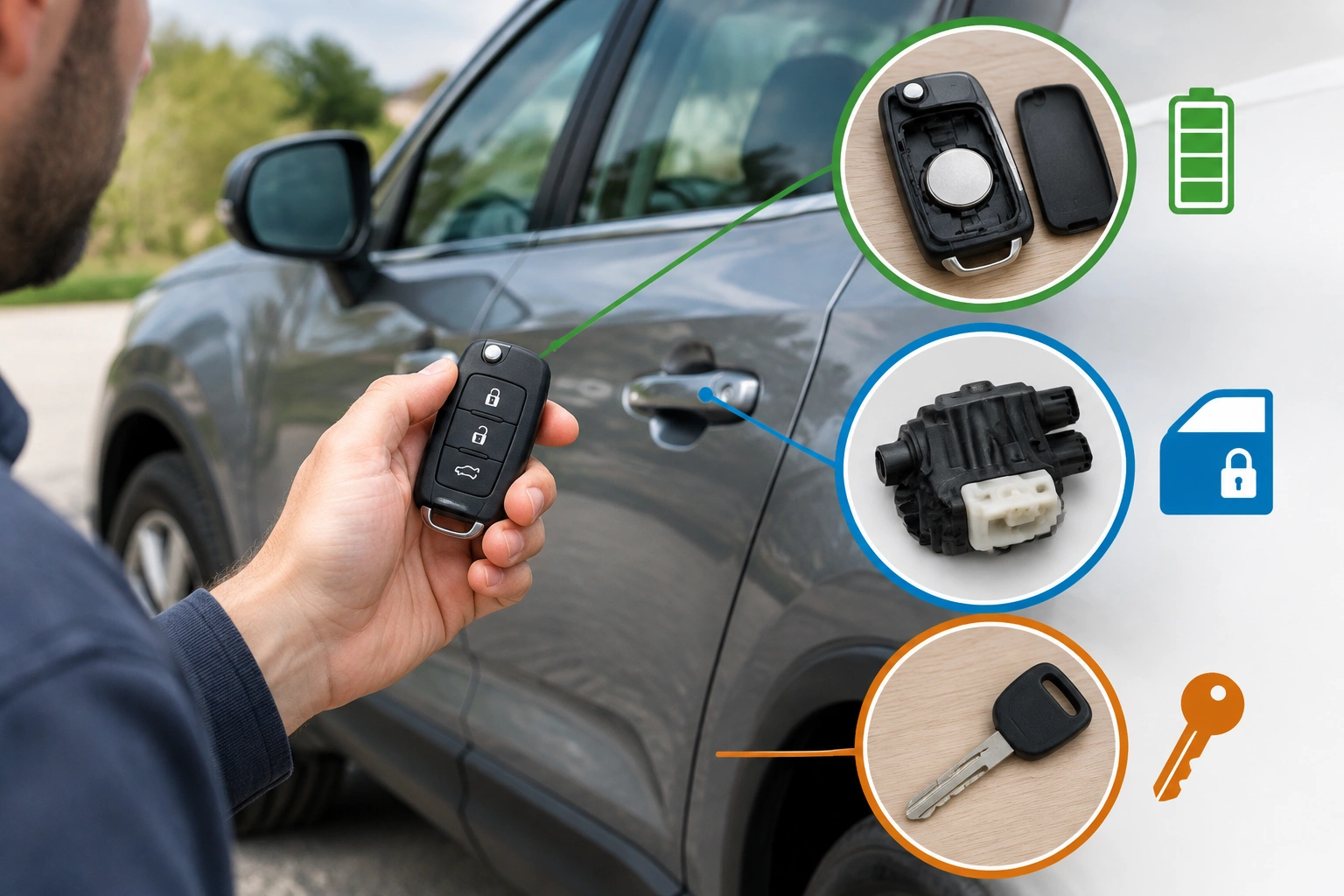
Why a key fob can beep but still not unlock the car
A key fob is basically a small transmitter. When you press unlock, it sends a coded signal to the car, and the vehicle’s receiver decides whether to unlock the doors. If the fob beeps or lights up, that only tells you the button press registered on the fob side.
That can happen even when the unlock command never reaches the car, or when the car receives it but cannot complete the action. A weak fob battery, a worn unlock button, a low vehicle battery, a bad door lock actuator, or a programming issue can all create that “it seems to work, but it doesn’t” feeling.
If your car is a passive entry system, the behavior can be a little different from a traditional remote. Still, the same basic rule applies: the fob’s sound is not the same thing as the car unlocking.
For a broader look at common no-unlock symptoms, see our guide on key fob locks but won’t unlock and our article on key fob unlock button not working.
Most likely causes, from simplest to deeper problems
When I’m narrowing down a lock/unlock complaint, I usually work from the easiest fix to the more involved ones.
1) Weak key fob battery
A weak fob battery is the first thing to check because it can cause partial function. The fob may still beep, flash, or work only at very close range, while the unlock command becomes unreliable.
A common example: the lock button still works from a few feet away, but unlock only works when you stand right next to the door. That often points to a fading fob battery rather than a dead fob.
2) Worn or damaged unlock button
If the unlock button is worn out, it may not make consistent contact inside the fob. You might hear a beep when you press it, yet the actual unlock signal is weak or intermittent.
This is especially likely if the lock button works better than the unlock button, or if the button feels mushy, sticky, or different from the others.
3) Car battery or low vehicle voltage
A dead car battery can stop the car’s receiver from recognizing the signal from the fob. Even a battery that is weak but not completely dead can cause strange remote behavior.
This matters because the engine may still crank in some cases, yet the body control system or receiver may not be getting stable voltage.
4) Door lock actuator or central locking issue
If the car receives the signal but the doors don’t move, the issue may be mechanical or electrical inside the locking system. A sticking door lock actuator can stop one door from unlocking, while the other doors may still work normally. If the central locking system is the problem, multiple doors—or all of them—may fail together.
A useful clue: if the fob unlocks one door but not the others, that usually points to the vehicle side, not the fob.
5) Reprogramming or sync problem
If the battery checks out and the spare fob behaves differently, the original fob may have lost sync or need reprogramming. That is less common than battery or actuator issues, so I would not jump there first.
First checks to do right now
Before opening the fob or calling for help, do these quick tests.
Try the spare fob
This is the fastest way to separate a fob problem from a car problem.
- If the spare works normally, the original fob is the likely problem.
- If both fobs fail the same way, the issue is more likely in the vehicle or its battery.
Test the fob close to the car
Stand right next to the driver’s door and try unlocking again. Then try from a few steps away.
If the fob only works at very close range, that points to a weak fob battery or a weak transmitter signal.
Press every button
See whether lock, unlock, panic, and trunk buttons behave differently.
For example, if lock and panic work but unlock does not, the unlock button itself may be worn or internally damaged.
Use the manual key once
If your fob has a hidden key, use it to open the door manually. That tells you whether the car is locked but otherwise accessible, and it gives you a safe way into the vehicle without forcing anything.
Step-by-step fixes for the key fob itself
If the spare fob works or the range has dropped, focus on the fob first.
Replace the key fob battery
This is the simplest repair and the one most worth trying first. A weak battery can let a fob beep while still failing to send a strong enough unlock signal.
When you open the fob, look for:
- corrosion on the battery contacts
- a loose battery
- a battery installed backward
- cracked plastic around the case
If the battery compartment is dirty, clean it gently with a dry cloth. Avoid scraping the contacts aggressively.
Check for button wear
If the unlock button feels soft or doesn’t “click” like the others, the internal contact may be worn. Sometimes the button cap is fine but the underlying switch is failing.
A practical test: press the unlock button in different spots. If it works only when you press hard or at an angle, the switch may be failing.
Inspect for water damage or impact damage
A fob that was dropped in water, washed, or cracked after a fall can still beep but fail to send a reliable command.
If you see moisture, rust, or mineral residue inside the case, the problem may be beyond a battery swap. In that case, repair or replacement usually makes more sense than repeated battery changes.
How to tell if the car battery or vehicle power is the real problem
The car battery can be the hidden culprit, especially if the vehicle has sat for days or weeks.
Here are signs the problem may be on the vehicle side:
- the dash lights are dim or erratic
- the car cranks slowly
- the interior lights are weak
- the headlights are unusually dim
- the car unlocks with the physical key but remote functions are unreliable
- other electrical features act strange
- both the main and spare fobs fail the same way
A dead car battery can stop the car’s receiver from recognizing the signal from the fob, so even a healthy remote may seem useless.
If the vehicle battery is suspect, test it or have it tested before replacing the fob. That saves you from fixing the wrong part.
For vehicle electrical safety and battery-related guidance, the NHTSA battery and electrical safety information is a useful place to start if you want a reliable public reference.
When the problem is the door lock actuator or central locking system
If the fob works in some situations but not others, the car’s locking hardware may be the real issue.
A door lock actuator is the small motor that physically moves the lock. If it sticks, the car may receive the unlock signal but not complete the job. In some cases you’ll hear a click, but the door won’t move. In others, one door unlocks while the rest stay locked.
That pattern is a major clue:
- One door fails every time: likely a bad actuator or door-specific wiring issue, while the other doors may still unlock normally.
- All doors fail together: more likely a central locking or vehicle power issue.
- Lock works but unlock does not: could be a worn switch in the fob, a car-side receiver issue, or a failing actuator depending on the pattern.
If the key works in the ignition but not the doors, it is likely a mechanical issue in the door lock or a problem with the remote transmitter. That does not prove the fob is bad, but it does tell you to inspect both the mechanical lock and the remote side before replacing the whole unit.
Reprogramming and sync issues: when they matter and when they do not
People often jump straight to reprogramming, but that is not the first move unless the basic checks are already clean.
Reprogramming becomes more plausible when:
- the fob battery is new
- the car battery is healthy
- the spare fob behaves differently
- the buttons are intact
- the fob still fails consistently
If the fob is water-damaged, has a broken button, or only works at close range, reprogramming is less likely to help than a hardware fix.
Think of it this way: a sync issue usually affects communication. A worn button or dead actuator affects the hardware. The symptom may look similar from the outside, but the fix is different.
How to unlock the car manually if the fob fails
If you’re locked out, use the backup key or manual lock method rather than forcing the door.
Use the hidden backup key
Many fobs contain a mechanical key blade. Remove it and use the driver’s door lock cylinder if your vehicle has one.
If the key is stiff, insert it carefully and avoid twisting hard. A worn key or frozen lock cylinder can break if you force it.
Check for a hidden key slot or cover
Some vehicles hide the lock cylinder behind a cap on the door handle. If you do not see a keyhole, look for a small cover or trim piece designed to be removed first.
Avoid prying the door open
Forcing the door can damage weather stripping, paint, or the lock mechanism. If the manual key does not work smoothly, that is a sign to pause and get help rather than make the situation worse.
Replace the battery, repair the fob, or replace the whole unit?
Use the symptom pattern to decide.
Replace the battery first if:
- the fob is older
- range has dropped
- the unlock button works intermittently
- the spare fob works better
- the fob still beeps but seems weak
This is the lowest-risk, lowest-effort step.
Repair the fob if:
- the casing is cracked
- the button is worn
- the battery contacts are corroded
- there was water exposure but the board may still be salvageable
Replace the whole fob if:
- the internal board is damaged
- water damage is severe
- the buttons are failing repeatedly
- the fob has already been opened and tested without improvement
If you are comparing replacement options, an OEM key fob is usually the safer bet for fit and compatibility, while an aftermarket replacement fob may cost less but can be more variable in quality and programming consistency. If you want a deeper comparison, our internal guide on why a key fob opens the trunk but not the doors covers another useful symptom pattern that often helps separate fob-side from vehicle-side issues.
When to Consult a Locksmith
Call a locksmith, dealer, or mechanic when the basic checks do not isolate the problem.
That usually means:
- both fobs fail
- the car battery tests weak or unstable
- one door or multiple doors will not unlock even with a known-good fob
- the manual key does not work properly
- the fob has been damaged and battery replacement did not help
- you suspect programming or actuator failure
At that point, the question is no longer “should I try another battery?” but “what system is actually failing?” A locksmith is often the best first call if the issue is lockout-related and you need the car opened without damage. A dealer or mechanic may be the better choice if the problem looks like a receiver, actuator, or vehicle programming issue.
FAQs
Why does my key fob beep but not unlock the car?
Usually because the fob is responding to the button press, but the car is not receiving the unlock command or cannot act on it. The cause may be a weak fob battery, worn button, low car battery, actuator issue, or sync problem.
Can a dead car battery cause the fob to stop working?
Yes. Without power, the car’s receiver can’t recognize the signal from the fob.
Why will the fob lock the car but not unlock it?
That often points to a worn unlock button, a weak battery, or a car-side issue affecting only part of the locking system.
How do I know if the key fob is sending a signal?
The best quick test is a spare fob. If the spare works and the original does not, the original is likely the problem. If neither works, suspect the vehicle side.
Can I unlock the car manually if the fob fails?
Yes, if your vehicle has a backup key or manual lock cylinder. Use it gently and avoid forcing the lock.
Should I replace the whole fob right away?
Not usually. A battery swap and spare-fob test are smarter first steps. Replace the full unit only after you rule out simple battery, button, and vehicle-side issues.
The fastest way to narrow it down
If you want the shortest path to the answer, use this order:
- Try the spare fob.
- Test the fob right next to the car.
- Replace the fob battery.
- Check the car battery.
- Look for one-door or all-door lock behavior.
- Consider reprogramming only after the hardware checks make sense.
That sequence catches most of the common causes without wasting time or money on the wrong fix.
