Why Won’t My Key Fob Program? Common Reasons and Fixes

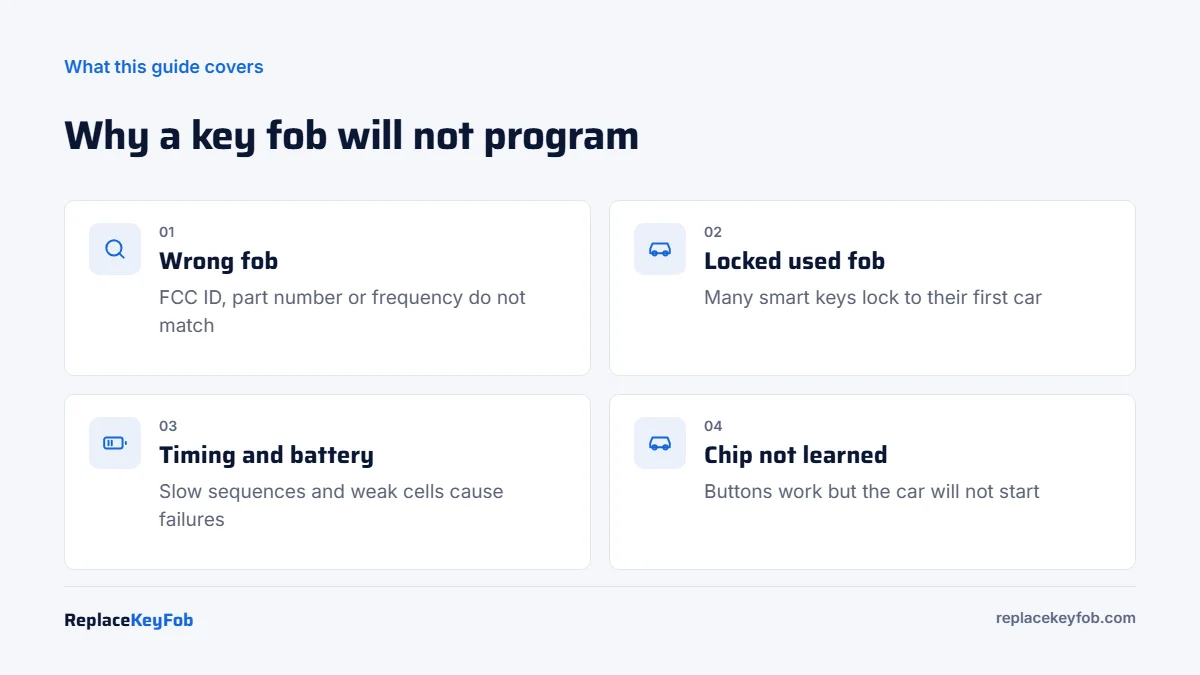
A key fob usually refuses to program because it is the wrong fob for the car (different FCC ID, part number or frequency), it is a used fob still locked to another vehicle, the onboard sequence was too slow, or the battery in the fob or car is weak. Smart keys also fail if you try onboard steps on a car that only accepts tool programming.
You followed the steps, the locks did not cycle, and the new fob does nothing. That is frustrating, but the cause is almost always one of a short list. Work through the checks below in order: the first ones are free and take a minute, and they solve the majority of cases.
Quick diagnosis table
| What you see | Most likely cause | Fix |
|---|---|---|
| Car never enters programming mode (no lock cycle or chime) | Timing too slow, wrong sequence, or car does not support onboard programming | Retry with a timer; confirm the procedure in the owner’s manual |
| Car enters programming mode but ignores the new fob | Wrong FCC ID or frequency, dead battery in fob, or locked used fob | Compare FCC ID; replace battery; reset or replace the fob |
| New fob works, old fobs stopped working | Old fobs were not programmed in the same session | Run the procedure again and press a button on every fob |
| Buttons work but car will not start | Transponder chip not programmed to the immobilizer | Separate key learning with a tool or professional |
| Tool says “security access failed” | Wrong PIN, outdated software, or gateway module | Update tool, use correct PIN, use gateway bypass or a locksmith |
1. The fob is not the right one for your car
Key fobs that look identical can have completely different electronics. The car only accepts a fob with the matching FCC ID, frequency (commonly 315 MHz in North America, 433 MHz on some imports) and, for many brands, the correct part number. Turn your original fob over or open it: the FCC ID is printed on the case or circuit board. If the new one does not match, no programming method will work. Our guide to key fob programming explains what to check before buying.
2. It is a used fob locked to another car
Many fobs, especially smart keys from Toyota, Lexus, Honda, Nissan, GM and most European brands, lock themselves to the first car they are programmed to. A used fob from eBay or a junkyard may need to be “unlocked,” “renewed” or “virginized” with a key programming tool before another car will accept it. Some cannot be reset at all. If you bought used, ask a locksmith whether your fob type can be renewed.
3. The onboard sequence timing was off
Onboard procedures often require steps within a few seconds, such as eight ignition cycles in ten seconds on many older Fords. Turning the key too slowly, going past ON to START, or pausing between steps will cancel the sequence. Read the full procedure first, count out loud, and do a practice run.
4. Your car does not support onboard programming
If nothing happens at all, your model may simply not have an owner procedure. That is the norm for push-button cars and most vehicles built after about 2010. Those need a tool or a professional. See programming with an OBD2 scanner.
5. The fob battery is weak or missing
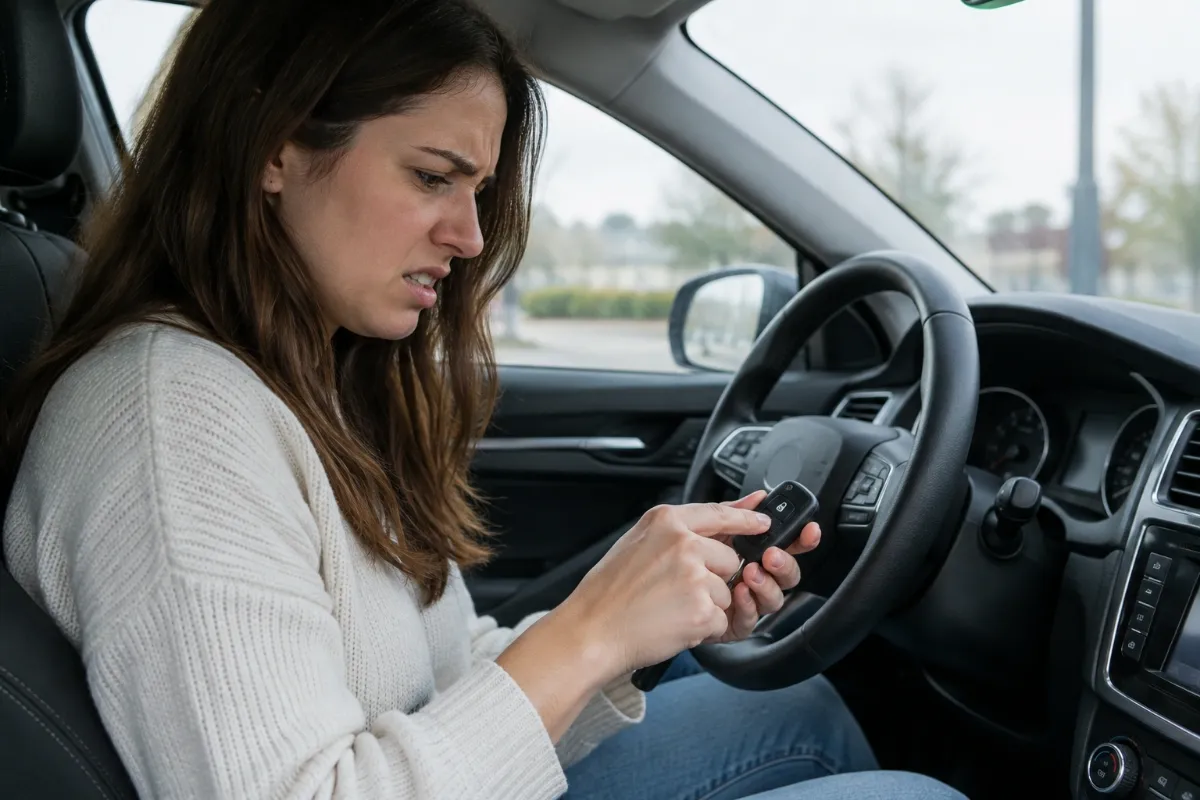
New aftermarket fobs often ship with a cheap or old battery, or with a plastic tab still in place. Replace it with a fresh name-brand cell of the right size, and check polarity. Our battery polarity guide shows which side faces up.
Name-Brand CR2032 Coin Batteries
CR2032 is the most common key fob size. Confirm the number printed on your fob’s old battery, and pick a pack with a long expiry date.
As an Amazon Associate, ReplaceKeyFob earns from qualifying purchases.
6. The car battery is low
A weak 12V battery can stop modules from entering programming mode or drop out mid-session, especially during long tool-based security waits. Charge the battery or connect a maintainer, then try again.
7. You only programmed the remote, not the chip
If the buttons lock and unlock the doors but the car will not start, or the security light flashes, the immobilizer has not learned the transponder chip. That is a separate procedure. Read what a flashing immobilizer light means.
8. The tool cannot get security access
Tool-based programming can fail on a wrong PIN, outdated software, or a security gateway module on newer Chrysler, Dodge, Jeep and Ram models. Update the tool, confirm the vehicle is on its coverage list, and use the correct gateway bypass or online login if required.
9. The fob or the car’s receiver is faulty
If a known-good fob also fails, the problem may be the car’s receiver, antenna or body control module. Our guide to key fob receiver problem symptoms walks through those faults. A quick transmitter test tells you if the new fob is sending any signal at all.
When to call a locksmith
Stop after two or three failed attempts. Some cars lock out programming for a period after repeated failures. A locksmith can confirm whether the fob is compatible, reset it if possible, and program it with the right tool, often in one visit.
Frequently Asked Questions
The most common reasons are a mismatched FCC ID or frequency, a weak battery in the new fob, missed onboard timing, or a car that only accepts tool programming.
Sometimes. Many remotes can be reprogrammed, but many smart keys lock to their first car and must be reset with a special tool. Some cannot be reused at all.
Most cars erase all stored remotes when programming starts. Only fobs pressed during the same session are saved. Repeat the procedure with every fob present.
Match the FCC ID, part number, frequency and button layout to your original fob. A seller listing a make and model range is not enough on its own.