
How to Test if a Key Fob Is Transmitting: A Practical Troubleshooting Guide

If your key fob stopped working, the first question is usually the most useful one: is the fob actually sending a signal, or is something else failing?
That distinction matters. A fob can have a bad battery, broken buttons, internal damage, or a working transmitter that the car still does not recognize. If you test the wrong thing first, you can end up replacing parts that were never the problem.
This guide walks through the simplest ways to check whether a key fob is transmitting, how to interpret the results, and what to do next if the fob sends a signal but the car still will not respond.
How to Tell Whether a Key Fob Is Transmitting
A button press is not the same thing as confirmed transmission.
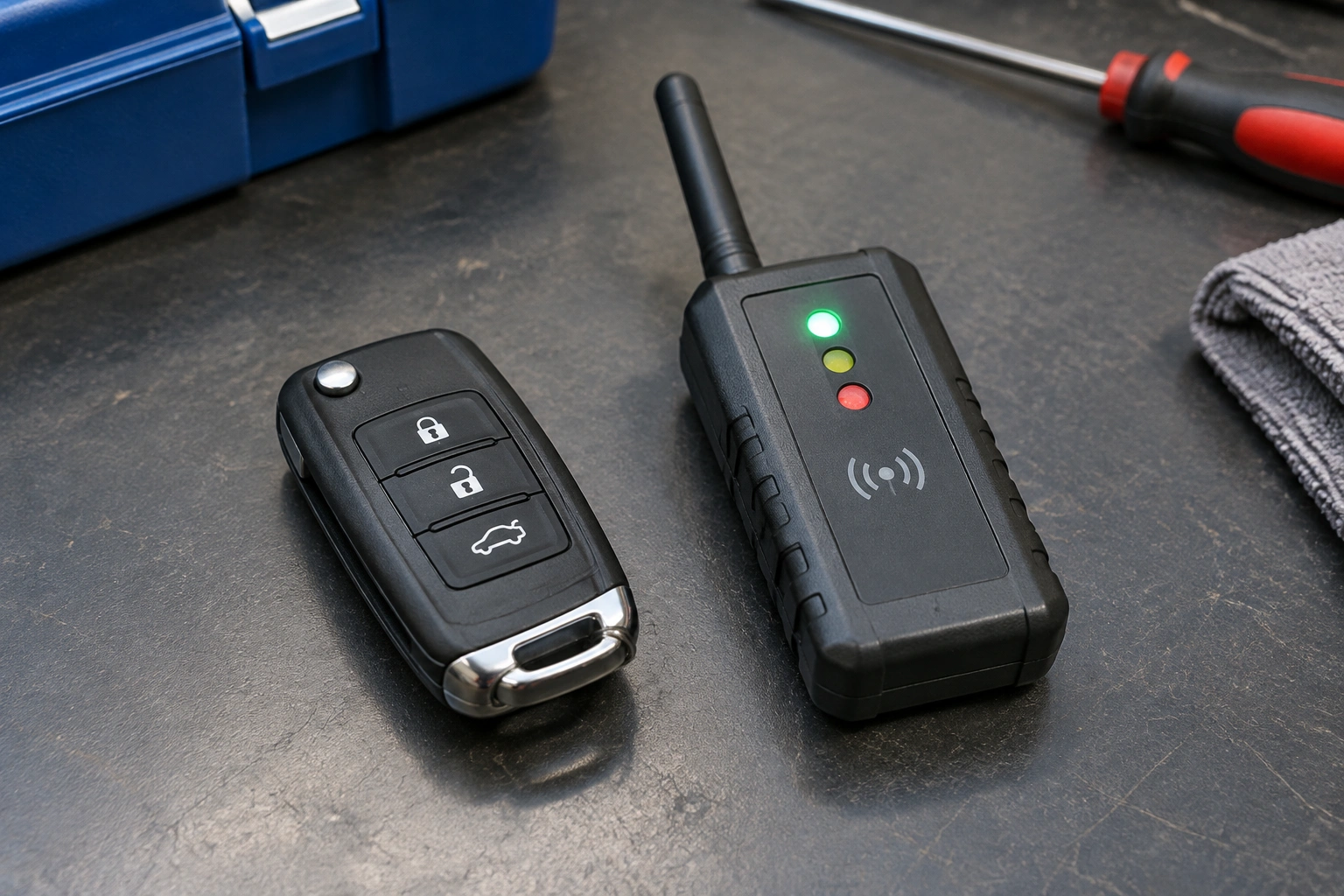
Some fobs light up an LED, some make a small click, and some seem completely dead. None of those reactions alone prove that the fob is sending an RF signal. What you are looking for is evidence that the fob is actually broadcasting something the car or a test device can detect.
A useful way to think about it:
- Button response only: the fob may have power, but that does not prove it is transmitting.
- Confirmed RF signal: a tester, receiver, or other device detects output when you press the button.
- Car response: the vehicle locks, unlocks, or otherwise reacts, which suggests the signal was sent and received.
That last point is important. A fob can transmit and still fail to unlock the car if the vehicle receiver is the issue.
Most Likely Causes, Ranked by Probability
When a key fob seems dead, I’d troubleshoot in this order:
-
Weak or dead battery
This is the easiest and most common thing to rule out first. -
Intermittent battery contact or worn battery terminals
A battery can be new and still not make solid contact if the internal clips are bent or dirty. -
Worn buttons or damaged case
If one button works and another doesn’t, the fob may still transmit sometimes, but not reliably. -
Internal circuit failure
A dropped fob, water exposure, or age can damage the transmitter board. -
Vehicle receiver or programming issue
If the fob transmits but the car ignores it, the problem may be on the vehicle side. -
Compatibility or reprogramming need
This matters more after battery replacement, module work, or a replacement fob purchase.
The practical takeaway: check the battery and compare the fob against a known-good one before assuming the fob is beyond repair.
Quick At-Home Checks You Can Try First
Before buying a tester, try the low-effort checks that give you real clues.
Look for weak-range symptoms
If the fob only works when you stand very close to the car, that often points to a weak battery or a weak signal. Range varies by vehicle and fob design, so treat a sudden drop in distance as a battery warning sign rather than a universal rule.
Try every button
Test lock, unlock, panic, and trunk release if your fob has them. Sometimes one button fails while another still works. That pattern can suggest a worn button pad or a partial internal failure rather than a total transmitter loss.
Open the fob and inspect the battery
If the case opens easily, check for:
- a battery installed backward
- corrosion or white residue
- bent battery contacts
- a loose coin cell that shifts around
If the battery looks old or the fob has been acting up for weeks, replacing the battery is usually the best first move.
Reassemble carefully and retest
A fob that works only when squeezed together often has a case alignment or contact issue. That is a clue worth noticing, because it points away from the car and toward the fob body itself.
How to Test the Fob With the Car Itself
Your car can act as a simple test bench.
Use the car in a safe, stationary spot
Stand near the vehicle and press the lock or unlock button. If the car responds normally, the fob is likely transmitting and the vehicle is receiving it at that moment.
If the car does not respond, move to a spare fob test before assuming the original is dead.
Test at different distances
Try the fob:
- beside the driver door
- at the rear hatch or trunk
- from a few feet away
- from inside the cabin if your vehicle supports that
A fob that works only at very short range may still be transmitting, but weakly.
Watch for partial response
Sometimes the car reacts inconsistently. For example, the doors may unlock but the panic button does nothing, or the trunk release works while lock/unlock does not. That usually points to button-specific wear or a partial transmitter problem, not a total failure.
For vehicle-specific behavior, it helps to check your owner’s manual or a model-specific troubleshooting guide.
Using a Smartphone Camera, Radio, or Other DIY Signal Check
DIY signal checks can be useful, but they have limits.
Smartphone camera test
Some older remotes use infrared for certain functions, and a phone camera may show a faint light when you press a button. That can confirm an infrared emitter, but it does not confirm RF transmission on every fob.
That matters because many car fobs use radio frequency, not infrared. So if the camera shows nothing, the fob may still be transmitting normally.
AM radio test
An AM radio can sometimes pick up interference or a burst of noise when a fob transmits. Some DIY testers rely on that idea. It can be a quick home check, but it is not a universal proof and it depends on the fob, the radio, and the setup.
Example frequency readings
Some testers or videos may show a number such as “315,” but that reading only has meaning in context. It does not, by itself, prove a specific vehicle signal or confirm that the fob is working correctly for your car. The relevant frequency depends on the fob and the tester being used.
The limitation to keep in mind
Home tests can suggest that a fob is sending something, but they may not fully prove whether the signal is correct for your vehicle. If you want a cleaner answer, use a dedicated tester.
Using a Key Fob Tester or RF Detector
This is the most reliable at-home method if your goal is to confirm output.
A key fob tester or RF detector is designed to detect the signal when you press a button. Instead of guessing from sound, light, or car response, you get a direct indication that the fob is transmitting.
Why this is better than indirect tests
A tester can help you separate three different situations:
- the fob sends a signal
- the fob sends no signal
- the fob sends a weak or inconsistent signal
That makes diagnosis much clearer than a phone camera or AM radio.
How to use one
Most testers are simple:
- Place the fob near the detector.
- Press a button.
- Watch for a signal indication, tone, or frequency reading.
If the tester shows output, the fob is transmitting something. If it shows nothing after a fresh battery, the transmitter or internal board may be the problem.
Trade-off to consider
A dedicated tester costs more than a DIY check, but it saves time when you are stuck between “bad battery,” “bad fob,” and “car not receiving.” If you troubleshoot fobs often, it is a useful tool. If you only need one answer once, borrowing one from a shop or friend may be enough.
Check and Replace the Key Fob Battery
If you only do one thing first, replace the battery when it is old or unknown.
A weak coin cell can cause all kinds of confusing symptoms:
- shorter range
- intermittent operation
- one button working better than another
- a fob that seems dead until you press it several times
What battery replacement can tell you
A new battery does not prove the transmitter board is perfect. It only tells you the fob has fresh power. If the fob still fails after a proper battery swap, that points more strongly to internal damage, button wear, or a vehicle-side issue.
Do not skip the contact check
Even with a new battery, poor contact can stop the fob from working. Make sure the battery sits firmly in place and the contacts are clean and aligned.
Retest immediately
After replacing the battery, test the fob in the same spot and under the same conditions as before. That makes the result easier to interpret. If range improves or the car responds again, you likely found the problem.
For practical troubleshooting, battery replacement is low risk and usually worth doing before spending money on a new fob.
Compare the Original Fob With a Spare
A working spare is one of the best diagnostic tools you can have.
If the spare works and the original does not
That strongly suggests the original fob has the problem, not the car. If the spare unlocks the doors, starts the vehicle, or works at normal range, the vehicle receiver is probably fine.
If both fail
Now the problem may be on the vehicle side, especially if both fobs are known good and both batteries are fresh. That could mean receiver trouble, a vehicle battery issue, or a system that needs attention.
Why this comparison matters
It removes guesswork. A spare fob gives you a built-in control sample, which is more useful than trying to judge the original by feel alone.
If you do not have a spare, it may be worth getting one programmed before you are stranded. But for diagnosis, nothing beats a known-working comparison.
What It Means If the Fob Transmits but the Car Still Won’t Respond
This is the point where a lot of people misread the problem.
If your tester shows transmission, or the fob works in another test but the car still does nothing, the fob may not be the issue anymore.
Possible vehicle-side causes
- the vehicle receiver is not picking up the signal
- the fob needs reprogramming
- the vehicle battery is weak enough to create electronic issues
- another module or related system is interfering
- the replacement fob is not compatible with the car
What to do next
Use the spare fob if you have one. If the spare works, the original fob is likely faulty. If neither fob works, the vehicle side deserves more attention.
At that stage, professional diagnostics are usually more efficient than guessing. A locksmith or dealer can verify whether the car is receiving the signal and whether the fob needs programming.
For more general context on vehicle safety and electronic systems, the NHTSA is a reliable starting point for owner information and safety guidance.
When to Suspect Internal Damage, Reprogramming, or Replacement
Once the battery is fresh and the fob still fails a transmission check, internal damage becomes more likely.
Signs the fob itself may be failing
- the case is cracked or water-damaged
- buttons feel mushy or inconsistent
- the fob only works when bent or squeezed
- the signal comes and goes after battery replacement
- the tester shows no output
A fob that has been dropped repeatedly or exposed to moisture can fail inside even if it looks normal on the outside.
Reprogramming versus replacement
If the fob transmits but the car does not respond, reprogramming may be the fix. If the fob does not transmit even with a new battery, replacement is often the more practical path.
That said, replacement should come after diagnosis, not before. Otherwise you may buy a new remote when the real issue is the car receiver or a vehicle battery problem.
For general shopping and ownership context, Edmunds has useful car ownership resources, though your vehicle’s owner’s manual should remain the final word for your specific model.
When to Consult a Locksmith
A locksmith is the right next step when the results are still unclear.
Call for help if:
- the spare fob also fails
- the tester shows transmission, but the car will not respond
- the fob works only sporadically after a battery swap
- you suspect the fob needs programming
- the car’s receiver or immobilizer system may be involved
A good locksmith can often tell you whether the issue is the remote, the vehicle receiver, or a programming mismatch without replacing parts blindly.
Common Mistakes That Lead to the Wrong Diagnosis
A few troubleshooting errors come up again and again.
Assuming any button reaction means transmission
An LED flash or a click is not proof of RF output.
Replacing the fob before checking the battery
A fresh battery is cheaper and faster than a replacement remote.
Using one weak test as the final answer
A phone camera, AM radio, or “the car didn’t respond” test can point you in the right direction, but none of those should be treated as perfect on their own.
Forgetting to compare with a spare
Without a known-good fob, it is easy to blame the wrong part.
Ignoring intermittent symptoms
If the fob works only sometimes, that usually means something is degrading. Weak batteries, worn buttons, and damaged contacts are all common culprits.
Quick Comparison: Which Test Tells You What?
| Test method | What it can tell you | Reliability | Best use |
|---|---|---|---|
| Car response test | Whether the vehicle reacts | Moderate | First check at the car |
| Smartphone camera | May show infrared output on some remotes | Limited | Only for applicable fobs |
| AM radio / DIY signal check | May detect activity or interference | Limited to moderate | Quick home screening |
| Dedicated key fob tester / RF detector | Confirms signal output more directly | High | Best at-home confirmation |
| Spare fob comparison | Separates original fob failure from vehicle issues | High | Best overall diagnostic comparison |
FAQ
How can I tell if my key fob is transmitting?
Use a dedicated key fob tester if possible. If you do not have one, compare the fob to a working spare or test the car response in a safe, stationary setting.
Will a dead battery stop the fob from transmitting?
Often, yes. A weak or dead battery is one of the most common reasons a fob stops working or loses range.
Can my phone camera detect the signal?
Sometimes, but only on remotes that use infrared for a function the camera can see. Many car fobs use RF, so a camera test is not universal.
What if the fob transmits but the car still does not respond?
That usually points to a vehicle-side issue, a programming mismatch, or a receiver problem rather than a dead fob.
Is a tester better than an AM radio?
Yes. A dedicated tester gives a clearer answer because it is designed to detect fob output directly.
Should I replace the battery before buying a new fob?
Yes, in most cases. It is the cheapest and fastest first step.
What if my spare fob works but the original does not?
That strongly suggests the original fob is faulty, not the vehicle.
When should I call a locksmith or dealer?
If both fobs fail, the tester shows transmission but the car will not respond, or the problem looks like programming or receiver trouble.
