
CR2016 Key Fob Battery Guide: Size, Fit and Replacement

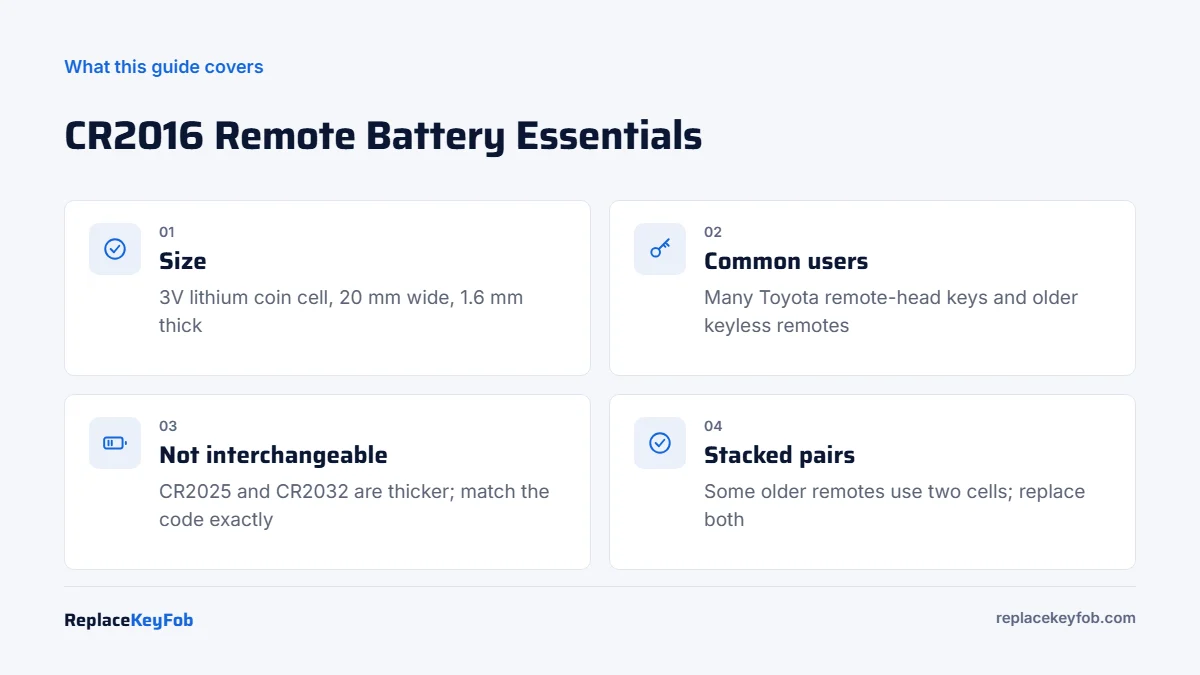
A CR2016 is a 3V lithium manganese dioxide coin cell, 20 mm across and 1.6 mm thick. It is the thinnest of the common 20 mm fob batteries and shows up in many Toyota remote-head keys and older keyless remotes. It is not a direct swap for a CR2025 or CR2032, so match the code exactly.
The CR2016, CR2025, and CR2032 all share the same 20 mm diameter, which makes them easy to confuse. The difference is thickness, and in a fob that difference decides whether the battery touches both contacts or rattles loose.
Here is what the CR2016 is, which remotes commonly use it, and how to replace it without damaging the case.
What Is a CR2016 Battery?
The code follows the IEC standard. “C” means lithium manganese dioxide chemistry, “R” means round, “20” is the diameter in millimeters, and “16” is the thickness in tenths of a millimeter (1.6 mm). Any brand that prints CR2016, DL2016, or ECR2016 on the cell is making the same size and voltage.
Nominal voltage is 3.0V, and a fresh cell usually reads about 3.2-3.3V on a meter with no load. Capacity is typically around 80-90 mAh, depending on the manufacturer. That is roughly a third of a CR2032’s capacity, so a fob designed around a CR2016 is built to sip power.
CR2016 vs CR2025 vs CR2032
| Battery | Diameter | Thickness | Approx. capacity | Voltage |
|---|---|---|---|---|
| CR2016 | 20 mm | 1.6 mm | About 80-90 mAh | 3V |
| CR2025 | 20 mm | 2.5 mm | About 150-170 mAh | 3V |
| CR2032 | 20 mm | 3.2 mm | About 210-240 mAh | 3V |
Voltage is identical, so the fob electronics do not care which one you use. The case does. A CR2025 or CR2032 in a CR2016 slot is too thick and can crack the housing, bend the contact, or keep the case from closing. Going the other way, a CR2016 in a CR2025 slot is 0.9 mm too thin and often loses contact. For the thicker pair, see our CR2032 vs CR2025 comparison.
Which Key Fobs Use a CR2016?
Battery choice follows the fob design, which can change mid-generation. These are common CR2016 users, but always confirm with the old cell:
- Toyota and Scion remote-head keys, roughly 2010s-early 2020s: The key-blade style with lock/unlock buttons in the head on many Camry, Corolla, Highlander, Tacoma, Tundra, and Scion models commonly takes a CR2016. Toyota smart keys (push-button start) usually take a CR2032 or, on some older smart keys, a CR1632.
- Older separate keyless remotes from several brands, including some Toyota, Lexus, and Chrysler-group remotes from the late 1990s and 2000s.
- A few older remote designs that stack two CR2016 cells for 6V. If you find two cells, replace both at the same time and stack them in the same orientation you found them.
Our Toyota key fob battery replacement guide covers Toyota key styles in more detail, and the key fob battery size chart lists other brands.
How to Check Which Battery Your Fob Uses
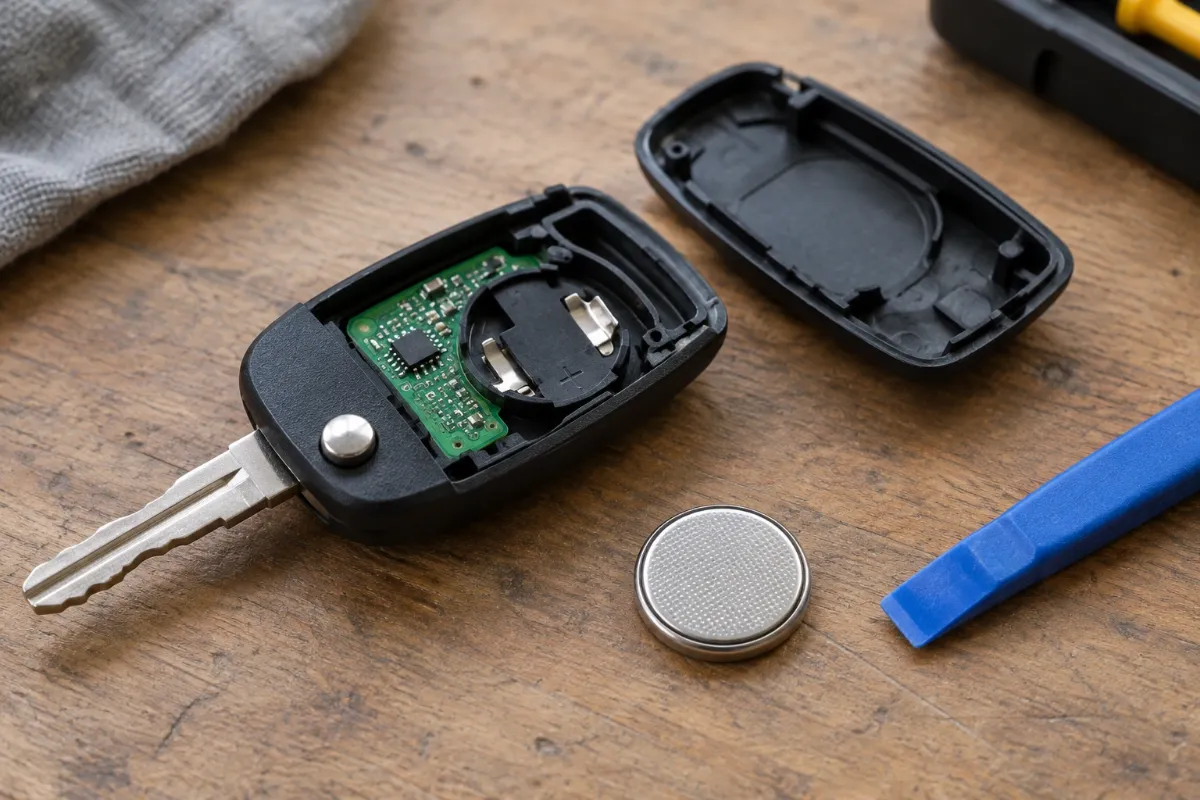
- Open the fob and read the cell. The code is stamped on the positive (+) face.
- Look in the owner’s manual under “remote,” “key,” or “battery.”
- Measure if the print is worn. A 20 mm cell about 1.6 mm thick is a CR2016. About 2.5 mm is a CR2025, and about 3.2 mm is a CR2032.
What You Need
- One CR2016 (two if your fob stacks a pair)
- A small flat screwdriver or plastic pry tool; Toyota remote-head keys often open with a coin or small blade at the seam near the key ring
- A cloth to avoid scratching the case
CR2016 3V Lithium Coin Battery
Match the CR2016 code exactly and choose a name brand with a recent date. Buy a 2-pack if your fob uses two stacked cells or you have a spare key.
As an Amazon Associate, ReplaceKeyFob earns from qualifying purchases.
How to Replace a CR2016 Battery in a Car Remote
- Remove the key ring and any visible screw.
- Pry at the seam slot with a coin or small blade, twisting rather than levering against the board.
- Lift out the inner module if your fob has one (common on Toyota remote-head keys), then open the module to reach the cell.
- Note which side faces up, then remove the old CR2016.
- Insert the new cell with the same orientation, handling it by the edges.
- Reassemble and test lock, unlock, and panic near the vehicle.
Most Toyota remotes keep their programming through a battery change. If the remote does not respond, check polarity and contact pressure first. Our guide to the smaller CR1620 key fob battery covers the 16 mm family, and Toyota key fob not working covers deeper troubleshooting.
Why CR2016 Fobs Can Drain Faster
With roughly 80-90 mAh on board, a CR2016 has less margin for heavy use, cold weather, or a stuck button. Typical life is about 2-3 years, but frequent remote start or a fob kept in a hot car can shorten that. Cold also lowers lithium cell output temporarily, so a weak CR2016 often fails first on a winter morning. Signs to watch for are covered in key fob battery low symptoms.
Buying Tips
- Buy name brands such as Panasonic, Energizer, Duracell, Maxell, or Murata.
- Avoid bulk no-name packs with no date code; old stock may already be partly drained.
- Do not use a BR2016 unless the manual calls for it; it uses a different chemistry with lower pulse output.
- Keep spare cells in their packaging and away from children. Coin cells are a serious swallowing hazard.
Checking a CR2016 With a Multimeter
If you are not sure whether the battery or the remote is at fault, a quick meter check helps. Set a digital multimeter to DC volts, touch the red probe to the flat positive (+) face and the black probe to the other side. A fresh CR2016 reads about 3.2-3.3V. Anything around 3.0V is normal. Below roughly 2.9V at rest, the cell is likely too weak to power the transmitter reliably, especially in cold weather. If a new cell reads well and the remote still fails, look at the contacts, the rubber button pad, and polarity. Our how to test a key fob battery guide covers the process in more detail.
If You Have Two Keys
Replace the battery in both keys at the same time. Cells installed together tend to wear out together, and a spare key with a dead CR2016 is no help on the day your main key fails. Keep one sealed spare cell at home in its original packaging, at room temperature and away from children.
Frequently Asked Questions
No. The CR2032 is twice as thick (3.2 mm vs 1.6 mm). It may not close and can damage the case or contacts. Use the size printed on your old battery.
Only as a temporary fix, and only if the contacts still press firmly. The CR2016 is thinner and holds about half the energy, so it may cut out or die quickly.
Yes. DL2016 (Duracell) and ECR2016 (Energizer) are brand labels for the standard CR2016 size and chemistry.
Some older remotes stack two 3V cells to get about 6V. Replace both at the same time and keep the same stacking orientation.
Typically about 2-3 years with normal use. Heavy daily use, remote start, and heat exposure can shorten that.