
Best Battery Maintainer for Key and ECU Programming

We may earn a commission when you buy through links on this page, at no extra cost to you. How we pick products.
For ECU flashing and long module programming, use a dedicated programming power supply, not a normal maintainer. The Schumacher INC100 is the best all-round choice, with a 70 to 100A Flash Reprogram mode. The AUTOOL EM355 gives the most current (120A) and a detailed display. For shorter jobs like adding a key fob, a strong charger such as the Schumacher SC1280 (15A) is usually enough to keep voltage up.
Programming a key fob, flashing an ECU or coding a module all have one thing in common: the car’s battery has to stay at a steady voltage while the ignition is on, the fans run and the modules are awake. If voltage sags in the middle of a session, the best case is a failed procedure you have to start again. The worst case is a module that is left half-written and will not talk to the scan tool. That is why tool makers like Autel and dealers ask for a battery support unit during programming. This guide explains how much current different jobs need and compares five units, from a 15A charger for quick key jobs to 120A shop power supplies.
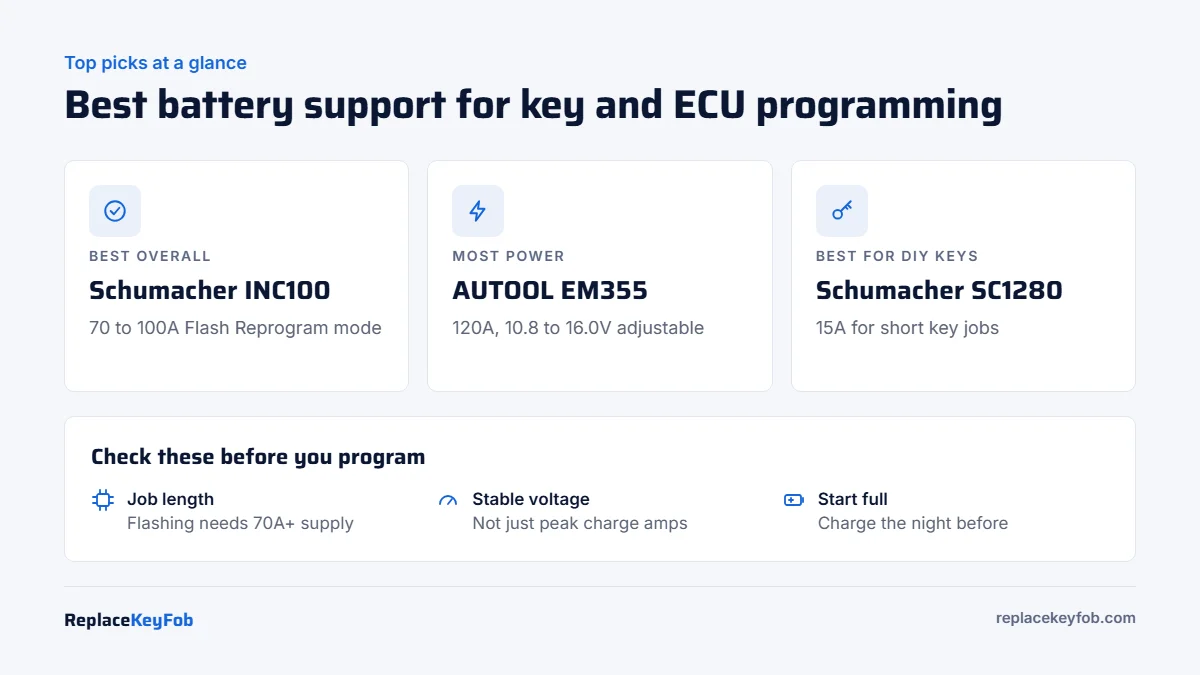
Our Top Picks at a Glance
| Unit | Best for | Max programming current | Key feature |
|---|---|---|---|
| Schumacher INC100 | Best overall for programming | 70 to 100A (Flash Reprogram mode) | Service, Flash and Boost modes |
| AUTOOL EM355 | Highest current, best display | 120A (for 3 minutes) | 10.8 to 16.0V adjustable, 3-year warranty |
| PowerMax PMBC-100-SE | Long cable reach in a shop | 100A | 15-foot 6 AWG cables |
| Schumacher SC1280 | DIY key fob programming | 15A charge | Light and garage-friendly |
| NOCO Genius10 | Charging before a job, then maintaining | 10A charge | Lithium support, temperature sensor |
How Much Power Does Programming Need?
With the ignition on and the engine off, a modern car can draw anywhere from a few amps to well over 30 amps, depending on fans, lights, pumps and how many modules are awake. A battery on its own drops voltage quickly under that load. Programming tools and modules can abort when voltage falls too low, and some procedures will not even start below a set voltage.
| Job | Typical length | What we recommend |
|---|---|---|
| Adding a key fob or smart key | A few minutes to about 20 minutes | A fully charged battery plus a 10A to 15A charger connected |
| All-keys-lost, immobilizer work | Often 20 to 60 minutes | A stable power supply, ideally 50A or more |
| ECU or module flashing (software update) | 30 minutes to over an hour | A dedicated programming power supply of 70A to 100A or more |
| Coding and adaptations | A few minutes per change | A charger connected, or a programming supply on long sessions |
The exact requirement depends on the vehicle maker and the tool, so always follow the procedure on your scan tool or the manufacturer’s service information. When in doubt, more stable current is the safer choice.
How We Chose These Units
- Stable voltage under load, not just peak charging amps.
- A dedicated programming or power-supply mode on the shop units.
- Adjustable output voltage, because some makers specify a target voltage during flashing.
- Cable length and gauge, since programming often happens with the battery in the trunk or under a seat.
- Protections such as reverse polarity, overvoltage and overheating.
The Best Battery Support Units for Key and ECU Programming
1. Schumacher INC100: Best Overall for Programming
Schumacher INC100 100A Battery Charger and Power Supply
Flash Reprogram mode 70 to 100A, selectable 13.0 to 14.8V
Check Price on AmazonThe INC100 is designed for exactly this job. It has three modes: Service Mode holds the battery at up to 13.5V during diagnostics and repairs, Flash Reprogram Mode delivers 70 to 100 amps for ECU updates, and Boost Mode pushes up to 14.4V to recover a discharged battery. Output is selectable from 13.0 to 14.8V DC, so you can match a target voltage when a procedure specifies one.
It is built for shop use, with an Anderson plug connection, 4-gauge 10-foot cables, a 9-foot power cord and mounting brackets for a wall or cart. At about 16 lb it is not something you carry to every job, but it is the unit we would choose for a small shop or a serious DIYer who flashes modules and does immobilizer work.
Pros: true flash-programming mode, selectable voltage, heavy cables, trusted brand.
Cons: heavy; more than you need for occasional key programming.
Best for: shops, mobile locksmiths with a van inverter or shore power, and advanced DIY coding.
Skip it if: you only add a spare key once a year.
2. AUTOOL EM355: Highest Current and Best Display
AUTOOL EM355 120A Flash Reprogramming Power Supply
120A max (3 minutes), 10.8 to 16.0V adjustable
Check Price on AmazonThe EM355 is the most powerful unit here. AUTOOL rates its programming mode at up to 120 amps for three minutes, with adjustable output from 10.8 to 16.0V, and pitches it for ECU reprogramming, module coding and ADAS calibration. A color display shows voltage, current and temperature in real time, which is useful when you want to see exactly what the car is drawing during a session.
It also works as a 20A charger for lead-acid, AGM, EFB and gel batteries and has a battery repair mode. AUTOOL lists nine protections, including an emergency stop, reverse polarity and overvoltage protection, and backs it with a 3-year warranty. At about 21 lb it is the heaviest unit here.
Pros: highest current, live voltage and current display, wide voltage range, 3-year warranty.
Cons: heaviest unit; the 120A figure is a short-duration rating.
Best for: shops doing ADAS calibration and frequent flashing.
Skip it if: you need something portable.
3. PowerMax PMBC-100-SE: Best Cable Reach
PowerMax PMBC-100-SE 100A ECU Programming Power Supply
Up to 100A, 15-foot 6 AWG cables
Check Price on AmazonPowerMax builds power supplies for workshops, and the PMBC-100-SE is aimed at ECU flashing, ADAS calibration and long diagnostic sessions. It provides up to 100 amps with adjustable, controlled voltage and comes with heavy 15-foot 6 AWG cables, the longest here. That extra reach helps when the battery is in the trunk, under a seat or on the far side of a bay from the outlet.
Pros: 100A, long heavy cables, made for shop power-supply use.
Cons: fewer published details on modes than Schumacher and AUTOOL.
Best for: workshops where the car and the outlet are far apart.
Skip it if: you also want a full multi-stage charger with repair modes.
4. Schumacher SC1280: Best for DIY Key Fob Programming
Schumacher SC1280 15A Battery Charger and Maintainer
15A charge, 3A maintain, 6V/12V
Check Price on AmazonFor adding a key fob with an OBD programmer or an onboard procedure, you usually do not need a 100A power supply. What you need is a fully charged battery and a charger that can offset the car’s draw for a short session. The SC1280 delivers 15A charging and a 3A smart trickle mode, has automatic 6V/12V detection, and handles standard, AGM, gel and deep-cycle batteries. At about 2.7 lb it lives easily in a home garage.
The workflow that works: charge the battery fully the night before, connect the SC1280 during programming, and turn off the headlights, HVAC and anything else you can. That keeps voltage steady for most key-adding jobs. For all-keys-lost or module flashing, use a dedicated supply from the picks above.
Pros: enough current for short key jobs, light, also a good everyday charger.
Cons: not a regulated programming power supply; not for long flashing sessions.
Best for: DIY key programming and coding at home.
Skip it if: you plan to flash ECUs.
5. NOCO Genius10: Best for Charging Before the Job
NOCO Genius10 10A Smart Battery Charger
10A, 6V/12V, lead-acid, AGM and LiFePO4
Check Price on AmazonThe most common reason a key programming session fails is simple: the battery was not full to begin with. The Genius10 is a 10A smart charger that brings a car battery to full charge, adjusts for temperature, supports lithium batteries and can stay connected afterwards. It is a good fit for owners who program keys or code features occasionally and also want a quality everyday charger. Keep it connected during short sessions; for long flashing, use a programming supply.
Pros: excellent charger, lithium support, Force Mode for dead batteries, 3-year warranty.
Cons: 10A is not enough to hold voltage on a long flash with high draw.
Best for: preparing the battery and short key jobs.
Skip it if: you need a dedicated programming supply.
Why Not Use an OBD Memory Saver or Jump Starter?
An OBD2 memory saver only keeps radio presets and settings alive while the battery is disconnected; it supplies very little current. A jump starter delivers a short burst for cranking, not steady power for an hour. Neither is designed to hold voltage during programming, and some jump packs shut off after a short time.
How to Set Up Battery Support for Programming
- Charge the battery fully before you start, ideally the night before.
- Connect the power supply or charger to the battery or the jump posts named in your owner’s manual.
- Select the supply or programming mode and the voltage your procedure calls for.
- Turn off headlights, HVAC, the radio and seat heaters, and close the doors so courtesy lights go out.
- Keep laptops and programming tools on their own charger.
- Do not disconnect the support unit until the procedure is fully complete and the tool confirms it.
For the programming side, see our guides on how to program a key fob yourself, programming a key fob with an Autel tool and the best OBD2 scanners for key programming.
Common Mistakes That Cause Failed Programming
- Starting with a half-charged battery. Even a good power supply has to work harder, and some procedures check voltage before they begin.
- Leaving the headlights or HVAC on. Some cars switch on lights automatically with the ignition; turn them off manually.
- Opening a door mid-session. Courtesy lights and module wake-ups add load and can interrupt communication on some models.
- Letting the laptop or tablet run flat. A tool that shuts down mid-flash causes the same problem as a voltage drop.
- Using thin extension cords on the power supply’s AC side, which can limit what it delivers.
Buying Guide
Charger or programming power supply?
A charger follows a charging curve and may reduce output as the battery fills. A programming power supply holds a set voltage and delivers whatever current the car draws, up to its limit. For flashing, that difference matters.
Size for the worst case
Large luxury vehicles with many modules can draw a lot of current with the ignition on. If you work on many makes, buy for the highest-draw car you will see.
Check the cables
Thin or short cables cause voltage drop. Look for heavy-gauge leads long enough to reach a trunk-mounted battery.
Related Guides
- Best battery maintainers for cars
- Best OBD2 scanners with ECU coding
- What is ECU coding on a scan tool?
- Universal key programmers explained
FAQ
Do I need a battery maintainer to program a key fob?
It is strongly recommended. A fully charged battery with a 10A to 15A charger connected is enough for most key-adding jobs. Longer immobilizer work and module flashing need a dedicated power supply.
What voltage should the battery be during programming?
It varies by maker, but many procedures want a steady voltage around 13V or higher and abort if voltage falls too low. Follow the procedure on your scan tool or service information.
Can a low battery brick an ECU?
It can interrupt a flash and leave a module that will not communicate. Many can be recovered, but it can be time-consuming. Stable battery support prevents most of these failures.
Is a trickle charger enough for programming?
No. A 1A to 2A trickle charger or maintainer cannot keep up with the car’s draw with the ignition on.
Can I use a jump starter during key programming?
It is not recommended. Jump starters are made for short cranking bursts and may switch off or drop voltage during a long session.
Does a new battery need registration after programming work?
Battery registration is a separate step needed on many BMW, Audi, VW and other cars when the battery is replaced. See how to register a car battery with a scan tool.