
Energizer vs Duracell CR2032: Which Is Better?

We may earn a commission when you buy through links on this page, at no extra cost to you. How we pick products.
Both are excellent CR2032 cells for key fobs, and in daily use most drivers will not notice a difference. Duracell claims a longer runtime than Energizer’s 3-in-1 cell in a standard household-device test and has a bitter coating on both sides. Energizer lists up to 12 years of storage life and a -4°F to 140°F operating range. The bigger factor is freshness: buy a recently made pack from a reliable seller and either brand will last years in most fobs.
The CR2032 is the most common key fob battery in the world. It powers remotes and smart keys from Toyota, Honda, Ford, Chevrolet, Lexus, BMW and many more, plus Apple AirTags and countless small devices. When it is time to replace one, the choice usually comes down to the two big names on the rack: Energizer and Duracell. This comparison looks at what each brand claims, the safety features that differ, and what actually decides how long a fob battery lasts.
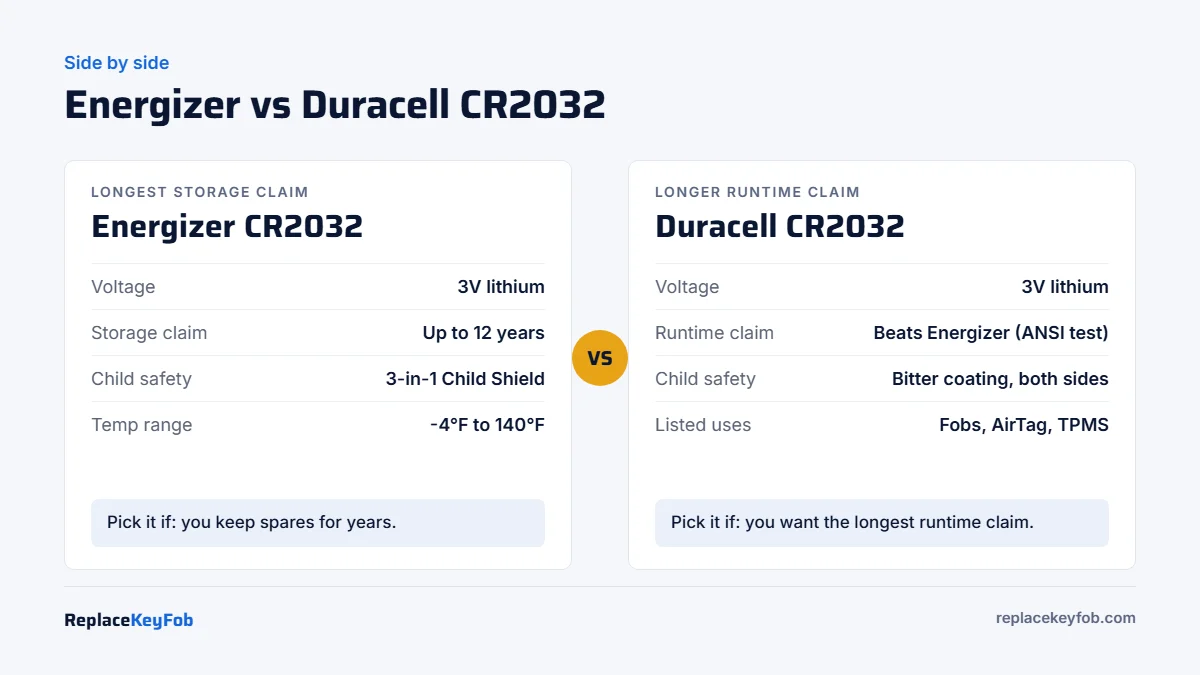
Energizer vs Duracell CR2032: Side by Side
| Energizer 2032 | Duracell 2032 | |
|---|---|---|
| Chemistry and voltage | Lithium, 3V | Lithium, 3V |
| Storage life (maker’s claim) | Up to 12 years | Not stated on this listing |
| Operating temperature (maker’s claim) | -4°F to 140°F | Not stated on this listing |
| Runtime claim | Long-lasting | Lasts longer than Energizer 3-in-1 (Duracell’s ANSI household test) |
| Child safety | 3-in-1 Child Shield: color alert, bitter coating, secure pack (select packs) | Bitter coating on both sides, child-secure pack |
| Listed uses | Keyless entry, AirTag, medical devices | Key fobs from major brands, AirTag, TPMS sensors |
Energizer 2032 Lithium Coin Battery, 2-Pack
Up to 12 years storage, -4°F to 140°F
Check Price on AmazonDuracell 2032 Lithium Coin Battery, 2-Count
Bitter coating on both sides
Check Price on AmazonRuntime: Does One Really Last Longer?
Duracell’s packaging says its 2032 lasts longer than Energizer’s 3-in-1 2032, based on an ANSI digital household device test. That is the maker’s own claim, measured under a standardized load. Key fobs draw very little current most of the time and short bursts when you press a button or the car polls a smart key. In that kind of use, the difference between two premium cells is small compared with the effect of the fob’s design, how often you use it, and how close it sits to the car.
What clearly matters more is freshness. A cell that has sat in a hot warehouse for years starts with less capacity. Check the expiry date on the package; a later date usually means a newer cell.
Verdict: Slight edge to Duracell on its own runtime claim; in real fobs, a tie.
Storage Life and Temperature
Energizer lists a storage life of up to 12 years and an operating range of -4°F to 140°F for this 2032. That matters for spares kept in a glove box and for fobs left in cold cars, since cold reduces a coin cell’s ability to deliver current and is a common trigger for “key battery low” warnings in winter. Duracell’s listing for this pack focuses on compatibility and child safety rather than temperature figures.
Verdict: Energizer, for the published storage and temperature ratings.
Child Safety
Both brands add a bitter coating to discourage swallowing, which is important because a swallowed coin cell can cause severe internal burns within hours. Duracell applies the bitter coating to both sides of the cell. Energizer’s 3-in-1 Child Shield combines a color alert that can show if a battery was in a child’s mouth, a bitter coating and secure packaging (on select packs). Both are big improvements over unbranded cells.
Verdict: Tie; both take it seriously in different ways.
Does the Bitter Coating Affect the Fob?
Owners sometimes ask whether coatings stop the battery from making contact. The coatings are designed to work with standard devices, and most fobs work normally. If a new cell does not work, clean the contacts and check orientation first; see key fob battery contacts not touching. A few devices are sensitive to coin cell thickness or contact pressure, which is unrelated to the coating.
Which Should You Buy?
| If you… | Pick |
|---|---|
| Want the longest published storage life for spares | Energizer |
| Live somewhere with cold winters | Energizer (published -4°F rating) |
| Want the maker’s longer runtime claim | Duracell |
| Have small children at home | Either; keep in child-resistant packs |
| Just need a battery today | Whichever pack has the latest expiry date |
The Verdict
Both brands make reliable CR2032 cells, and either is a good choice for a key fob. Energizer publishes a longer storage life and a cold-weather rating, which is useful for spares and winter. Duracell claims a longer runtime and coats both sides for child safety. Buy a fresh pack from a reputable seller, avoid cheap unbranded multipacks, and you should get years from either one.
For more options, including other brands, see our guide to the best CR2032 batteries for key fobs. If your fob uses a larger cell, see the best CR2450 batteries.
How to Make a Fob Battery Last Longer
- Store spare keys away from the car, so they are not constantly woken by the car’s proximity signal.
- Avoid keeping the fob next to phones, laptops or other electronics for long periods.
- Do not press buttons unnecessarily, including in your pocket.
- In winter, keep the fob in an inside pocket rather than a cold car.
If your fob still drains quickly, read why a key fob battery drains quickly.
Other CR2032 Brands Worth Knowing
Energizer and Duracell are the most common choices, but they are not the only good ones. Panasonic, Maxell, Murata (which took over Sony’s battery business) and Renata are also respected coin cell makers, and some car makers supply their own branded batteries that are often made by one of these companies. If your local store only stocks one of these brands, it is a perfectly sensible choice. What matters most is buying a genuine battery from a trusted seller and checking the date code. Our guide to the best CR2032 batteries for key fobs compares more options.
How to Swap a CR2032 Without Damaging the Fob
- Find the small notch on the fob’s seam or remove the emergency key first if your fob has one.
- Use a plastic pry tool or a coin to open the case. A metal screwdriver can scratch the plastic or damage the circuit board.
- Note which way the old battery faces. On most fobs the positive side (with the text) faces up.
- Avoid touching the flat faces of the new battery with your fingers, as skin oils can affect contact.
- Press the new battery in firmly, close the case evenly and test every button.
Most fobs keep their programming when you change the battery. If yours stops working afterward, check the battery direction and contacts before assuming it needs reprogramming.
Related Guides
- Best CR2032 batteries for key fobs
- CR2032 vs CR2025 key fob battery
- CR2032 battery replacement guide
- Key fob battery size chart
FAQ
Is Duracell or Energizer better for key fobs?
Both are reliable. Duracell claims longer runtime in a standard test; Energizer lists longer storage and a published cold rating. Freshness matters more than brand.
How long does a CR2032 last in a key fob?
Usually two to four years, depending on the fob, how often you use it, and whether it is a smart key that is constantly polled by the car.
Can I use a CR2025 instead of a CR2032?
It may fit but is thinner, so contact can be loose and it holds less energy. Use the size your fob specifies. See CR2032 vs CR2025.
Why does my new battery not work in my fob?
Check orientation, clean the contacts, and make sure the protective film or sticker is removed. If it still fails, see key fob not working after battery replacement.
Are cheap CR2032 multipacks okay?
Some are fine, but quality varies widely and old stock is common. For a key fob, a name-brand cell is worth it.