
How to Lubricate Car Door Locks and Latches

To lubricate car door locks, puff dry graphite or spray dry PTFE into the keyhole and work the key in and out. Then spray white lithium grease into the latch on the door edge, cycle it ten times, grease the hinges and check strap, and wipe silicone onto the rubber seals. The whole job takes about 20 minutes.
A car door has four moving areas that need care: the key lock cylinder, the latch on the door edge, the hinges and check strap, and the rubber seals. Each one wants a different product. The most common mistake is spraying the same oily product into everything, which works for a week and then collects grit, gums up in cold weather and makes the lock harder to turn.
Lubricating the doors once or twice a year keeps locks smooth, stops doors from popping and creaking, helps them latch on the first close, and reduces winter freezing. It also reduces strain on the power lock actuators, because a stiff latch makes the motor work harder every time you press the fob.
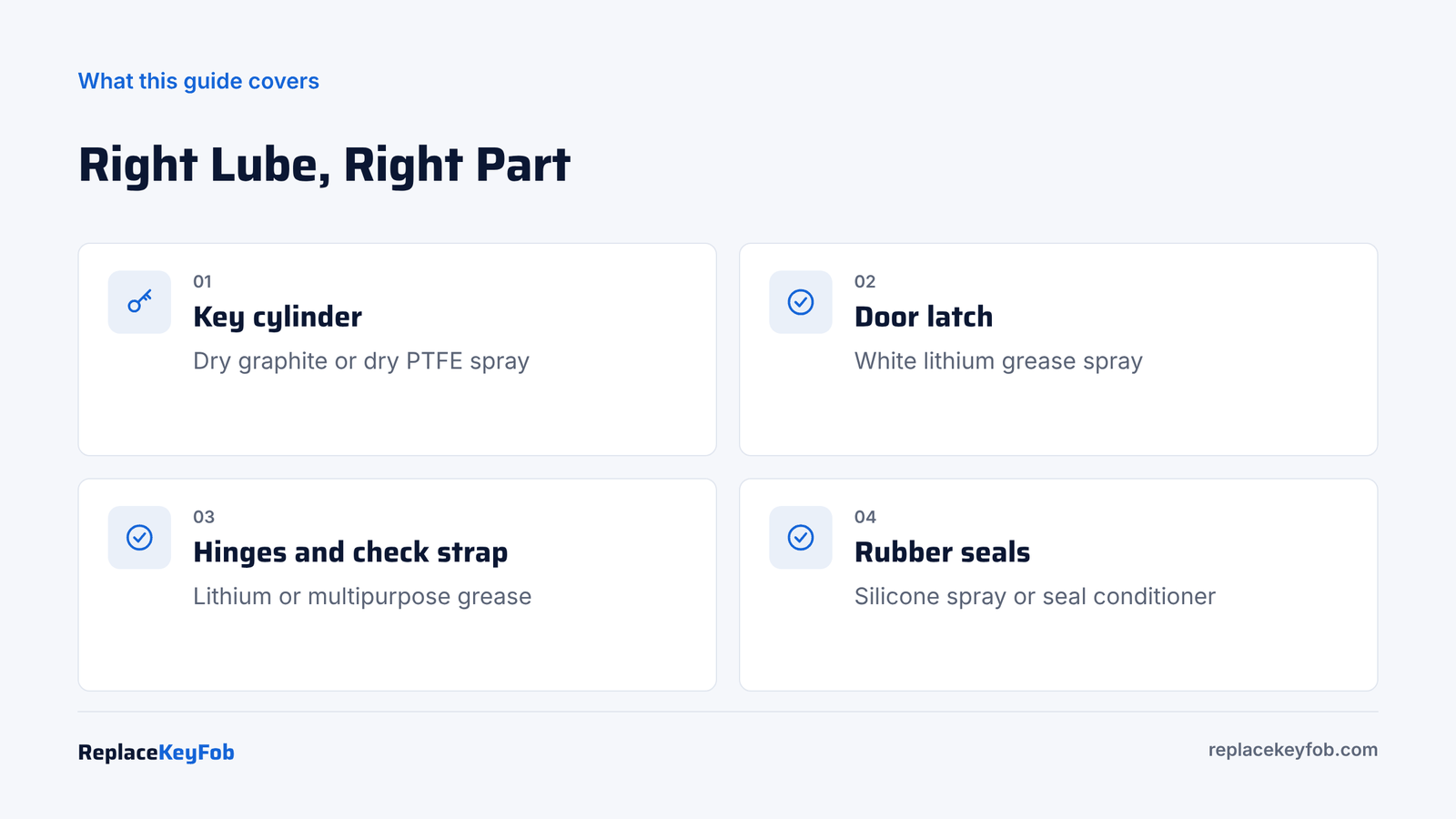
Which Lubricant Goes Where
| Part | Best lubricant | Why | Avoid |
|---|---|---|---|
| Key lock cylinder | Dry graphite or dry PTFE lock spray | Dry film does not attract dirt or thicken in cold | Grease, heavy oil |
| Door latch (on door edge) | White lithium grease spray | Clings to metal, resists water, stays put | Dry graphite alone |
| Striker (on body pillar) | Thin film of white lithium grease | Reduces wear and clunks | Thick grease blobs |
| Hinges | White lithium or multipurpose grease | Handles heavy load and weather | Light oil that runs off |
| Door check strap | White lithium grease | Stops popping and clicking | Silicone |
| Rubber weatherstrip | Silicone spray or rubber conditioner | Protects rubber, stops sticking and freezing | Petroleum products, grease |
| Window channels | Silicone spray | Lets glass slide, safe for rubber | Grease, graphite |
Some manufacturers list a specific lubricant in the owner’s manual or service information. If yours does, use it.
What You Need
- Dry graphite lock lubricant or dry PTFE lock spray
- White lithium grease in a spray can with a straw
- Silicone spray or rubber seal conditioner
- Electrical contact cleaner or lock cleaner (plastic-safe)
- Shop towels or microfiber cloths
- A flat screwdriver or plastic trim tool to cycle the latch
- Painter’s tape or a towel to protect paint and trim
White lithium grease spray with straw
Pick a white lithium grease spray that comes with a straw nozzle so you can reach into the latch jaw and hinge pins without coating the paint.
As an Amazon Associate, ReplaceKeyFob earns from qualifying purchases.
Step 1: Clean Before You Lube
Old grease mixed with road grit is the main reason latches stick. New lubricant on top of dirty grease just creates more paste.
- Open the door fully and lay a towel on the sill to catch drips.
- Spray plastic-safe contact cleaner or lock cleaner into the latch jaw on the door edge.
- Wipe away the dirty run-off with a shop towel. Repeat until it runs clean.
- Wipe the striker on the body pillar with a towel and a little cleaner.
- Spray a short burst of lock cleaner into the keyhole and work the key in and out to flush it.
Let everything dry for five minutes before adding lubricant.
Step 2: Lubricate the Key Lock Cylinder
- Hold the graphite tube or PTFE nozzle against the keyhole shutter.
- Puff graphite or spray PTFE for one second.
- Insert the key fully and remove it five to ten times.
- Lock and unlock with the key three or four times.
- Wipe the key and the keyhole face to remove excess.
Many newer cars only have a keyhole on the driver door, often hidden under a cap at the end of the handle. Those locks are rarely used, so they seize from neglect. Lubricating them once a year keeps them working for the day your fob battery dies.
Step 3: Lubricate the Door Latch Mechanism
The latch is the metal mechanism on the rear edge of the door that grabs the striker. It is the part people most often mean when they ask how to lubricate a car door lock mechanism.
- Locate the latch jaw (the slot with the rotating claw).
- Spray white lithium grease into the jaw and around the claw pivot for one to two seconds.
- Use a screwdriver tip to push the claw closed, as if the door had shut on the striker. It should click into the latched position.
- Pull the outside or inside handle to release it. Repeat ten times so the grease works into the mechanism.
- Lock and unlock with the fob or the lock button several times while the door is open, so the lock lever inside the latch also moves.
- Wipe off any grease on the painted door edge.
Remember to pull the handle to release the latch before you close the door, or the door will not close fully on the striker.
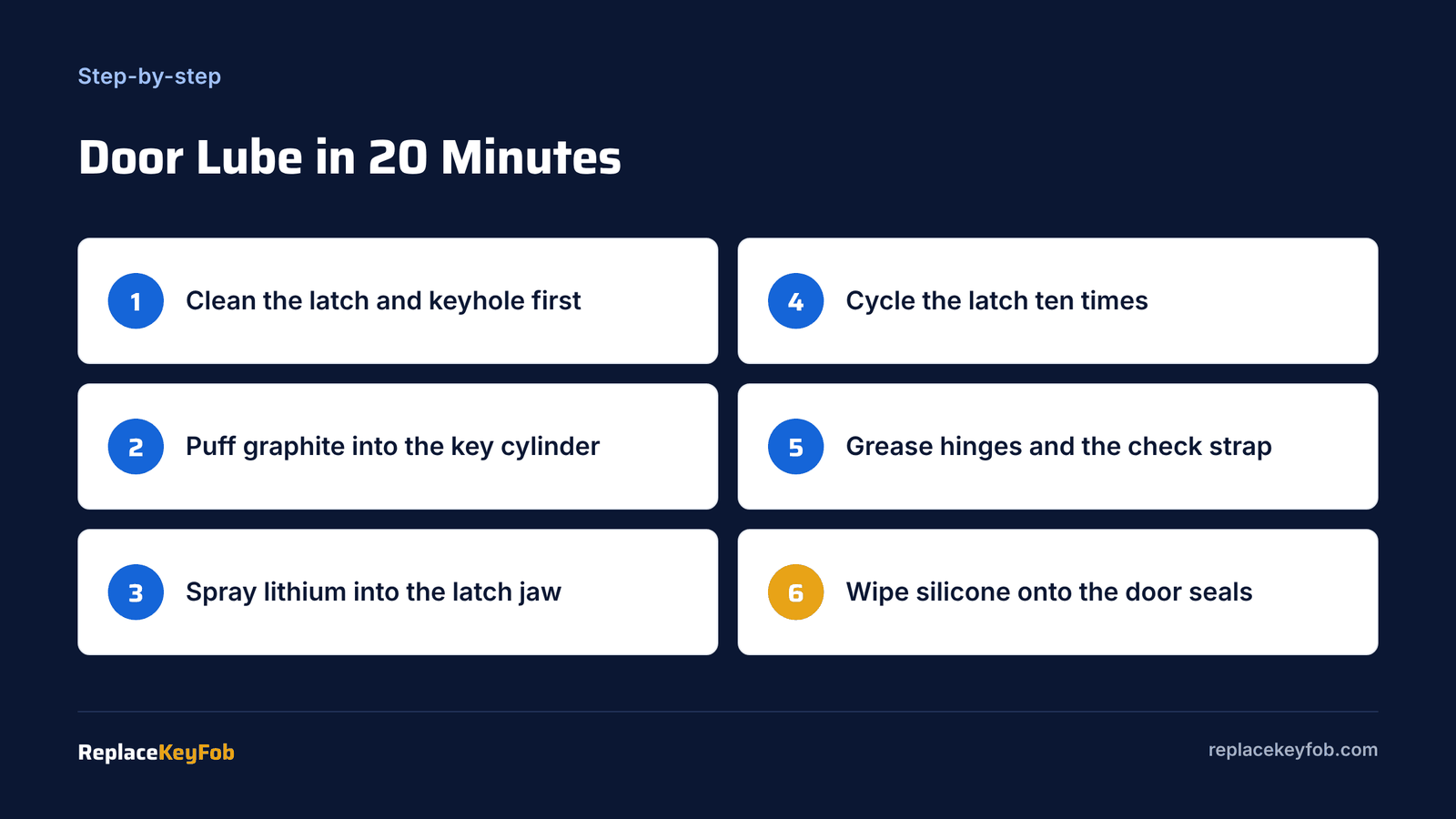
Step 4: Hinges and Check Strap
- Find the upper and lower hinges at the front edge of the door.
- Spray lithium grease onto the hinge pins and pivot points.
- Swing the door fully open and closed five times.
- Find the check strap (the arm between the hinges that holds the door open in steps).
- Grease the strap where it slides through its housing.
- Wipe excess from paint and the door jamb.
If the door pops, clicks or holds open poorly, the check strap is usually the cause, and grease often fixes it.
Step 5: Treat Rubber Door Seals
- Spray silicone onto a cloth, not directly onto the seal, to avoid overspray on glass.
- Wipe the full length of the door weatherstrip and the matching body seal.
- Wipe the rubber window channel lightly if the glass is slow.
Silicone keeps rubber soft, stops it sticking to paint in the heat and reduces freezing in winter. For winter specifics, see how to unfreeze a car door.
Variations by Vehicle Type
- Sliding van doors: grease the upper, center and lower rollers and tracks, and the rear latch. Clean the lower track first; it collects the most grit.
- Tailgates and liftgates: lubricate the latch at the bottom and the hinges at the top. Truck tailgate cables and trunnions also benefit from grease.
- Frameless window doors: wipe silicone on the window seals only. Do not get grease on the glass.
- Power locks: lubricate only the latch and linkage you can reach from the door edge. The actuator motor inside the door is sealed and does not need lube.
Troubleshooting After Lubricating
| Symptom | Likely cause | Next step |
|---|---|---|
| Key still stiff in the lock | Worn key or worn cylinder wafers | Try the spare key; see our sticky lock guide |
| Fob locks the door slowly or only some doors | Weak lock actuator | Check actuator; see unlocks passenger door only |
| Door has to be slammed to close | Latch dirty or striker out of position | Clean the latch again, then check striker alignment |
| Door clicks or pops opening | Dry check strap | Grease the strap and housing |
| Lock only works sometimes | Electrical fault or actuator | See why a key fob locks but won’t unlock |
Mistakes to Avoid
- Grease in the keyhole. It traps grit and thickens in the cold. Use graphite or dry PTFE only.
- Graphite in the latch. It is too light for the load on the latch claw. Use lithium grease.
- Petroleum products on rubber. They can swell and soften seals.
- Overspray on paint and upholstery. Use a straw, cover the area and wipe up immediately.
- Skipping the cleaning step. Lube on top of grit makes things worse.
How Often to Lubricate Car Door Locks
A good schedule is twice a year: once before winter and once in spring. Add an extra lock treatment after pressure washing the car or after a long winter of road salt. If you live by the coast or in heavy salt areas, check the latches every three months.
When to Call a Pro
If the latch still binds after cleaning and greasing, the latch assembly may be worn or broken inside. A door latch replacement typically costs about $200 to $600 per door in 2026, including the actuator on most modern cars where the two are one unit. A locksmith can service or rekey a worn door lock cylinder for about $100 to $250.
Frequently Asked Questions
Dry graphite or a dry PTFE lock spray is best for the key cylinder. For the latch on the door edge, use white lithium grease, and use silicone on rubber seals.
WD-40 is mainly a cleaner and water displacer. It can free a stuck lock short term, but follow up with graphite or dry PTFE, because the oily film collects dirt.
The parts that wear are the latch and lock lever, which you can reach through the latch jaw on the door edge. Spray lithium grease there and cycle the latch. You rarely need to remove the door panel.
Yes. A silicone spray or rubber conditioner keeps seals soft, prevents sticking and squeaks, and helps stop doors freezing shut in winter.
About twice a year, before winter and in spring, plus after car washes in freezing weather or if a lock starts to feel stiff.