
How to Open a Car Door With a Broken Latch

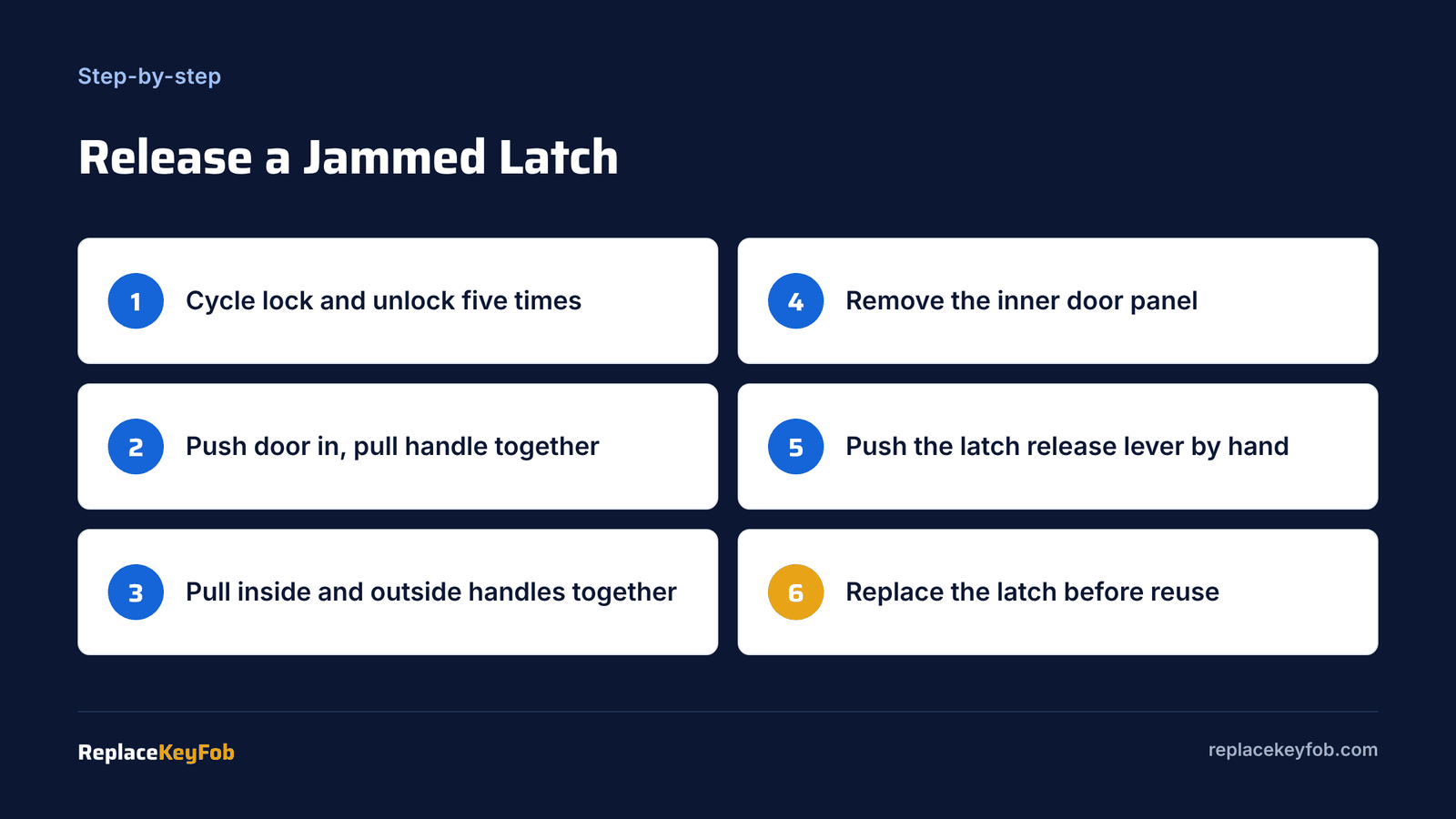
To open a car door with a broken latch, cycle the locks five times, then push the door firmly inward while a helper pulls the outside handle and you pull the inside one. If it stays shut, remove the inner door panel and push the latch release lever by hand with a screwdriver.
The latch is the mechanism on the rear edge of the door that grips the striker bolt on the body. When it fails in the closed position, the door is trapped: the handles move, the lock may click, but the claw inside never lets go of the striker. It is one of the more frustrating car problems, because the obvious method (pull harder) is the one most likely to break something else.
This guide covers a latch stuck shut. If your problem is the opposite, where the door will not stay closed or keeps bouncing open, see our guide on fixing a car door that won’t close.
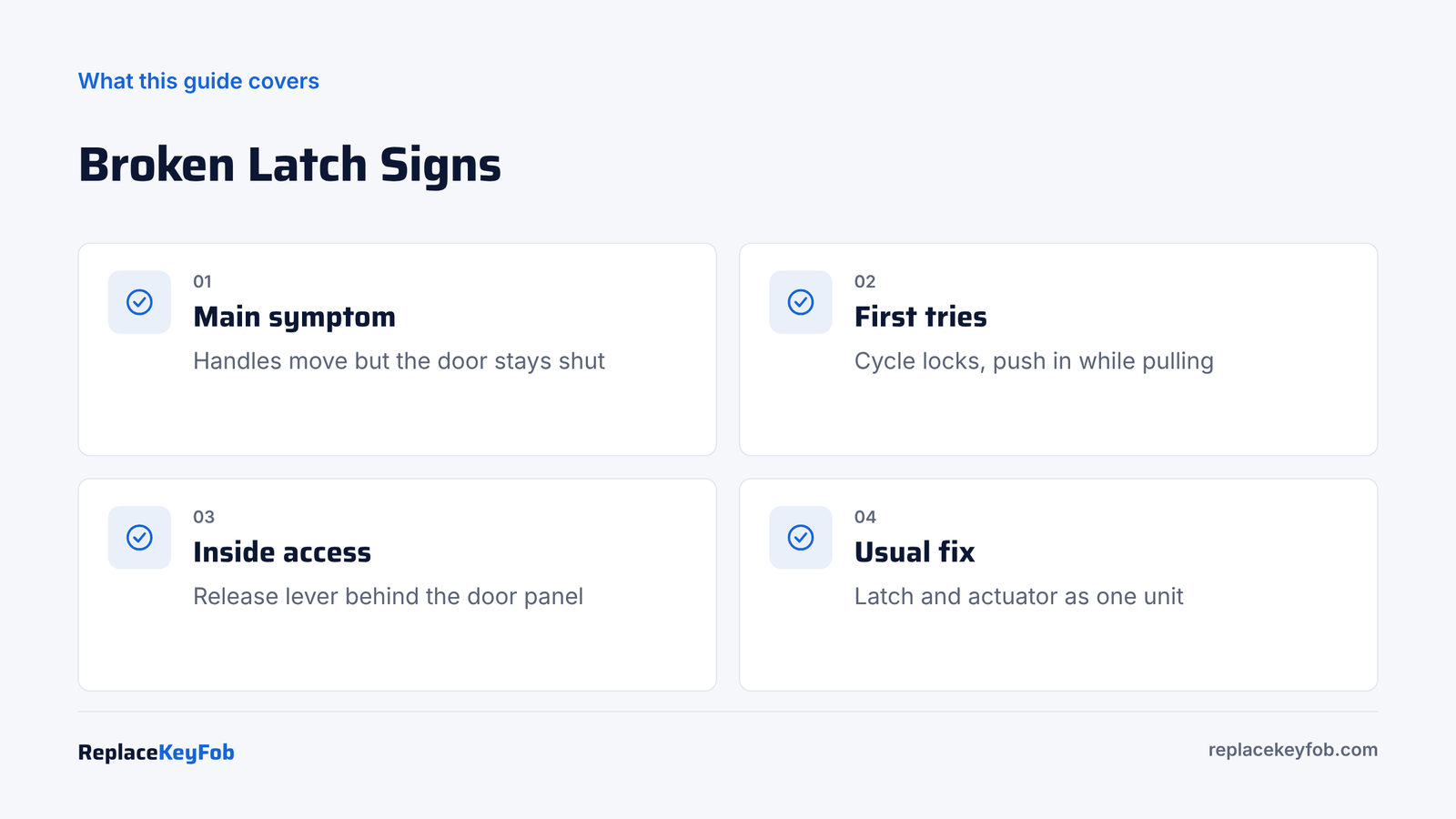
Signs the Latch Is Broken, Not the Handle
| Symptom | Points to |
|---|---|
| Both handles move with normal resistance, door stays shut | Latch claw stuck or broken |
| Handle feels loose, floppy, no resistance | Handle rod or cable disconnected |
| Lock button moves but door stays locked | Lock lever inside latch or actuator failed |
| Door opens only after slamming or pushing | Latch dirty or striker misaligned |
| Grinding or buzzing in the door when you unlock | Actuator part of the latch failing |
| Problem only in freezing weather | Ice in the latch |
If the handle is loose, follow how to open a car door with a broken handle instead. If it is cold out, try how to unfreeze a car door first.
Why Door Latches Fail
Latches live in a harsh spot. Water runs down inside the door shell onto them, road salt and dust wash in with it, and the grease that came from the factory slowly dries out. Over years, the claw pivot gets stiff and the small return springs weaken or rust through. On cars with combined latch and actuator units, the plastic gears in the actuator also wear, and a failing gear can jam the lock lever halfway. Doors that are slammed hard, or used by heavy daily traffic like a driver door or a rideshare rear door, wear out first. Regular lubrication, explained in our lubrication guide, does not make a latch last forever, but it slows every one of these failures.
Tools You May Need
- A helper (makes the first methods much more effective)
- Plastic trim removal tools
- Phillips and flat screwdrivers, including a long thin flat screwdriver
- Socket set with 7 mm, 8 mm, 10 mm and a T30 Torx bit (common on latch screws)
- Flashlight or headlamp
- Penetrating lock cleaner or white lithium spray
Long-reach flat screwdriver set
A set of long, thin screwdrivers lets you reach the latch release lever through the door shell openings without removing the window.
As an Amazon Associate, ReplaceKeyFob earns from qualifying purchases.
Step 1: Rule Out the Lock
A latch can be perfectly fine but held locked. The lock lever inside the latch assembly blocks the release.
- Press unlock on the fob, then lock, five times.
- Use the master lock switch on the driver door the same way.
- Move the door’s own lock pin or tab by hand.
- Try the mechanical key in the driver door.
Each of these moves the lock lever by a different route. If one of them frees the door, the latch claw is fine but the lock actuator is weak or the lock rod is loose. That is a cheaper repair than a full latch.
Step 2: Take the Load Off the Latch
When a door seal pushes outward, it loads the latch claw against the striker. A sticky claw cannot rotate under that load.
- Push the door firmly inward toward the car, near the rear edge.
- While still pushing, pull the inside handle and hold it.
- Have a helper pull and hold the outside handle at the same time.
- Release your push and let the door swing out.
Pulling both handles at once moves the release lever as far as it can go. Pushing the door in removes the tension so the claw can turn. This step opens many stuck doors without tools.
Step 3: Try a Lubricant
If the latch is gummed up rather than broken, a lubricant can free it. Spray penetrating lock cleaner or white lithium grease into the gap where the latch sits at the rear edge of the door, aiming toward the striker. Wait five minutes, then repeat Step 2. If it opens, clean and grease the latch properly as shown in how to lubricate car door locks.
Step 4: Release the Latch From Inside the Door
If the door is still stuck, the latch has to be released directly. You will be working from inside the car, because the inner door panel faces the cabin.
- Lower the window on that door if it works.
- Remove the screws in the inside handle recess, armrest and panel edges.
- Pop the panel clips with trim tools, starting at a lower corner.
- Lift the panel off the window ledge and unplug the switches.
- Peel back the rear part of the plastic moisture barrier.
- Find the latch at the rear of the door. You will see the inside handle cable, the outside handle rod and the lock rod connecting to it, plus an electrical connector for the actuator.
- Locate the release lever (where the handle rods connect). Push or pull it in the direction the handle moves it, using a long screwdriver, while pushing the door outward.
- If the lock lever is stuck in the locked position, move it to unlocked first, then release.
When this works, the door will swing open. Leave the panel off until the latch is replaced.
If you cannot reach the release lever
On some models the latch is hidden behind the window glass channel or a steel reinforcement. A long, thin screwdriver through an access hole can often reach it. On others, the latch can only be released by removing the screws on the door edge, which you cannot reach with the door closed. That is when a locksmith or body shop is needed; they have tools to release the latch through the door gap with less damage.
Variations by Door Type
- Rear doors: check the child safety lock first. It disables the inside handle only.
- Sliding van doors: have a front latch, rear latch and a remote control unit. A stuck sliding door usually needs the rear latch released through the inner panel.
- Liftgates and trunks: most have an emergency release lever or a hole for a screwdriver inside the trim. Check the owner’s manual.
- Two-door coupes: long doors have heavy latch loads. Step 2 with a helper is especially effective.
- Electronic latches: some EVs and luxury cars release the latch with a motor. If power is lost, look for the mechanical inner release described in the manual.
Replacing the Broken Latch
Once the door is open, the latch should be replaced. Most modern latches combine the mechanical latch and the lock actuator in one sealed unit.
- Disconnect the 12V battery negative terminal if the manual advises it, then unplug the actuator connector.
- Unclip the handle rods and cables from the latch.
- Remove the three latch screws on the door edge (often Torx).
- Work the latch out through the door shell.
- Fit the new latch, reconnect rods, cable and connector.
- Test the handles, lock and unlock several times with the door open before closing it.
That last step matters: always test a new latch with the door open by pushing the claw closed with a screwdriver and releasing it with each handle. If you close the door on an untested latch, you could trap it shut again.
Mistakes to Avoid
- Pulling the handle with force. It snaps the handle or the rod clip and leaves you with two problems.
- Prying the door edge. You will bend the door and damage paint and seals.
- Cutting the moisture barrier. Peel it back and reseal it.
- Closing the door on a new latch before testing it.
- Driving with a door that will not latch fully. It can open in a turn.
Repair Cost and When to Call a Pro
A door latch with built-in actuator typically costs about $60 to $250 for the part and about $200 to $600 installed at a shop in 2026, depending on the vehicle. A locksmith or body shop can release a jammed door for about $75 to $200, which is worth paying if you cannot reach the latch from inside. If the lock side also misbehaves on other doors, read why a key fob locks but won’t unlock, because the cause might be electrical rather than mechanical.
Frequently Asked Questions
The handles move normally, with their usual resistance, but the door stays shut. Sometimes you hear the lock click or the actuator buzz, but the claw never releases the striker.
Sometimes, by pushing the door inward while someone pulls the outside handle. If the latch claw is broken, you will need to release it from inside the door panel.
On most modern cars they are one assembly. The latch grips the striker and the actuator motor moves the lock lever inside it. A failure in either often means replacing the whole unit.
About one to two hours for a DIYer with the right tools, and about one hour at a shop. Some models take longer if the window glass must be removed.
Yes. Ice inside the latch can stop the claw rotating. If the problem appears only in freezing weather, warm the car and de-ice the latch area before replacing anything.