
How to Replace a Car Door Lock Cylinder

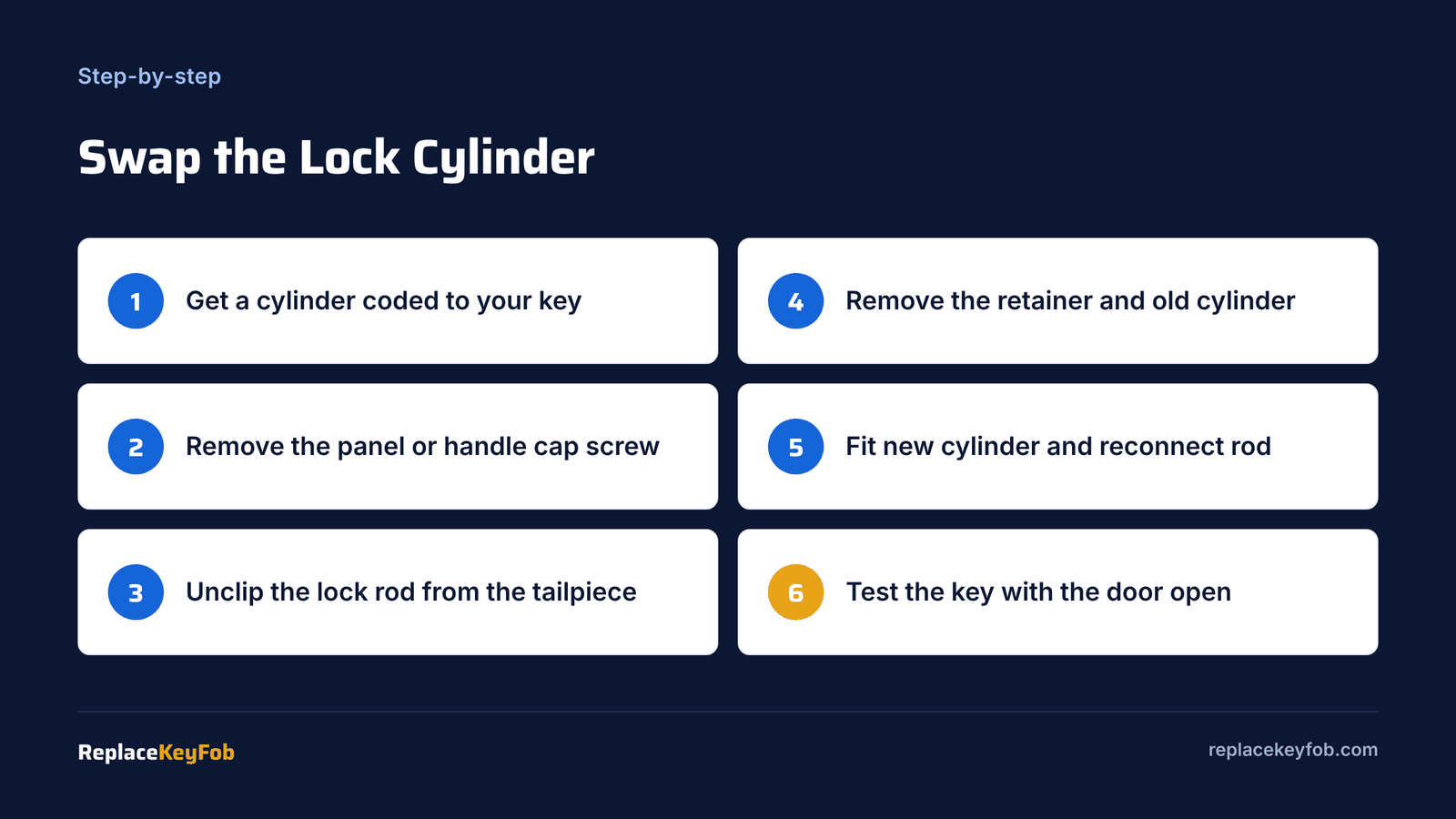
To change a car door lock cylinder, get a new cylinder coded to your key, then remove the door panel or the handle cap screw on the door edge. Unclip the lock rod, remove the retainer and pull out the old cylinder. Fit the new one, reconnect the rod and test the key with the door open.
The door lock cylinder is the part your key goes into. It turns a small lever that moves a rod, which locks or unlocks the latch. When the cylinder wears out, the key sticks, turns without doing anything, or will not go in at all. On many cars the cylinder is rarely used, so the first sign of a problem shows up on the day the fob battery dies and you actually need it.
Replacing it is a moderate DIY job. The physical swap is not hard. The part people get wrong is the key: a new cylinder must match your existing key, or you end up carrying two keys.
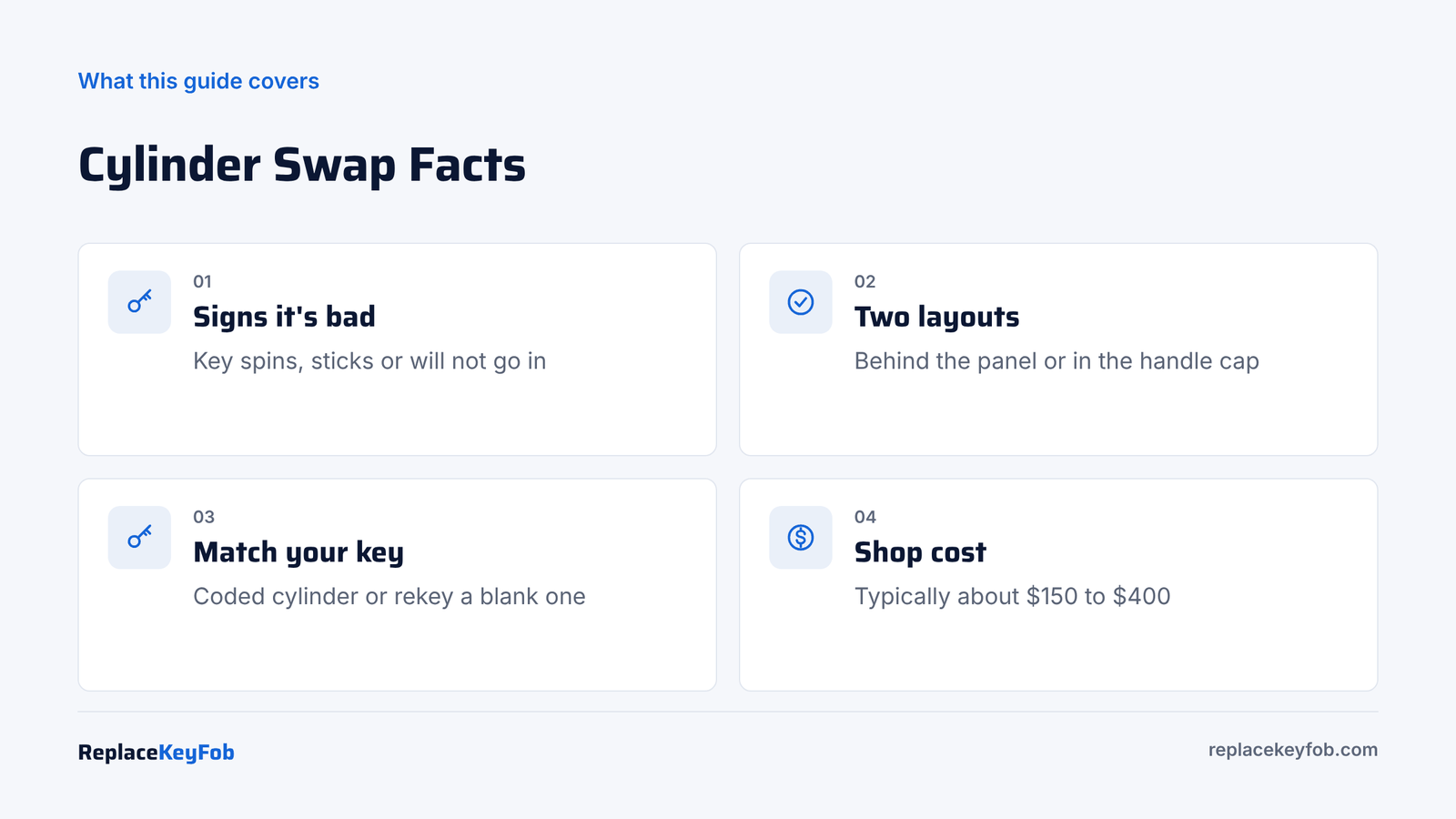
Signs Your Door Lock Cylinder Needs Replacing
| Symptom | Cylinder or something else? |
|---|---|
| Key turns freely and nothing locks | Broken cylinder tailpiece, or rod disconnected |
| Key will not go in, even after cleaning | Damaged wafers or bent shutter |
| Key goes in but will not turn, both keys | Worn or seized wafers |
| Cylinder spins in the handle with the key | Broken cylinder housing or retainer |
| Visible damage from a break-in attempt | Cylinder damaged |
| Sticky but works after lube | Cleaning, not replacement |
Before buying parts, try cleaning and lubricating the lock as shown in how to fix a sticky car door key lock. Many stiff cylinders only need that. If the key turns but the door does not lock, check the rod clip first; it is a cheaper fix.
Getting a Cylinder That Matches Your Key
| Option | How it works | Pros | Cons |
|---|---|---|---|
| Dealer cylinder coded by VIN | Dealer orders a cylinder set to your key code | Plug and play | Can take days, costs more |
| Uncoded cylinder plus wafer kit | You or a locksmith set the wafers | Cheaper, available fast | Needs rekeying work |
| Keyed-alike aftermarket cylinder | Comes with its own keys | Cheapest | Second key to carry unless rekeyed |
| Used cylinder from a salvage car | Rekey to your key | Low cost | Wear unknown |
| Locksmith supply and fit | Locksmith brings and codes the part | One visit | Higher labor cost |
If you buy an uncoded or keyed-alike cylinder, it can be set to your key. Our guide on how to rekey a car door lock explains the process.
Tools You Need
- Replacement cylinder (coded to your key or with a wafer kit)
- Plastic trim removal tools
- Screwdrivers and a socket set (7 mm, 8 mm and 10 mm are common)
- Torx bits (T20 to T30 common on handle cap screws)
- Needle-nose pliers and a small pick
- Flashlight and a magnetic pickup tool
- Dry graphite lock lubricant
- Butyl tape to reseal the moisture barrier
Door panel trim tool and clip set
A trim tool kit with spare door panel clips helps you remove the panel cleanly and replace any clips that break during the job.
As an Amazon Associate, ReplaceKeyFob earns from qualifying purchases.
Method A: Cylinder Held Behind the Door Panel
This layout is common on older cars and many trucks. The cylinder sits in the outside handle or the door skin and is held by a clip from inside.
- Lower the window so the glass is out of the way.
- Remove the door panel. Remove screws in the handle cup, armrest and panel edges, pop the clips with trim tools and unplug the switches.
- Peel back the moisture barrier near the rear upper corner of the door.
- Find the cylinder from behind the outside handle. A thin rod runs from its tailpiece down to the latch.
- Unclip the lock rod. Swing the plastic clip open and pull the rod out of the tailpiece. Take a photo first.
- Remove the retainer. Most use a U-shaped spring clip that slides off sideways, or a small bolt. Slide the clip off with a flat screwdriver or pliers.
- Pull the cylinder out from the outside of the door.
- Fit the new cylinder in the same orientation, slide the retainer on until it seats, and reconnect the rod.
Why orientation matters
The tailpiece lever must point the same direction as the old one, or the lock rod will not line up and the key will lock when it should unlock. Compare the old and new cylinders side by side before fitting.
Method B: Cylinder in the Outside Handle Cap
Many newer cars hide the cylinder in a small cap at the rear end of the outside door handle. The cap is held in place by a screw accessed from the door edge, so you may not need to remove the door panel at all.
- Open the door and find a rubber plug or small cover on the rear door edge, in line with the outside handle.
- Remove the plug to reveal a Torx screw.
- Loosen the screw a few turns. It usually does not come out completely; it releases a bracket inside the door.
- Pull the outside handle out and hold it, then pull the handle cap (with the cylinder) outward and off.
- Separate the cylinder from the cap by removing its retaining clip.
- Fit the new cylinder into the cap, refit the cap while holding the handle out, and tighten the edge screw.
- Refit the rubber plug.
This style is common on many Ford, Volkswagen, Hyundai and Kia models, among others. Do not overtighten the edge screw, because it can crack the handle bracket.
Test Before Closing the Door
- With the door open, push the latch claw closed with a screwdriver, as if the door were shut.
- Turn the key to lock. Pull the outside handle. The door should stay latched.
- Turn the key to unlock. Pull the handle. The latch should release.
- Lock and unlock with the fob to make sure the power lock still works.
- Lube the new cylinder with dry graphite.
Reseal the moisture barrier and refit the door panel only after everything works.
Vehicle Variations
- Driver door with cylinder switch: some cars have a small switch on the cylinder that disarms the alarm or controls one-touch windows when you turn the key. Transfer or reconnect it, or the alarm may go off when you unlock with the key.
- Passenger and rear doors: many newer cars have no cylinder there. Only the driver door has one.
- Smart key cars: the cylinder may be hidden under a cap. The emergency blade from the fob must match the new cylinder.
- Tailgates and trunks: cylinders are replaced the same way, from inside the tailgate or trunk lid trim.
- Older cars: may use a separate cylinder in the door skin, not the handle.
Troubleshooting After the Swap
| Problem | Cause | Fix |
|---|---|---|
| Key locks when it should unlock | Tailpiece reversed | Refit with correct orientation |
| Key turns, door does not lock | Rod not clipped in | Reconnect rod and close clip |
| Alarm sounds when unlocking with the key | Cylinder switch not connected | Reconnect switch |
| Handle cap loose | Edge screw not tight or bracket misaligned | Re-seat cap and tighten |
| Key stiff in new cylinder | Wafer slightly off or no lube | Lube; check wafer coding |
Mistakes to Avoid
- Buying a cylinder that does not match your key without planning to rekey it.
- Losing the retaining clip inside the door. Use a magnet and cover the drain holes with tape.
- Reversing the tailpiece.
- Closing the door before testing. You could lock it shut.
- Leaving the moisture barrier open.
Cost to Replace a Car Door Lock Cylinder
Typical 2026 US costs:
| Item | Typical cost |
|---|---|
| Aftermarket cylinder, keyed alike | About $20 to $60 |
| Uncoded cylinder with wafer kit | About $30 to $90 |
| Dealer cylinder coded to your key | About $60 to $200 |
| Shop or locksmith labor | About $80 to $200 |
| Total at a shop or locksmith | About $150 to $400 |
If your ignition cylinder is also worn and you want one key for both, see ignition lock cylinder replacement. For a new key cut to your code, see our locksmith guide.
Frequently Asked Questions
The key spins without locking, will not go in, will not turn with either key, or the cylinder spins in the handle. If cleaning and graphite do not help, replace it.
Yes, if you buy a cylinder coded to your key from the dealer or rekey an uncoded cylinder to match your existing key.
On older designs, yes. On many newer cars, the cylinder sits in a handle cap released by a screw on the door edge, so the panel can stay on.
Typically about $150 to $400 at a shop or locksmith in 2026, including a cylinder coded to your key. DIY parts start around $20.
No. They are separate parts, though both can be coded to the same key. The ignition cylinder is a different repair with its own cost.