
How to Fix a Trunk Latch That Won’t Close

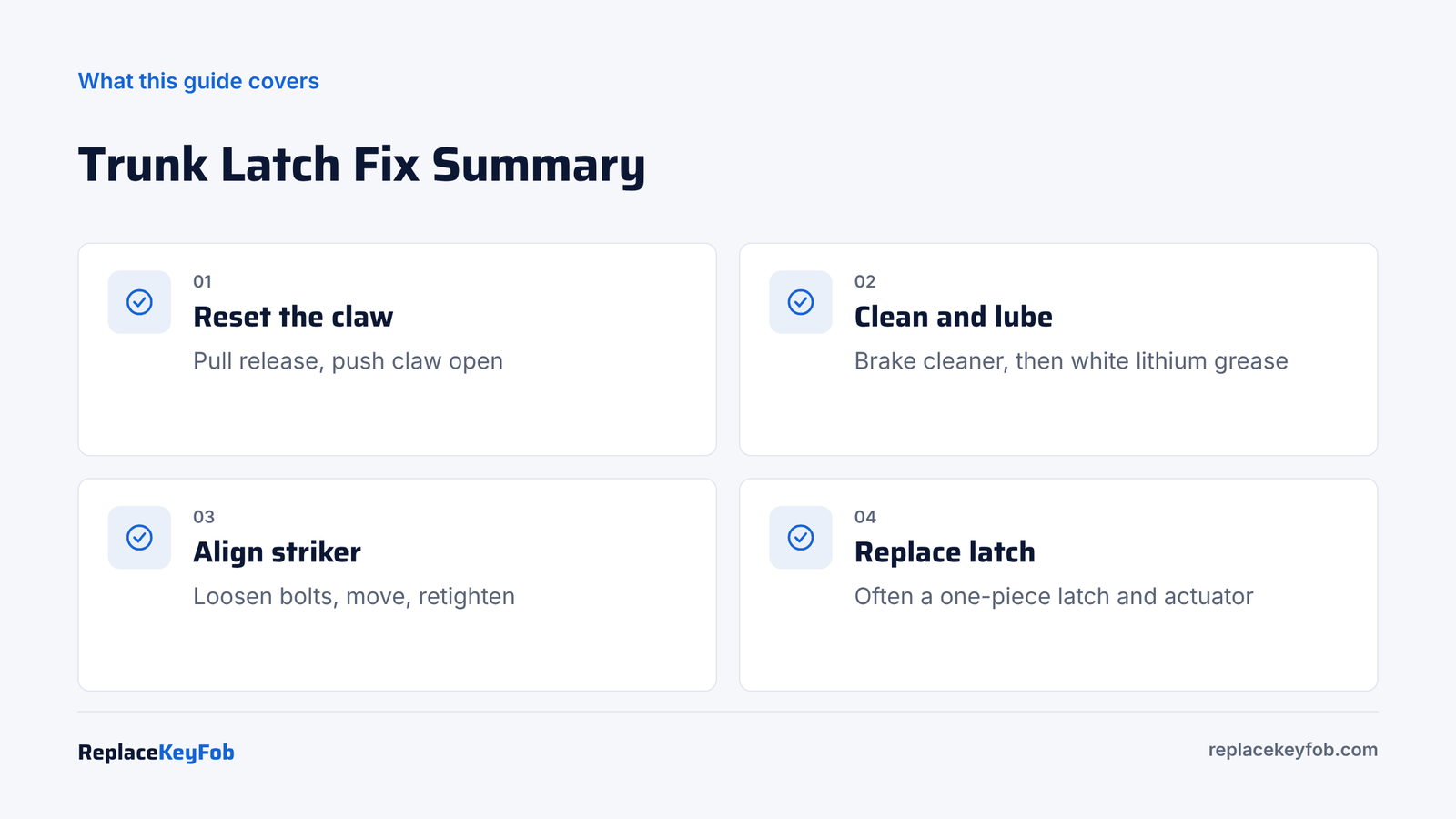
To fix a trunk latch that won’t close, first check that the latch claw is open: pull the trunk release and push the claw with a screwdriver until it clicks open. Then clean the latch, lube it with white lithium grease and check the striker alignment. If the claw is broken or the actuator is stuck, replace the latch.
A trunk lid that bounces back up is annoying, and it is a security and safety problem too. An open trunk lets exhaust into the cabin on some cars and leaves your cargo exposed. The good news is that most latch problems are mechanical and simple. The fix is often a five-minute reset or a careful clean.
The steps below apply to sedans and most hatchbacks. Truck tailgates and SUV liftgates use different hardware, which we cover in a separate tailgate guide. If the trunk will not open at all, see how to open a locked car trunk instead.
Why a Trunk Latch Won’t Close
The latch is a spring-loaded claw (the fork) that grabs a U-shaped metal loop on the body, called the striker. When you shut the lid, the striker pushes the claw closed and a small pawl locks it. If any part of that chain fails, the lid bounces.
| Symptom | Likely cause |
|---|---|
| Lid bounces up, latch looks closed | Claw is stuck in the closed position |
| Lid closes only when slammed | Dry or dirty latch, stiff spring |
| Lid closes but trunk ajar light stays on | Faulty latch switch or loose connector |
| Lid catches on one side, gaps uneven | Striker or lid out of alignment |
| Clicking from the latch, will not catch | Actuator stuck or broken latch spring |
| Latch freezes in winter only | Moisture in the latch |
Before you start, look for the obvious. Cargo straps, a bag handle or a loose trunk liner can stop the lid from going down far enough. Clear the opening and try once more.
Tools You Need
- Flat screwdriver or a thin pick tool
- 10 mm socket or wrench (many striker and latch bolts use this size; check yours)
- Brake cleaner or a degreaser spray
- White lithium grease spray
- Masking tape and a marker
- Flashlight and a rag
White Lithium Grease Spray
Spray grease sticks to latch parts and does not wash out like thin oil. Choose one with a straw nozzle so you can reach inside the latch without overspray.
As an Amazon Associate, ReplaceKeyFob earns from qualifying purchases.
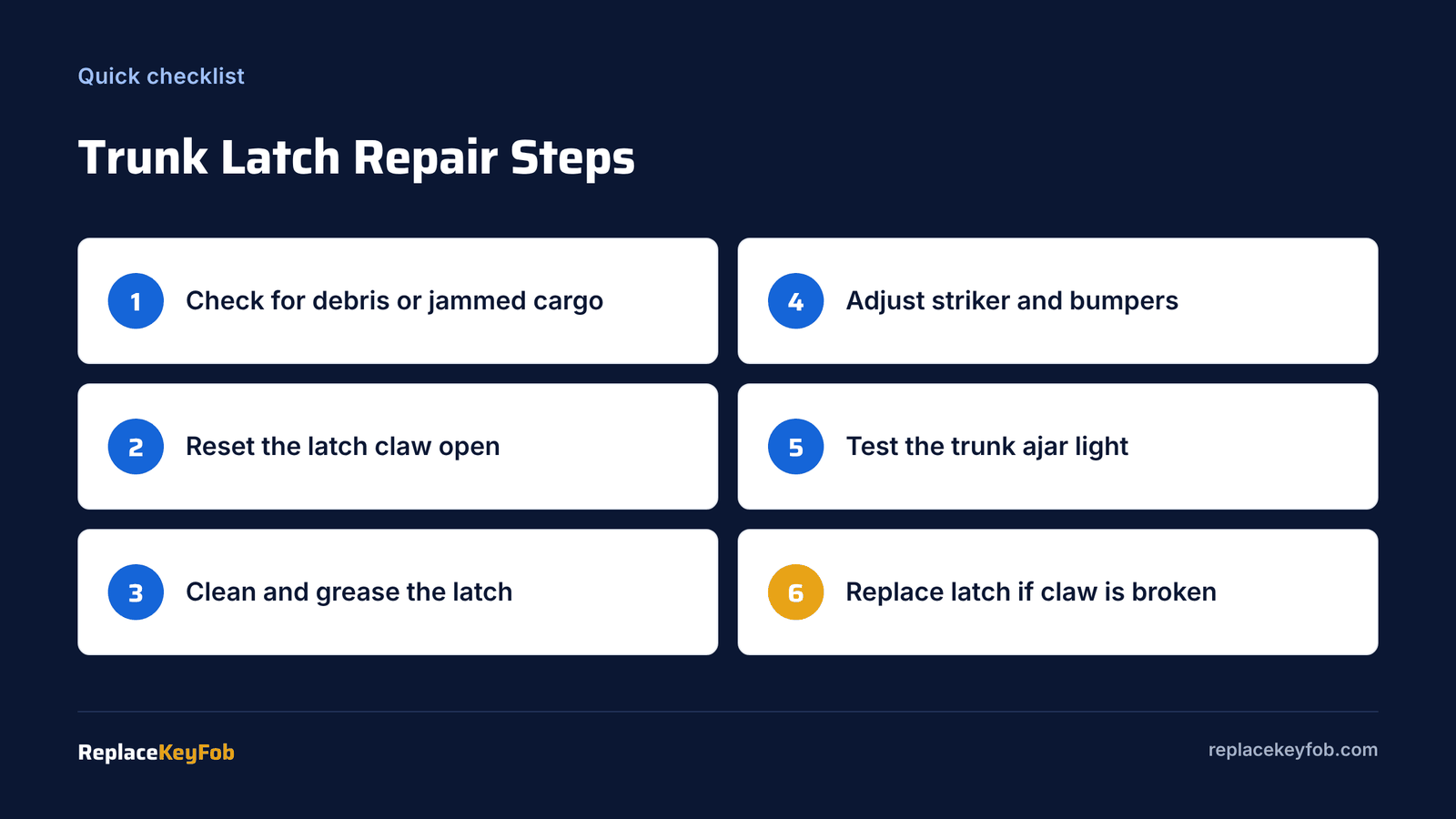
Step 1: Reset a Latch Stuck in the Closed Position
This is the most common cause, and it often happens when someone pushes the claw closed by hand or when the lid closes on an object.
- Open the trunk and look at the latch on the lid edge. If the claw is closed (it looks like a hook pointing down and around), the striker cannot enter.
- Have a helper hold the cabin trunk release or the fob trunk button. If you are alone, pull the interior emergency release handle, which works the latch mechanically.
- While the release is held, push the claw with a flat screwdriver until it swings open and clicks.
- Close the lid gently from about a foot above the latch. It should catch.
The release pulls the pawl away, so the claw is free to move. Forcing the claw without the release can bend it.
Step 2: Clean and Lubricate the Latch
Road dirt and old grease turn into a paste that slows the claw. A slow claw does not snap shut in time.
- Spray brake cleaner into the latch while working the claw open and closed with the screwdriver. Keep the spray off paint and plastic trim where you can, and wipe overspray at once.
- Let it dry for a few minutes.
- Spray white lithium grease into the pivot points and the claw. Work it several times.
- Wipe off excess grease so it does not collect grit.
Avoid thin penetrating oil as the final lube. It dissolves grease and attracts dust. In cold climates, a latch that was cleaned and greased is also less likely to freeze.
Step 3: Adjust the Striker and Lid Bumpers
If the lid hits the striker off center, the claw cannot grab it cleanly. Look for shiny wear marks on one side of the striker loop.
- Trace around the striker base with masking tape and a marker so you can return it to the original spot.
- Loosen the striker bolts just enough that the striker can move with a tap.
- Move it slightly toward the wear mark side, or up or down if the lid sits too high or too low. Small moves of 1 to 2 mm make a difference.
- Snug the bolts, close the lid gently and check the gaps. Repeat until the lid catches with a light push and sits flush with the fenders.
Many trunks also have rubber bumpers (stops) at the corners. If they are screwed out too far, the lid springs back before the latch catches. Turn them in a half turn at a time.
Check the trunk seal
A swollen or bunched weatherstrip pushes back against the lid. Run your hand around the seal and press it fully onto the flange. A torn seal also lets water into the latch, which leads to rust.
Step 4: Test the Trunk Ajar Switch
On most modern cars the latch has a built-in switch that tells the body computer the trunk is shut. If the lid latches but the dash still says trunk open, the trunk light stays on, or the alarm will not arm, suspect the switch.
- Unplug the latch connector, inspect it for green corrosion, clean it with electrical contact cleaner, and plug it back in firmly.
- Check the wiring where it passes through the rubber boot between the body and the lid. Wires there break from years of opening and closing.
- If the switch is built into the latch, the latch is replaced as one part.
A trunk ajar signal can also drain the battery overnight because the trunk light and modules stay awake.
Step 5: Replace the Latch or Actuator
Replace the latch if the claw is cracked, the spring is broken, or the latch clicks but will not hold. On many cars the latch and actuator are one assembly.
- Disconnect the negative battery cable if your manual recommends it.
- Remove the plastic trim panel on the inside of the lid. Most use push clips and one or two screws.
- Mark the latch position with tape, unplug the connector and unhook the release cable or rod.
- Remove the bolts (often two or three) and swap in the new latch.
- Reconnect everything, test with the lid open by pushing the claw closed with a screwdriver and pressing release, then refit the trim.
Always test with the lid open first. If the new latch is faulty, you will not lock it shut with the release cable still loose.
Variations by Vehicle Type
- Soft-close trunks: some Audi, BMW, Mercedes and other luxury models pull the lid closed with a motor. If yours does not finish closing, do not slam it. Check the soft-close motor fuse and have the system scanned.
- Power trunks: some cars stop and reverse if they sense resistance. Clean the pinch sensors and reset the system by opening and closing fully with the button.
- Older cars with lock cylinders: a lock rod that has slipped out of its clip can hold the pawl open. Look behind the trim panel for a loose rod.
Troubleshooting Table
| What you see | Try this |
|---|---|
| Claw closed with lid open | Hold release, push claw open |
| Lid catches only when slammed | Clean and grease, check bumpers |
| Latch catches, lid rattles | Move striker down slightly |
| Works warm, fails cold | Dry out latch, grease, add a de-icer |
| Clicking but no catch | Replace latch or actuator |
| Dash shows trunk open | Clean connector, check wiring boot |
Mistakes to Avoid
- Slamming harder. Repeated slams bend the striker and crack the latch.
- Moving the striker without marking it. You can lose the factory fit in minutes.
- Overtightening tiny bolts. Strip a latch bolt thread and you need a new nut plate.
- Driving with the trunk tied down by rope. Exhaust can enter the cabin through an open trunk. Fix it before a long drive.
When to Call a Pro and What It Costs
If the lid is bent after a collision, or the wiring through the hinge is broken, a body shop or mechanic is the better choice. Typical 2026 US costs are about:
- Latch or latch actuator part: about $30 to $150
- Shop replacement: about $150 to $350 total
- Striker adjustment only: often $50 to $100
- Soft-close motor repair: about $300 to $800 on luxury cars
If your trunk also has fob or lock problems, our guide on key fob trunk button not working helps you separate remote faults from latch faults. Electrical problems after battery work may relate to disconnecting the car battery.
Frequently Asked Questions
The latch claw is often already closed, so the striker cannot enter. Hold the release and push the claw open with a screwdriver, then close the lid gently.
Spray brake cleaner into the latch while working it, let it dry, then lube with white lithium grease. If it still sticks, the latch or actuator likely needs replacement.
Only a short distance, slowly, with the lid secured. An open trunk can let exhaust into the cabin and hide your brake lights on some cars.
A latch part typically costs about $30 to $150, and a shop replacement about $150 to $350 total in 2026.
The latch switch or its wiring is faulty. Clean the connector, check the wires where they enter the lid, and replace the latch if the switch is built in.