
How to Fix a Hood Latch That Won’t Close

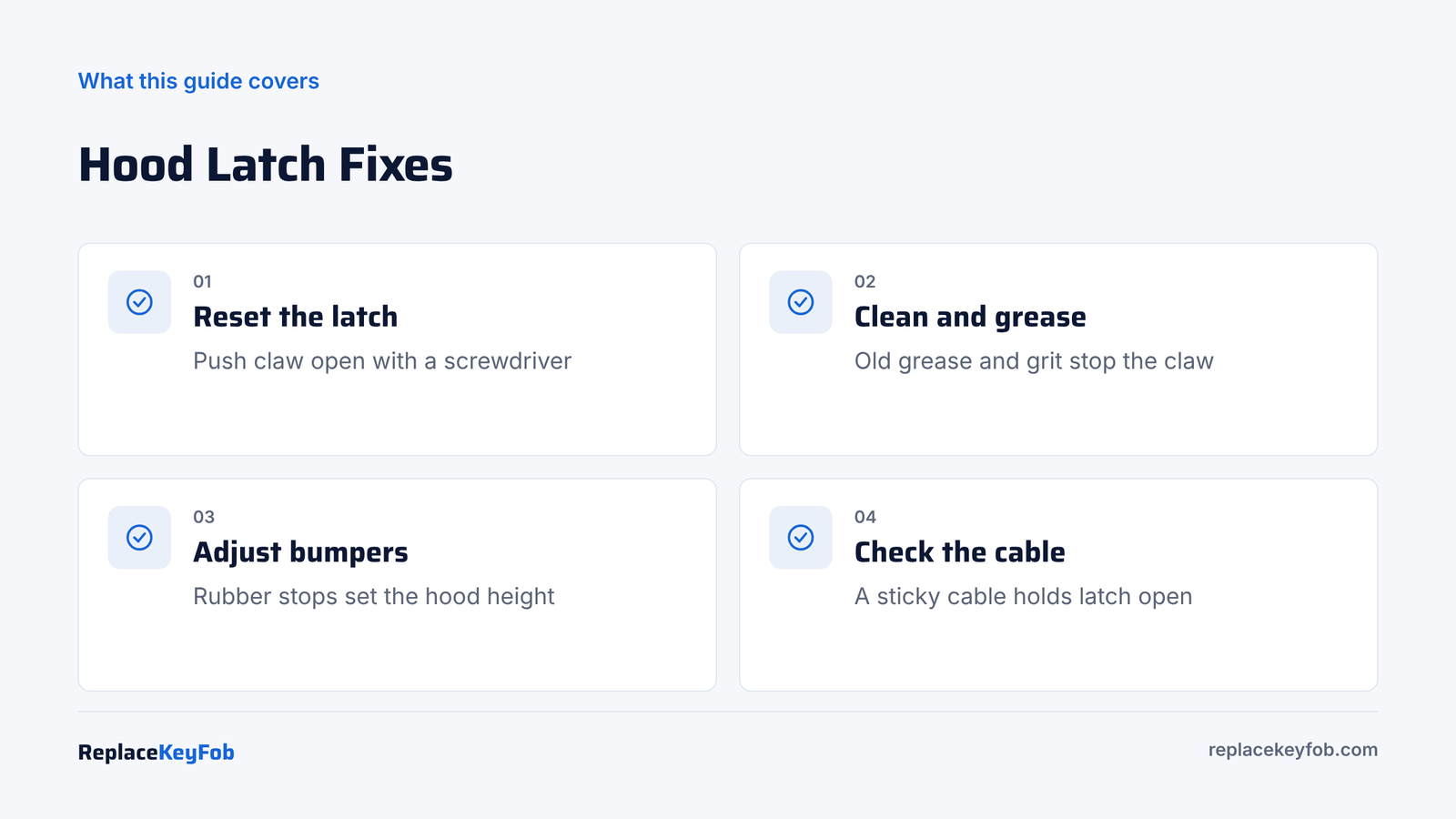
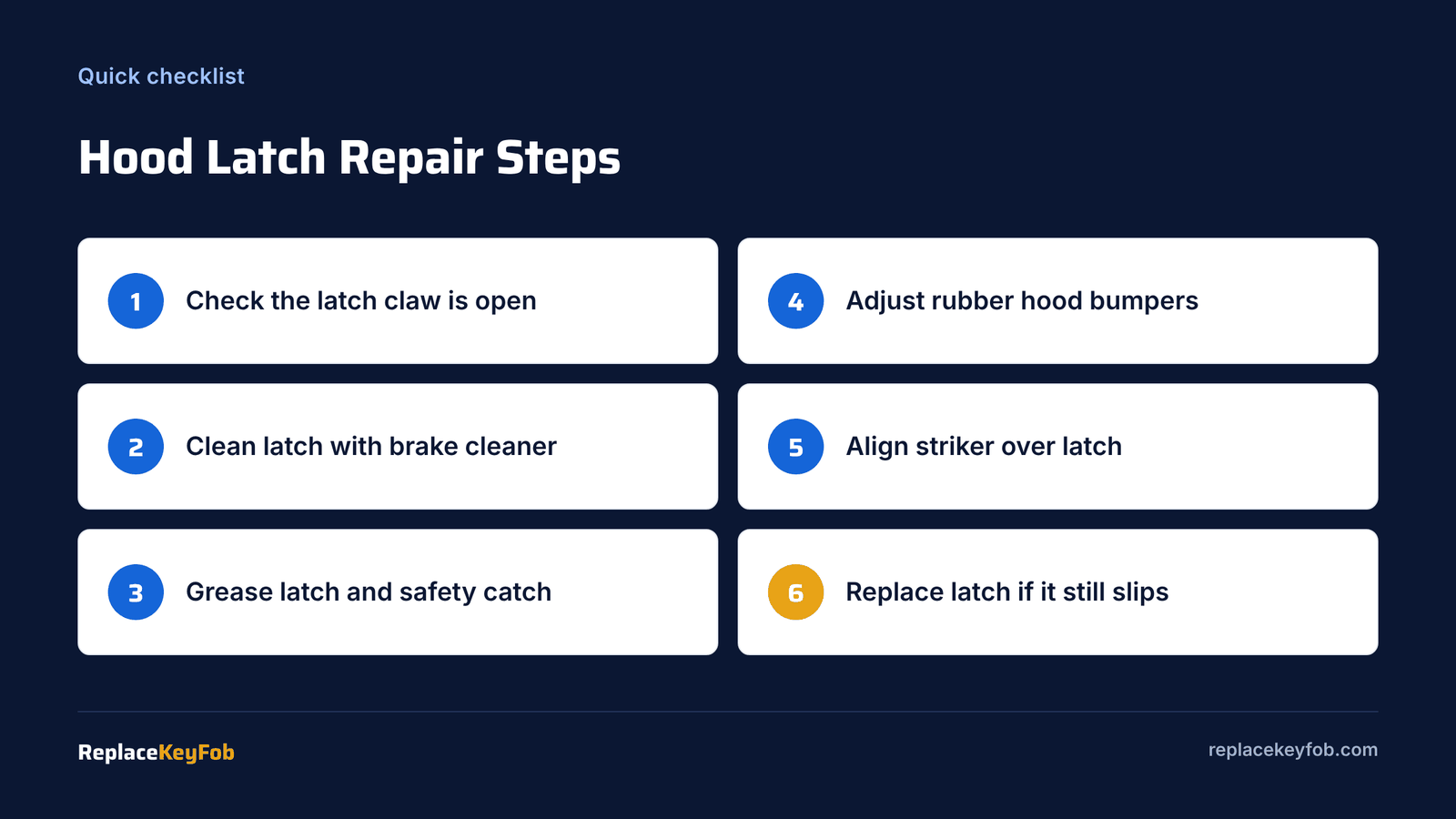
To fix a hood latch that won’t close, open the hood and check the latch claw. If it is already closed, pull the release lever and push the claw open with a screwdriver. Clean and grease the latch, check that the release cable snaps back, then adjust the rubber bumpers and striker so the hood lines up. Replace the latch if it still slips.
A hood that will not stay closed is not just an annoyance. If the main latch is not holding, only the secondary safety catch keeps the hood down, and at highway speed wind under the hood edge can rip it free and slam it into the windshield. Fix it before you drive any distance.
Most of the time the fault is simple. The latch is closed when it should be open, it is gummed up, or the hood is sitting at the wrong height. All three are DIY jobs with basic tools.
How a Hood Latch Works
The latch bolts to the radiator support in front of the engine. On the hood is a U-shaped striker. When the hood drops, the striker pushes into the latch, rotates a spring-loaded claw and locks it with a pawl. The release cable pulls the pawl to let go. A separate safety catch on the hood hooks onto the body until you release it by hand.
Things that stop the latch from closing:
| Symptom | Likely cause |
|---|---|
| Hood bounces straight back up | Latch claw already in closed position |
| Latches only when slammed hard | Dry, dirty or rusted latch |
| Hood closes but pops up after a short drive | Cable not returning, latch half engaged |
| Hood sits high on one side | Rubber bumper screwed out too far |
| Striker hits the latch off center | Hood or latch misaligned |
| Alarm or hood ajar warning on | Hood switch stuck or misaligned |
Tools You Need
- Flat screwdriver
- Socket set (latch and striker bolts are often 10 mm or 12 mm)
- Brake cleaner or degreaser
- White lithium grease
- Masking tape and a marker
- A helper is useful for alignment checks
Spray Lithium Grease With Straw
The single most useful product for a sticky hood latch. Choose a spray grease with a straw so you can reach the pivots, and avoid thin oils that wash out.
As an Amazon Associate, ReplaceKeyFob earns from qualifying purchases.
Step 1: Reset a Closed Latch
If the claw is closed while the hood is open, the striker cannot enter, and the hood bounces up every time.
- Look down at the latch. A closed claw looks like a hook wrapped around an empty space.
- Have someone pull and hold the interior hood release, or pull the cable at the latch.
- Push the claw open with a flat screwdriver until it clicks into the open position.
- Lower the hood to about 12 inches and let it drop.
This often happens after someone tests the latch by pushing it with a finger or tool.
Step 2: Clean and Grease the Latch
The hood latch sits right behind the grille, so it collects road spray, salt and dirt. Old grease turns into a sticky paste.
- Spray brake cleaner into the latch while working the claw open and closed with a screwdriver.
- Wipe out the black residue with a rag. Repeat until the cleaner runs clear.
- Let it dry, then spray white lithium grease into the claw pivot and the pawl.
- Grease the safety catch on the hood too, and work it several times.
Do this once a year, before winter, and the latch rarely gives trouble. It also helps a latch that freezes in cold weather.
Step 3: Check the Release Cable
A cable that sticks in its sheath can hold the pawl partly open, so the latch only half grabs. The hood may seem closed, then pop up onto the safety catch after a few bumps.
- Pull the interior lever and let go. It should snap back fully.
- At the latch, watch the release arm while a helper pulls and releases the lever. It should spring back to rest.
- If it is slow, spray penetrating oil into the end of the cable sheath, then work the lever several times.
- If the cable is kinked or frayed, replace it. A stretched or damaged cable can also be the reason the hood is hard to open; see how to open a car hood with a broken latch.
Step 4: Adjust the Hood Bumpers
Most hoods rest on two or more rubber bumpers near the front corners. They thread in and out to set the hood height.
- Close the hood and look along the gap with the fenders. If the front edge sits higher than the fenders, the bumpers are too high, and the latch cannot pull the hood down far enough.
- Open the hood and turn each bumper in (clockwise on most) a half turn.
- Close and check. Repeat until the hood sits flush and latches with a gentle drop.
The bumpers also keep the hood from rattling, so do not lower them so far that the hood flops on the latch.
Step 5: Align the Latch and Striker
If the striker hits the latch off center, look for shiny scrape marks on one side.
- Mark around the latch with tape and a marker so you can return it to the start point.
- Loosen the latch bolts just enough to move it.
- Slide the latch a few millimeters toward the striker’s scrape side.
- Snug the bolts, close gently and check. Make small changes only.
Some cars also allow the striker on the hood to move. Adjust one part at a time so you do not lose track.
Step 6: Replace the Latch
Replace the latch if the claw is cracked, the spring is weak, or it still will not hold after cleaning. Many replacement latches include the hood ajar switch.
- Mark the latch position with tape.
- Disconnect the release cable from the latch arm, and unplug the hood switch if fitted.
- Remove the bolts and fit the new latch in the marked spot.
- Reconnect the cable and switch, then test the latch with the hood open by pushing the claw closed with a screwdriver and pulling the release. Only then close the hood.
Hood Ajar Switch Problems
If the hood latches fine but the dash says hood open, the alarm goes off, or remote start will not run, the hood switch is the suspect. It can be part of the latch or a separate plunger switch. Clean the connector and check that the plunger is pressed when the hood is closed. Honda owners see this often; our guide on Honda Pilot alarm keeps going off covers the hood sensor. Remote start owners may also find their system blocked by it; see why remote start won’t work on the Honda Pilot.
Seasonal and Climate Notes
- Salt-belt states: road salt speeds up latch corrosion. Clean and grease the latch every fall, and check the safety catch spring for rust.
- Freezing rain: water in the latch can freeze the claw open or shut. A latch greased before winter sheds water and rarely freezes.
- Hot, dusty climates: dust mixes with grease into a paste. Clean more often and use a light coat of grease, not a heavy one.
- After a front-end repair: if the bumper, grille or radiator support was replaced, the latch may have been reinstalled slightly out of place. Check alignment marks and gaps first.
Mistakes to Avoid
- Slamming with your palms on the middle of the hood. It dents the panel. Drop from a foot instead.
- Driving on the safety catch only. It is a backup, not a lock.
- Big adjustments. Move parts a few millimeters at a time and mark where they started.
- Using thin oil as lube. It attracts grit and washes off. Use spray grease.
When to Call a Mechanic and What It Costs
If the hood was bent in a collision or the radiator support is damaged, alignment needs a body shop. Typical 2026 US costs are about:
- Latch clean and adjust: about $50 to $120
- Hood latch replacement: about $150 to $400 installed
- Release cable replacement: about $100 to $300 installed
- Hood alignment at a body shop: about $100 to $250
A hood that will not close can also make your battery checks harder in winter. Keep it fixed, and if you need to work on the battery, see battery terminal corrosion.
Related guides: How to Open a Car Hood (Release Lever and Safety Catch); How to Open a Car Hood With a Broken Latch or Cable.
Frequently Asked Questions
The most common causes are a latch claw already in the closed position, a dirty or dry latch, a sticking release cable or hood bumpers set too high.
Push the claw open with a screwdriver while holding the release, clean and grease the latch, then adjust the rubber bumpers so the hood sits flush.
Not safely. With only the safety catch holding, the hood can fly up at speed and block your view. Fix it or tie it down securely for a short slow drive to a shop.
A clean and adjustment is typically about $50 to $120, and a latch replacement about $150 to $400 installed in 2026.
White lithium grease in a spray can with a straw. It sticks to the parts and resists water better than thin oil.