
How to Open a Car Hood With a Broken Latch or Cable

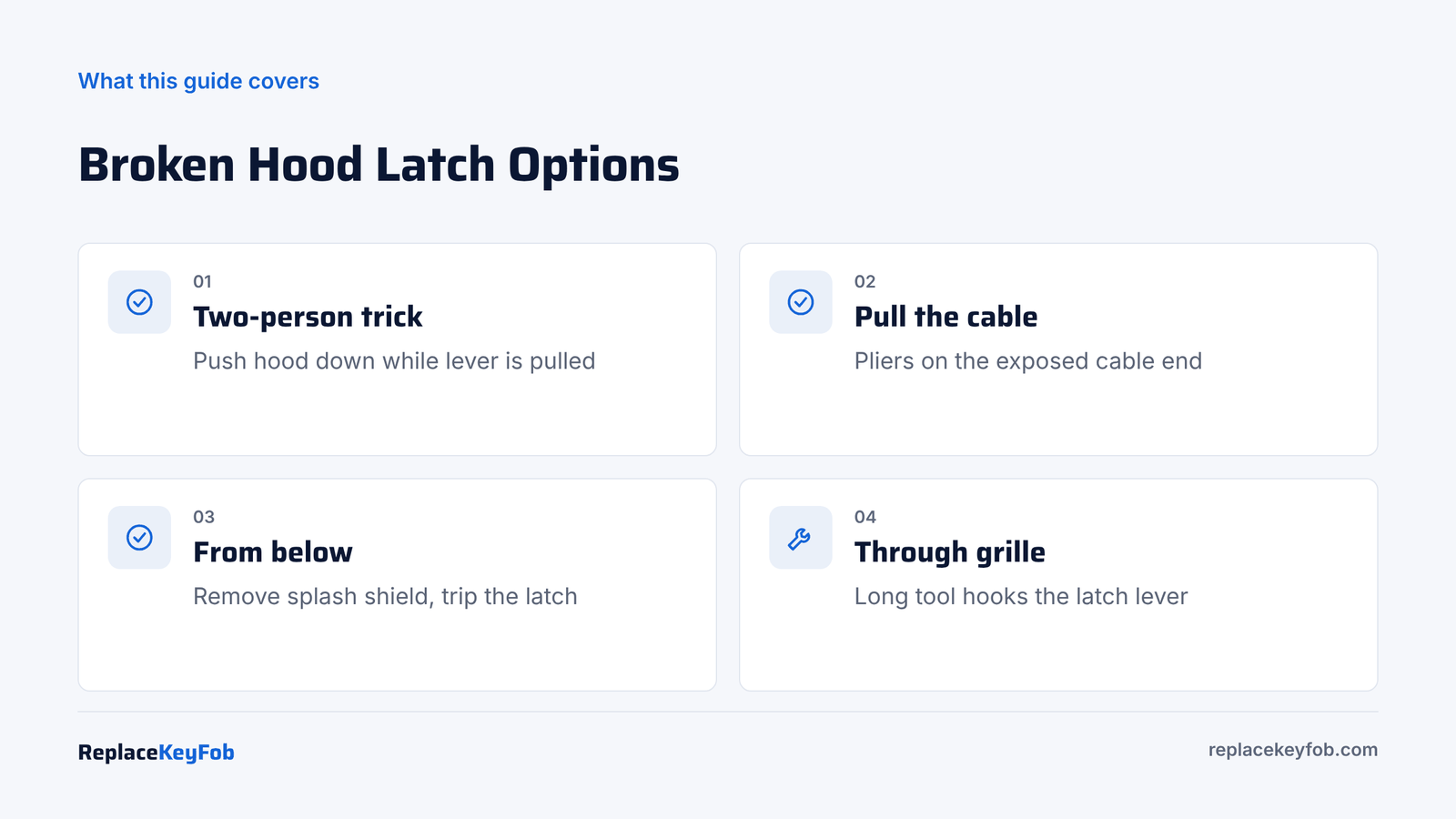
To open a car hood with a broken latch or cable, first try pulling the release while a helper presses down on the hood. If the lever feels loose, pull the cable itself with pliers at the lever or near the latch. Otherwise, reach the latch from under the car or through the grille and push its release arm with a long screwdriver.
A hood that will not open is a real problem because the battery, oil and coolant all live under it. The fix depends on what failed. A cable can snap, slip off the lever, or stretch so far that it no longer pulls the latch. The latch itself can seize with rust and grime. Each one leaves a different clue at the release lever.
If your hood opens normally and you just want to know where the lever and safety catch are, read how to open a car hood first. This guide is for when the normal way does not work.
Diagnose It by Feel
Pull the interior release lever and notice how it feels. That tells you where to work.
| Lever feel | What failed | Where to work |
|---|---|---|
| Floppy, no resistance | Cable snapped or came off the lever | At the lever first, then the latch |
| Normal tension, hood stays down | Latch seized or cable stretched | At the latch, from below or grille |
| Very stiff, will not pull | Cable rusted inside its sheath | Lube cable, then pull at the latch |
| Hood pops, safety catch will not move | Rusted secondary catch | Grease and work the catch |
| Lever broken off, cable intact | Plastic handle failed | Pull cable with pliers |
What You Need
- Needle-nose pliers and locking pliers
- Long flat screwdriver or a metal rod about 18 to 24 inches long
- Flashlight or headlamp
- Trim clip tool and a socket set for splash shields
- White lithium grease or penetrating spray
- A helper for the push-down trick
- Jack stands or ramps if you need to work underneath
Long Reach Pliers or Hook Tool Set
A set of long reach pliers or pick hooks lets you grab a cable or trip a latch through grille gaps. Check the reach length and that the jaws are thin enough to fit between grille slats.
As an Amazon Associate, ReplaceKeyFob earns from qualifying purchases.
Method 1: The Push-Down Trick
Try this before anything else, because it frees many stuck latches.
- Have a helper sit in the driver seat and hold the release lever pulled all the way.
- At the front, press down firmly on the hood right above the latch, then let go quickly. Repeat a few times.
- If the hood rises, use the safety catch as normal.
The latch claw is under tension from the hood’s weight and the seal. Pressing down unloads it, so a weak or stretched cable can finally move the latch.
Method 2: Pull the Cable at the Lever
If the lever feels floppy, the cable may have popped off the lever or the plastic handle may have broken.
- Remove the kick panel or lower dash cover around the lever. Most use one or two clips or screws.
- Look for the cable end. It is a steel wire with a small barrel or ball at the end that seats in the lever.
- If the cable is intact, grab it with pliers and pull firmly toward the rear of the car. The hood should pop.
- If the cable is snapped here, you will see a frayed wire. Move to the latch end.
If pulling with pliers works, you can often reattach the cable to the lever or replace just the lever.
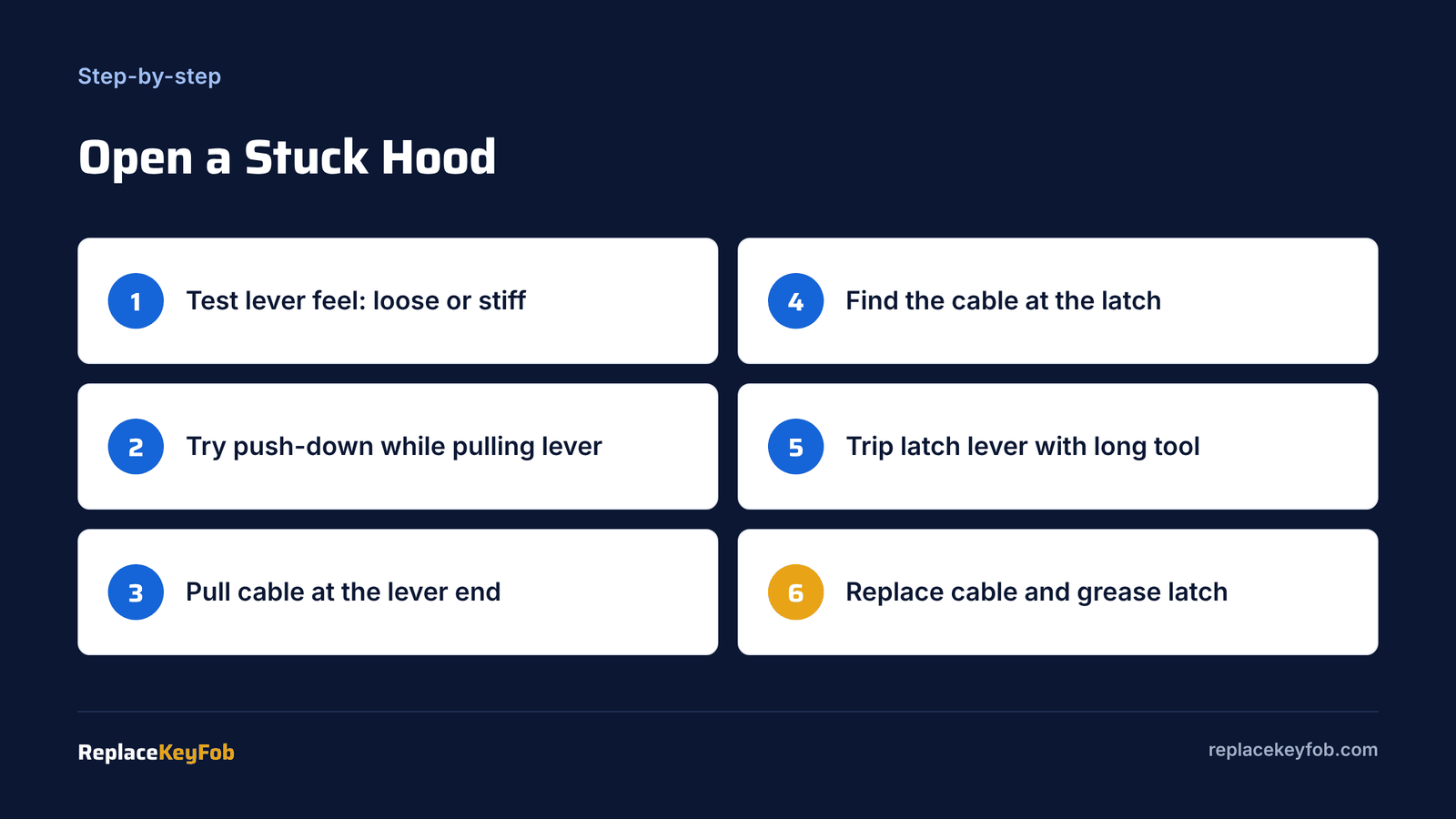
Method 3: Reach the Latch From Below
When the cable is broken near the front or the latch is seized, go to the latch itself.
- Raise the front of the car safely on ramps or jack stands. Never rely on a jack alone.
- Remove the lower splash shield or engine undertray. It is usually held by plastic push clips and a few 10 mm bolts.
- Shine a light up behind the radiator support toward the center of the hood. The latch sits on the top of the radiator support.
- Find the release arm on the latch, the part the cable connects to. Follow the cable to it.
- Push or pull the arm in the direction the cable pulls (usually toward the driver side) with a long screwdriver or rod.
- Once the hood pops, release the safety catch from the front.
On many cars you can also grab the cable near the latch with locking pliers and pull it, which works the latch just like the lever would.
Method 4: Go Through the Grille
On cars with open grille slats, you may reach the latch from the front without lifting the car.
- Look through the grille with a flashlight to find the latch and its release arm.
- Feed a long screwdriver, a stiff wire hook or long pliers through the closest gap.
- Push the release arm toward the cable side, or hook and pull the cable.
Take care not to scratch the radiator or the AC condenser just behind the grille. A pierced condenser leaks refrigerant and costs several hundred dollars to replace.
Through the wheel well
On some cars the cable runs along the inner fender. Removing a few clips from the front wheel-well liner lets you reach the cable and pull it. This works when the cable has broken near the lever but is still connected to the latch.
Method 5: A Rusted or Seized Latch
A latch that has not been greased in years can rust solid. Spray penetrating oil onto the latch from below or through the grille, wait 15 minutes, then repeat the push-down trick. Once the hood is open, clean the latch with brake cleaner and grease it with white lithium grease. If the latch still binds, replace it.
Fixing It After the Hood Is Open
- Replace the cable: most hood release cables cost about $15 to $60 and route from the lever through the firewall to the latch. Tie the new cable to the old one before pulling the old one out, so it follows the same path.
- Adjust cable slack: some latches have an adjuster where the cable sheath clips to the latch. Remove slack so a short pull opens the latch.
- Replace the latch: mark its position with tape before removing the bolts, so the hood still lines up.
- Grease everything: latch, safety catch and cable end.
If the hood now will not close or latches poorly, reset the claw to the open position with a screwdriver while the release is held, then drop the hood from about a foot.
Hood Latch Sensors and Alarms
Many cars have a hood ajar switch on the latch for the alarm and remote start. After latch work, if the alarm sounds at random or remote start refuses to run, the hood switch may be unplugged or misaligned. Owners of some Honda models see this often; our guide on Honda Pilot alarm keeps going off explains the hood sensor link.
Mistakes to Avoid
- Prying the hood edge with a bar. It bends the hood and the fender edges. The repair costs far more than a cable.
- Cutting or drilling the hood. Rarely necessary; a mechanic can almost always open it from underneath.
- Working under a car on a jack alone. Use stands or ramps.
- Damaging the condenser. Go slowly with tools behind the grille.
- Driving with the safety catch only. If the main latch is not engaged after repair, the hood can fly up at speed.
When to Call a Mechanic and What It Costs
If none of the methods work, a shop can open the hood from underneath, usually in under an hour. Typical 2026 US costs are about:
- Opening a stuck hood: about $50 to $150
- Hood release cable replacement: about $100 to $300 installed
- Hood latch replacement: about $150 to $400 installed
- Safety catch repair: about $75 to $200
If your car will not start and the hood is stuck, a mobile mechanic can open the hood and then jump the battery. Read how to jump start a car for the safe connection order, and check battery terminal corrosion once you are in.
Frequently Asked Questions
Pull the cable at the lever with pliers if it broke there. If it broke near the front, reach the latch from under the car or through the grille and push its release arm.
Have a helper hold the release lever while you press down hard on the hood above the latch and let go. Spray penetrating oil on a rusted latch first.
Yes. Most shops reach the latch from below after removing the splash shield, typically for about $50 to $150 in 2026.
The cable usually costs about $15 to $60, and a shop replacement is typically about $100 to $300 total.
The cable has snapped, slipped off the lever, or the plastic lever has broken. Remove the trim around the lever to check.
No. If the main latch is not holding, only the safety catch keeps the hood down, and it can fail at highway speed.