
How Long to Drive a Car to Charge the Battery

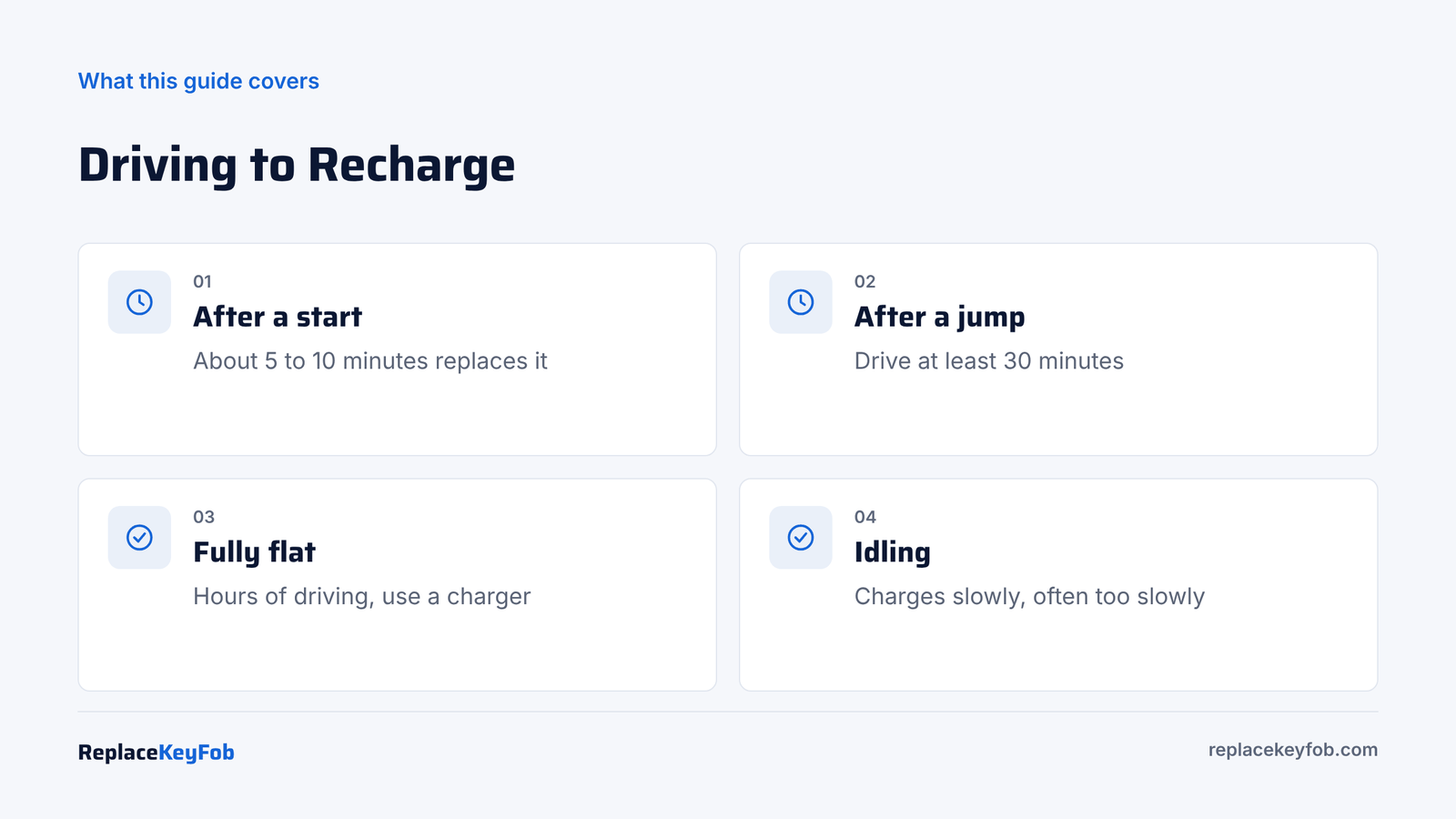
After a jump start, drive at least 30 minutes at steady speeds to put meaningful charge back into the battery. That is enough for a healthy battery that was only slightly drained. A fully flat battery needs several hours of driving to refill, and many cars never fully charge it that way. For a deeply discharged battery, an overnight charge with a smart charger is better.
The idea that a quick drive “charges the battery” is half true. The alternator does charge the battery, but it is designed to keep a healthy battery topped up, not to refill an empty one. How long you need to drive depends on how flat the battery is, how fast the battery can accept charge, and how much power the car itself uses while you drive.
This guide gives realistic times, explains why idling is a poor substitute, and shows how to tell whether the drive worked. If the car will not start at all right now, see how to jump start a car first.
Quick Answer by Situation
| Situation | Suggested drive | What to expect |
|---|---|---|
| Normal start, healthy battery | 5 to 10 minutes | Replaces starting energy |
| Lights left on, car still started | 30 to 60 minutes | Partial recharge; check next morning |
| After a jump from a flat battery | 30 minutes minimum, 1 hour better | Enough to restart, not a full charge |
| Battery deeply discharged (under 12.0 V) | Several hours of driving | Charger strongly recommended |
| Old or failing battery | Driving will not fix it | Test and likely replace |
The Math Behind the Times
A typical car battery stores about 50 to 70 amp-hours (Ah). Starting the engine uses very little of that, often well under 1 Ah, because the starter runs for only a second or two. That is why a few minutes of driving replaces it.
A battery that is half flat is missing about 25 to 35 Ah. While driving, the alternator might send about 10 to 30 amps into a low battery at first, but the battery accepts less and less as it fills. Charging also slows near full because lead-acid batteries need time in the final stage. So putting 25 Ah back can take an hour or more of driving, and the last 10 to 20 percent can take several more hours.
A fully flat battery, missing 50 Ah or more, may need 4 to 8 hours of driving to come close to full, and some cars never get there.
Why the Alternator Does Not Fully Recharge Flat Batteries
- The car uses power while driving. Headlights, fans, heated seats, the blower motor and engine electronics all draw current. In winter with everything on, there may be little spare current for the battery.
- Charge acceptance falls as the battery fills. The alternator holds a set voltage, and the battery takes less current as it charges.
- Smart charging systems. Many newer cars, especially with start-stop, deliberately keep the battery around 75 to 85 percent to save fuel and leave room to recover braking energy. They do not aim for 100 percent on every drive.
- Deep discharge damages batteries. A battery that sat flat for days may have sulfated plates that accept charge slowly or not at all.
Smart Battery Charger
A smart charger fully recharges a flat battery overnight and switches to maintenance when done, which is faster and gentler than hours of driving. Check that it has a mode for your battery type and at least 4 to 10 amps of charge.
As an Amazon Associate, ReplaceKeyFob earns from qualifying purchases.
Is Idling Good Enough?
Idling charges the battery, but slowly. At idle, many alternators produce only a fraction of their rated output, and the car’s own electrical load takes much of that. Idling for 30 minutes after a jump may leave you barely better off than when you started. If you must idle, turn off everything you can: blower, lights where legal and safe, seat heaters and rear defrost.
A drive at steady speeds keeps the alternator in its efficient range. Highway driving is better than stop-and-go city traffic.
How to Recharge by Driving: Step by Step
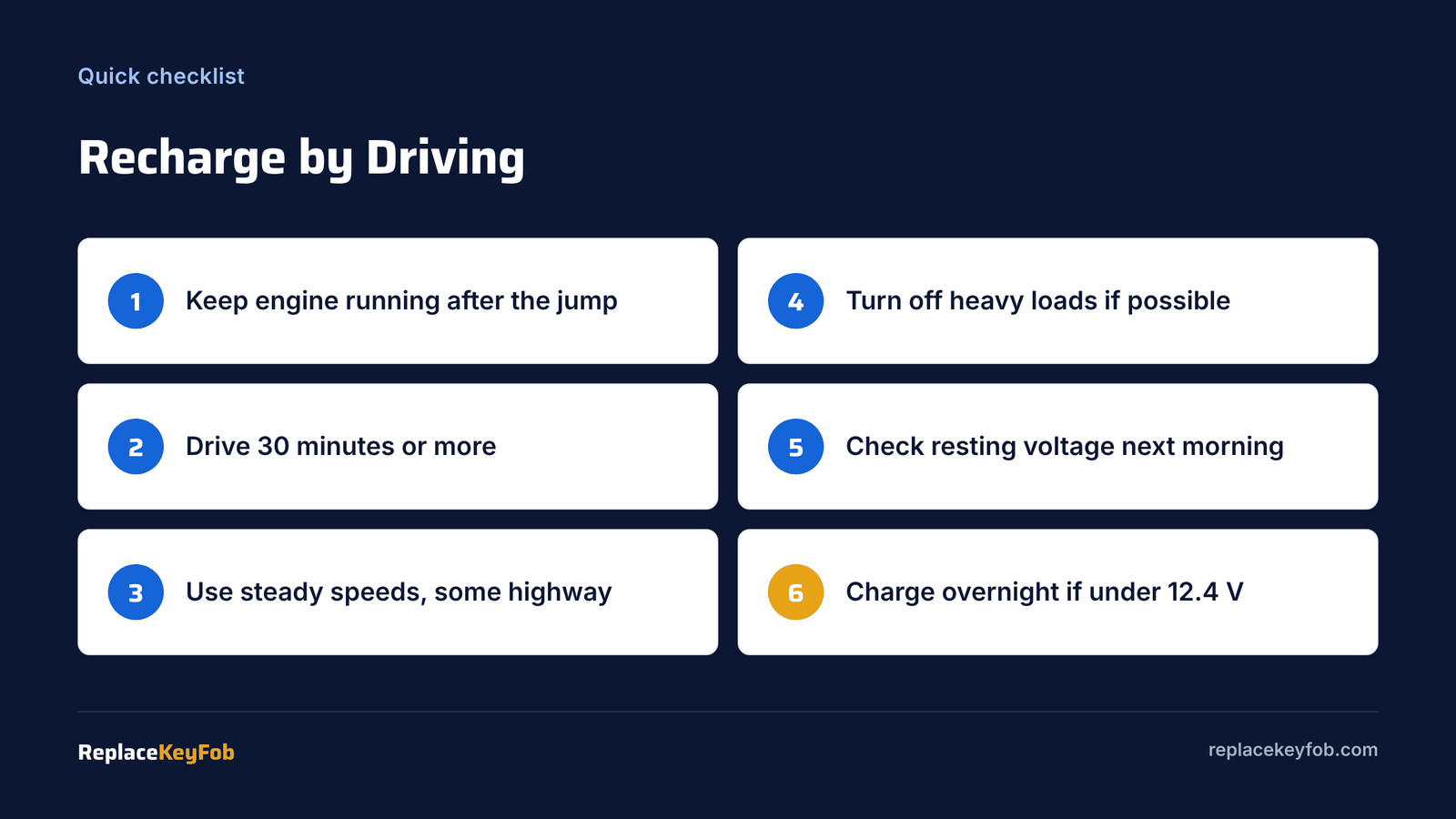
- After the jump, leave the engine running. Do not shut it off at the next stop if you can avoid it.
- Drive at least 30 minutes, ideally 60. Include steady speeds, such as a highway stretch.
- Reduce electrical load. Use the blower on a low setting, avoid seat heaters and rear defrost once the windows are clear, and unplug chargers.
- Do not stop and restart repeatedly. Each start uses some of what you have just put back.
- Park and wait. Let the car sit for at least an hour, preferably overnight.
- Measure resting voltage. About 12.6 volts or more means full; about 12.4 is three-quarters; below 12.2 means it still needs charging. See how to test a car battery with a multimeter.
- Charge with a charger if it is low. An overnight charge finishes the job.
Does Jump Starting Charge the Battery?
Barely. During a jump, the donor car’s battery supplies most of the starting current. Leaving the cables on for a few minutes before you try to start transfers a little charge, which helps a very flat battery crank. But the real recharging happens after the car is running, from its own alternator, and as explained above, that takes time. For a deeper look at jump starters versus chargers, see jump starter vs battery charger.
Charger Times Compared With Driving
| Battery state | Driving time (approximate) | Smart charger at about 10 A |
|---|---|---|
| 75% charged | About 30 to 60 minutes | About 2 to 3 hours |
| 50% charged | About 1 to 3 hours | About 3 to 5 hours |
| Fully flat | 4 hours or more, may not finish | About 6 to 10 hours |
A charger at a lower rate, such as 2 to 4 amps, takes longer but is gentle and fine for overnight use. A useful rule of thumb: hours to charge is roughly the amp-hours missing divided by the charger’s amps, plus about 20 percent.
Signs the Drive Was Not Enough
- The car cranks slowly the next morning.
- The resting voltage is under about 12.4 volts after sitting overnight.
- A battery or charging warning light appears.
- Electrical accessories, including the remote, seem weak. A weak car battery can confuse keyless systems; see key fob not detected after a jump start.
If the battery is flat again within a day or two after a good drive, something else is wrong.
When the Problem Is Not the Battery
| Symptom | Likely cause | Check |
|---|---|---|
| Engine running voltage under about 13.5 V | Weak alternator or loose belt | Test alternator output |
| Battery dies in 1 to 3 days | Parasitic drain | Measure draw with a multimeter |
| Will not hold charge after full charging | Worn or sulfated battery | Load test at a parts store |
| Corroded terminals | High resistance | Clean posts and clamps |
You can check charging voltage with a scan tool too; see how to test an alternator with an OBD2 scanner. For terminal problems, see battery terminal corrosion.
Start-Stop Cars, Hybrids and Winter Driving
- Start-stop cars: these use EFB or AGM batteries and a battery sensor. If the battery is low, the car often disables auto stop until it recovers. If auto stop stays off for days, the battery may be weak or the sensor may need a new-battery registration.
- Hybrids: the 12V battery is charged by the high-voltage system through a converter whenever the car is in Ready mode, even while stationary. One hour in Ready mode recharges a 12V battery more reliably than idling a gas car. Keep the car in Park and in a ventilated place.
- Winter: cold batteries accept charge more slowly, and heaters, lights and defrosters take much of the alternator’s output. Plan on longer drives in winter, or use a charger.
- Summer: heat speeds charging but also speeds battery wear. A battery that struggles in summer is often near the end of its life.
Mistakes to Avoid
- Shutting the engine off right after a jump. It may not restart.
- Idling for 10 minutes and calling it charged.
- Running every accessory on the first drive.
- Ignoring repeated jumps. A battery that needs jumping more than once a month needs testing or replacement.
Cost if the Battery Needs Replacing
If the battery fails a load test, a new one typically costs about $110 to $380 in 2026, with free installation at many parts stores on easy-access cars. See car battery replacement cost for the full breakdown.
Frequently Asked Questions
At least 30 minutes, and an hour is better, at steady speeds. Then check the battery the next morning and charge it if it reads below about 12.4 volts.
It replaces the energy used to start the car, but it will not meaningfully recharge a drained battery.
A half-flat battery may need 1 to 3 hours of driving. A fully flat battery can take 4 hours or more, and some cars never fully charge it that way.
Slowly. Many alternators produce little spare current at idle, so driving at steady speed is much more effective.
For a deeply discharged battery, a smart charger is faster, more complete and gentler on the battery than driving.