
How to Use a Battery Tender (Connect, Leave On, Remove)

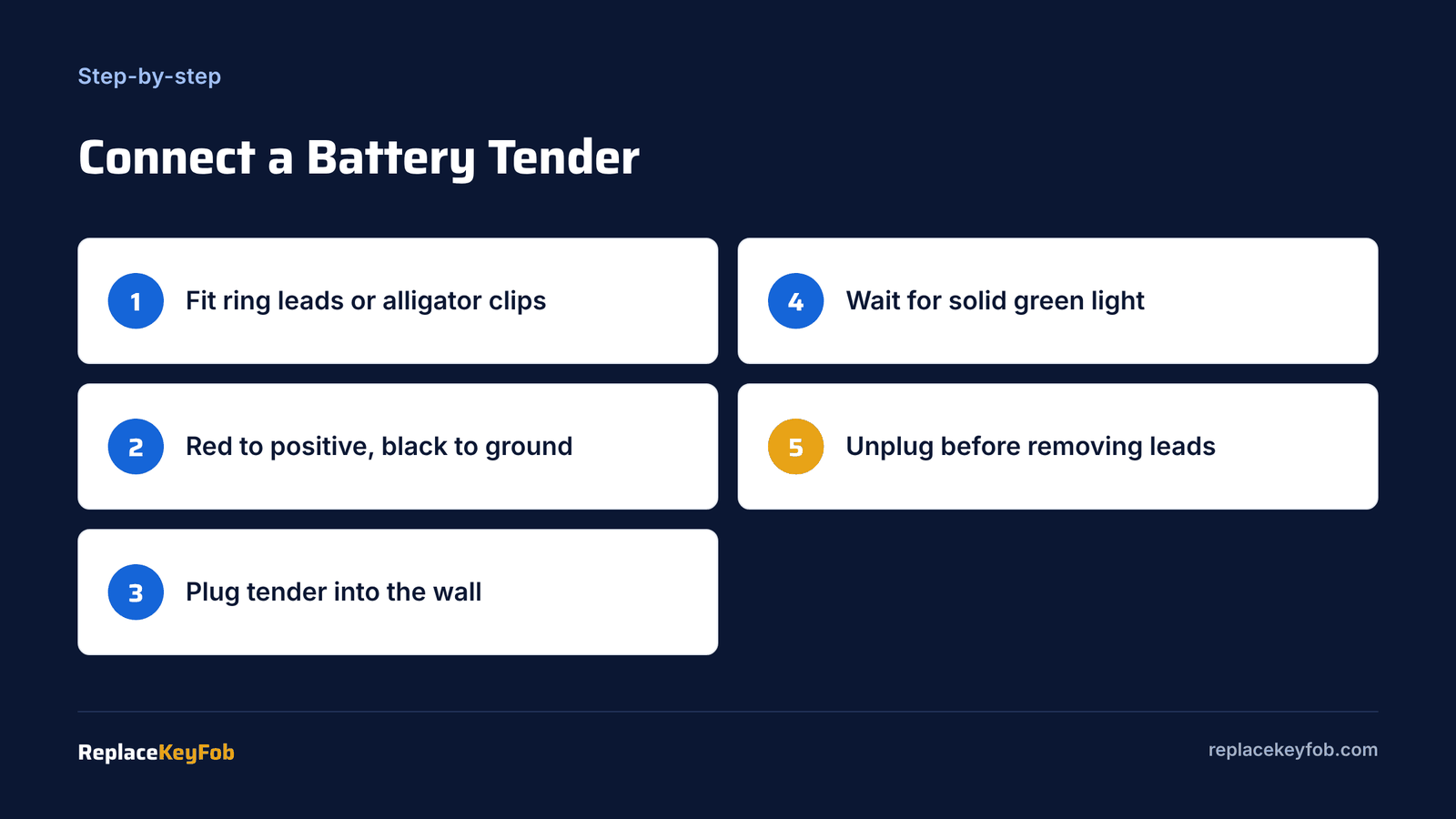
To use a Battery Tender, connect the red lead to the battery positive and the black lead to the negative post or chassis ground, using either the alligator clips or the bolt-on ring terminals. Then plug the unit into the wall. A solid green light means the battery is full and the tender is maintaining it. Unplug before removing the leads.
Battery Tender is a brand, but the name has become shorthand for any small smart charger that keeps a battery topped up while a vehicle sits. The classic Battery Tender Junior puts out well under one amp, which is too slow to rescue a dead car battery quickly but ideal for holding a healthy battery at full charge for months.
That difference matters. A tender is a maintainer first. If your battery is already flat, charge it properly first or expect a long wait. If the car sits for weeks at a time, a tender stops the slow drain from clocks, alarms and computer modules from killing it. For a hands-on look at the most popular model, see our Battery Tender Junior review.
Clips or Ring Terminals: Choose Your Hookup
Most Battery Tender kits ship with two quick-disconnect harnesses that plug into the charger’s output cable:
- Alligator clips for temporary use. Good for a car you charge now and then, or when you cannot reach the battery bolts easily.
- Ring terminals that bolt permanently to the battery posts. The harness ends in a weatherproof plug you can tuck near the grille, under a seat or behind a side panel. This is the standard setup on motorcycles, boats and project cars.
The ring terminal setup is worth the ten minutes it takes. Once installed, you just plug in the tender whenever you park, with no hood opening and no chance of a clip slipping off.
Smart Battery Maintainer With Ring Terminals
Choose one with float mode, a quick-disconnect ring harness, and a mode that matches your battery type, especially if it is lithium.
As an Amazon Associate, ReplaceKeyFob earns from qualifying purchases.
How to Use a Battery Tender on a Car
- Turn the vehicle off and remove the key. Leave the hood open while you work.
- Leave the tender unplugged. You connect the battery side first so no spark happens at the clamps.
- Attach the positive lead. Clip or bolt the red lead to the positive (+) terminal.
- Attach the negative lead. For a battery in the car, clip the black lead to a solid, unpainted metal point on the engine or body. For ring terminals, bolt it under the negative terminal nut along with the factory cable.
- Route the cable safely. Keep it clear of fans, belts and the hood latch. Close the hood gently on the cable if the tender sits outside the car, without pinching it.
- Plug the tender into a wall outlet. A red light usually comes on first, showing it is charging.
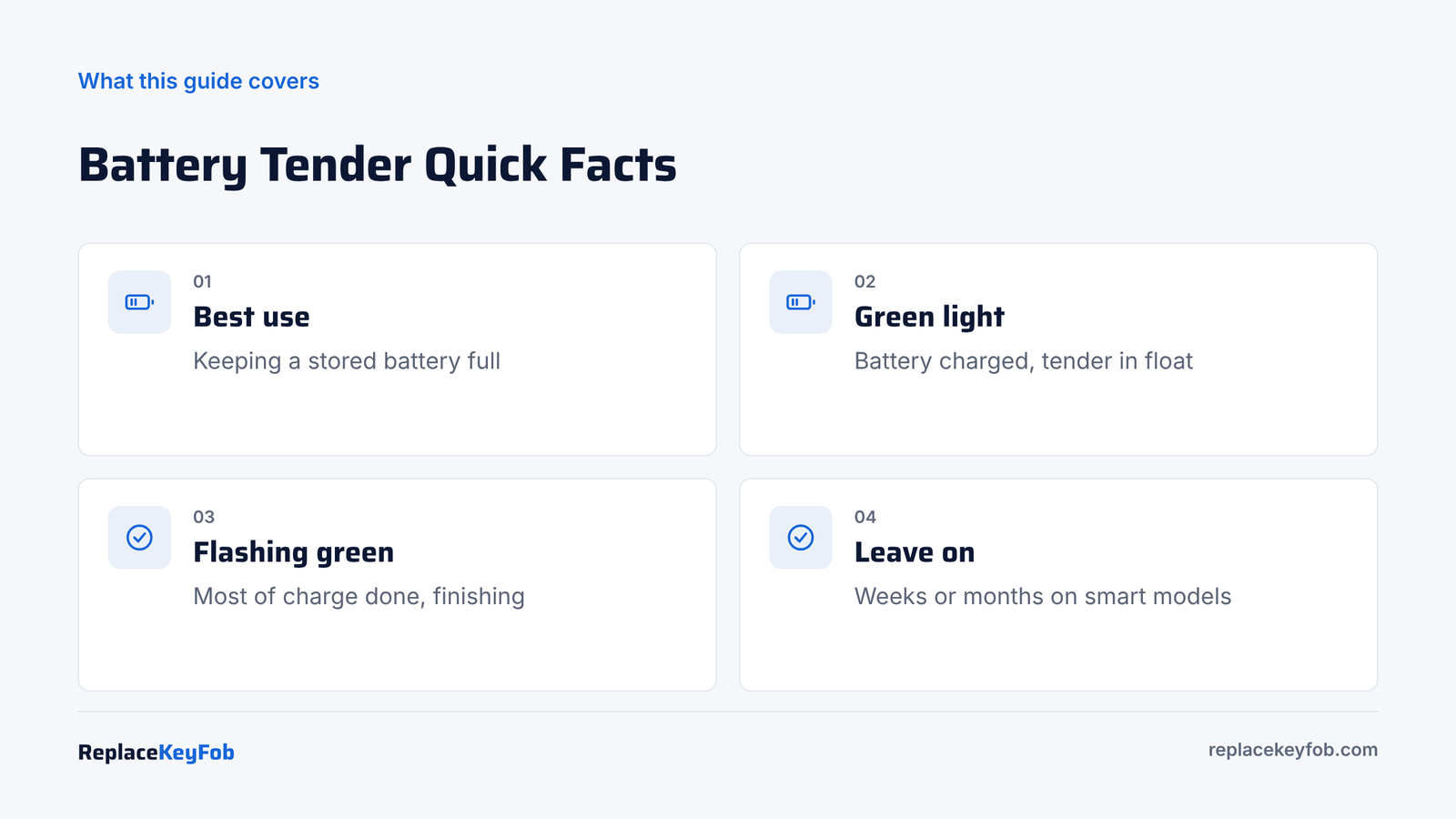
- Wait for green. On most Battery Tender models, a flashing green light means the battery is about 80 percent or more charged and a solid green light means it is full and in float. Check your manual, as newer units use slightly different codes.
- Leave it connected while the car is parked. A smart tender holds the battery at a safe float voltage and adds charge only when it drops.
Why ring terminals go under the factory cable
Stacking the ring under the terminal nut keeps the main cable’s contact surface clean. Put the factory clamp on the post first, the tender ring on top, and then tighten the nut so both are snug. A loose stack can cause starting problems that look like a weak battery.
Battery Tender Lights Explained
| Light | What it usually means | What to do |
|---|---|---|
| Solid red | Charging | Wait; normal for several hours to a day |
| Flashing red | Polarity reversed, poor connection, or battery too low to detect | Check clamp order and contact; charge a very flat battery first |
| Flashing green | Most of the charge is done | Leave it on |
| Solid green | Fully charged, maintaining | Safe to leave connected |
| No lights | No power or bad outlet | Check outlet, cord and fuse in quick-disconnect if present |
LED behavior varies between the Junior, Plus and newer smart models, so check the card that came with yours. If the light flashes red and you are sure of polarity, the battery may be under about 3 volts or have a dead cell.
How Long to Leave a Battery Tender On
A tender can stay connected as long as the vehicle sits. That is the point of it. Owners leave them on all winter on motorcycles, classic cars and RVs. A few practical notes:
- First charge can be slow. A Junior at under one amp may need two days or more to bring a half-empty car battery to full.
- Check water in flooded batteries. If the battery has removable caps, look at the fluid level every month or two during long storage.
- Keep it ventilated. Do not seal the tender inside a cover with the battery.
- Mind the outlet. A GFCI outlet that trips will silently stop the tender. Check it now and then.
If you want guidance specific to long storage, our guide to the best battery maintainers for winter car storage compares models by amp output and modes, and how to store a car battery for winter covers the full routine.
How to Remove a Battery Tender Safely
- Unplug the tender from the wall outlet first.
- Disconnect the quick-disconnect plug if you use ring terminals, and cap the harness end.
- If using clips, remove the black clamp first, then the red clamp.
- Start the car and confirm it cranks strongly.
Never drive off with the tender connected. It sounds obvious, but a tender left on the bumper or under the hood is a common way to rip out a harness.
Using a Battery Tender on Different Vehicles
Motorcycles and powersports
Bolt the ring harness on once and route the plug to an easy spot. Many bikes have small lithium batteries, so use a tender with a lithium mode if your battery is lithium iron phosphate. A lead-acid profile can over- or under-charge it.
Cars with batteries in the trunk
Use the remote positive post and the ground stud under the hood, or a cigarette-lighter adapter if the manual approves it. Lighter-socket charging only works if the socket stays powered with the car off.
Battery Tender jump starters
Battery Tender also sells portable jump starters. These are not maintainers. They store energy to start a car and should be recharged by USB or their own adapter, not left on a car battery.
Mistakes to Avoid
- Expecting a tender to fix a dead battery fast. Use a higher-amp charger first; see how to charge a car battery at home.
- Clipping black to the negative post on a start-stop car. Clip to chassis ground so the battery sensor reads the charge.
- Leaving clips exposed to rain. The tender and clips are not fully waterproof.
- Skipping the fuse. Ring harnesses include an inline fuse. Do not bypass it.
If you are comparing brands, NOCO Genius vs Battery Tender explains the differences in output and modes.
Do You Actually Need a Battery Tender?
A tender earns its place when a vehicle sits longer than it drives. Modern cars draw a small current even when parked, often about 20 to 50 milliamps for the alarm, keyless entry receiver and computer memory. On a healthy 60 amp-hour battery, that can pull the battery low enough to struggle in two to four weeks, faster in cold weather or with an older battery.
You will get the most value from one if:
- The car is parked for more than two weeks at a time
- You store a motorcycle, boat, RV or classic car over winter
- The vehicle mostly makes short trips that never fully recharge the battery
- You live somewhere with hard winters, where a weak battery fails first
A daily driver that covers 20 minutes or more most days usually does not need one. Basic tenders typically cost about $30 to $70, and a battery that lasts an extra year or two easily pays that back. For other ways to keep the charge up, see how to keep a car battery charged.
Frequently Asked Questions
Yes. Smart Battery Tender models switch to float once the battery is full and only add charge when voltage drops. That is what they are designed to do during storage.
Connect red to battery positive and black to negative or chassis ground, then plug it in. Wait for a solid green light, which means full and maintaining. It is slow, so charge a dead battery first.
No. You can maintain the battery while it is connected. The tender handles the small drain from clocks and modules.
Usually reversed polarity, a loose clip, or a battery too low to detect. Check the connections first. If those are fine, the battery may have a dead cell.
Only models with a lithium mode or a dedicated lithium version. Using a lead-acid profile on lithium can damage the battery or trigger its protection circuit.