
How to Install a Battery Disconnect Switch on a Car

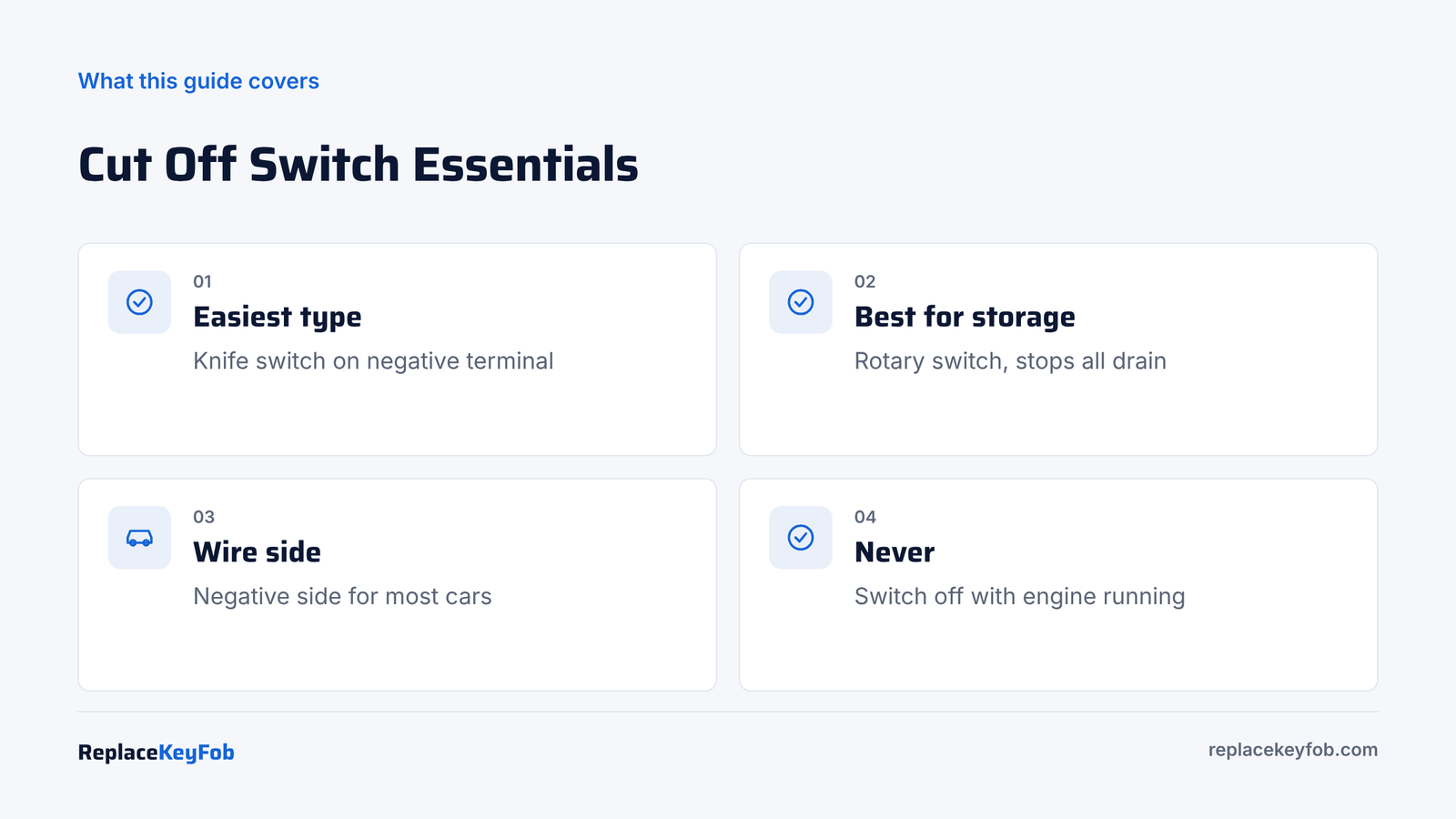
To install a car battery cut off switch, disconnect the battery negative cable, then fit the switch on the negative side: a knife switch bolts directly onto the negative post, while a rotary switch is mounted nearby and wired in with matching-gauge cable. Tighten all connections, reconnect, and test. Never use the switch while the engine is running.
A battery cut off switch, also called a disconnect switch or kill switch, lets you break the battery circuit without unbolting a cable. It is popular for stored cars, boats, RVs, classic cars and project vehicles. It stops parasitic drain from killing the battery during storage, makes electrical work safer, and adds a simple layer of theft protection.
On modern cars, a disconnect switch has trade-offs. Cutting power erases radio presets, may reset window and sunroof positions, and can trigger warning lights until the car relearns. This guide covers which switch to choose, how to install it safely, and how to live with it on a modern car. If the car also has an alarm that misbehaves after power loss, see car alarm keeps going off and key fob issues.
Types of Battery Cut Off Switches
| Type | How it works | Best for | Downsides |
|---|---|---|---|
| Knife blade | Lever on the negative post | Quick storage use, older cars | Exposed, needs hood open |
| Top-post or side-post knob | Twist knob on the terminal | Simple storage, small cars | Low current rating on some |
| Rotary (marine style) | Panel-mount key or dial switch | Trucks, RVs, boats, project cars | Needs cable work and mounting |
| Remote (solenoid) | Key fob or button switches a relay | Convenience, theft deterrence | Small standby drain, more wiring |
| Racing master switch | Cuts battery and alternator field | Race cars, safety rules | Complex wiring, not for street needs |
Choose a switch rated well above your starter’s current draw. Many rotary switches are rated at about 250 to 300 amps continuous, with higher short-term cranking ratings. For big diesel trucks, choose a heavy-duty rating.
Should You Put It on the Negative or Positive Side?
For most street cars, install the switch on the negative side. That is the standard choice because:
- It is safer. A wrench slipping on a negative switch cannot short against the body.
- It is simpler. The negative cable is usually short and easy to reach.
- It cuts everything. Breaking the ground cuts all circuits.
Race cars that must meet sanctioning rules usually use a positive-side master switch that also kills the alternator so the engine shuts off. That is a different job and needs its own wiring diagram.
Battery Disconnect Switch (Rotary or Knife Type)
Choose a switch with a current rating well above your starter draw, the right post type for your battery, and solid copper contacts.
As an Amazon Associate, ReplaceKeyFob earns from qualifying purchases.
Tools and Parts You Need
- The cut off switch and its mounting hardware
- 10 mm and 13 mm wrenches or sockets
- Battery cable of the same gauge as the original, plus lugs (rotary installs)
- Cable cutter and lug crimper
- Heat shrink tubing
- Drill and bits if mounting a rotary switch
- Safety glasses and gloves
- Optional memory saver, though it is not needed if you accept losing settings
How to Install a Knife or Top-Post Cut Off Switch
This is the easiest install and takes about 10 minutes.
- Turn the car off and remove the key.
- Disconnect the negative cable from the battery post.
- Clean the battery post until it is bright; see battery terminal corrosion.
- Fit the switch onto the negative post and tighten its clamp firmly.
- Attach the negative cable to the switch’s output end and tighten.
- Check clearance. The lever must not touch the hood, a strut brace or any metal.
- Close the switch and confirm the car starts.
- Open the switch to test that everything goes dead.
Why the switch goes between post and cable
Placing the switch directly on the post means the battery is fully isolated when the switch is open. If the switch were placed further down the cable, any wire that taps off before the switch would still drain the battery.
How to Install a Rotary Cut Off Switch
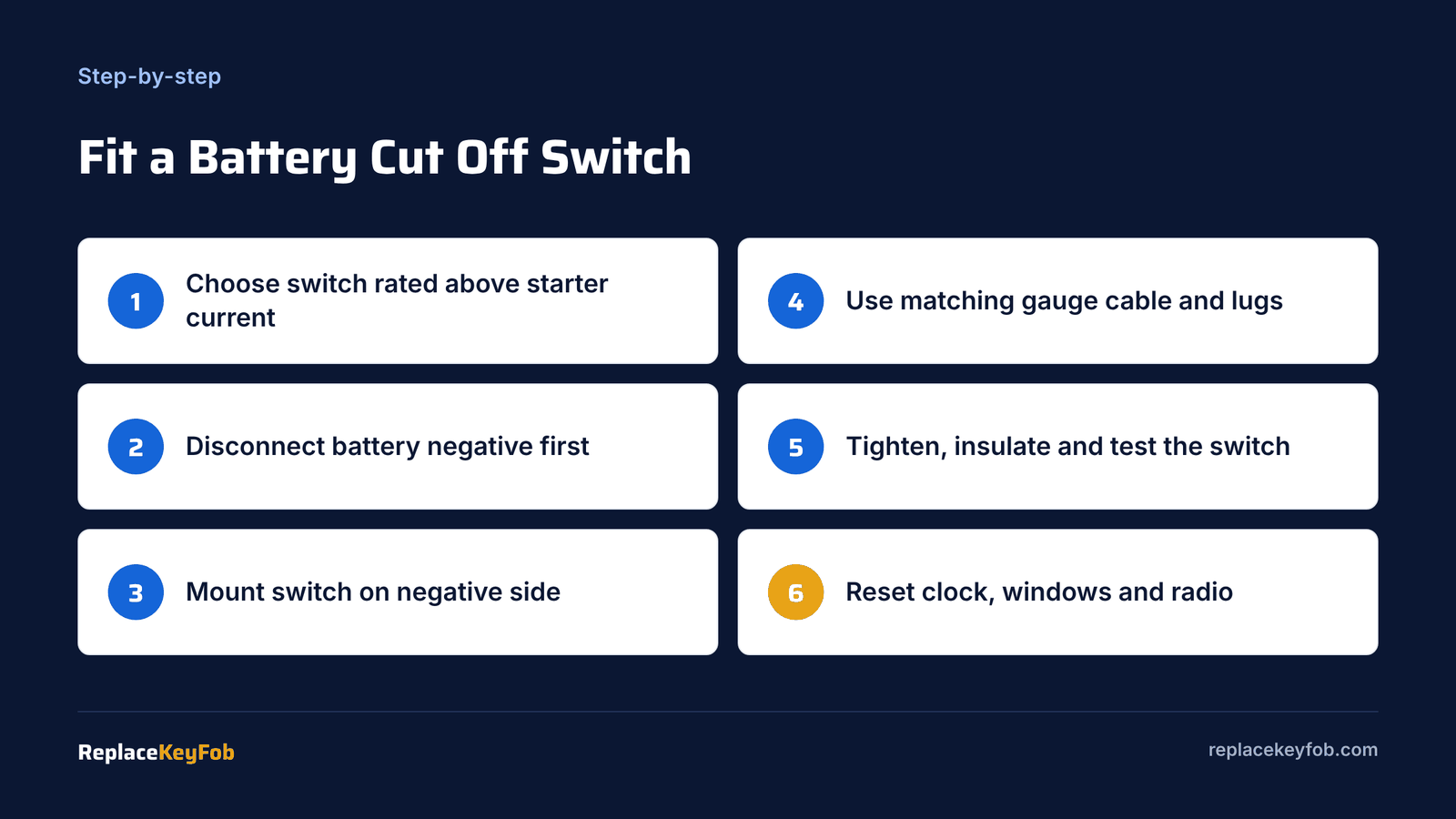
- Disconnect the battery negative cable.
- Choose a mounting spot that is easy to reach, protected from water, and close to the battery. On trucks and project cars, a fender or firewall location is common. In an RV or trailer, a battery box or interior panel.
- Drill and mount the switch following the template.
- Measure and cut two cables: one from the battery negative post to the switch, and one from the switch to the original ground point (engine block or chassis).
- Crimp lugs onto both cables and seal with heat shrink.
- Connect the cables to the switch terminals and tighten.
- Connect the battery end last and close the switch.
- Test the switch in both positions.
Use cable at least as heavy as the original. Most cars use about 4 AWG to 1/0 AWG battery cable. A longer run may need a heavier gauge to limit voltage drop.
Using a Disconnect Switch on a Modern Car
- Expect settings to reset. Clock, presets, trip data and sometimes auto-up windows. See how to reset auto-up windows after a battery change.
- Check for radio codes. Some cars ask for a code after power loss; see radio code after battery change.
- Wait before cutting power. Many cars keep modules awake for several minutes after locking. Disconnecting during that time can log faults. Wait about 10 to 15 minutes after shutdown.
- Key fob and push start. Most keys work normally after power returns, but if yours does not, see key fob not working after disconnecting car battery.
- Consider a maintainer instead. For a car stored in a garage with power, a maintainer keeps the battery full without resetting anything; see the best battery maintainers for cars.
Never Switch Off While Running
Opening a disconnect switch with the engine running can cause a voltage spike from the alternator. That spike can damage the alternator’s regulator, computers and other electronics. Only use the switch with the engine off and the key out.
Troubleshooting
| Problem | Likely cause | Fix |
|---|---|---|
| Car will not start with switch closed | Loose connection or wrong switch rating | Tighten connections; check rating |
| Switch gets warm when cranking | Undersized switch or poor contact | Upgrade to a higher-rated switch |
| Battery still drains with switch open | Switch on wrong cable or bypass ground | Ensure switch is in series with the only negative path |
| Warning lights after reconnecting | Normal after power loss | Drive briefly; scan if they stay |
| Lever touches hood | Poor clearance | Rotate or relocate switch |
Which Switch Fits Your Use?
- Classic or project car in a garage: a knife or knob switch on the negative post is cheap and quick. Open the hood, flip it, done.
- Truck, farm vehicle or RV that sits outdoors: a rotary switch mounted in a protected spot is tougher and easier to reach.
- Daily driver parked at an airport or a second home: a remote solenoid switch lets you cut power from a fob without opening the hood, but check its standby drain, which can be small but not zero.
- Boat or trailer with two batteries: a marine rotary switch with off, 1, 2 and both positions lets you choose which battery to use and isolate both.
Theft protection tips
If you are using the switch mainly to stop theft, a hidden rotary switch inside the cabin with a removable key is more effective than an exposed knife switch. Keep in mind that cutting all power also disables a factory alarm and any GPS tracker that runs off the car battery. Some owners choose a hidden fuel pump or starter kill instead, which leaves the alarm powered.
Mistakes to Avoid
- Using a switch with too low a rating for the starter current
- Leaving a second ground path, such as an extra engine or body strap that bypasses the switch
- Mounting a rotary switch where water collects
- Using thin cable for the extra run
- Relying on it as your only theft protection; a determined thief can find it
Cost to Install a Battery Cut Off Switch
Simple knife or knob switches typically cost about $10 to $30. Rotary switches typically run about $25 to $80, and remote solenoid switches about $40 to $120. A shop usually charges about $75 to $200 to install one, more for remote systems or custom cable work.
Frequently Asked Questions
On the negative side for most street cars, either directly on the negative post (knife or knob switch) or in the negative cable near the battery (rotary switch).
It is not harmful when the engine is off, but it resets clocks, presets and sometimes windows. Wait 10 to 15 minutes after shutdown before switching off.
It can slow a thief who does not know it is there. It is a deterrent, not a full security system.
No. That can cause a voltage spike and damage the alternator and electronics.
Choose one rated well above your starter’s draw. Many rotary switches handle about 250 to 300 amps continuous with higher cranking ratings; diesel trucks need heavy-duty switches.