
Why Your Car Alarm Keeps Going Off When the Key Fob Is Involved

If your car alarm keeps going off key fob problems are frustrating you, the fastest way to solve it is to separate a fob issue from a vehicle-side issue. In plain English: the fob can absolutely be part of the problem, but it is not the only suspect.
I’ve seen plenty of alarms blamed on the remote when the real culprit was a weak car battery, a sticky hood latch, or a door sensor that thought something was open. The trick is to check the right things in the right order so you do not waste money replacing parts that are still fine.
Why a key fob can trigger a car alarm
A key fob can set off the alarm in a few different ways:
- The panic button is stuck or being pressed repeatedly in a pocket or bag.
- The key fob battery is weak, so the signal becomes inconsistent.
- The fob casing is damaged, letting buttons sit partially pressed.
- Water intrusion has affected the circuit board.
- The fob has lost sync with the vehicle or is sending a signal the car is misreading.
- Another device or source of signal interference is confusing the system.
A weak fob battery usually causes erratic remote behavior first, like shorter range or missed lock/unlock commands. A completely dead battery often stops remote functions altogether rather than making the alarm go off by itself. That distinction matters, because it helps you avoid blaming the battery when the real issue may be a stuck button or a vehicle sensor.
For a broader battery comparison, our guide on can a bad car battery cause key fob problems can help you sort out whether the car or the remote is more likely at fault.
Stop the alarm safely right now
If the alarm is actively sounding, use this order first.
- Press unlock on the fob once if it still responds.
- If that does not work, use the physical key to unlock the driver door, if your fob has one.
- Start the car with the fob present. On many vehicles, that will silence the alarm state.
- If the alarm continues, remove the fob from your pocket, bag, or nearby surface in case the panic button is being pressed accidentally.
- If the car still will not unlock or start, do not keep repeatedly pressing buttons. That can make the diagnosis less clear and may not help the alarm at all.
If you need a generic reset option and your vehicle allows it, a brief battery disconnect and reconnect may reset some alarm states, but it can also erase settings or trigger anti-theft issues on some vehicles. Use that only if you are comfortable with the risks and can do it safely; otherwise, skip it and get help.
Fast triage: check the most likely cause first
Use this order. It saves time and keeps you from replacing the wrong part first.
1) Test the spare key fob
If you have a second fob, use it immediately. If the spare behaves normally and the main fob triggers the alarm, the problem is likely in the fob itself. If both fobs cause the same alarm behavior, the vehicle side becomes more likely.
2) Look for a stuck panic button or damaged casing
Without opening the fob yet, press each button lightly. A panic button that feels mushy, does not spring back, or sits lower than the others is a red flag. Cracked casing around the buttons can do the same thing by holding a switch partially closed.
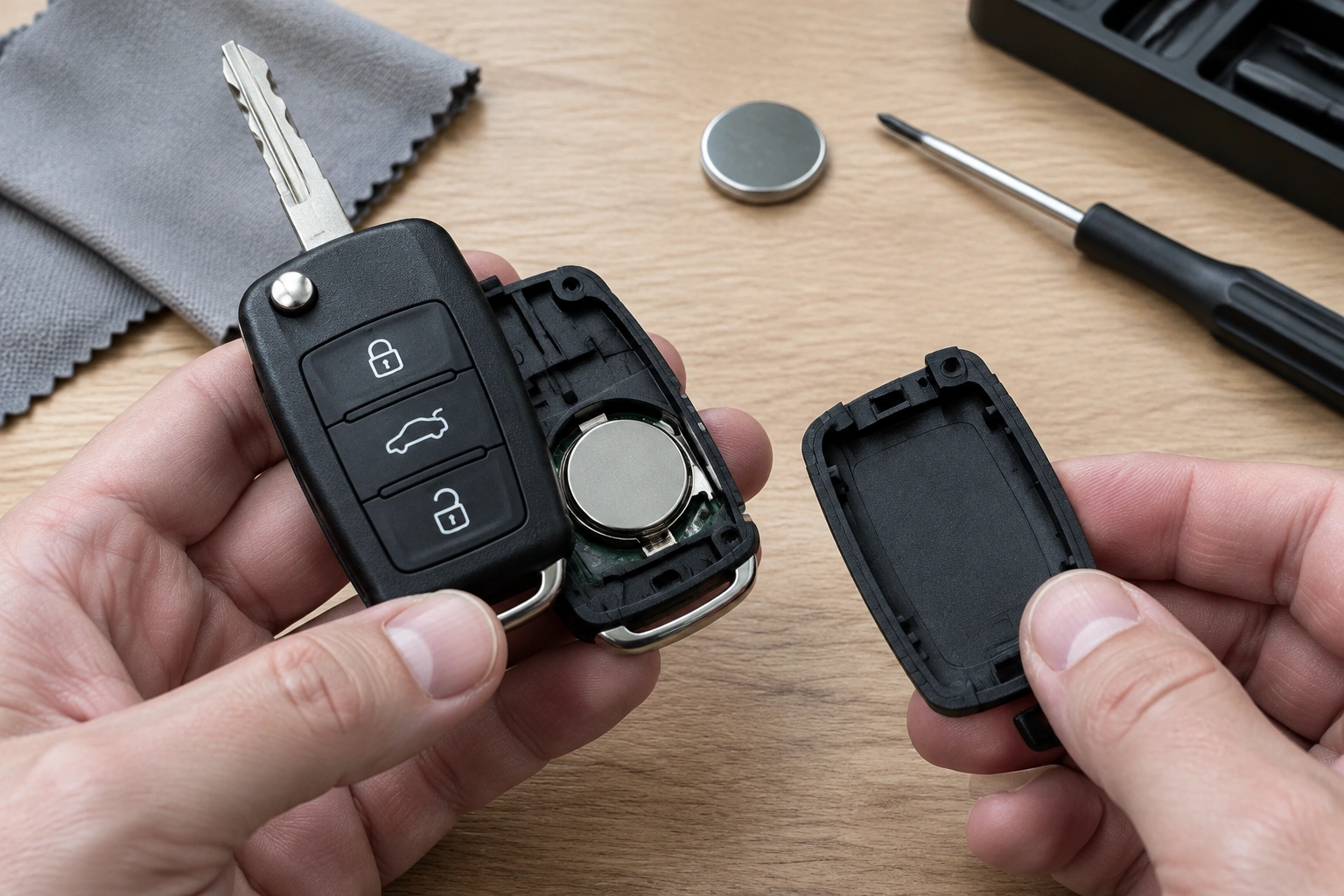
3) Replace the fob battery
This is the cheapest first repair when the fob is acting inconsistently. If the alarm issue disappears after the battery change, you likely found the problem. If remote range improves but the alarm still triggers, keep going.
4) Check the car battery
A weak vehicle battery can cause false alarm behavior and other odd electrical symptoms. If the car also cranks slowly, lights dim, or electronics act strangely, the car battery deserves attention before the fob gets blamed.
5) Inspect doors, hood, and trunk
A loose latch or faulty sensor can tell the alarm system that a panel is open or being tampered with. That can trigger the alarm even when the fob is fine.
How to check for a stuck panic button without opening the fob
You can usually get a useful answer from outside the fob.
- Compare the button height and feel with the other buttons or with a spare fob.
- Look for a button that sits lower, feels mushy, or does not spring back cleanly.
- Check the casing for cracks, warping, or separation near the button area.
- See whether the alarm starts when the fob is squeezed, bumped, or carried in a pocket or bag.
- If the spare fob behaves normally in the same situation, that makes a stuck button on the suspect fob more likely.
Check the key fob battery, buttons, and casing
The easiest fob checks are also the most useful.
Signs the battery is weak
- Shorter remote range
- Intermittent lock/unlock response
- The car only responds when you stand very close
- The fob works sometimes, then not at all
If the battery is low enough, the fob may stop communicating reliably. RAC notes that if your car uses a remote key fob to activate the alarm, a low battery in the fob or a malfunctioning fob may be the cause, and replacing the battery may resolve it. You can read that guidance on the RAC’s car alarm troubleshooting page.
Signs the button is stuck
A stuck panic button often shows up as a fob that seems to work normally except for random alarm triggers. Common clues:
- The alarm goes off when the fob is bumped or squeezed
- The panic button feels different from the others
- The alarm starts after the fob has been in a pocket or purse all day
- The casing is warped, cracked, or separating
If you suspect a stuck button, compare the feel of the suspect fob with the spare. That side-by-side comparison is often more helpful than staring at the fob alone.
Water damage and cracked casing
A fob that has been dropped in water, washed, or exposed to moisture can work intermittently. Sometimes the buttons still click normally, but the circuit board has corrosion or a short that causes unexpected signals. If the case is cracked and the battery contacts look dirty or green, replacement is often more practical than trying to nurse it along.
Rule out signal interference or a lost sync
Not every alarm problem is a dead battery or broken button. Sometimes the fob is fine, but the signal is not getting through cleanly.
Try these checks:
- Stand several feet away from the car and test the fob again.
- Move away from other electronics, parking garage equipment, or heavy metal structures.
- Use the spare fob in the same location and compare results.
- If your vehicle recently had battery work, a module reset, or a fob replacement, the fob may need re-syncing.
Signal interference usually looks inconsistent. The alarm may trigger once, then behave normally for a while. That pattern is different from a hard mechanical issue like a stuck panic button, which tends to be repeatable.
Inspect the car battery and basic electrical health
A weak car battery can create symptoms that look like a bad fob. RAC also notes that if the alarm keeps being triggered, the vehicle may have a wider electrical fault, including a weak battery, a faulty alternator, or loose connections. That is why a fob-only diagnosis can miss the real issue.
Look for these signs:
- Slow cranking
- Dim headlights or interior lights
- Dash warnings or odd electrical resets
- The alarm acting up after the car sat unused for a while
- Multiple electrical systems behaving strangely at the same time
If the battery is weak, you may see low-voltage symptoms first, especially slow cranking and dim lights. If the battery tests okay but the charging system is failing, the car may start and then show repeated electrical glitches while running, which points more toward alternator or connection issues than a simple battery problem.
If those symptoms are present, the problem may be vehicle-side rather than remote-side. A car battery that is near failure can cause voltage swings that confuse the alarm system. In that case, replacing the fob battery will not solve much.
For more on how vehicle power issues can overlap with remote problems, see our article on car won’t start but key fob unlocks doors.
Check door, hood, and trunk sensors for false triggers
If the alarm goes off when the car is parked and locked, the system may think a door, hood, or trunk is open.
What to inspect
- Door latches: Make sure each door closes firmly and sits flush.
- Hood latch sensor: A hood that is not fully latched can trigger repeated alarms.
- Trunk sensor: Check that the trunk closes completely and the latch is not obstructed.
A practical example: if the alarm starts after you checked fluids under the hood, the hood may not have clicked fully into place even though it looks closed. That is a classic false trigger.
Also pay attention to dirt, corrosion, or a loose connector around the latch area. Sensors do not have to be completely broken to cause trouble; sometimes they are just dirty or misaligned enough to send the wrong signal.
When the problem is the alarm system, not the fob
If both fobs behave the same way, the car battery tests okay, and all doors and latches are secure, the alarm system itself may be at fault.
That can include:
- A failing door, hood, or trunk sensor
- Wiring damage
- A module fault
- An immobilizer-related issue
- Moisture intrusion in a connector or control unit
Common examples include a hood latch switch that intermittently reads “open” when the hood is fully shut, or damaged wiring in a door jamb that loses contact when the door moves. Either one can cause repeated false alarms even when the fob is fine.
At that point, the issue is no longer a simple fob swap. Replacing the remote will not help if the car is seeing a false open-door signal or a wiring fault in the alarm circuit.
Should you replace, repair, or reprogram the key fob?
Here is the practical decision:
Repair the fob if:
- The casing is cracked but the electronics still work
- One button is sticky but the board looks clean
- The battery contacts are dirty but not badly corroded
Replace the fob if:
- The case is badly damaged
- Water got inside and corrosion is visible
- Buttons are worn out or permanently unreliable
- The fob still causes problems after a fresh battery and basic checks
Reprogram the fob if:
- The vehicle lost sync after a battery disconnect or module work
- A replacement fob works inconsistently
- The alarm and remote functions are out of step even though the hardware looks fine
Reprogramming can solve a sync issue, but it will not fix a weak car battery or a bad sensor. That trade-off matters because it keeps you from paying for programming when the root cause is elsewhere.
When to consult a locksmith
Call a locksmith, mechanic, or dealer when:
- Both the primary and spare fobs trigger the same alarm issue
- The car also shows slow cranking or other electrical symptoms
- The alarm continues after a fob battery change
- You see damaged wiring, corrosion, or water intrusion
- The hood, door, or trunk sensors seem inconsistent
- You suspect the fob needs reprogramming and do not have a reliable DIY procedure for your vehicle
A locksmith is often the best first call when the remote hardware itself seems bad. A mechanic is usually better when the car battery, charging system, or sensor wiring looks suspicious. A dealer may be necessary for certain programming or module-level faults, especially on newer vehicles with more integrated security systems.
Quick decision guide: fob problem vs car problem
Use this short rule set:
- Only one fob misbehaves: suspect the fob first.
- The spare fob does the same thing: suspect the car, sensor, or alarm module.
- The fob button feels stuck or the case is cracked: suspect the remote hardware.
- The car cranks slowly or lights dim: check the car battery and charging system.
- The alarm triggers after a door, hood, or trunk was opened: inspect the latch or sensor.
- The fob works better after a battery change but the alarm still acts up: look beyond the fob.
That sequence keeps you focused on the likely cause instead of guessing.
FAQ
Can a bad key fob make my car alarm go off by itself?
Yes, if the fob is malfunctioning, has a stuck button, or is sending inconsistent signals. A weak battery can also contribute, though it more often causes poor remote performance than random alarm activation.
Is the key fob battery causing this?
It might be. Replacing the battery is a sensible first step when remote functions are weak or inconsistent. If the alarm still triggers afterward, the cause may be the fob itself, the car battery, or a sensor issue.
Why does the alarm go off when the fob is in my pocket?
That often points to a stuck panic button, a damaged case, or pressure on the remote from other items in the pocket or bag.
Could a weak car battery cause the alarm to malfunction?
Yes. Weak battery voltage, charging problems, or loose connections can create false alarm behavior and other electrical oddities.
Do I need to reprogram the key fob?
Only if the fob lost sync or a replacement part was installed. Reprogramming will not fix a bad battery, stuck button, or vehicle-side sensor fault.
When should I stop DIY troubleshooting?
If the spare fob acts the same way, the alarm keeps returning after a battery change, or the car shows other electrical symptoms, it is time for professional diagnosis.
