
How to Jump Start a Motorcycle (With a Car or Jump Pack)

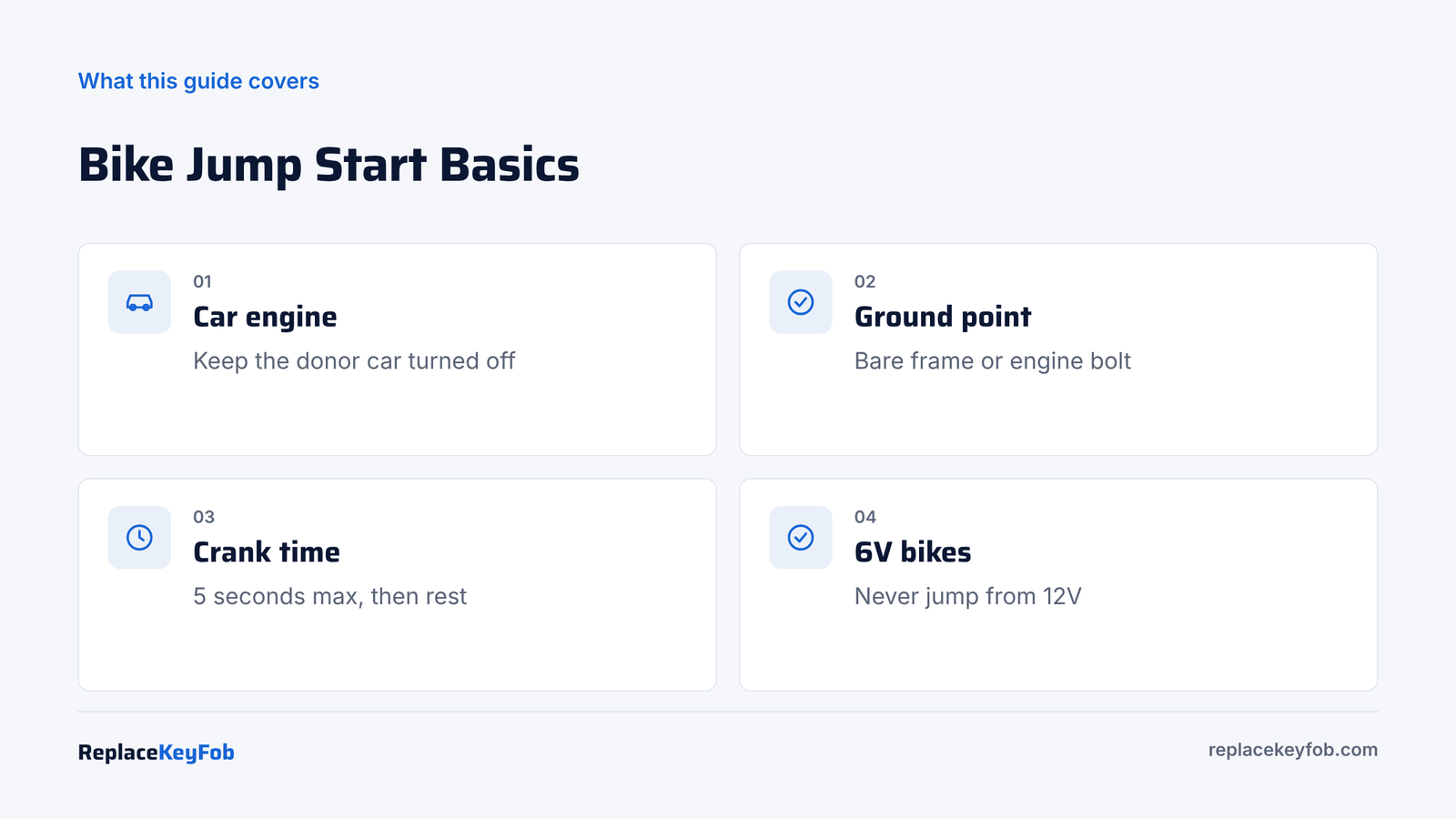
To jump start a motorcycle, keep the donor car’s engine off, connect red to the bike’s positive and the car’s positive, black to the car’s negative, then black to bare metal on the bike frame. Crank for no more than 5 seconds at a time. Only jump a 12V bike from a 12V source, never a 6V bike.
A motorcycle battery is tiny compared with a car battery, often 5 to 14 amp hours instead of 50 to 80. That small size is why bikes drain so fast after a few weeks parked, and also why you need to be gentle when you jump one.
The good news is that a jump is quick once you know where the battery lives on your bike. This guide covers jumping from a car, from a jump pack, from another motorcycle, and push starting a bike with a manual gearbox.
What You Need
- A 12V donor: a car, truck or another motorcycle with a healthy 12V battery, or a small jump pack.
- Jumper cables: standard car cables work, but small motorcycle cables with narrow clamps fit tight bike terminals better.
- Tools to reach the battery: usually a hex key or Phillips screwdriver to remove the seat or a side cover.
- Safety glasses and gloves.
- Owner’s manual: to confirm battery location and whether the battery is lithium.
Small lithium jump starter for motorcycles
Choose a compact 12V pack in the 400 to 1000 peak amp range with reverse-polarity protection and small clamps that fit bike terminals.
As an Amazon Associate, ReplaceKeyFob earns from qualifying purchases.
A small pack is the easiest solution if you ride alone. Our list of compact jump starters that fit in a glove box includes several that suit bikes.
Where Is the Motorcycle Battery?
| Bike type | Usual battery location | Access |
|---|---|---|
| Sport bikes | Under the rider or passenger seat | Seat lock with the ignition key |
| Cruisers | Under the seat or behind a side cover | Seat bolts or a side cover clip |
| Touring bikes | Under the seat, sometimes front fairing | Seat removal, often several bolts |
| Scooters | Under the floorboard or seat | Floor panel screws |
| Dirt and adventure bikes | Under the seat or a side panel | Seat bolts or quick release |
Some newer bikes have a dedicated jump terminal or a battery tender lead coming out near the seat. A tender lead is not designed for jump-starting current, so use the battery terminals themselves.
How to Jump Start a Motorcycle With a Car
The key rule: leave the car engine off. A running car alternator can push more current than a small bike battery and charging system are built for. The car battery alone has more than enough power to crank a motorcycle.
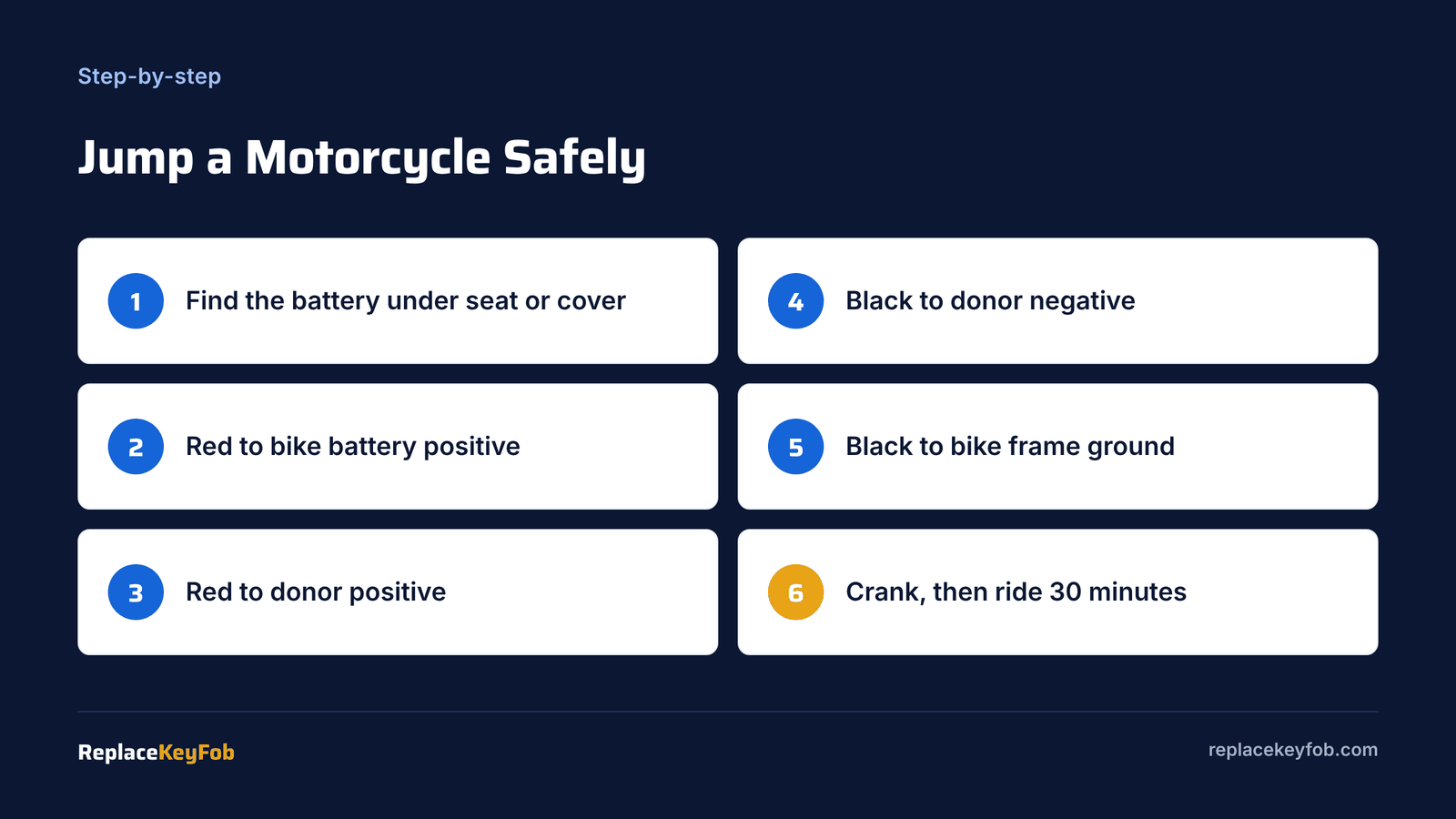
- Park the car close to the bike. Put the bike on its center stand or side stand and turn the ignition off.
- Remove the seat or cover to expose the battery.
- Connect a red clamp to the bike’s positive (+) terminal.
- Connect the other red clamp to the car battery’s positive (+) terminal.
- Connect a black clamp to the car battery’s negative (-) terminal.
- Connect the last black clamp to bare metal on the bike: an engine bolt or a frame point away from the battery and fuel system. If there is no clean point, the bike’s negative terminal works.
- Make sure the cables are clear of the chain, wheel and exhaust.
- Turn the bike’s ignition on, check that it is in neutral (green N light), pull the clutch, and press the starter.
- Crank for up to 5 seconds. If it does not start, wait 30 to 60 seconds before trying again.
- Once it runs, remove cables in reverse order: black from the bike, black from the car, red from the car, red from the bike.
How to Jump Start a Motorcycle With a Jump Pack
A jump pack is safer for the bike’s electronics and needs no second vehicle.
- Check the pack is charged (most show 3 or 4 lights for full).
- With the pack off, connect red to the bike’s positive and black to the bike’s negative or frame.
- Turn the pack on. A green light usually confirms correct polarity.
- Crank the bike for up to 5 seconds.
- When it starts, turn the pack off and remove black, then red.
Many car-size packs work on bikes, but very large packs have big, heavy clamps that are hard to fit on tiny bolts. If your clamps slip, use short bolts and nuts to make a small temporary post, or buy a pack with narrow clamps. For general pack steps, see how to use a jump starter.
How to Jump Start a Motorcycle With Another Motorcycle
This works the same as with a car. Both bikes stay off during the connection. Some riders run the donor bike, but small bike charging systems are not made to supply another bike’s starter, so the safer method is donor engine off, crank once or twice, then let the donor ride to recharge.
Can You Push Start a Motorcycle?
If the bike has a manual gearbox and the battery is not completely flat, a push start (bump start) often works:
- Turn the ignition on and the kill switch to run.
- Put the bike in second gear and pull the clutch in.
- Push or roll downhill to a fast walking or jogging pace.
- Release the clutch quickly while pushing down on the seat for rear tire grip.
- When it fires, pull the clutch back in, add a little throttle and shift to neutral.
Fuel-injected bikes need enough battery voltage to run the fuel pump and ECU, so a totally dead battery may still fail to push start. Scooters with automatic CVT transmissions cannot be push started.
Lithium Motorcycle Batteries
Many sport and adventure bikes now use lithium iron phosphate (LiFePO4) batteries. They are light and hold charge well, but they behave differently:
- Some lithium batteries have a built-in “wake up” or reserve button. Check the battery case before jumping.
- Many makers allow a jump from a 12V lead-acid source, but some prefer you use a lithium-compatible charger instead. Check your battery’s instructions.
- Never use a charger with a desulfation or high-voltage repair mode on lithium.
- If a lithium battery has dropped below about 9 volts, it may have a damaged cell and may not recover.
6-Volt Motorcycles
Vintage bikes (and some small older models) use a 6V system. Do not jump a 6V bike from a 12V car or pack. It can burn out bulbs, the regulator and the battery. Use a 6V charger or a 6V battery.
If the Bike Still Won’t Start
| Symptom | Likely cause | What to check |
|---|---|---|
| No lights when ignition is on | Main fuse, dead terminal, loose cable | Check fuse under seat, tighten terminals |
| Click but no crank | Low voltage, bad starter relay | Recheck clamps, test relay |
| Cranks but no fire | Kill switch, side stand switch, fuel | Kill switch on run, side stand up, fuel petcock |
| Starts then dies when clamps removed | Charging system fault | Check stator and regulator output |
| Fob not recognized | Key fob battery | See our motorcycle key fob guide |
Mistakes to Avoid
- Running the car engine. Leave it off.
- Long cranking. Small starters overheat fast; 5 seconds is plenty.
- Clamps touching the frame and battery at once. A short across terminals can melt a cable or weld a clamp.
- Forgetting the side stand switch. Many bikes will not start or will cut out with the stand down and in gear.
- Jumping a swollen or leaking battery. Replace it.
After the Jump
Ride for at least 30 minutes at normal road speeds. Idling does almost nothing for a bike battery. Then test it. A healthy 12V bike battery reads about 12.6 to 13.0V at rest (lithium often reads 13.2V or more), and 13.5 to 14.5V while running at about 3,000 to 4,000 rpm. Below that, the stator or regulator rectifier may be failing.
If the bike will sit for more than two weeks, connect a maintainer. Our guide on how to charge a motorcycle battery explains the safe charge rates and the right charger for lithium and AGM batteries.
When to Get Help and Cost
If the battery is more than three or four years old, keeps dying, or will not hold 12.4V overnight, replace it. In 2026, a typical motorcycle AGM battery costs about $50 to $150, and a lithium battery about $120 to $300. A shop charging-system test is usually about $50 to $120.
Frequently Asked Questions
Yes, as long as both are 12V. Keep the car engine off, connect red to both positives, black to the car negative, then black to bare metal on the bike. Crank in 5-second bursts.
No. The car battery has more than enough power. A running alternator can push excess current into the bike’s small battery and electronics.
A jump may still start the bike, but a battery that drops that low is often damaged. Charge it fully with a smart charger, let it rest 12 hours, and test it. Replace it if it will not hold 12.4V.
Usually, but check the battery maker’s instructions. Some lithium batteries have a reserve button and some prefer a lithium-safe charger instead of a jump.
At least 30 minutes at road speed. Idling or a short trip around the block will not recharge the battery.